Yes, you can help your third grader become a stronger reader. Reading comprehension at this critical stage develops through consistent practice, active reading strategies, and the right support at home. Key approaches include the Five-Finger Retell for story recall, KWL charts for nonfiction, daily reading routines of 20-30 minutes, and making connections between text and life experiences. With just 15-20 minutes of focused practice daily, most third graders show significant improvement in understanding what they read within weeks.
Third grade represents a crucial turning point in your child’s reading journey. This is the year children transition from learning to read to reading to learn. Instead of focusing primarily on sounding out words and recognizing sight words, third graders must now extract meaning, analyze stories, and learn new information from increasingly complex texts. This shift makes reading comprehension more important than ever before.
Many parents notice their third grader can read fluently but struggles to explain what they just read or answer questions about the story. This frustration is common, and completely normal. With the right support and consistent practice, every child can become a better reader who understands and enjoys what they read.
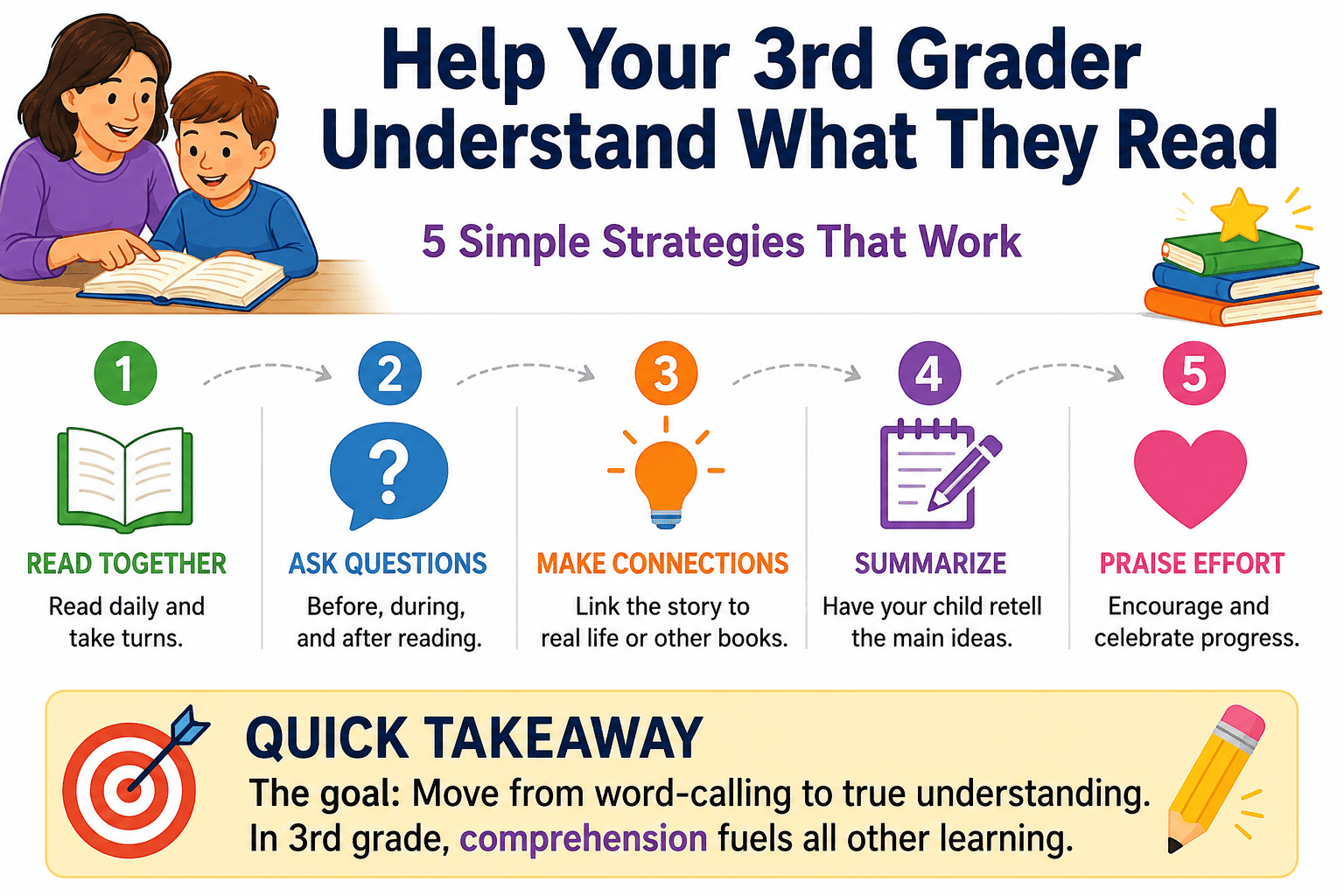
The goal: Move from word-calling to true understanding. In 3rd grade, comprehension fuels all other learning. Use the strategies below to build a confident, thoughtful reader at home.
Your child should be able to identify main ideas, understand story elements (character, setting, plot), follow sequences, recognize cause and effect, and extract information from nonfiction texts. For fiction, they should describe how characters respond to events and distinguish their own point of view. For nonfiction, they need to use text features like headings and captions, and compare information across multiple texts.
Identify main ideas, understand character motivation, follow plot sequences, recognize cause and effect, and describe how characters respond to challenges.
Use text features (headings, captions, diagrams), identify main topics, compare information across texts, and extract key facts from informational passages.
Make inferences, distinguish their own point of view from the author’s, use text evidence to support answers, and draw conclusions from what they read.
✔ Longer texts with fewer pictures → losing plot threads
✔ Vocabulary gaps → unknown words disrupt meaning
✔ Inference struggles → reading between the lines
✔ Passive reading habits → eyes move, brain disengages
Daily reading routines form the bedrock. Aim for 20–30 minutes daily, mixing independent reading and shared reading. Create a cozy reading nook, let your child choose interesting books, and use the Five-Finger Rule to assess difficulty: 0-1 unknown words per page = too easy; 2-3 = just right; 4+ = too hard for independent reading.
After a story, use fingers to recall: Thumb=Characters, Pointer=Setting, Middle=Beginning, Ring=Middle events, Pinky=End. Plus favorite part.
K (What I Know), W (What I Want to know), L (What I Learned). Perfect for nonfiction and building purpose before reading.
Text-to-Self, Text-to-Text, Text-to-World. Ask: “Does this remind you of something?” “How is this book like another one we’ve read?”
Have your child hold up a hand and walk through each finger after every chapter or picture book. This becomes an automatic mental organizer that structures their understanding.
After asking a question, wait at least 3 seconds. Silence gives your child space to think deeply rather than rushing to an answer they haven’t fully processed.
Model your own reading brain: “I wonder why the character did that… Oh, maybe because he was scared.” This shows children how good readers actively engage with text.
Research shows that children who practice retelling stories demonstrate significantly stronger comprehension skills than those who simply read without discussion. Retelling forces the brain to organize information, identify main ideas, and sequence events, all essential comprehension skills.
Draw simple charts for characters, setting, problem, events, solution. For nonfiction: cause/effect diagrams, Venn diagrams, main idea webs that visually organize information.
Use symbols: ★ = important, ? = confused, ❤ = like, 💡 = new idea. Mark pages as you read, then discuss what you marked. This builds active engagement with text.
Cover most of the page with a card, reveal one paragraph at a time. Summarize each chunk before moving on. This prevents overwhelm and builds comprehension incrementally.
Continue reading chapter books slightly above their level. Pause to predict, question, and connect. This exposes them to more complex vocabulary and story structures than they can read independently.
| Activity | Best For | Time Needed |
|---|---|---|
| Five-Finger Retell | Fiction, chapter books | 5 min after reading |
| KWL Chart | Nonfiction, science/history topics | 10-15 min |
| Sticky Note Hunt | Building active reading habits | During reading |
| Chunk & Summarize | Struggling or overwhelmed readers | 15-20 min |
Encourage drawing scenes, characters, or concepts. Use color-coded mind maps, illustrated timelines, and books with strong visuals. Let them doodle while listening, it helps anchor meaning.
Act out stories, use puppets, build dioramas, arrange story event cards in order. Allow standing, walking, or fidget tools during reading. Play comprehension relay games.
Use audiobooks and read-alongs (hearing while seeing text reduces decoding load). Pre-teach vocabulary and background knowledge. Choose high-interest, lower-reading-level books.
Never criticize struggles, instead say, “Let’s figure this out together.” Praise effort (“You tried that tricky word!”), not just correct answers. Let your child choose books freely, even graphic novels. A child who loves reading will become a strong reader.
Keep a simple reading log with observations: Does your child remember main ideas? Can they retell with details? Do they connect to prior knowledge? Watch for real-world comprehension too.
Seek professional evaluation if comprehension difficulties persist despite consistent home support, your child falls increasingly behind peers, extreme reading anxiety develops, or skills vary wildly day to day.
Talk to your child’s teacher. Request school-based interventions or reading specialist support if needed. Teachers can provide specific strategies, recommend appropriate books, and monitor progress more formally.
Improving your third grader’s reading comprehension is one of the most valuable investments you can make. Strong comprehension supports learning across all subjects, builds confidence, and opens doors to knowledge and joy. Every child develops at their own pace, focus on progress, not comparison.
Choose two or three strategies from this guide and practice them consistently for a month. Build routines, celebrate small victories, and keep reading joyful. Your support, your patience, your encouragement, your willingness to read together, makes the single biggest difference. You’ve got this, and so does your child.
The best predictor of reading success is time spent reading, and the best predictor of time spent reading is enjoyment. Keep it light, loving, and consistent. You are exactly the reading coach your child needs.
Try just ONE new strategy this week. Small changes build lifelong readers.
Explore More Parent Guides → Try Our ToolsContinue supporting your child’s learning journey with our guides on English phonetics, types of adjectives, and adjectives to describe yourself.

Belekar Sir is the founder and lead instructor at Belekar Sir’s Academy, a trusted name in English language education. With over a decade of teaching experience, he has helped thousands of students—from beginners to advanced learners—develop fluency, confidence, and real-world communication skills. Known for his practical teaching style and deep understanding of learner needs, Belekar Sir is passionate about making English accessible and empowering for everyone. When he’s not teaching, he’s creating resources and guides to support learners on their journey to mastering spoken English.