The return to school after Christmas break presents unique challenges for educators. Students arrive with minds still filled with holiday memories, sleep schedules thrown off, and academic skills that may have gone dormant for two weeks. Teachers face the daunting task of re-establishing routines, rebuilding classroom culture, and reigniting the learning momentum that was building before the break. The first week back can make or break the entire second half of the school year.
Many teachers make the mistake of diving straight back into rigorous academics, only to find students unprepared emotionally and mentally for the sudden shift. Others go too far in the opposite direction, treating the entire week as an extended vacation with movies and free time that waste valuable instructional days. The key lies in finding the perfect balance between easing students back into routines while maintaining engagement and learning.
This comprehensive guide provides practical, tested classroom activities specifically designed for the post-holiday transition. You will discover icebreakers that rebuild community, reflection activities that process break experiences, goal setting exercises that motivate students for the new year, and academic review activities disguised as fun games. Whether you teach kindergarten or high school, you will find grade-appropriate activities to make your first week back productive and enjoyable.
Understanding the Post-Holiday Student Mindset
Before planning activities, it is crucial to understand what students are experiencing when they return. Many children feel anxious about returning to academic pressures after carefree days at home. Others experienced family difficulties or disappointing holidays and carry emotional baggage into the classroom. Some students traveled and are dealing with jet lag or exhaustion from late nights.
Additionally, students have temporarily forgotten classroom procedures, expectations, and even basic routines like where to put their backpacks or how to line up properly. Their attention spans are shorter, their energy levels are unpredictable, and their ability to follow multi-step directions has diminished. Recognizing these realities allows teachers to plan appropriately rather than becoming frustrated when students struggle with tasks that seemed simple in December.
The most successful teachers approach the first week back with patience, flexibility, and a commitment to rebuilding before advancing. This investment of time pays dividends throughout the rest of the year.
Day One: Soft Start Welcome Back Activities
The first day back sets the tone for the entire second semester. Start with a clean, organized classroom that feels fresh and inviting. Remove holiday decorations and create a January display that celebrates new beginnings. Have a welcome back message on the board that shows your excitement to see students again.
Morning Meeting Share Circle
Gather students in a circle and create a safe space for sharing. Use a talking stick or ball that students pass around, allowing each person to share one highlight from their break. Set clear guidelines that sharing is optional and students can pass if they prefer. This activity accomplishes multiple goals: it allows excited students to share their experiences, it helps shy students feel heard, and it builds classroom community through active listening.
For younger students, provide sentence stems like “Over break I…” or “My favorite part of the holidays was…” Older students can share without prompts but benefit from guidelines about appropriate length and content.
Musical Mingle Holiday Stories
Play upbeat music while students walk around the classroom. When the music stops, students find the nearest classmate and have 30 seconds to one minute to share something about their break. Restart the music and repeat several times so students connect with multiple classmates. This energizing activity gets students moving, talking, and reconnecting with peers they may not have seen in weeks.
Provide conversation starters on the board for students who struggle with spontaneous conversation. Examples include what they ate, who they saw, where they went, what they received, or what they did for fun.
Welcome Back Writing Activity
Provide students with a creative writing prompt that allows them to process their break experiences. For younger grades, a drawing activity with simple sentences works well. Middle and upper elementary students can create a holiday memory photo album where they draw pictures and write captions. Secondary students can write reflective paragraphs or creative pieces.
Consider providing multiple prompt options so students can choose what resonates with them. Some students had wonderful breaks and want to celebrate that, while others prefer to focus on returning to school rather than rehashing difficult family situations.
Rebuilding Classroom Procedures and Routines
Do not assume students remember procedures established in the fall. The two week break has erased much of their muscle memory around classroom routines. Dedicating time to explicitly review and practice procedures prevents weeks of frustration and constant redirection.
Procedure Practice Stations
Set up stations around the classroom where students rotate through practicing key procedures. One station reviews lining up properly, another practices the quiet signal, a third reviews how to get and return supplies, and a fourth practices transitioning between activities. Make it fun by timing students and celebrating when they improve their speed or accuracy.
This hands-on approach beats lecturing about rules. Students actually practice the behaviors you expect, which creates stronger habits than simply hearing about them.
Classroom Expectations Refresh
Review your classroom rules or expectations, but make it interactive rather than preachy. Have students work in small groups to create posters illustrating what each expectation looks like in action. Or conduct a class discussion about why each rule matters and how it helps create a positive learning environment. Older students can even suggest modifications to rules if they have constructive feedback.
The goal is to get student buy-in rather than simply enforcing rules from a position of authority. When students understand the reasoning behind expectations and feel heard in the process, they are more likely to follow them.
Create New Seating Charts
Many teachers use the return from break as an opportunity to rearrange the classroom and create new seating assignments. This signals a fresh start and allows you to separate students who developed problematic dynamics in the fall. Present this change positively as a new year tradition rather than as a punishment.
Consider having students help choose elements of the new arrangement. Perhaps they vote on whether desk clusters or rows work better, or they suggest which classmates they learn well with. This ownership increases acceptance of the changes.
Community Building and Connection Activities
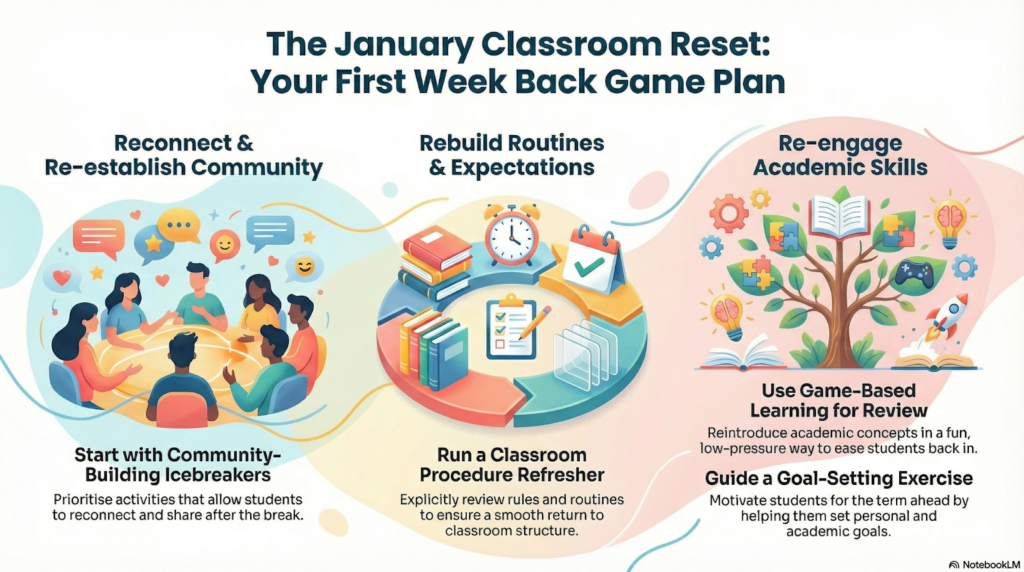
The break often disrupts the sense of classroom community that teachers worked hard to establish in the fall. These activities rebuild those connections and create a supportive environment for learning.
Find Someone Who Holiday Edition
Create bingo cards with holiday related prompts such as “Find someone who built a snowman,” “Find someone who traveled out of state,” “Find someone who baked cookies,” or “Find someone who stayed in their pajamas all day.” Students circulate around the classroom, talking to classmates and collecting signatures when they find matches.
This classic icebreaker works well because it is structured enough that even shy students can participate successfully, yet open-ended enough to allow genuine conversations. Tailor the prompts to your students’ likely experiences for maximum engagement.
Classroom Goals Wall
Create a collaborative bulletin board where every student contributes their personal goal for the semester. Provide colorful paper shapes like snowflakes, snowmen, or simple rectangles where students write or draw their goals. Display these prominently and reference them throughout the semester to maintain motivation.
For younger students, goals might be simple like “learn to read harder books” or “make a new friend.” Older students can set academic, behavioral, or personal goals. The public nature of this display creates accountability while the collective aspect builds class unity.
Gratitude Circle
Combat post-holiday blues by having students share what they are grateful for as they enter the new year. This can be a quick verbal activity during morning meeting or a written reflection in journals. Focusing on gratitude shifts mindsets from what students might have wished for during the holidays to appreciating what they do have.
Research shows that gratitude practices improve mental health, increase resilience, and create more positive classroom environments. Even a brief daily gratitude share can transform classroom culture.
Academic Review Activities Disguised as Games
Students need academic skill review after the break, but jumping straight into worksheets and lectures will fail. These engaging activities refresh skills while maintaining the fun, energetic atmosphere students need during the transition week.
Kahoot or Quizizz Review Game
Use these free online platforms to create review quizzes covering material from before break. The game show format with music, timers, and leaderboards turns review into exciting competition. Students can play individually on devices or in teams.
Create questions that cover a range of difficulty levels so all students can experience success. Include some silly or fun questions mixed with academic content to maintain engagement.
Scavenger Hunt Review
Hide review questions or problems around the classroom and have students hunt for them. As they find each card, they solve the problem before searching for the next one. This combines movement with academics, which is perfect for students who have been sedentary during break.
You can make this self-checking by putting answers on the back of cards or by having a station where students check their work before continuing. Consider making it collaborative so students work in pairs or small groups.
Jeopardy Style Class Game
Divide the class into teams and play Jeopardy using content from previous units. Create categories that cover different subjects or topics, with point values indicating difficulty. The familiar game show format provides structure while the competition motivates students to recall information.
This activity works for all ages with modifications. Elementary students love simpler categories and questions, while secondary students can handle complex content and more sophisticated strategy around point values.
Four Corners Review
Post four different answers or concepts in the four corners of the classroom. Read a question or problem and have students move to the corner representing the correct answer. Students who answer incorrectly sit down while those who are correct remain standing for the next round. Continue until one student remains or until time runs out.
This kinesthetic activity is perfect for subjects like math facts, vocabulary, science concepts, or historical facts. Students love the movement and competition, while teachers get valuable formative assessment data about what students retained.
Goal Setting and New Year Activities
Capitalize on the natural motivation that comes with a new year by incorporating goal setting and reflection activities into your curriculum.
One Word Theme Activity
Have students choose one word that will be their theme or focus for the new year. This could be a character trait they want to develop like “kindness” or “perseverance,” an academic focus like “reading” or “math,” or a personal quality like “confidence” or “organization.” Students create artistic representations of their word and write about why they chose it and how they plan to live it out.
This activity is powerful because a single word is memorable and actionable. Students can return to their word throughout the year as a touchstone for decision making and self-reflection.
SMART Goals Workshop
Teach students to set Specific, Measurable, Achievable, Relevant, and Time-bound goals. Provide worksheets that walk them through the process of transforming vague wishes like “do better in school” into concrete goals like “raise my math grade to a B by the end of February by completing all homework and attending tutoring twice per week.”
For younger students, simplify this to helping them identify what they want to improve and one specific action they will take. The key is making goals concrete enough that students can actually work toward them rather than just having good intentions.
New Year Time Capsule
Have students create time capsules to be opened at the end of the school year. Include predictions about what they will learn, drawings of themselves now and how they imagine they will look in June, lists of current favorites, and sealed envelopes with goals or wishes. Store these safely and mark a date on your calendar to open them during the final weeks of school.
Students love this activity and the anticipation of opening the capsules later provides motivation throughout the year. The comparison between their January selves and their May or June selves often surprises and delights them.
Subject Specific Transition Activities
These activities review content while maintaining the lighter, more engaging atmosphere needed during the transition week.
Math Skills Stations
Set up stations focusing on different math skills covered before break. Make each station game-based or hands-on rather than worksheet-based. One station might feature dice games for practicing addition, another uses manipulatives for geometry review, and a third incorporates a digital math game. Students rotate through stations, getting varied practice in a low-pressure environment.
Winter Writing Prompts
Provide creative writing prompts with winter or New Year themes. Examples include writing about a snow day adventure, describing the perfect hot chocolate recipe, or imagining what they would do if they could travel back to New Year’s Day 1925. These prompts allow students to practice writing skills while connecting to seasonal topics that interest them.
Science Observation Journals
Have students observe and document winter phenomena, whether that is snowflakes outside the window, ice forming on surfaces, or changes in daylight hours. This combines science skills with the natural curiosity many students have about winter weather.
Reading Interest Inventories
Use the fresh start of a new year to reassess reading interests and help students discover new books. Conduct interest surveys, book talks about new titles, or visits to the library. Getting students excited about reading sets a positive tone for literacy instruction throughout the semester.
Activities by Grade Level
Different ages require different approaches to the post-break transition. Here are specific strategies for various grade bands.
| Grade Level | Best Activities | Key Considerations |
| Kindergarten – Grade 2 | Picture drawing of break memories, simple goal setting with teacher guidance, lots of movement breaks, review of basic routines like bathroom procedures | Need maximum structure and routine review, shorter attention spans require frequent activity changes |
| Grades 3 – 5 | Written reflection about holidays, peer sharing circles, collaborative goal setting, game based academic review | Can handle more independence but still need clear expectations, benefit from choice in activities |
| Middle School | Journaling about break experiences, small group discussions, SMART goal workshops, competitive review games | Social connections are paramount, need balance between structure and autonomy |
| High School | Reflective essays, current events discussions, project based goal setting, peer teaching review sessions | Treat more as young adults, allow more voice and choice, focus on relevance |
Common Mistakes to Avoid
Even experienced teachers make these errors when planning the return from break:
- Expecting students to immediately function at December levels without any transition time
- Skipping procedure review because it seems boring or redundant
- Assigning major tests or projects during the first week back
- Ignoring the emotional needs of students who had difficult holidays
- Packing so much into the first days that students feel overwhelmed
- Treating the entire week as a throwaway with only fun activities and no learning
- Failing to adjust expectations based on how students actually present rather than how you hoped they would
- Not allowing any time for students to share about their breaks, leaving them distracted and unfocused
Creating Your Transition Week Schedule
A sample schedule for the first week back might look like this:
Monday: Soft start with community building and sharing, procedure review, light academic review games, goal setting introduction
Tuesday: Continue goal setting activities, begin reintroducing academic content through engaging formats, practice routines that still need work
Wednesday: More rigorous academic content but still with support and engagement strategies, continue building momentum
Thursday: Near normal schedule but with some fun elements still incorporated, formative assessments to gauge retention
Friday: Celebration of successful return with a fun activity, introduction of what the following week will bring
Adjust this framework based on your students’ specific needs and your curriculum demands. The key is gradual progression rather than immediate full intensity.
Tips for Teacher Self-Care During the Transition
Teachers also need transition time after enjoying break. Do not put pressure on yourself to have everything perfect. Plan only the first week in detail and be okay with adjusting on the fly. Ask colleagues for help or to share resources. Build in moments of calm during the day for yourself, not just for students.
Remember that investing time in the transition week is not wasted time. The routines you reestablish and the community you rebuild will pay dividends all semester long. Students who feel connected, clear on expectations, and gradually eased back into academics will learn more effectively than those who are thrown into the deep end immediately.
Conclusion
The return from Christmas break does not have to be a painful experience filled with chaos and frustration. With thoughtful planning and the right activities, you can transform this transition into an opportunity to strengthen classroom culture, reset expectations, and launch the second half of the year with energy and purpose. The key lies in acknowledging the unique challenges of this moment while refusing to waste precious instructional time.
The activities outlined in this guide provide a roadmap for balancing the social-emotional needs of students returning from break with the academic requirements of your curriculum. By incorporating sharing activities that honor students’ experiences, explicitly reteaching procedures they have forgotten, building community through collaborative games, and reviewing content through engaging formats, you create an environment where students feel supported, clear on expectations, and ready to learn.
Remember that every class is different. Your students may need more time on procedures and less on sharing, or vice versa. Pay attention to their cues and adjust accordingly. The flexibility to meet students where they are while gently moving them toward where they need to be is the hallmark of excellent teaching.
As you prepare for that first day back, take a deep breath and remember your why. You chose this profession because you believe in young people and their potential. That first week back after Christmas break is your chance to show them you missed them, you believe in them, and you are excited about all they will accomplish in the months ahead. With the right activities and the right mindset, you will not just survive the transition, you will use it to set the stage for the best semester yet.
Frequently Asked Questions:
How long should the transition period last after Christmas break?
Plan for three to five days of modified instruction, with gradual progression back to full rigor throughout the first week.
Should I give homework the first week back?
Start with light homework midweek and gradually increase to normal levels by the following week to ease students back in.
What if students did not have good holidays and do not want to share?
Always make sharing optional and provide alternatives like drawing or writing privately rather than speaking aloud.
How much time should I spend reviewing procedures?
Dedicate at least 30 to 45 minutes over the first two days to explicitly review and practice key classroom routines.
Can I give assessments during the first week back?
Avoid major tests until week two, but use informal formative assessments to gauge what students retained from before break.
What if my students come back really hyper and unfocused?
Incorporate more movement breaks, shorter activities, and explicit behavior expectations rather than trying to force immediate calm.
Should I rearrange seating after break?
Many teachers find new seating charts help signal a fresh start, but only change if you have a good reason to do so.
How do I balance fun activities with academic content?
Disguise academic review as games and incorporate learning into engaging formats rather than treating them as separate categories.
What if students are at very different places after break?
Use differentiated activities and flexible grouping to meet students where they are while moving everyone forward appropriately.
Is it worth spending a whole week on transition activities?
Yes, investing in transition time prevents behavioral problems and academic struggles that would waste far more time later in the semester.

Belekar Sir is the founder and lead instructor at Belekar Sir’s Academy, a trusted name in English language education. With over a decade of teaching experience, he has helped thousands of students—from beginners to advanced learners—develop fluency, confidence, and real-world communication skills. Known for his practical teaching style and deep understanding of learner needs, Belekar Sir is passionate about making English accessible and empowering for everyone. When he’s not teaching, he’s creating resources and guides to support learners on their journey to mastering spoken English.