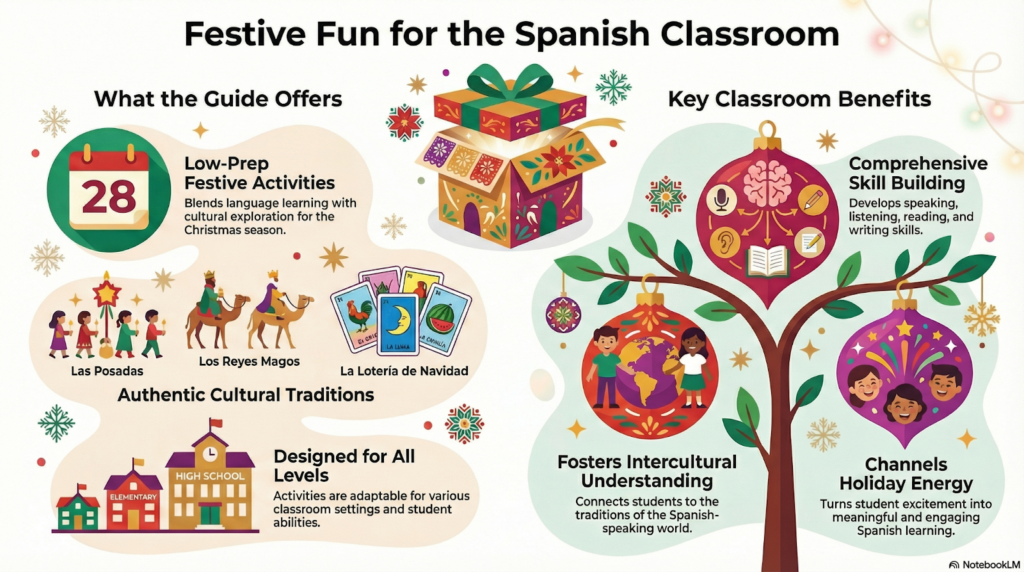
December in the Spanish classroom presents a unique challenge and opportunity. Students buzz with holiday excitement while you struggle to maintain focus and engagement. Rather than fighting against this energy, channel it into meaningful language learning through culturally rich Christmas activities that connect students to the diverse celebrations across Spanish-speaking countries.
Spanish Christmas traditions offer far more than typical holiday festivities. From Las Posadas processions in Mexico to the Loteria de Navidad in Spain, from eating twelve grapes at midnight to waiting for Los Reyes Magos on January 6th, the Hispanic world celebrates with vibrant customs that provide authentic contexts for language acquisition. These traditions give students real reasons to communicate, learn vocabulary, and understand cultural perspectives while maintaining their natural enthusiasm during those final weeks before winter break.
This comprehensive guide delivers 28 practical activities designed specifically for Spanish classrooms. Whether you teach middle school beginners or advanced high school students, you will find low-prep options for quick engagement and deeper cultural explorations that build intercultural competence. Most importantly, these activities balance educational rigor with festive fun, ensuring students continue learning while enjoying the season.
Understanding La Navidad Across Spanish-Speaking Cultures
Before diving into activities, understanding how different Spanish-speaking regions celebrate Christmas enriches your teaching approach. While some elements remain consistent, significant variations exist across countries and communities.
In Mexico, Las Posadas recreates Mary and Joseph’s search for lodging through nine nights of processions from December 16 to 24. Families travel between homes, singing traditional songs and ultimately celebrating with pinatas, food, and community gatherings. This tradition blends indigenous Mexican festivals with Catholic practices introduced during colonization.
Spain celebrates with its famous Loteria de Navidad, the world’s largest lottery drawn on December 22nd. Families gather for la Nochebuena feast on Christmas Eve, then celebrate Nochevieja on New Year’s Eve by eating twelve grapes at midnight, one for each chime of the clock. Children receive gifts on January 6th from Los Reyes Magos rather than Santa Claus.
Throughout Latin America, el Dia de los Reyes Magos holds special significance. Children write letters requesting gifts and leave their shoes out on January 5th, waking to find presents the next morning. Many countries celebrate with roscón de reyes, a ring-shaped cake hiding small figurines.
Understanding these differences helps you present Christmas not as a monolithic celebration but as diverse cultural expressions worthy of exploration and respect.
Essential Spanish Christmas Vocabulary
Build your word wall with these fundamental terms students will encounter throughout December activities:
Core Christmas Words:
- la Navidad (Christmas)
- Feliz Navidad (Merry Christmas)
- Papa Noel or Santa Claus (Santa Claus)
- Los Reyes Magos (Three Kings)
- el arbol de Navidad (Christmas tree)
- los regalos (gifts)
- la estrella (star)
- el belen or el nacimiento (nativity scene)
- la flor de Nochebuena (poinsettia)
- el villancico (Christmas carol)
Mexican Christmas Traditions:
- Las Posadas (the inns)
- la pinata (pinata)
- los tamales (tamales)
- el ponche (punch)
- pedir posada (to ask for lodging)
Spanish Traditions:
- la Loteria de Navidad (Christmas lottery)
- las uvas (grapes)
- la Nochebuena (Christmas Eve)
- la Nochevieja (New Year’s Eve)
- el turron (nougat candy)
Display these words prominently with visual supports. Encourage natural usage rather than isolated memorization by incorporating vocabulary into every activity context.
Quick Five-Minute Activities for Daily Engagement
1. Christmas Vocabulary Scavenger Hunt
Transform your classroom into an interactive learning environment by hiding vocabulary cards featuring Spanish Christmas terms. Students race to find cards, then must use each word correctly in a complete sentence to earn points. This kinesthetic activity works perfectly when students need movement breaks and reinforces vocabulary through active engagement.
2. Flashlight Vocab Review
Dim classroom lights and use a flashlight to randomly highlight words on your word wall. Students identify and pronounce the illuminated word, then create sentences using it. This simple game builds recognition skills while adding excitement through the element of surprise.
3. Christmas Would You Rather
Present students with holiday-themed choices in Spanish, such as prefieres abrir regalos en Navidad o el Dia de los Reyes Magos. Students choose sides of the classroom based on preferences, then explain their reasoning using target vocabulary and structures.
4. Daily Christmas Facts Calendar
Create an advent-style calendar revealing daily facts about Christmas celebrations in different Spanish-speaking countries. Students read facts aloud, discuss traditions, and compare them with their own experiences. This builds cultural awareness while providing consistent exposure to authentic content.
5. Christmas Charades
Prepare cards with Spanish Christmas vocabulary and actions. Students act out words while classmates guess in Spanish. Include verbs like decorar, cocinar, cantar, celebrar, and envolver to practice action vocabulary alongside holiday terms.
Interactive Speaking and Listening Activities
6. Las Posadas Classroom Simulation
Divide students into two groups to recreate this meaningful Mexican tradition. One group stands outside your classroom door as pilgrims while the other remains inside as innkeepers. Groups alternate singing verses of the traditional Posada song. After several refusals, pilgrims gain entrance and everyone celebrates together. This immersive activity teaches vocabulary, pronunciation, and cultural understanding while creating memorable experiences.
7. Christmas Interview Exchange
Provide interview questions about holiday traditions, favorite memories, and celebration plans. Partners interview each other, then report findings to the class using third person. Sample questions include cual es tu tradicion navidena favorita, que comida especial comes en Navidad, and como celebra tu familia la Nochebuena.
8. Christmas Bingo with Description Clues
Rather than simply calling out vocabulary words, describe items in Spanish while students mark corresponding images on their bingo cards. This listening comprehension activity forces students to process descriptive language rather than relying on direct translation.
9. Spanish Christmas Song Analysis
Select age-appropriate villancicos with clear pronunciation and repetitive structures. Students identify vocabulary, discuss themes, and complete listening comprehension activities. Popular choices include Campana sobre Campana, Los Peces en el Rio, and Mi Burrito Sabanero.
10. Holiday Storytelling Circle
Start a collaborative narrative about Christmas adventures using sentence stems like Un dia en diciembre, Papa Noel decidio. Each student adds one sentence, building an unpredictable story that develops listening skills, creativity, and spontaneous speaking ability.
Writing and Reading Activities
11. Letters to Los Reyes Magos
Students write letters requesting gifts while describing their behavior throughout the year and making promises for the future. Provide sentence frames for beginners such as Queridos Reyes Magos, este ano he sido, Quisiera recibir porque. Advanced students incorporate conditional tense, subjunctive mood, or persuasive writing techniques.
12. Christmas Sweater Design and Description
Students roll dice to determine elements of their ugly Christmas sweater design, then create and color their masterpiece. Finally, they write descriptions using color vocabulary, clothing terms, and phrases like hay, tiene, and lleva. Extension activities include gallery walks where students match written descriptions to displayed sweaters.
13. Venn Diagram Cultural Comparisons
Students compare Christmas traditions in their own culture with celebrations from a Spanish-speaking country or compare traditions between two Hispanic countries. After completing diagrams, they write paragraphs explaining similarities and differences using comparative structures and cultural vocabulary.
14. Christmas Journal Prompts
Offer daily bellringer prompts throughout December. Questions range from simple preferences like cual es tu villancico favorito to complex reflections such as como han cambiado tus tradiciones navidenas con el tiempo. Consistent writing practice builds fluency naturally.
15. Create a Class Christmas Story Book
Each student contributes one illustrated page answering questions like que hace Papa Noel despues de Navidad or como celebran los animales del bosque la Navidad. Compile pages into a collaborative book students can read together, building reading skills while creating lasting memories.
Cultural Deep-Dive Projects
16. Las Posadas Research and Presentation
Assign groups to research different aspects of Las Posadas including historical origins, regional variations, traditional songs, foods, and symbolic elements like the seven-pointed pinata representing seven deadly sins. Students present findings through posters, digital presentations, or performances.
17. Loteria de Navidad Exploration
Introduce Spain’s famous Christmas lottery through authentic commercials, particularly the emotional Justino advertisement. Students analyze the commercial’s narrative, discuss cultural significance, and explore how this tradition brings communities together. Activities include creating lottery tickets, discussing probability in Spanish, and comparing fundraising traditions.
18. Dia de los Reyes Magos Study
Explore Three Kings Day traditions across Spanish-speaking countries. Students research how different regions celebrate, compare gift-giving customs, and learn about roscón de reyes. Create classroom celebrations where students leave shoes out and receive small treats while practicing relevant vocabulary.
19. Regional Christmas Food Exploration
Investigate traditional holiday foods from various Spanish-speaking countries including tamales from Mexico, turron from Spain, hallacas from Venezuela, and paneton from Peru. Students research preparation methods, cultural significance, and regional variations. If possible, organize tastings or cooking demonstrations.
20. Virtual Tour of Christmas Markets
Explore traditional mercados navidenos through virtual tours and authentic images. Discuss items sold, decorations displayed, and cultural practices. Students can create their own classroom market selling crafted items while practicing shopping vocabulary and transaction phrases.
Game-Based Learning Activities
21. Christmas Escape Room Challenge
Design puzzle sequences where students solve Christmas-themed challenges to save the holiday or help Papa Noel complete deliveries. Include vocabulary matching, reading comprehension, cultural trivia, and logic puzzles. This collaborative activity maintains high engagement while reviewing content comprehensively.
22. Loteria Navidena
Create Christmas-themed loteria cards featuring holiday vocabulary instead of traditional images. This culturally authentic game teaches vocabulary recognition while introducing students to a beloved Hispanic tradition they can enjoy with families.
23. Christmas Jeopardy Tournament
Organize categories including Vocabulario, Tradiciones Mexicanas, Celebraciones en Espana, Comida Navidena, and Villancicos. Teams compete answering questions at varying difficulty levels. This format motivates participation while reviewing extensive content.
24. Corre en Circulos Christmas Edition
Adapt this popular Spanish classroom game with Christmas vocabulary. Students race between circles answering questions, matching vocabulary, or completing challenges. The movement component helps channel excess energy productively.
25. Christmas Trivia Relay Race
Divide students into teams for relay races where they must correctly answer Christmas culture questions before advancing. Include questions about traditions, vocabulary, geography, and cultural practices from across the Spanish-speaking world.
Art and Craft Activities
26. Christmas Door Decoration Contest
Students create esferas de Navidad using colorful cardboard cut into circles. Each ornament includes the student’s name and hangs from classroom doors or ceilings with colorful strings, transforming your classroom into a festive learning environment.
27. Paper Plate Christmas Trees
Students create arboles de Navidad from paper plates, decorating them with construction paper ornaments while labeling parts in Spanish. This craft combines creativity with vocabulary practice and produces meaningful decorations.
28. Cootie Catcher Fortune Tellers
Students fold paper into comecocos (cootie catchers) and decorate faces with Christmas drawings while labeling items in Spanish. Partners practice vocabulary by opening fortune tellers and identifying images, creating an interactive review tool.
Implementation Strategies for Maximum Success
Differentiation Approaches:
Adapt activities for varying proficiency levels by adjusting language complexity and support structures. Beginners receive sentence frames, word banks, and visual aids while advanced students tackle authentic texts, complex grammar, and extended speaking tasks. Mixed-level classrooms benefit from tiered assignments where students complete the same basic activity with different expectations.
Balancing Fun and Learning:
Every activity should serve clear language learning objectives beyond simply filling time. Christmas activities provide authentic contexts for communication practice, cultural exploration, and vocabulary acquisition. Maintain this focus while embracing festive spirit by connecting activities to curriculum standards and assessing learning informally through observation, participation, and product collection.
Time Management Tips:
Prepare quick activities for unexpected free moments and longer projects for full periods. Store materials in organized bins labeled by activity type for easy access. Create master copies of game pieces and laminate them for durability and reuse. Digital versions of activities provide flexibility for absent students or hybrid learning situations.
Activity Quick Reference Guide
| Activity | Time Needed | Best For | Primary Skills | Prep Level |
| Vocabulary Scavenger Hunt | 10-15 min | All levels | Vocabulary, Movement | Low |
| Las Posadas Simulation | 30-40 min | Intermediate+ | Culture, Speaking, Listening | Medium |
| Letters to Reyes Magos | 25-35 min | All levels | Writing, Creativity | Low |
| Christmas Escape Room | 45-60 min | Intermediate+ | All skills, Problem-solving | High |
| Loteria Navidena | 20-30 min | All levels | Vocabulary, Listening | Medium |
| Christmas Sweater Activity | 30-40 min | Novice-Intermediate | Writing, Speaking, Art | Low |
| Cultural Research Projects | 2-3 periods | Advanced | Research, Presentation | Medium |
| Christmas Jeopardy | 30-45 min | All levels | All skills, Review | Medium |
| Daily Fact Calendar | 5 min daily | All levels | Reading, Culture | Low |
| Interview Exchange | 20-30 min | Intermediate+ | Speaking, Listening | Low |
Making Activities Work in Different Settings
For Core Spanish Programs:
Focus on vocabulary acquisition, basic cultural awareness, and simple communication tasks. Use more structured activities with clear instructions and visual supports. Emphasize recognition over production for beginners.
For Spanish Immersion:
Integrate Christmas themes into existing curriculum rather than creating separate units. Use holiday contexts for teaching regular content like grammar structures, reading strategies, and writing techniques. Expect higher language output and deeper cultural analysis.
For Heritage Speakers:
Honor students’ existing knowledge by inviting them to share family traditions. Focus on formal register, literacy development, and exploring traditions from countries beyond their heritage backgrounds. Use activities as opportunities for cultural pride and leadership.
For Virtual or Hybrid Classes:
Adapt activities to digital platforms using Google Slides, Padlet, Flipgrid, or Kahoot. Create breakout room activities for small group work. Record yourself reading Christmas stories or singing villancicos for asynchronous learning. Design digital escape rooms using Google Forms or specialized websites.
Managing Diverse Student Populations
Students come from varied backgrounds with different relationships to Christmas celebrations. Create inclusive environments by framing activities as cultural exploration rather than personal celebration. Emphasize learning about traditions across Spanish-speaking countries without assuming student participation.
Offer alternative activities focusing on winter themes, New Year celebrations, or other December holidays for students who prefer not engaging with Christmas content. Always provide choice and maintain respect for diverse beliefs and practices within your classroom community.
Include discussions about how not all Spanish speakers celebrate Christmas the same way or at all. This builds cultural competence while validating diverse student experiences.
Assessment Integration
Christmas activities need not be purely recreational. Collect evidence of learning through informal and formal assessment methods:
- Observe participation during speaking activities and note vocabulary usage
- Collect writing samples from letters, journal entries, and descriptions
- Record oral presentations about cultural research
- Use exit tickets requiring students to demonstrate vocabulary knowledge
- Create quick quizzes on cultural facts learned through activities
- Evaluate creative projects using rubrics assessing both language and content
Balance fun with accountability by communicating clear expectations and providing feedback that helps students recognize their growth.
Materials and Resources Checklist
Basic Supplies:
- Colored cardstock and construction paper
- Markers, crayons, colored pencils
- Scissors, glue sticks, tape
- Chart paper for group work
- Dice for probability activities
- Timer for timed challenges
Printable Resources:
- Vocabulary cards with images
- Game boards and playing cards
- Cultural information handouts
- Writing templates and graphic organizers
- Song lyrics and listening guides
Digital Tools:
- Projector or smartboard for videos
- Audio system for music
- Tablets or computers for research
- Digital platforms for virtual activities
Organize materials in clearly labeled containers and store them together for easy access next year. Create digital folders with all printables, lesson plans, and resources for quick retrieval.
Conclusion
Spanish Christmas activities transform December from a challenging time into an opportunity for rich cultural learning and authentic communication practice. The activities presented here offer flexibility for various teaching contexts, proficiency levels, and time constraints while maintaining focus on meaningful language development.
Success comes from selecting activities that match your students’ interests and needs while connecting language practice to cultural understanding. Balance quick engagement activities with deeper explorations, mix individual work with collaborative projects, and always emphasize the diversity of Christmas celebrations across the Spanish-speaking world.
Start implementing a few favorite activities from this guide, observe what resonates with your students, and build your December repertoire over time. Remember that holiday activities should enhance rather than replace regular instruction. Use festive contexts to teach language skills your students need while honoring the excitement and energy they naturally bring to class during this special season.
The traditions you explore, vocabulary you teach, and cultural connections you facilitate create lasting impressions that extend far beyond December. Students remember the teacher who helped them understand Las Posadas, appreciate the Christmas lottery tradition, or write their first letter to Los Reyes Magos. These experiences build not just language proficiency but genuine intercultural competence and lifelong curiosity about the Spanish-speaking world.
Feliz Navidad y prospero Ano Nuevo. May your Spanish classroom be filled with joy, learning, and cultural discovery this December.
Frequently Asked Questions:
What are the best Spanish Christmas activities for beginners?
Simple bingo games, vocabulary matching activities, coloring pages with labels, and basic letter writing with sentence frames work excellently for novice students.
How can I teach Spanish Christmas vocabulary without just memorizing lists?
Use contextual activities like scavenger hunts, charades, interactive games, and authentic cultural projects where students use vocabulary for real communication purposes.
What Spanish-speaking Christmas traditions should I prioritize teaching?
Focus on Las Posadas from Mexico, Dia de los Reyes Magos celebrated across Latin America, and Spain’s Loteria de Navidad for diverse cultural representation.
How long should I dedicate to Christmas activities in Spanish class?
Balance festive activities throughout December with regular curriculum, spending perhaps two to three full lessons on themed content while incorporating shorter activities into daily routines.
Can these activities work for high school students?
Absolutely. Focus on authentic cultural research, complex escape rooms, analysis of Spanish commercials, and discussion-based activities that challenge older learners appropriately.
What if I have students who don’t celebrate Christmas?
Frame activities as cultural exploration rather than celebration, emphasize learning about diverse traditions, and provide alternative winter-themed or New Year activities.
How do I assess learning during Christmas activities?
Use informal observation, collect writing samples, record presentations, create cultural knowledge quizzes, or develop rubrics for creative projects that evaluate language use.
What are good emergency sub plans with Spanish Christmas themes?
Provide complete worksheet packets, cultural reading passages with comprehension questions, video viewing guides with clear instructions, or self-guided game activities.
How can I make activities more challenging for advanced students?
Require extended writing without supports, eliminate sentence frames, assign authentic text analysis, ask students to lead activities, or add time constraints and competitive elements.
Where can I find authentic Spanish Christmas videos and songs?
Search YouTube for villancicos tradicionales, commercials like Loteria de Navidad Justino, or cultural documentaries. Many educational websites offer curated Spanish Christmas content.

Belekar Sir is the founder and lead instructor at Belekar Sir’s Academy, a trusted name in English language education. With over a decade of teaching experience, he has helped thousands of students—from beginners to advanced learners—develop fluency, confidence, and real-world communication skills. Known for his practical teaching style and deep understanding of learner needs, Belekar Sir is passionate about making English accessible and empowering for everyone. When he’s not teaching, he’s creating resources and guides to support learners on their journey to mastering spoken English.