Transform December Spanish lessons with 28 engaging Christmas activities including Las Posadas simulations, letters to Los Reyes Magos, Loteria de Navidad exploration, cultural research projects, games like Christmas Bingo and Escape Room, plus crafts like paper plate Christmas trees. Activities range from 5-minute warm-ups to full-period cultural deep-dives, with options for beginner to advanced students.
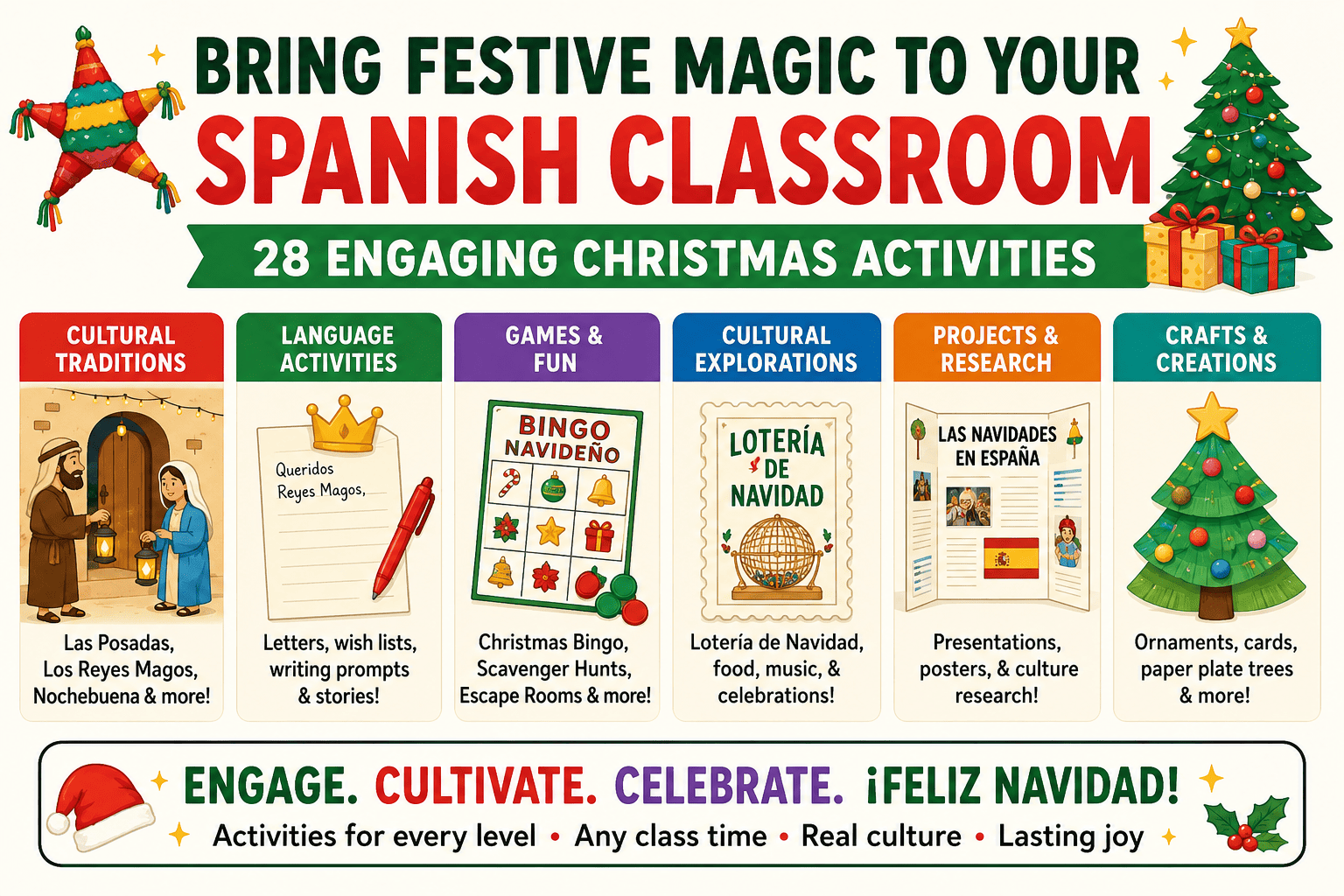
Looking for fresh ways to bring festive magic into your Spanish classroom this December? Whether you’re teaching novice learners or advanced heritage speakers, Christmas offers a rich cultural context for language learning. From Las Posadas in Mexico to Los Reyes Magos across Latin America and Spain’s Loteria de Navidad, Spanish-speaking cultures celebrate the holiday season with vibrant traditions that captivate students and provide authentic language opportunities.
This comprehensive collection of 28 engaging activities spans quick 5-minute warm-ups to full-period cultural immersions, vocabulary games to in-depth research projects, and everything in between. Each activity is designed to be low-prep, high-engagement, and easily adaptable for different proficiency levels. Let’s explore how to turn December into the most culturally enriching month of your Spanish teaching year!
The goal: Create a December curriculum that balances cultural exploration with language practice. Start with 3-5 favorite activities this year and build your repertoire. Focus on authentic traditions that provide meaningful communication opportunities, not just holiday fluff.
Mexico: Las Posadas (Dec 16-24), nine nights of processions reenacting Mary and Joseph’s search for lodging, ending with piñatas and celebrations.
Spain: Loteria de Navidad (Dec 22), world’s largest lottery; Nochebuena feast on Christmas Eve; eating 12 grapes at midnight on Nochevieja; gifts from Los Reyes Magos on Jan 6.
Latin America: El Dia de los Reyes Magos (Jan 6), children write letters, leave shoes out, receive gifts; roscón de reyes cake with hidden figurines.
Introduce vocabulary through word walls, picture cards, and interactive games. Use comprehensible input strategies, show images while saying the word, use gestures, and provide example sentences in context. Don’t just translate; help students connect words to cultural concepts and authentic usage.
Hide vocabulary cards around the room. Students find cards and use each word in a complete sentence to earn points.
Dim lights, shine a flashlight on word wall words. Students identify and pronounce the word, then create a sentence.
“¿Prefieres abrir regalos en Navidad o el Día de los Reyes Magos?” Students choose sides and explain reasoning in Spanish.
Advent-style calendar revealing daily facts about Christmas celebrations in different Spanish-speaking countries.
Students act out words like decorar, cocinar, cantar, envolver while classmates guess in Spanish.
Divide students into pilgrims (outside door) and innkeepers (inside). Groups alternate singing traditional Posada song verses. After several refusals, pilgrims enter and celebrate together.
Partners interview each other about traditions, favorite memories, and celebration plans, then report findings to class using third person.
Describe items in Spanish while students mark corresponding images, builds listening comprehension without direct translation.
Analyze villancicos like “Campana sobre Campana,” “Los Peces en el Río,” or “Mi Burrito Sabanero” for vocabulary and themes.
Start collaborative narrative: “Un día en diciembre, Papá Noel decidió…” Each student adds one sentence.
Students write letters requesting gifts, describing behavior, and making promises. Sentence frames for beginners: “Queridos Reyes Magos, este año he sido… Quisiera recibir… porque…”
Students design ugly Christmas sweaters, then write descriptions using color vocabulary, clothing terms, and phrases like “hay,” “tiene,” “lleva.”
Compare own traditions with Spanish-speaking countries or compare two Hispanic countries. Write paragraphs explaining similarities and differences.
Daily bellringers: “¿Cuál es tu villancico favorito?” or “¿Cómo han cambiado tus tradiciones navideñas con el tiempo?”
Each student contributes one illustrated page answering prompts like “¿Qué hace Papá Noel después de Navidad?” Compile into collaborative book.
| Project | Description | Skills |
|---|---|---|
| 16. Las Posadas Research | Groups research historical origins, regional variations, songs, foods, and symbolic elements (7-pointed piñata = 7 deadly sins) | Research, presentation |
| 17. Lotería de Navidad Exploration | Analyze the emotional “Justino” commercial, discuss cultural significance, create lottery tickets, compare fundraising traditions | Critical thinking, culture |
| 18. Día de los Reyes Magos Study | Explore Three Kings traditions, compare gift-giving customs, learn about roscón de reyes, create classroom celebration | Writing, culture |
| 19. Regional Christmas Food Exploration | Investigate tamales (Mexico), turrón (Spain), hallacas (Venezuela), panetón (Peru), preparation, significance, variations | Research, vocabulary |
| 20. Virtual Tour of Christmas Markets | Explore mercados navideños, discuss items sold and cultural practices, create classroom market with shopping dialogues | Speaking, culture |
Puzzle sequences with vocabulary matching, reading comprehension, cultural trivia, and logic puzzles to “save Christmas” or help Papá Noel.
Christmas-themed Lotería cards featuring holiday vocabulary, culturally authentic game teaching vocabulary recognition.
Categories: Vocabulario, Tradiciones Mexicanas, Celebraciones en España, Comida Navideña, Villancicos.
Students race between circles answering questions, matching vocabulary, or completing challenges.
Teams answer Christmas culture questions correctly before advancing, includes traditions, vocabulary, geography.
Create “esferas de Navidad” using colorful cardboard circles. Each ornament includes student’s name and hangs from doors or ceilings.
Create “árboles de Navidad” from paper plates, decorate with construction paper ornaments while labeling parts in Spanish.
Fold paper into “comecocos,” decorate with Christmas drawings, label items in Spanish, practice vocabulary with partners.
| Activity | Time | Best For | Prep Level |
|---|---|---|---|
| Vocab Scavenger Hunt | 10-15 min | All levels | Low |
| Las Posadas Simulation | 30-40 min | Intermediate+ | Medium |
| Letters to Reyes Magos | 25-35 min | All levels | Low |
| Christmas Escape Room | 45-60 min | Intermediate+ | High |
| Lotería Navideña | 20-30 min | All levels | Medium |
| Christmas Sweater Activity | 30-40 min | Novice-Intermediate | Low |
| Cultural Research Projects | 2-3 periods | Advanced | Medium |
For beginners: Sentence frames, word banks, visual aids. For advanced: Authentic texts, complex grammar, extended speaking. For heritage speakers: Invite sharing of family traditions, focus on formal register. For non-Christmas celebrating students: Frame as cultural exploration, offer winter or New Year alternatives.
Spanish Christmas activities transform December from a challenging time into an opportunity for rich cultural learning and authentic communication practice. From Las Posadas simulations and letters to Los Reyes Magos to Loteria de Navidad exploration and collaborative crafts, these 28 activities offer flexibility for various teaching contexts, proficiency levels, and time constraints.
Balance quick engagement activities with deeper cultural projects, mix individual work with collaborative games, and always emphasize the diversity of Christmas celebrations across the Spanish-speaking world. Start with a few favorite activities, observe what resonates with your students, and build your December repertoire over time. ¡Feliz Navidad y próspero Año Nuevo!
You don’t need to do all 28 activities this year! Choose 3-5 favorites that fit your students’ level and your teaching style. Build your December toolkit gradually, and soon you’ll have a rich collection of culturally authentic activities that students love.
Explore more Spanish teaching resources, grammar guides, and classroom activities at Belekar Sir’s Academy.
Browse All Articles → Try Our ToolsContinue building your teaching resources with our guides on how to improve English speaking, adjectives to describe a friend, and list of adjectives for students.

Belekar Sir is the founder and lead instructor at Belekar Sir’s Academy, a trusted name in English language education. With over a decade of teaching experience, he has helped thousands of students—from beginners to advanced learners—develop fluency, confidence, and real-world communication skills. Known for his practical teaching style and deep understanding of learner needs, Belekar Sir is passionate about making English accessible and empowering for everyone. When he’s not teaching, he’s creating resources and guides to support learners on their journey to mastering spoken English.