Yes, critical reading directly transforms your writing skills. Active, analytical reading, not passive consumption, expands your vocabulary, sharpens critical thinking, reveals structural techniques, and develops your unique voice. Great writers learn from masters by reading with intention and curiosity. 30 minutes of daily critical reading yields measurable improvements in writing quality, from stronger arguments to more distinctive prose.
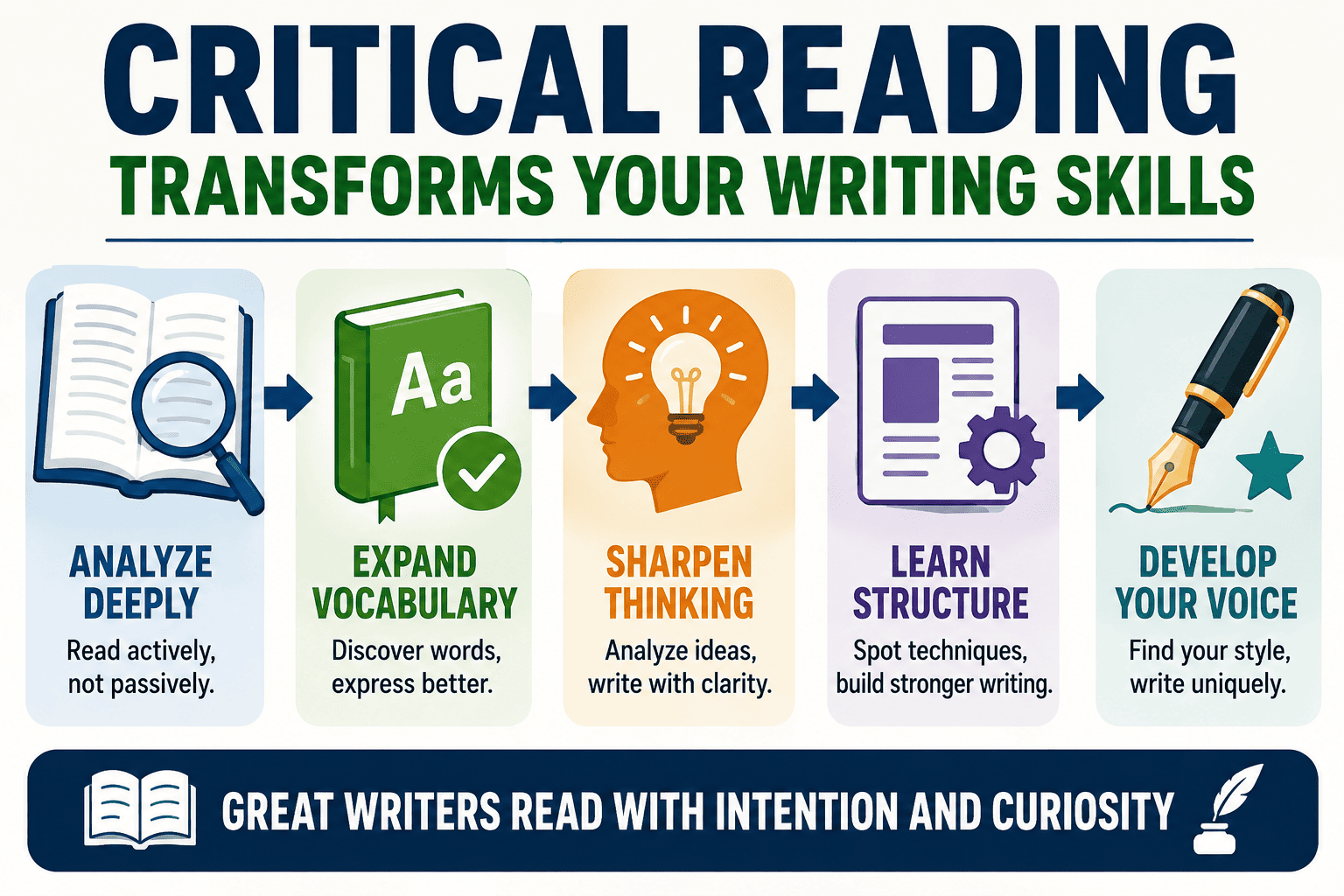
You sit down to write. The words come slowly. Your sentences feel flat. Your arguments lack conviction. Something is missing. The solution isn’t more writing practice alone, it’s critical reading. The most accomplished writers share a common habit: they read with intention, analyzing how great writing works rather than simply consuming it. This guide shows you exactly how critical reading transforms your writing skills and how to develop this essential practice.
Critical reading is active, purposeful engagement with text. Instead of absorbing information passively, you interrogate the author’s choices, evaluate arguments, and uncover the mechanics behind effective writing. It’s the difference between watching a magician and learning the sleight of hand. Critical readers ask why and how, not just what.
Ask why each word, sentence, and paragraph exists. What effect does the author intend? How does each element serve the whole?
Who wrote this? When? For what audience? What perspectives are included or missing? Context illuminates choices.
Assess evidence strength, logical consistency, and rhetorical effectiveness. Learn what works and what doesn’t.
A surface reader absorbs plot points. A critical reader examines foreshadowing, dialogue reveals, sentence rhythm, and thematic architecture, learning the craft behind the story. Surface reading entertains; critical reading educates.
| Reading Skill | Writing Benefit | Example |
|---|---|---|
| Exposure to diverse techniques | Versatile stylistic range | Learn pacing from thrillers, lyricism from poetry, clarity from journalism |
| Vocabulary in context | Precise word choice | Understand connotations, not just definitions |
| Analyzing argument structure | Stronger persuasive writing | Recognize what makes claims convincing |
| Observing organization | Logical flow & transitions | Notice how masters build momentum and satisfying conclusions |
| Studying voice | Developing your unique voice | Identify what makes distinctive prose distinctive |
Research consistently shows a strong correlation between reading volume and writing quality. Frequent readers demonstrate wider vocabularies, more sophisticated syntax, better argumentation skills, and greater writing fluency than their non-reading peers. The connection isn’t coincidental, reading provides the raw material writing transforms.
Define what you’re studying before you begin: persuasive techniques? Character arcs? Argument structure? Sentence rhythm? A focused purpose makes every page productive.
Underline, highlight, write questions in margins, circle patterns, draw connections. The physical act of writing notes cements insights and creates a record for later review.
Engage generously with opposing views. Understand before judging. Suspending judgment makes your writing more empathetic and persuasive by teaching you to see multiple sides.
Historical, cultural, and biographical context explains why specific choices were made. Understanding context prevents superficial criticism and deepens appreciation of craft.
Link texts: recurring themes, contrasting approaches, evolving conversations across time. Recognizing patterns builds your internal network of influences and techniques.
First for comprehension, then for style, then for structure. Each pass reveals new layers. Masterpieces reward multiple readings with deeper craft understanding.
Record reflections, techniques you admire, ideas sparked, passages you want to remember. A reading journal becomes a treasure trove for future writing projects.
Translating complex ideas into your own words builds clarity and flexibility. If you can’t paraphrase, you haven’t truly understood.
Note field-specific terms and authentic usage. Write example sentences. Active vocabulary grows through deliberate collection and application.
| Author | Critical Reading Habit | Resulting Craft |
|---|---|---|
| Stephen King | Reads 70+ books per year across genres | Masterful pacing and relentless narrative drive |
| Toni Morrison | Dissected sentences of other writers | Distinctive lyrical, powerful voice |
| Ernest Hemingway | Studied journalism and modernist spareness | Economy of language, iceberg theory |
| Maya Angelou | Read widely, poetry, essays, fiction | Multilayered, resonant prose |
| George Orwell | Analyzed political writing’s manipulation techniques | Clarity, precision, moral authority |
Every great writer is a voracious reader who reads with intention. They don’t just read for pleasure, though they do, they read to understand how writing works, to learn from masters, and to continuously expand their craft vocabulary.
Choose one text per week to read critically. Apply the strategies systematically. Even 15-20 minutes of focused analysis yields insights you can apply immediately.
Read outside your comfort zone. If you write business content, read poetry. If you write fiction, read essays. Cross-pollination prevents staleness and unlocks innovation.
Join a reading group. Share insights with a writing partner. Teach what you’re learning. Teaching others deepens your own understanding and reinforces habits.
Treat critical reading like any important task. Schedule 20-30 minutes daily. Consistent practice compounds over time, just like consistent writing practice.
Notice how your writing evolves: expanded vocabulary in your drafts, stronger openings, tighter arguments, more varied sentence structures. Celebrate these small wins, they signal deep transformation. Review your writing from three months ago to see the progress clearly.
Transform your craft through intentional, analytical reading. Start your critical reading journey today.
Explore More Writing Guides → Try Our ToolsContinue exploring writing and communication with our guides on English phonetics, types of adjectives, and adjectives to describe yourself.
Great writing doesn’t emerge from a vacuum, it grows from deep engagement with the voices who came before. Read to learn how writing works. Write to apply those lessons. Return to reading with greater insight. This virtuous cycle elevates your craft continuously.

Belekar Sir is the founder and lead instructor at Belekar Sir’s Academy, a trusted name in English language education. With over a decade of teaching experience, he has helped thousands of students—from beginners to advanced learners—develop fluency, confidence, and real-world communication skills. Known for his practical teaching style and deep understanding of learner needs, Belekar Sir is passionate about making English accessible and empowering for everyone. When he’s not teaching, he’s creating resources and guides to support learners on their journey to mastering spoken English.