Yes, but only when used correctly. Silent reading builds vocabulary and grammar, but reading aloud, shadowing, and active recall are what transform passive knowledge into fluent spoken English. Reading alone won’t make you a confident speaker, but reading + speaking techniques will accelerate your progress dramatically.
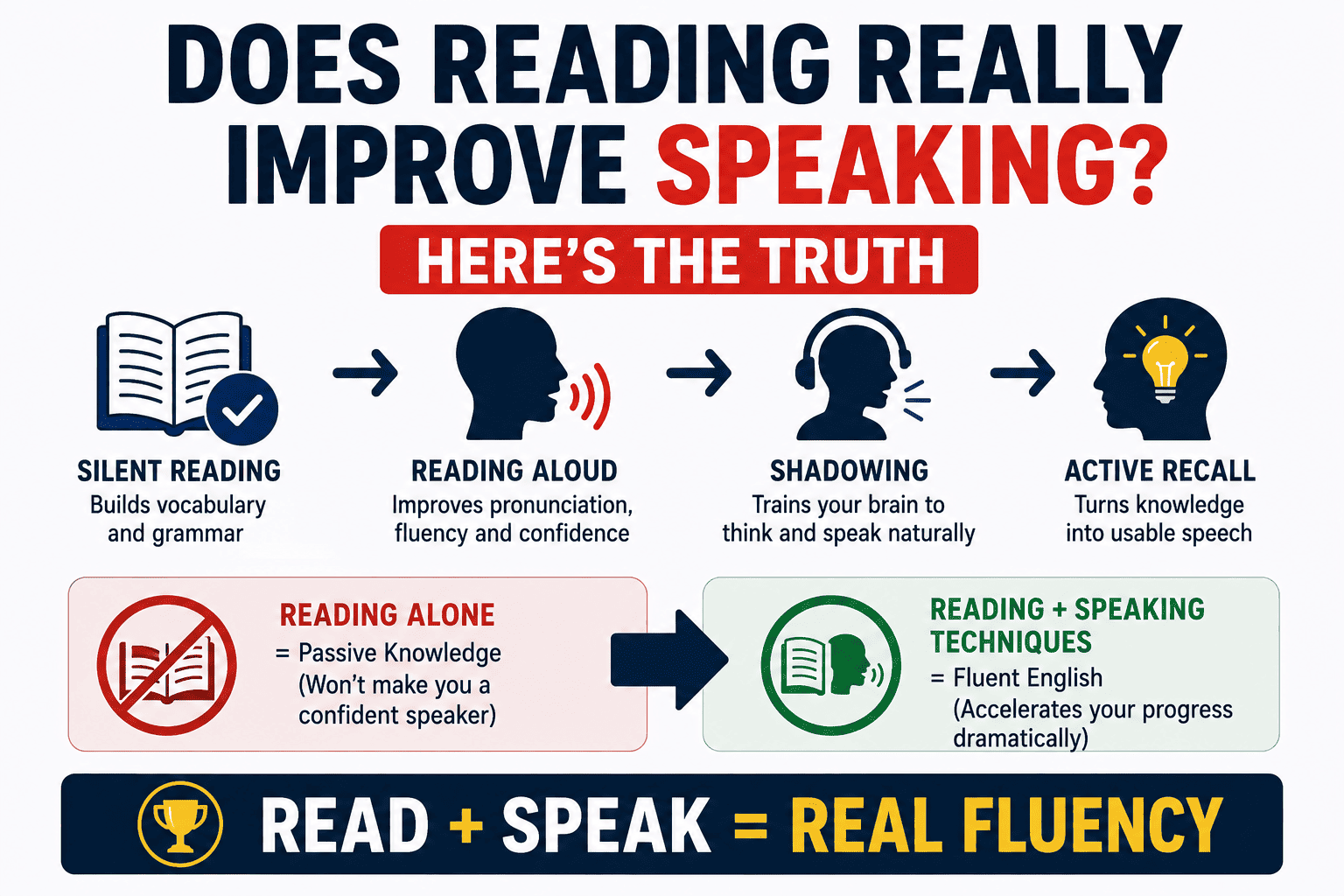
Many English learners have the same question: Does reading actually help you speak better? After all, reading is a silent, passive activity, while speaking requires real-time thinking, pronunciation, confidence, and conversation skills. So is there a real connection between the two?
Reading is a foundation, but not the whole house. It builds the vocabulary, grammar, and mental models you need. But to speak well, you must actively practice speaking. The magic happens when you combine reading with speaking-specific techniques like reading aloud and shadowing.
Reading exposes you to more words, idioms, and sentence patterns than daily conversation. You learn how words are used in real contexts.
Your brain absorbs grammar patterns naturally through repeated exposure, no need to memorize charts.
Reading trains your brain to process ideas directly in English, reducing mental translation and making speech more spontaneous.
Good speakers have content. Reading provides ideas, facts, and perspectives that fuel confident conversations.
While silent reading strengthens vocabulary and grammar, reading aloud is where reading directly transforms into speaking practice. It forces your mouth, tongue, and vocal cords to work just like in real conversation.
Take any paragraph from a news article or blog. Read it aloud slowly, focusing on each sound. Then read it again, paying attention to natural pauses and emphasis. Record yourself, you’ll hear the improvement within a week.
Reading becomes even more powerful when paired with listening, especially through shadowing, listening to a native speaker and immediately repeating while reading the text.
| Technique | How It Works | Speaking Benefit |
|---|---|---|
| Shadowing | Listen + repeat immediately while reading transcript | Trains pacing, intonation, and natural flow |
| Reading While Listening | Follow along with an audiobook or captioned video | Links written words to correct pronunciation |
| Multisensory Learning | See, hear, and speak the same content | Creates stronger memory connections, faster recall |
A strong vocabulary is foundational to good speaking. Reading exposes you to thousands of words in context, helping you understand tone, collocations, and usage naturally.
Good speakers don’t just know words, they know how to put them together. Reading provides implicit learning of grammar rules.
| Type | Best For | Example Activity |
|---|---|---|
| Reading Aloud | Pronunciation, fluency, confidence | Read a news paragraph aloud for 5 minutes daily |
| Silent Reading | Vocabulary, grammar, sentence patterns | Read a blog or short story, note new phrases |
| Guided/Assisted Reading | Accurate pronunciation, rhythm | Listen to audiobook while reading along |
| Interactive Reading | Speaking practice, recall | Read an article, then discuss or summarize it verbally |
Step 1 (5 min): Silent reading, choose a short article or dialogue. Underline 3-5 useful phrases.
Step 2 (5 min): Read the same passage aloud. Focus on clarity and natural rhythm.
Step 3 (5 min): Shadowing, listen to a native audio clip (30 seconds) and repeat while reading.
Step 4 (3 min): Summarize what you read verbally, without looking at the text.
Step 5 (2 min): Record yourself speaking the summary. Listen and note one area to improve tomorrow.
This routine combines input (silent reading + listening) with active output (reading aloud + summarizing). It builds vocabulary, trains pronunciation, and practices spontaneous speaking, all in 20 minutes a day.
Start transforming your reading into real speaking power. Use the 5-step daily routine and watch your fluency grow.
More Fluency Guides → Try Vocabulary ToolsIf you want to speak better, clearer, quicker, and more confidently, reading is one of the simplest habits to start. It requires no special tools, no partner, no expensive classes. Just a book, an article, and your voice. But remember: read aloud, shadow native speakers, and summarize what you read. With consistent practice, you’ll notice your speaking skills transforming naturally and steadily.

Belekar Sir is the founder and lead instructor at Belekar Sir’s Academy, a trusted name in English language education. With over a decade of teaching experience, he has helped thousands of students—from beginners to advanced learners—develop fluency, confidence, and real-world communication skills. Known for his practical teaching style and deep understanding of learner needs, Belekar Sir is passionate about making English accessible and empowering for everyone. When he’s not teaching, he’s creating resources and guides to support learners on their journey to mastering spoken English.