Quick Answer: English phonetics uses the International Phonetic Alphabet (IPA) to represent sounds consistently. Unlike English spelling, each IPA symbol represents exactly one sound. The key to reading phonetics is learning the 44 English sounds: 19 vowels (including short, long, and diphthongs) and 25 consonants. Start with familiar symbols like /p/, /b/, /t/, /d/, then master challenging sounds like /θ/ (think), /ð/ (this), /ʃ/ (ship), /ʒ/ (vision), and the schwa /ə/.
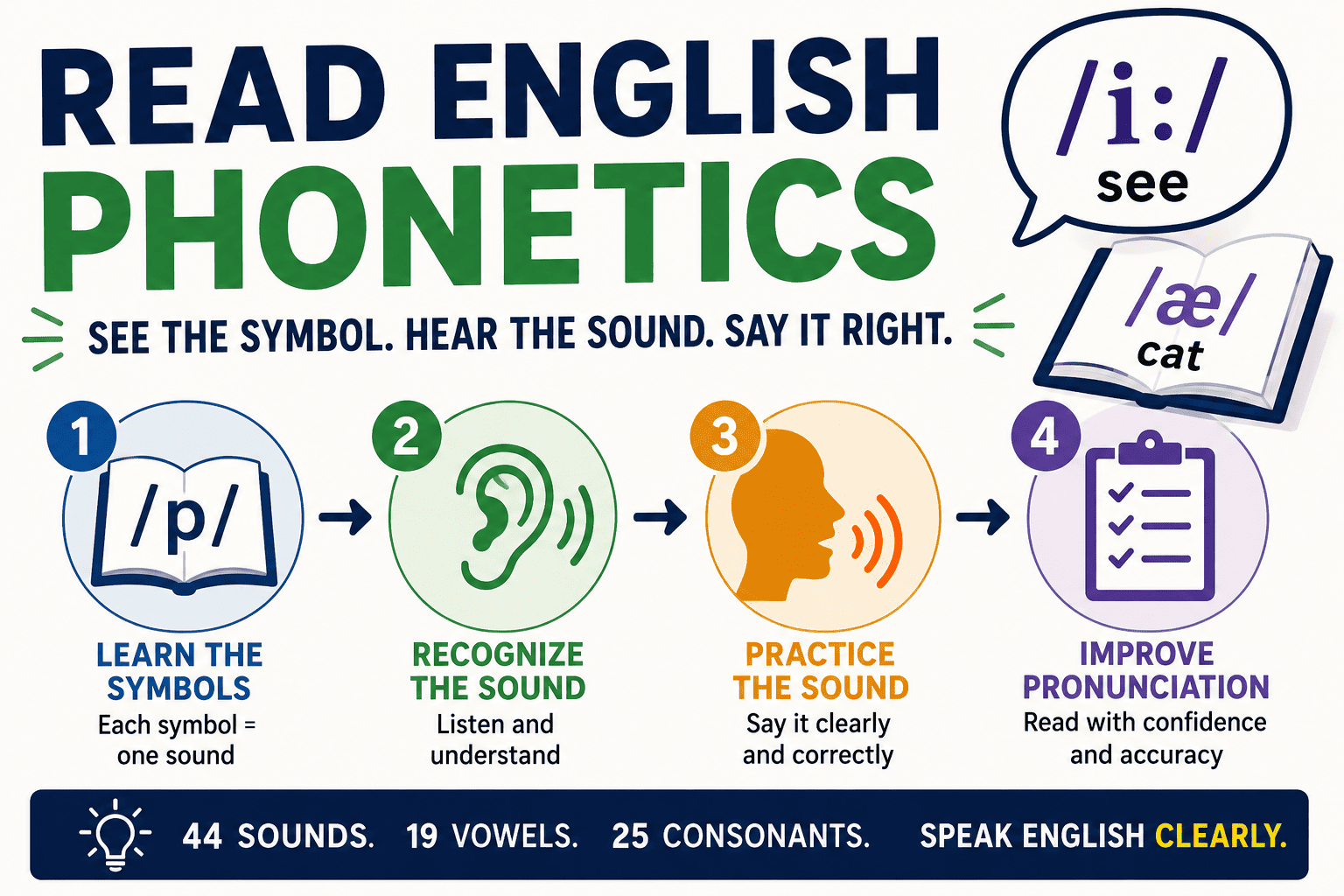
Have you ever looked up a word in the dictionary and found strange symbols in parentheses that looked nothing like the word itself? Those mysterious symbols represent phonetics, a system designed to show you exactly how to pronounce any word correctly. While English spelling can be wildly inconsistent (think about how “ough” sounds different in “through,” “though,” “cough,” and “tough”), phonetic symbols provide a reliable, consistent way to represent pronunciation.
The International Phonetic Alphabet (IPA) stands as the most widely used phonetic system in the world. Developed in the late 19th century by language teachers and linguists, the IPA provides a standardized way to represent speech sounds across all languages. While it might seem daunting at first glance, learning to read phonetics is far simpler than it appears. This comprehensive guide will take you from complete beginner to confident reader of phonetic symbols.
Phonetics is the scientific study of speech sounds. When we talk about reading phonetics, we specifically mean understanding phonetic transcription, the written representation of how words sound when spoken. This system becomes essential because English spelling provides unreliable guidance for pronunciation.
Phonemes are the smallest units of sound that change word meaning (/p/ vs /b/ changes “pat” to “bat”). Phonemic transcription (between slashes / /) focuses on these distinct sounds. Most dictionaries use phonemic transcription, enough for correct pronunciation without overwhelming detail.
The letter combination “ough” produces at least seven different sounds in English: through (/uː/), though (/əʊ/), cough (/ɒf/), rough (/ʌf/), bough (/aʊ/), thought (/ɔː/), and hiccough (/ʌp/). Phonetic transcription solves this chaos by representing actual sounds rather than letters.
English contains approximately 15 to 20 distinct vowel sounds, depending on the dialect. This abundance far exceeds the five vowel letters in the alphabet, which explains why English spelling creates so much confusion about pronunciation.
The schwa is the most common vowel sound in English. It’s the neutral “uh” sound in unstressed syllables: about /əˈbaʊt/, banana /bəˈnænə/, sofa /ˈsəʊfə/. Mastering the schwa instantly improves your natural English rhythm.
| Symbol | Sound Type | Example Word | Phonetic Transcription |
|---|---|---|---|
| /ɪ/ | Short vowel | ship | /ʃɪp/ |
| /iː/ | Long vowel | sheep | /ʃiːp/ |
| /æ/ | Short vowel | cat | /kæt/ |
| /ʌ/ | Short vowel | cup | /kʌp/ |
| /ə/ | Schwa | banana | /bəˈnænə/ |
| /eɪ/ | Diphthong | day | /deɪ/ |
Consonants create the framework around which vowels flow. English has 25 consonant sounds, organized into natural groups based on how and where you produce them.
The /θ/ and /ð/ sounds (as in “think” and “this”) don’t exist in many languages. Practice by placing your tongue between your teeth and blowing air. The /ʃ/ sound (“ship”) and /ʒ/ sound (“vision”) also require careful attention.
Starting your phonetic reading journey requires a systematic approach. Begin with simple, short words that use familiar symbols before progressing to complex transcriptions.
Primary stress mark /ˈ/ appears before the stressed syllable. Secondary stress /ˌ/ appears in longer words.
knight → /naɪt/ (silent k, silent gh)
psychology → /saɪˈkɒlədʒi/ (silent p)
island → /ˈaɪlənd/ (silent s)
| Word | British IPA | American IPA | Difference |
|---|---|---|---|
| car | /kɑː/ | /kɑr/ | r sound (rhotic vs non-rhotic) |
| dance | /dɑːns/ | /dæns/ | vowel quality |
| hot | /hɒt/ | /hɑt/ | /ɒ/ vs /ɑ/ |
| water | /ˈwɔːtə/ | /ˈwɔːtər/ | final r and schwa |
Both British and American English are correct. Choose the variety most relevant to your goals. Most dictionaries indicate which system they use. The important thing is consistency, learn one variety thoroughly before exploring differences.
Every quality dictionary includes pronunciation guides using phonetic symbols. When using a dictionary, first locate the pronunciation key (usually in the front matter or bottom of pages). This key explains which symbols the dictionary uses and provides example words for each sound.
/ɪ/ vs /iː/: ship/sheep, bit/beat, live/leave
/æ/ vs /ʌ/: cat/cut, hat/hut, bat/but
/s/ vs /ʃ/: see/she, sock/shock, mass/mash
/θ/ vs /ð/: thigh/thy, mouth (n)/mouth (v), ether/either
/i/ vs /ɪ/, /ɔ/ vs /ɒ/, /ʊ/ vs /u/, Create comparison charts and practice minimal pairs.
Accept that variation is normal. Focus on one variety consistently (British or American).
Regular, daily practice of 15-20 minutes builds automatic recognition faster than marathon sessions.
Use online audio charts to hear symbols while seeing them. Listen and repeat actively.
Cambridge Advanced Learner’s Dictionary, Oxford Advanced Learner’s Dictionary, include IPA and audio.
Sounds: The Pronunciation App, English Phonetics & Pronunciation, interactive IPA charts with audio.
Interactive charts with clickable audio for every symbol, free from many universities.
YouTube channels dedicated to English pronunciation with IPA explanations and examples.
Week 1: Learn short vowels and simple consonants (/p/, /b/, /t/, /d/, /k/, /g/, /m/, /n/).
Week 2: Add long vowels and schwa /ə/. Practice with 5 words daily.
Week 3: Master fricatives (/f/, /v/, /s/, /z/, /ʃ/) and the “th” sounds.
Week 4: Tackle diphthongs and affricates. Read full dictionary entries.
Learning to read English phonetics transforms how you approach language learning, pronunciation improvement, and vocabulary development. While phonetic symbols might seem mysterious initially, systematic study reveals that phonetics provides a logical, consistent system for representing speech sounds.
Phonetic literacy empowers you to pronounce any word correctly from the moment you first encounter it, eliminating pronunciation uncertainty and building confidence in your speaking abilities. This skill proves invaluable whether you are learning English as a foreign language, teaching others to speak clearly, preparing for public speaking, or simply enriching your understanding of how language works.
Begin your phonetic reading journey today, start with the vowel chart, practice with common dictionary entries, and incorporate phonetics into your daily vocabulary study. With consistent effort and the strategies outlined in this guide, you will soon read phonetic transcription fluently, opening new possibilities for language mastery and communication excellence.
Explore more language learning resources at Belekar Sir’s Academy.
Browse All Articles → Try Our ToolsContinue improving your English skills with our guides on nouns used as adjectives, positive adjectives for husbands, and adjectives for mom.

Belekar Sir is the founder and lead instructor at Belekar Sir’s Academy, a trusted name in English language education. With over a decade of teaching experience, he has helped thousands of students—from beginners to advanced learners—develop fluency, confidence, and real-world communication skills. Known for his practical teaching style and deep understanding of learner needs, Belekar Sir is passionate about making English accessible and empowering for everyone. When he’s not teaching, he’s creating resources and guides to support learners on their journey to mastering spoken English.