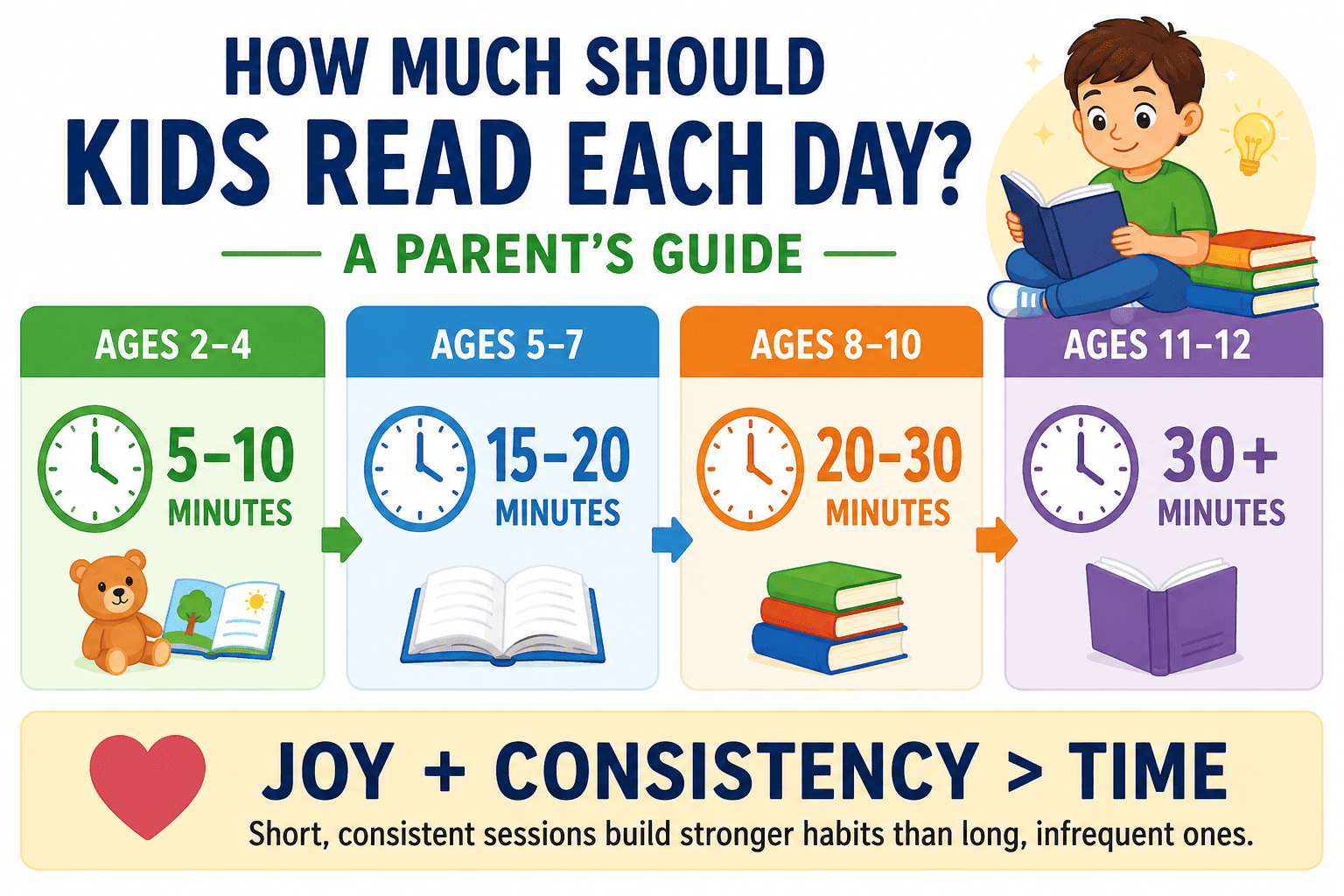
Daily reading time depends on your child’s age. For toddlers (ages 2–4), aim for 5–10 minutes of shared reading daily. Early readers (ages 5–7) benefit from 15–20 minutes, while growing readers (ages 8–10) should read 20–30 minutes. Preteens (ages 11–12) can handle 30+ minutes daily. The key is consistency over duration, short, joyful sessions build stronger habits than long, infrequent ones. Quality and enjoyment matter more than watching the clock.
In today’s fast-paced, screen-dominated world, cultivating a reading habit in children can feel like a challenge. Yet, reading remains one of the most valuable gifts we can give our child, not just for academics, but for imagination, empathy, and lifelong learning. The question many parents ask is: how much reading per day is enough?
Based on decades of research and expert recommendations, this post offers a clear, age-wise guide to daily reading time for kids, practical advice for making reading enjoyable, and strategies to help build strong reading habits that last.
Joy + Consistency > Marathon sessions. A child who reads 15 minutes every day gains more than a child who reads two hours only on weekends. Make it a natural, enjoyable part of their day.
Daily reading shapes cognitive, emotional, and social growth. When reading becomes a daily part of life, children naturally absorb vocabulary, develop stronger memory, and gain a deeper understanding of the world.
Regular reading exposes kids to 1.5 million more words per year than occasional readers. This word gap directly impacts academic success across all subjects.
Daily readers consistently outperform peers across all subjects, including math and science. Reading builds critical thinking and comprehension skills that transfer to every learning area.
Stories build emotional awareness by letting children experience different perspectives and cultures. They learn to understand characters’ feelings and motivations.
Reading strengthens memory, focus, and problem-solving, it’s exercise for the brain. It builds neural pathways that support lifelong learning.
Here is a clear breakdown of daily reading recommendations by age group, based on expert guidelines from literacy organizations and child development research.
| Age Range | Recommended Daily Reading Time | Weekly Target |
|---|---|---|
| Ages 2 to 4 | 5 to 10 minutes (shared reading) | Around 1 hour |
| Ages 5 to 7 | 15 to 20 minutes | 1.5 – 2 hours |
| Ages 8 to 10 | 20 to 30 minutes | 2.5 – 3.5 hours |
| Ages 11 to 12 | 30 minutes or more | 3.5+ hours |
These are minimum recommendations, not strict rules. Some children may naturally read more; others may need to build up gradually. The goal is a consistent habit, not hitting an exact number. Start where your child is and grow from there.
Recommended: 5–10 minutes/day, At this age, reading is about bonding and early language exposure. Short, interactive sessions with colorful picture books build positive associations with reading. Let your child turn pages, point to pictures, and ask questions.
Focus on rhythm, rhyme, and repetition. Board books with textures, flaps, and bright illustrations capture attention. The goal is to make reading a warm, enjoyable part of your daily routine.
Use expressive voices for different characters, let your child turn pages, and keep it pressure‑free. A nightly bedtime story works wonders. Even 5 minutes of focused, loving attention builds a foundation for lifelong reading.
Recommended: 15–20 minutes/day, Children in this age range are transitioning from decoding words to reading with fluency. Combine shared reading with early independent reading. At this stage, phonics skills and sight word recognition develop rapidly.
Encourage your child to read books with predictable patterns, rhyming text, or familiar storylines. Take turns reading pages to keep it engaging and supportive. Celebrate progress and build confidence with positive reinforcement.
For ages 5–7, daily reading builds reading stamina. Many children can read for 15 minutes by the end of first grade and 20 minutes by the end of second grade. Use a timer and gradually extend sessions as focus improves.
Recommended: 20–30 minutes/day, Third and fourth graders develop greater reading stamina and comprehension skills. They can tackle longer chapter books, series, and more complex narratives. Offer a variety of genres: chapter books, comics, adventure stories, and age-appropriate nonfiction.
This is the critical “reading to learn” phase where comprehension skills become essential for academic success. Encourage your child to read books that challenge them just enough while maintaining enjoyment.
Recommended: 30+ minutes/day, Preteens face increasing academic demands. Daily pleasure reading maintains vocabulary growth, cognitive strength, and emotional well-being. Independent reading should include a mix of fiction and nonfiction.
At this age, allow your child to explore diverse genres, authors, and perspectives. Series, fantasy, realistic fiction, and informational texts all contribute to their reading development. Encourage discussions about what they’re reading to deepen understanding.
The research is clear: consistent, enjoyable reading habits matter more than the number of minutes. A child who joyfully reads 15 minutes daily will develop stronger skills than one who is forced to read 45 minutes reluctantly. Focus on building a positive relationship with reading.
Reading should feel like a privilege, not a punishment. When children associate reading with warmth, connection, and discovery, they’re far more likely to become lifelong readers. Celebrate every page turned and every book finished.
Let your child choose books based on their interests, not just what you think they “should” read. Comics, graphic novels, and magazines count as reading. Interest is the engine that drives reading growth.
Short daily sessions build habit and momentum. Even 10 minutes every day is more effective than a long session once a week. Attach reading to existing routines like bedtime or after-school downtime.
Increase reading time slowly as your child’s stamina develops. Use the age recommendations as a guide, but always follow your child’s cues. Some children naturally read more than others.
Integrate reading into existing routines: bedtime, breakfast, car rides, or waiting times. Use audiobooks during commutes. Short sessions throughout the day add up significantly.
Create a screen‑free reading corner with cozy seating and good lighting. Establish a family reading time where everyone reads together. Model the behavior you want to see.
Use local libraries, book swaps, Little Free Libraries, or second‑hand stores. A small diverse library with 20–30 books is enough to build a habit. Rotate books to keep interest fresh.
Choose books at your child’s reading level, read aloud together, and praise effort, not just accuracy. Avoid correcting every mistake. Build confidence with success experiences.
First, rule out vision or learning difficulties. Then, focus 100% on enjoyment. Graphic novels, joke books, magazines, and audiobooks all count as reading. Never use reading as punishment. Keep sessions short and stop before frustration sets in. Celebrate any reading, no matter how small.
Challenge your family to read for 20 minutes every day for one month. Track progress together and celebrate as a family. You’ll be amazed at the transformation in vocabulary, comprehension, and reading confidence.
Building a daily reading habit is one of the most valuable gifts you can give your child. It doesn’t require hours of time each day, just consistency, warmth, and the right approach for your child’s age and interests. Whether your child is a toddler exploring board books or a preteen diving into chapter books, the principles remain the same: make it joyful, make it consistent, and let your child lead.
Remember, every child’s reading journey is unique. Some will naturally read more than others, and that’s okay. Focus on progress, not perfection. Celebrate small victories, a new word learned, a chapter finished, a book loved. Your support and encouragement make all the difference.
You are your child’s first and most important reading teacher. Your enthusiasm, patience, and presence create the foundation for a lifelong love of reading. Start today, even 5 minutes counts. Your child will thank you for years to come.
Start small. Stay consistent. Keep reading joyful. Explore more parenting guides to support your child’s learning journey.
Explore More Articles → Try Our ToolsContinue supporting your child’s learning journey with our guides on 3rd grade reading comprehension, how to motivate kids to read, and how reading improves creativity.

Belekar Sir is the founder and lead instructor at Belekar Sir’s Academy, a trusted name in English language education. With over a decade of teaching experience, he has helped thousands of students—from beginners to advanced learners—develop fluency, confidence, and real-world communication skills. Known for his practical teaching style and deep understanding of learner needs, Belekar Sir is passionate about making English accessible and empowering for everyone. When he’s not teaching, he’s creating resources and guides to support learners on their journey to mastering spoken English.