Yes, you can dramatically improve your LSAT Reading Comprehension score. The key is shifting from passive reading to active, structural analysis. Master active reading, annotate strategically (author viewpoint, evidence, transitions), identify passage architecture, anticipate questions, and build stamina with daily drills. Structure over details, that’s the key. With just one passage daily and focused error review, most students see meaningful improvement within 4-8 weeks.
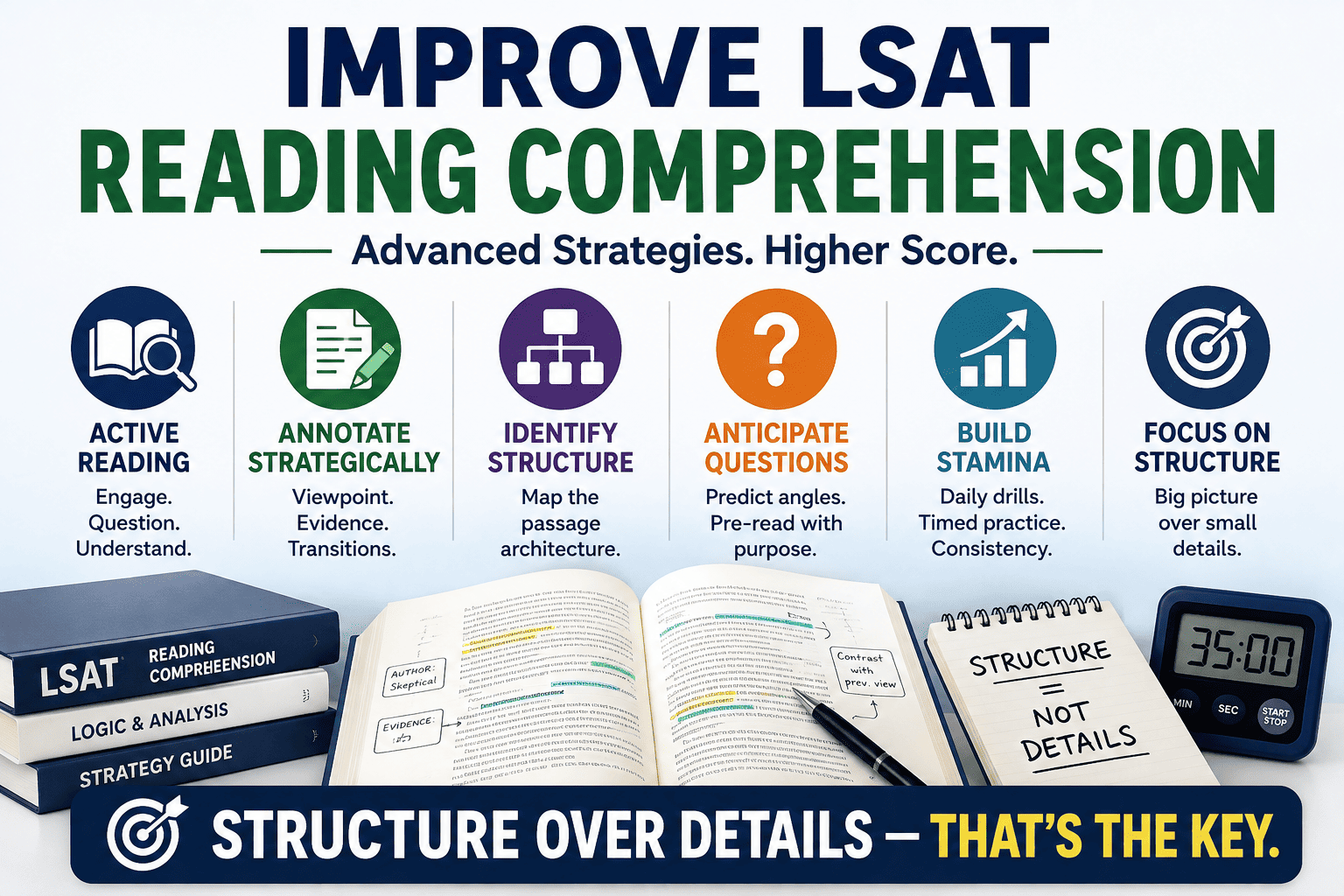
LSAT Reading Comprehension challenges even strong readers because it demands much more than casual reading. The passages are dense, the arguments subtle, and the questions are intentionally designed to test precision, endurance, and analytical thinking. Many test-takers struggle not because they lack intelligence, but because they haven’t learned the specific type of active, structured reading the LSAT requires.
From reading for information → reading for structure. Once you understand the author’s purpose, track viewpoints, and anticipate what the exam tests, the section becomes far more manageable. With consistent practice, you can significantly boost both accuracy and timing.
Reading Comprehension is not about reading quickly, it’s about understanding deeply. The LSAT evaluates how well you analyze arguments, interpret complex ideas, and identify relationships between viewpoints. Every passage is a mini-exercise in critical thinking. The test measures your ability to recognize tone, locate main ideas, and distinguish between evidence, assumptions, and conclusions.
Identify why the author wrote this, to persuade, explain, compare, or critique?
Note shifts between author, cited experts, and opposing perspectives.
Every paragraph serves a function: evidence, counterargument, conclusion.
✔ Over-focusing on details → missing the main argument
✔ Reading passively → failing to track author attitude
✔ Re-reading excessively → time management collapse
✔ Ignoring structure → struggling with “main point” questions
Active reading means treating each passage like a structured argument. Identify the author’s purpose, tone, attitudes, and central thesis. Highlight or mentally note shifts with keywords like “however,” “although,” “therefore,” and “on the other hand.” These signal important logical turns. Also monitor your understanding, if a sentence feels confusing, pause and reframe it in simpler words.
While reading, ask: “Why did the author mention this example?” or “How does this paragraph support the overall claim?” This habit helps you anticipate LSAT question traps.
LSAT passages follow predictable patterns: introduction, background, argument, conflicting perspective, conclusion. Learn to instantly identify these sections. Start labeling each paragraph’s function: “Is this defining a concept? Presenting evidence? Offering criticism?” These functional labels give you a roadmap of the author’s logic.
Every passage has an internal architecture: introduction → shift → supporting points → counterarguments → conclusion. When you recognize these components, the text feels less overwhelming. Find the main purpose of each paragraph. This skill improves comprehension and speeds up your ability to locate information during questions.
| Structural Element | What to Look For | Example Keywords |
|---|---|---|
| Introduction / Thesis | Author’s main claim or purpose | “The purpose of this article is…” |
| Context / Background | Historical or factual setup | “In the early 20th century…” |
| Evidence / Support | Examples, data, or citations | “For instance…”, “Research shows…” |
| Counterargument | Opposing viewpoint or limitation | “Critics argue…”, “However…” |
| Conclusion / Implication | Author’s final stance or takeaway | “Therefore…”, “Thus…” |
Break long sentences into smaller parts and restate them in your own words. Focus on the author’s attitude, as tone reveals what arguments the author supports or criticizes.
Words like “however,” “although,” “therefore,” and “furthermore” reveal the logical flow. These are your road signs through dense prose.
After reading a dense sentence, translate it into plain English. This trains your brain to decode complex syntax quickly.
High scorers pay attention to how the passage is built. Practice summarizing each paragraph in one short sentence immediately after reading it. Identify the function: does it introduce a problem, contrast viewpoints, supply evidence, present a theory, or challenge an existing one? This trains your brain to track the hierarchy of ideas.
Research shows that students who focus on passage structure rather than memorizing details consistently outperform those who read for content. Understanding the architecture of an argument allows you to answer most questions without re-reading the passage.
Annotations should be lean, functional, and strategic. Use quick symbols or brief margin notes. A simple system:
The goal is to create a visual map you can rely on during timed questions. Effective annotation reduces cognitive load.
As you read, pause periodically to predict likely question types. If the author strongly criticizes a theory, expect questions about the author’s attitude or the weaknesses of the theory.
If you see two contrasting viewpoints, prepare for comparison questions. This anticipatory mindset keeps your brain engaged and reduces time spent hunting for answers.
Practice summarizing paragraphs mentally in 3–5 words. This forces your brain to store only essential meaning rather than unnecessary details. Over time, you’ll naturally keep track of main arguments, tone shifts, and logical development without heavy annotation.
After reading a paragraph, close your eyes and say its function in 3 words: “Evidence for X” or “Author disagrees.” This builds the mental habit of structure-based retention.
Build stamina through daily reading drills using materials similar to LSAT density: scientific journals, legal essays, humanities criticism. Start with 10–15 minutes of uninterrupted reading and gradually increase to 30 minutes.
Pair your daily practice with full timed sections 2–3 times per week. This builds the mental endurance needed for test day.
Blind drilling won’t boost your score. After each passage, analyze why you missed a question. Common traps: out-of-scope answers, extreme language, subtle distortions, or reversed logic. Keep an error log to spot patterns in your mistakes.
| Error Type | Description | How to Avoid |
|---|---|---|
| Out-of-Scope | Answer introduces new information not in passage | Verify every answer against passage text |
| Extreme Language | Absolute words like “always” or “never” | Look for qualified, nuanced language |
| Subtle Distortion | Answer twists passage meaning slightly | Re-read the relevant section carefully |
| Reversed Logic | Answer says opposite of what passage states | Check author’s actual stance |
Not all passages are equal. Adjust your approach based on passage difficulty and your strengths. If a passage seems unusually dense, skim the first paragraph for its main idea before committing to a deeper read. Strategic flexibility allows you to maximize your score by avoiding mental fatigue.
Never get stuck on a single passage, if it’s not clicking, move on and return if time permits. Focus on accuracy first, then speed will follow. A calm, strategic approach consistently outperforms frantic rushing.
Improving LSAT RC is not about reading faster, it’s about reading smarter. Recognize passage structures, identify author viewpoints, analyze logic, and anticipate LSAT traps. With consistent practice and strategic review, Reading Comprehension can become one of your strongest sections.
Improving your LSAT Reading Comprehension score is one of the most impactful investments you can make in your law school journey. Strong RC skills not only boost your LSAT score but also prepare you for the analytical reading required in law school. Every student develops at their own pace, focus on progress, not perfection.
Choose two or three strategies from this guide and practice them consistently for a month. Build routines, celebrate small victories, and keep your practice focused and strategic. Your dedication, your patience, your willingness to analyze mistakes, your commitment to daily practice, makes the single biggest difference. You’ve got this, and your target LSAT score is within reach.
The best predictor of LSAT RC success is consistent, focused practice, and the best predictor of consistent practice is understanding why it works. Keep it strategic, reflective, and disciplined. You are exactly the test-taker your target score needs.
Get more advanced strategies, practice drills, and full-length RC sections. Transform your approach from passive to strategic.
More LSAT Prep → Explore ToolsContinue your LSAT preparation with our guides on English phonetics, types of adjectives, and adjectives to describe yourself.

Belekar Sir is the founder and lead instructor at Belekar Sir’s Academy, a trusted name in English language education. With over a decade of teaching experience, he has helped thousands of students—from beginners to advanced learners—develop fluency, confidence, and real-world communication skills. Known for his practical teaching style and deep understanding of learner needs, Belekar Sir is passionate about making English accessible and empowering for everyone. When he’s not teaching, he’s creating resources and guides to support learners on their journey to mastering spoken English.