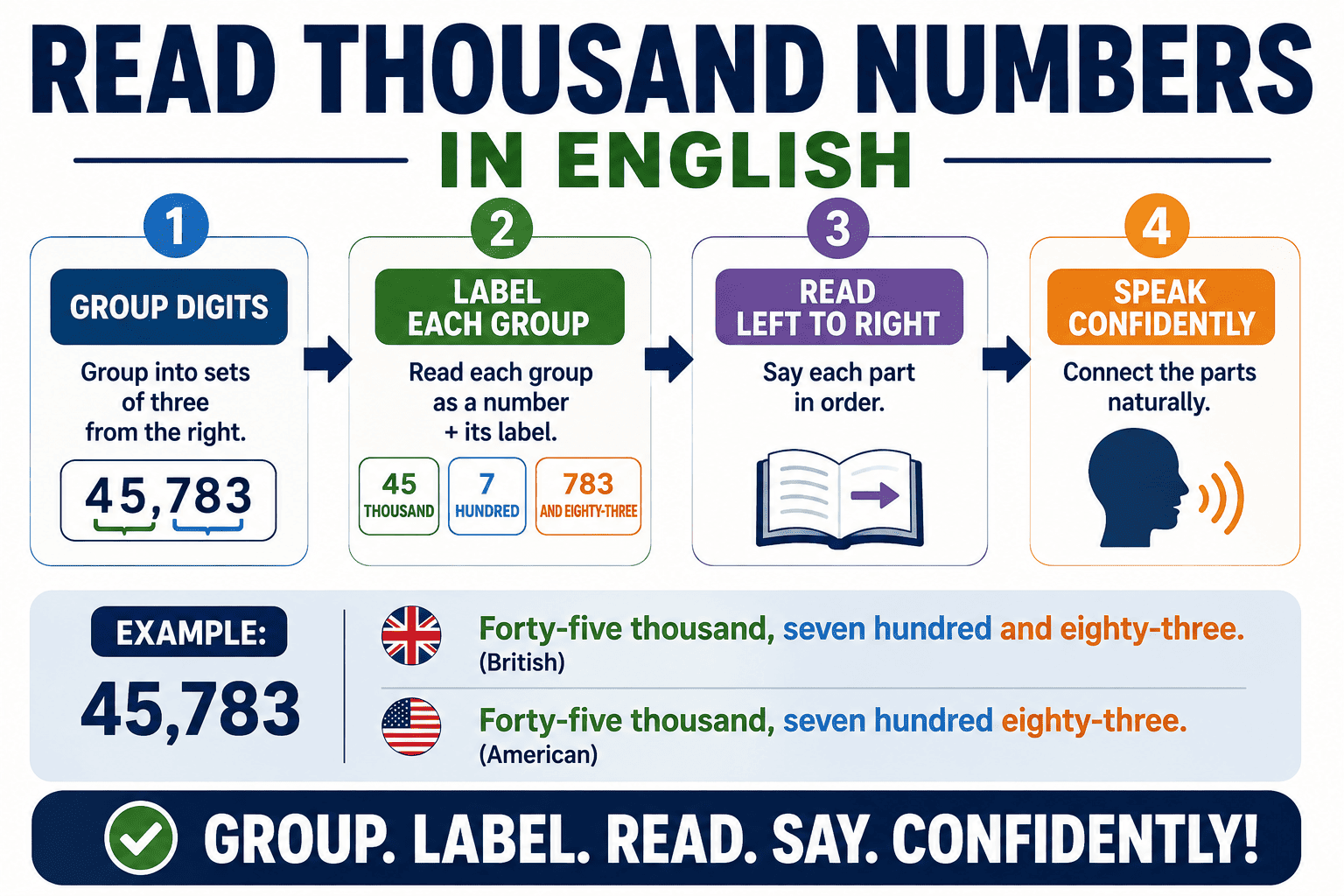
To read thousand numbers in English, group digits into sets of three from the right (thousands, millions, billions). Read each group as a simple number followed by its label. 45,783 = “forty-five thousand, seven hundred and eighty-three” (British) or “forty-five thousand, seven hundred eighty-three” (American). 2,504,619 = “two million, five hundred and four thousand, six hundred and nineteen” (British).
Numbers are everywhere, from bank statements and population statistics to scientific data and financial reports. While reading small numbers comes naturally, large numbers containing thousands, millions, and billions can feel overwhelming. Many people stumble when faced with numbers like 45,783 or 2,504,619, unsure of how to properly pronounce them.
This comprehensive guide will teach you everything you need to know about reading numbers in the thousands, millions, billions, and beyond. You will learn the fundamental principles, master important exceptions, understand regional differences between British and American English, and practice with real examples.
The goal: Master the pattern of grouping digits in threes and reading each group as a simple number. Once you understand the structure, any large number becomes readable with confidence.
The English number system groups digits into sets of three, moving from right to left. Each group has a specific name: ones (units), thousands, millions, billions, etc. This grouping makes large numbers manageable by breaking them into smaller chunks.
| Group | Place Values | Example (1,234,567,890) |
|---|---|---|
| Billions | Billions, Hundred Millions, Ten Millions | 1 billion |
| Millions | Millions, Hundred Thousands, Ten Thousands | 234 million |
| Thousands | Thousands, Hundreds, Tens, Ones | 567 thousand, 890 |
Group from the right: Place a comma every three digits from the right. Read each three-digit group as a normal number, then add the group name (thousand, million, billion).
| Number | Reading (British) | Reading (American) |
|---|---|---|
| 15,600 | fifteen thousand, six hundred | fifteen thousand, six hundred |
| 47,892 | forty-seven thousand, eight hundred and ninety-two | forty-seven thousand, eight hundred ninety-two |
| 100,000 | one hundred thousand | one hundred thousand |
| 456,789 | four hundred and fifty-six thousand, seven hundred and eighty-nine | four hundred fifty-six thousand, seven hundred eighty-nine |
Apply the same grouping pattern: read the millions group, add “million,” then read the thousands and ones groups.
Until the 1970s, a British billion meant 1,000,000,000,000 (one million millions). The UK officially adopted the American short scale in 1974, so now both use 1,000,000,000 = one billion.
| Style | Rule | Example |
|---|---|---|
| British English | Use “and” before the final two-digit number in each three-digit group | 345 = three hundred and forty-five 2,567 = two thousand, five hundred and sixty-seven |
| American English | Generally omit “and” within numbers | 345 = three hundred forty-five 2,567 = two thousand, five hundred sixty-seven |
Both British and American styles are correct. Choose one style and be consistent. In formal writing, British English is commonly used in the UK, Australia, and other Commonwealth countries, while American English is preferred in the US.
Think of commas as “road signs.” Each comma tells you what comes next: thousand, million, billion. Read each section between commas as a standalone number, then add the sign.
Test your knowledge by reading these numbers aloud. Cover the “Correct Reading” column to challenge yourself, then check your answers.
| Number | Your Reading | Correct Reading (British) |
|---|---|---|
| 5,432 | _____ | five thousand, four hundred and thirty-two |
| 45,000 | _____ | forty-five thousand |
| 3,456,789 | _____ | three million, four hundred and fifty-six thousand, seven hundred and eighty-nine |
| 1,000,000,001 | _____ | one billion and one |
| 1984 (year) | _____ | nineteen eighty-four |
| 2,004,050 | _____ | two million, four thousand and fifty |
Reading thousand numbers in English is a skill that becomes second nature with practice. The core principle, grouping digits into threes and reading each group as a simple number, works for any number, no matter how large.
Start with smaller numbers like thousands, then gradually work up to millions and billions. Use real-world numbers from news articles, financial reports, and everyday life to practice. Consistency is key, spend just a few minutes each day reading numbers aloud, and you’ll see rapid improvement.
Remember: native English speakers sometimes stumble on large numbers too. The key is to slow down, group the digits, and read each part deliberately. With this systematic approach, you’ll read any number with clarity and confidence.
Explore more grammar guides, vocabulary tools, and practical exercises at Belekar Sir’s Academy.
Browse All Articles → Try Our ToolsContinue improving your English skills with our guides on English phonetics, types of adjectives, and adjectives to describe yourself.

Belekar Sir is the founder and lead instructor at Belekar Sir’s Academy, a trusted name in English language education. With over a decade of teaching experience, he has helped thousands of students—from beginners to advanced learners—develop fluency, confidence, and real-world communication skills. Known for his practical teaching style and deep understanding of learner needs, Belekar Sir is passionate about making English accessible and empowering for everyone. When he’s not teaching, he’s creating resources and guides to support learners on their journey to mastering spoken English.