Traditional New Year’s resolutions often overwhelm children with lengthy lists of goals they struggle to remember or achieve. A frustrated eight-year-old abandoning resolutions by February benefits no one. The one word resolution approach transforms goal-setting from a discouraging exercise into an empowering experience children can actually succeed with throughout the year.
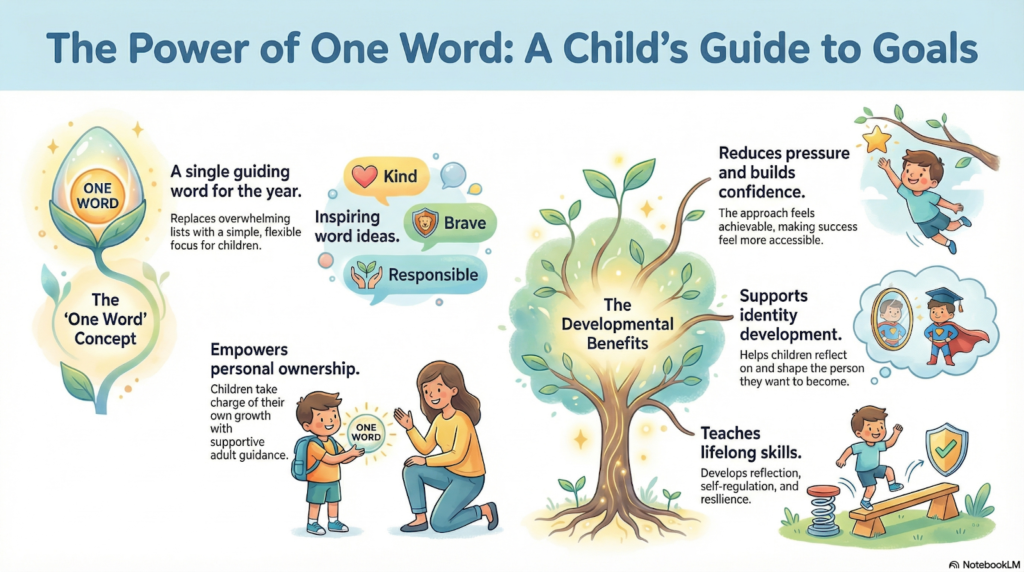
One word resolutions simplify goal-setting by having children select a single word that becomes their focus and guide for the entire year. Instead of creating multiple specific goals like read more books, be nicer to my sister, and eat healthier snacks, children choose words like kindness, growth, or brave that encompass their aspirations. This approach works because it meets children where they are developmentally while teaching them valuable life skills about intention, reflection, and personal growth.
Research shows that children who learn goal-setting skills early develop better self-regulation, increased confidence, and stronger resilience when facing challenges. The one word method provides an age-appropriate framework for these crucial skills without creating the pressure and complexity that cause traditional resolutions to fail. When a child’s entire year revolves around one powerful word, that word becomes internalized, shaping decisions and behaviors naturally rather than feeling like an obligation.
This comprehensive guide provides everything parents, teachers, and caregivers need to implement one word resolutions successfully with children. You will discover why this method works better than traditional goal-setting, explore 50 age-appropriate word suggestions organized by theme, learn step-by-step processes for helping children choose their word, find engaging activities and reminders that keep words alive throughout the year, and understand how to support children without taking over their goal-setting process. Whether working with preschoolers or teenagers, this approach can transform how children think about personal growth and their ability to create positive change in their lives.
Why One Word Resolutions Work for Kids
Understanding the psychology and developmental appropriateness behind one word resolutions helps adults implement this strategy effectively and appreciate its advantages over traditional goal-setting approaches.
Simplicity Reduces Overwhelm
Children’s brains develop executive function skills gradually throughout childhood and adolescence. Complex multi-step planning, working memory, and sustained attention all mature slowly over years. Traditional resolutions requiring children to track multiple specific behaviors across various life domains exceed their developmental capacity, setting them up for failure and discouragement.
A single word simplifies dramatically. Children can remember one word easily. They can evaluate whether choices align with their word without complex analysis. When your seven-year-old considers whether to include a new classmate in playground games, remembering their word friendly provides instant guidance without requiring them to recall detailed behavioral rules.
This simplicity also prevents the paralysis that comes from too many options. When everything connects to one central theme, children understand how different aspects of their lives relate to their overarching intention.
Flexibility Encourages Growth
Specific goals lock children into predetermined outcomes that may not remain relevant as circumstances change. A child who resolves to practice piano thirty minutes daily faces discouragement when soccer season eliminates available practice time. The rigid goal becomes a source of guilt rather than motivation.
One word resolutions flex naturally with life changes. A child focused on the word balance can apply it to managing piano, soccer, homework, and family time simultaneously. When circumstances shift, the word adapts without requiring goal revision or abandonment. The child learns to apply their guiding principle to new situations rather than seeing change as failure.
This flexibility also allows children to interpret their word in age-appropriate ways that deepen over time. A kindergartener’s understanding of brave might mean speaking up during circle time. That same word for a sixth grader might encompass advocating for a bullied peer. The word grows with the child.
Positive Focus Builds Confidence
Traditional resolutions often frame goals negatively, focusing on what children should stop doing or problems needing fixing. Stop fighting with siblings. Quit leaving messes everywhere. Don’t forget homework. This deficit-based approach makes children feel inadequate and emphasizes their shortcomings.
One word resolutions reframe goal-setting positively by focusing on who children want to become rather than what they want to stop being. Words like peaceful, organized, and responsible emphasize positive aspirations. When children orient toward becoming rather than stopping, they feel empowered rather than criticized. This positive framing builds confidence and creates momentum.
Connection to Identity Development
Middle childhood and adolescence are crucial periods for identity formation when children begin understanding themselves as distinct individuals with particular characteristics, values, and aspirations. One word resolutions support this developmental work by encouraging children to consider their values, reflect on personal qualities they admire, and articulate who they want to be.
Choosing a word requires self-knowledge. Children must think about what matters to them, where they want to grow, and what would make them proud. This reflection process itself teaches valuable skills while the chosen word becomes part of how children conceptualize themselves. A child who chooses creative begins seeing themselves as a creative person, which influences subsequent choices and self-understanding.
Teaches Root Cause Thinking
One word resolutions help children identify core issues rather than surface symptoms. Instead of resolving to complete homework on time, raise test scores, and organize their backpack, children focusing on the word responsible understand that all these challenges stem from one underlying area for growth. This root cause thinking develops analytical skills and helps children recognize patterns in their behavior.
Teaching children to look beneath surface problems to identify central themes prepares them for complex problem-solving throughout life. The ability to identify fundamental issues rather than attacking isolated symptoms becomes invaluable in academic, professional, and personal contexts.
50 Powerful One Word Resolution Ideas for Kids
Selecting the right word matters enormously for resolution success. These age-appropriate suggestions organized by theme provide starting points for children to consider based on their unique personalities, challenges, and aspirations.
Character and Values Words
| Word | What It Means | Best For | Example Actions |
| Honest | Always telling the truth | Kids learning integrity | Admitting mistakes, keeping promises |
| Brave | Having courage to try new things | Shy or anxious children | Speaking in class, making new friends |
| Kind | Showing compassion to others | Children learning empathy | Helping others, gentle words |
| Respectful | Treating people with courtesy | Kids struggling with authority | Listening to adults, polite speech |
| Grateful | Appreciating what you have | Children focused on wants | Thank you notes, recognizing gifts |
| Generous | Giving and sharing freely | Kids learning to share | Donating toys, helping family |
Character words help children develop moral foundations and understand how they want to show up in relationships. These words work well for elementary-aged children building social awareness and middle schoolers navigating increasingly complex peer dynamics.
Growth and Learning Words
| Word | What It Means | Best For | Example Actions |
| Curious | Wanting to learn and discover | Natural learners | Asking questions, trying new things |
| Focus | Paying attention to tasks | Easily distracted children | Finishing work before playing |
| Persist | Continuing despite difficulty | Kids who give up easily | Practicing skills, asking for help |
| Learn | Gaining new knowledge and skills | All students | Reading daily, exploring interests |
| Practice | Repeating to improve | Children developing talents | Daily music, sports drills |
| Improve | Getting better over time | Perfectionists or strugglers | Setting small goals, celebrating progress |
| Create | Making and building things | Imaginative children | Art projects, inventions |
Growth-oriented words appeal to children at all ages and work particularly well in educational settings where learning naturally connects to daily activities. These words help shift mindset from fixed to growth-oriented thinking.
Self-Management Words
| Word | What It Means | Best For | Example Actions |
| Organized | Keeping things neat and planned | Messy or forgetful children | Using planners, cleaning room |
| Responsible | Taking care of duties | Kids avoiding chores | Completing homework, helping family |
| Healthy | Making good body choices | Children learning wellness | Active play, nutritious food |
| Balance | Managing different parts of life | Overscheduled children | Time for work and play |
| Calm | Staying peaceful and controlled | Kids with big emotions | Deep breathing, quiet time |
| Strong | Building physical and mental toughness | Children facing challenges | Exercise, positive self-talk |
Self-management words teach executive function skills and personal responsibility. These words work especially well for older elementary and middle school students developing independence and for children with ADHD or anxiety who need concrete focal points for self-regulation.
Social and Emotional Words
| Word | What It Means | Best For | Example Actions |
| Friendly | Being a good friend to others | Socially isolated children | Including others, smiling |
| Patient | Waiting without frustration | Impulsive children | Taking turns, waiting quietly |
| Peaceful | Avoiding conflict and fighting | Kids with aggression issues | Walking away, gentle responses |
| Helpful | Assisting others | Self-centered children | Chores, helping siblings |
| Cheerful | Having a positive attitude | Negative children | Finding good things, smiling |
| Forgiving | Letting go of anger | Kids holding grudges | Saying sorry, moving on |
| Include | Bringing others into activities | Exclusive children | Inviting others to play |
Social-emotional words support relationship building and emotional intelligence development. These resonate with children experiencing friendship challenges, family conflicts, or emotional regulation difficulties.
Personal Excellence Words
| Word | What It Means | Best For | Example Actions |
| Excellence | Doing your personal best | Underachieving children | Careful work, checking assignments |
| Prepared | Getting ready ahead of time | Procrastinators | Packing bags nightly, planning ahead |
| Confident | Believing in yourself | Children with low self-esteem | Trying new things, positive thoughts |
| Unique | Embracing your special qualities | Kids seeking conformity | Expressing individuality, original ideas |
| Leader | Guiding and inspiring others | Natural leaders | Starting projects, helping organize |
| Determined | Refusing to give up | Kids facing obstacles | Continuing through difficulty |
Excellence-focused words work well for older elementary and middle school students developing achievement orientation and for gifted children who need challenges that match their abilities.
Action-Oriented Words
| Word | What It Means | Best For | Example Actions |
| Try | Attempting new experiences | Risk-averse children | Sampling new foods, joining activities |
| Move | Being physically active | Sedentary children | Daily exercise, outdoor play |
| Read | Enjoying books regularly | Reluctant readers | Bedtime stories, library visits |
| Explore | Discovering new things | Adventurous spirits | Nature walks, museums |
| Build | Creating and constructing | Hands-on learners | Blocks, crafts, projects |
| Listen | Paying attention to others | Impulsive talkers | Waiting turns, following directions |
Action words appeal to kinesthetic learners and children who respond better to doing than being. These words translate easily into observable behaviors that parents and teachers can recognize and reinforce.
Step-by-Step Process for Choosing One Word
Guiding children through word selection without imposing adult preferences requires careful facilitation that honors children’s autonomy while providing appropriate structure and support.
Reflection on the Past Year
Begin by helping children reflect on the year ending. This backward look provides context for forward planning and helps children recognize growth areas based on actual experiences rather than abstract ideals.
Ask guiding questions that prompt thoughtful reflection. What are you most proud of from this year? What was hardest for you? When did you feel most happy? What do you wish had been different? What did you learn about yourself? These open-ended questions invite genuine self-assessment without judgment.
For younger children who struggle with abstract reflection, make it concrete. Look through photos from the year and discuss memories. Review schoolwork to remember challenges and successes. Talk about favorite activities and difficult moments. These tangible prompts help young minds engage with reflection meaningfully.
Validate all responses without criticism or correction. The goal is helping children develop self-awareness, not imposing adult perspectives on their experiences. When children feel safe being honest, they engage more deeply with the process.
Envisioning the Coming Year
After reflecting backward, shift focus forward by having children imagine their ideal year ahead. This visioning exercise generates possibilities and desires that inform word selection.
Use guided imagery with younger children. Close your eyes and imagine it is December next year. What do you see yourself doing? Who are you with? How do you feel? What are you proud of? This narrative approach helps concrete thinkers access their hopes and dreams.
Older children can journal or discuss their aspirations more directly. Where do you want to grow? What kind of person do you want to be? What would make you feel proud when next December arrives? These explicit questions work better for abstract thinkers who can conceptualize future selves.
Encourage big thinking without immediately imposing limitations. Let children dream before reality-checking. The word selection process naturally narrows focus, so initial brainstorming benefits from expansiveness rather than constraint.
Brainstorming Potential Words
With reflection and vision complete, begin generating possible words. This brainstorming phase should feel creative and open rather than immediately evaluative.
Create a visual brainstorm by writing or drawing potential words on a large paper, whiteboard, or digital document. Seeing multiple options simultaneously helps children compare and contrast possibilities. Group related words to show connections and patterns.
Encourage children to think about their values. What matters most to you? What do you admire in others? When do you feel happiest? What makes you proud? These value-based questions generate meaningful word options that resonate personally rather than selecting trendy or impressive-sounding words.
Introduce the word lists from earlier in this guide as inspiration but avoid simply assigning words. Children may not know words exist that perfectly capture their intentions until exposed to options, but the choice must remain theirs.
Narrowing to Three Candidates
After generating possibilities, help children narrow to three finalist words. This intermediate step prevents rushing to one word while managing decision paralysis.
Have children articulate why each finalist appeals to them. What would focusing on this word mean? How would it change things? What would you do differently? These clarifying questions reveal whether children truly understand and connect with each option.
Consider how each word applies across life domains. A good one word resolution works at home, school, with friends, in activities, and during personal time. Test each candidate by asking how it would apply in various scenarios to ensure sufficient scope and relevance.
Discuss each word’s challenges and opportunities honestly. Choosing responsible means doing chores even when you don’t want to. Can you commit to that? This reality-checking prevents selection of words that sound good but don’t match genuine readiness for associated effort.
Making the Final Selection
After thorough consideration of finalists, invite children to make their final selection. This moment should feel significant rather than rushed, marking a genuine commitment to personal growth.
Some children know immediately which word feels right. Trust their intuition when clear preference emerges. Others need time to sit with options. Allow a few days of living with finalist words before deciding. Sometimes sleeping on choices clarifies thinking.
For very young children or those struggling with decisions, simplify by presenting two options and letting them choose. The binary choice reduces overwhelm while maintaining their agency in selection.
Once selected, celebrate the choice with a ritual that marks its importance. Sign a commitment card, create artwork featuring the word, or share it formally with family. Making the selection ceremonial increases buy-in and signals that this word matters.
Activities to Reinforce One Word Resolutions
Selecting a word means little without ongoing engagement that keeps it alive and relevant throughout the year. These activities provide varied approaches to regular reinforcement.
Visual Reminders and Displays
Create permanent visual reminders that keep words present in daily life without feeling intrusive or nagging.
Word Art Projects Have children create personalized artwork featuring their word using favorite colors, symbols, and decorative elements. Frame and display this art in their bedroom where they see it morning and night. The personal creative investment makes the reminder meaningful rather than just another poster.
Pennant Banners Cut triangular pennants and have children write one letter of their word on each pennant. String these together to create a colorful banner displayed in their space. This project works well for classrooms where multiple children create banners that hang together, building community around goal-setting.
Word Bookmarks Design bookmarks featuring their word that children use in school books, library books, and pleasure reading. The repeated exposure during daily reading naturally reinforces their focus without requiring separate reminder time.
Mirror Messages Use dry erase markers to write words on bathroom mirrors where children see them during morning and bedtime routines. This placement integrates reminders into existing habits without adding tasks to already busy schedules.
Regular Reflection Activities
Structured reflection helps children connect their word to daily experiences and evaluate progress toward embodying their chosen quality.
Weekly Check-Ins Schedule brief weekly conversations asking children to share one way they lived their word and one opportunity they missed. This balanced approach celebrates successes while acknowledging growth areas without judgment. Keep these check-ins conversational rather than interrogational to maintain engagement.
Monthly Journaling Older children benefit from monthly journal prompts exploring their relationship with their word. How did your word help you this month? When was it hardest to remember your word? How have you grown? This written reflection builds metacognitive skills while documenting progress.
Photo Documentation Have children photograph moments when they embody their word. A child focused on creative might photograph artwork, building projects, or imaginative play. Reviewing these photos monthly creates a visual record of growth and reinforces positive patterns.
Family and Classroom Integration
Involving others in supporting children’s words creates accountability and celebration without pressure or surveillance.
Family Word Spotting Family members look for examples of children demonstrating their word and share observations at dinner or bedtime. I noticed you being really patient with your brother today when he wanted to play your game describes specific behavior while connecting it to the word.
Classroom Word Wall Teachers can create displays where each student’s word appears with their name. Reference these words during relevant moments. Sarah’s word is helpful and she really showed that during cleanup time today. This public recognition motivates children while teaching the class about character qualities.
Peer Accountability Partners Pair children with classmates to support each other’s words. Partners check in weekly, ask about successes and challenges, and encourage continued effort. This peer support often motivates children more effectively than adult reminders.
Creative Projects
Ongoing creative engagement with words keeps them fresh and interesting throughout the year.
Word Acronyms Have children create acronyms where each letter of their word starts a phrase describing how they will embody it. For BRAVE: Be myself, Raise my hand, Ask questions, Voice my opinion, Enter new situations. This exercise deepens understanding while creating additional reminders.
Story Writing Children write stories featuring characters who demonstrate their word. This narrative approach helps them visualize what their word looks like in action while exercising creativity and writing skills.
Comic Strips Create ongoing comic strips where a character faces situations requiring the child’s word quality. This serialized approach maintains engagement over months while allowing children to explore their word through storytelling.
Supporting Without Hovering
Adults play crucial roles in one word resolution success while avoiding the common trap of taking over children’s goals or turning them into parent-driven projects.
Let Children Own Their Word
The most critical principle in supporting one word resolutions is maintaining children’s ownership over their choice and progress. When adults become too involved, resolutions transform from children’s goals into parent expectations, destroying intrinsic motivation.
Resist correcting word choices even when children select words you would not choose. If your child picks fun when you hoped for responsible, honor their choice. They will engage infinitely more with their selected word than with your imposed preference. Trust the process even when outcomes differ from your vision.
Avoid constantly policing word adherence. Saying remember your word is helpful every time your child acts inconsistently with their resolution creates resentment and rebellion. Instead, ask open questions when problems arise. How could your word help with this situation? This Socratic approach maintains their ownership while providing guidance.
Provide Structure Without Pressure
Children benefit from adult-provided structure that supports their goals without creating pressure or obligation that kills motivation.
Establish rhythms for reflection and discussion without making them feel like interrogations. Sunday evening word check-ins become expected parts of weekly routine that children prepare for mentally. This predictability supports consistency without surveillance.
Offer tools and resources children can use independently. Provide journals, art supplies for word projects, or bookmark templates without requiring specific output. Making resources available demonstrates support while preserving autonomy over how and when to use them.
Create environmental supports that make living words easier. If your child’s word is organized, provide bins, labels, and storage solutions that facilitate organization without doing organizing for them. These scaffolds support success without removing responsibility.
Model Your Own Word
Adults dramatically increase children’s engagement by selecting and sharing their own one word resolutions. Children learn far more from what adults model than from what adults say.
Share your word selection process with children. Talk about how you reflected on your year, what you hope to work on, and why you chose your particular word. This transparency teaches goal-setting while normalizing imperfection and ongoing growth at all ages.
Discuss your successes and struggles with your word openly. Today was hard to stay patient, which is my word this year. I had to take some deep breaths when traffic made me late. This honesty shows children that living your word involves continuous effort, not immediate perfection.
Invite children to notice when you demonstrate your word. I worked really hard on being organized today by planning our week. Did you notice? This explicit connection between word and behavior helps children recognize what embodying words looks like in practice.
Celebrate Progress Not Perfection
Frame conversations around growth and progress rather than compliance and achievement to maintain motivation throughout the year.
Acknowledge effort and improvement regardless of outcomes. You tried really hard to be brave by speaking up in class even though your voice shook. That took courage. This praise recognizes the attempt rather than requiring successful results.
Normalize setbacks as learning opportunities rather than failures. Everyone forgets their word sometimes. What helped you remember it again? This problem-solving approach treats lapses as natural parts of growth rather than character flaws or goal failures.
Celebrate specific moments when children embody their word rather than making vague positive statements. Marking these specific instances helps children understand exactly what behaviors align with their word while building confidence through concrete recognition.
Age-Appropriate Adaptations
Different developmental stages require adjusted approaches to one word resolutions that match children’s cognitive, emotional, and social capacities.
Preschool and Kindergarten Ages 4 to 6
Very young children benefit from one word resolutions with significant adult guidance and concrete supports that make abstract concepts tangible.
Keep word choices simple and concrete. Happy, kind, helper, and share work better than abstract concepts like integrity or perseverance. Young children need words they can visualize and connect to specific actions easily.
Use pictures and symbols extensively. If your kindergartener chooses sharing, create a visual chart with pictures showing sharing toys, sharing snacks, and taking turns. These concrete images help young minds grasp what the word means practically.
Make check-ins very brief and positive. Did you share today? What did you share? Simple questions with yes/no or one-word answers match their verbal capacity. Longer reflections overwhelm young children and create negative associations.
Provide immediate positive feedback when you observe word-aligned behavior rather than waiting for formal reflection times. You were so helpful putting away toys! That matches your word! These in-the-moment connections build understanding more effectively than delayed recognition.
Early Elementary Ages 7 to 9
Early elementary students have greater cognitive capacity for abstraction while still needing concrete connections and frequent positive reinforcement.
Expand word options to include more abstract concepts like brave, curious, and respectful that require slightly more interpretation but remain accessible. Children this age can understand and apply these terms with modeling and discussion.
Introduce brief journaling or drawing for those with emerging writing skills. Weekly reflections can combine pictures and simple sentences describing one way they lived their word. This documentation builds literacy while supporting goal achievement.
Create peer connections around words by having children share their words with classmates and support each other. Second graders can meaningfully encourage friends’ goal progress and feel motivated by reciprocal support.
Use concrete rewards strategically without making resolutions transactional. A sticker chart marking days when children remember and apply their word provides visual progress tracking that motivates this age group. Avoid monetary or material rewards that shift focus from intrinsic growth to external gain.
Upper Elementary Ages 10 to 12
Older elementary students can engage in more sophisticated reflection and independently apply their words across varied contexts with less direct adult oversight.
Encourage words requiring nuanced interpretation and application like integrity, determination, or compassionate. These students can grapple with complexity and benefit from stretch goals that challenge developing abstract thinking.
Facilitate written reflection through journaling, blogging, or other formats that build writing skills while supporting goal tracking. Monthly reflections can include multiple paragraphs analyzing successes, challenges, and lessons learned.
Connect words to identity development explicitly. Your word says something about who you want to be and what you value. Helping preteens connect goals to emerging identity supports developmental work while increasing investment in goal achievement.
Reduce direct adult oversight and increase peer accountability. Children this age often respond more strongly to peer input than parent directives, so structured peer check-ins may prove more effective than adult-led conversations.
Conclusion
One word New Year’s resolutions transform goal-setting from an adult-imposed obligation into a child-owned journey of self-discovery and intentional growth. By simplifying focus to a single powerful word that encompasses children’s aspirations, this approach meets developmental needs while teaching crucial life skills about reflection, intention, and perseverance. The success stories emerging from classrooms and families who have adopted this method demonstrate that children genuinely internalize and embody their chosen words throughout the year when given appropriate support, autonomy, and encouragement.
The 50 word suggestions organized by theme provide starting points, but the most powerful words emerge from children’s own reflection on who they are and who they want to become. Whether a kindergartener chooses helper, a fourth grader selects determined, or a middle schooler embraces authenticity, the chosen word becomes a north star guiding decisions and behavior across all life domains. This consistent focal point creates coherence children need while allowing flexibility to interpret and apply their word in age-appropriate ways that evolve as they grow.
Successful implementation requires adults to walk a careful line between providing supportive structure and maintaining children’s ownership over their goals. The activities, reflection practices, and reinforcement strategies outlined in this guide offer tools for keeping words alive throughout the year without nagging or surveillance that destroys intrinsic motivation. When children feel genuine ownership over their word and see adults modeling the same commitment through their own words, the practice becomes a shared family or classroom value rather than another adult expectation to resist.
The beauty of one word resolutions lies in their adaptability across ages, environments, and individual needs while maintaining core principles of simplicity, focus, and child-directed growth. A preschool classroom implementing this approach looks different from a middle school advisory program, yet both create powerful learning experiences when facilitated with respect for children’s developmental capacities and individual preferences. The flexibility of this framework ensures it can be tailored to any child’s unique personality, challenges, and goals.
As you introduce one word resolutions to the children in your life, remember that the goal extends beyond goal-setting mechanics to building foundational beliefs about personal agency, growth potential, and the ability to shape one’s own development. When children choose words, work toward embodying them, and see themselves making progress, they learn that they have power to become who they want to be. This lesson in self-efficacy proves far more valuable than any specific character trait or behavioral change, creating foundations for lifelong growth and intentional living. Start this New Year by empowering the children you care about with the simple yet profound practice of choosing one word and watching how that single word expands into a year of meaningful transformation.
FAQs
What age is appropriate for one word resolutions?
Children as young as 4 can participate with adult support, while the approach works through high school with age-appropriate modifications.
How do I help my child choose without deciding for them?
Offer suggestions and ask guiding questions but let them make the final choice even if you would select differently.
What if my child wants to change their word mid-year?
Allow changes if truly needed but encourage sticking with the original choice to build commitment skills unless circumstances significantly change.
Should siblings have different words?
Yes, each child should select their own word that reflects their unique personality, challenges, and goals rather than coordinating with siblings.
Can we do this as a whole family?
Absolutely! Each family member choosing and sharing their word creates powerful shared commitment to growth and mutual support.
How often should we discuss the word?
Weekly brief check-ins work well without becoming burdensome, plus organic mentions when relevant situations arise naturally.
What if my child forgets their word?
Use gentle reminders through visuals and conversations rather than punishment, recognizing that forgetting is normal and part of learning.
Should teachers assign one word resolutions?
Teachers can facilitate the process but children must choose their own words to maintain intrinsic motivation and personal ownership.
Is this better than traditional resolutions?
For children yes, because one word is simpler to remember, more flexible, and creates lasting impact better than multiple specific goals.
What makes a good one word resolution?
Good words are personally meaningful, apply across multiple life areas, match developmental level, and inspire growth without overwhelming.

Belekar Sir is the founder and lead instructor at Belekar Sir’s Academy, a trusted name in English language education. With over a decade of teaching experience, he has helped thousands of students—from beginners to advanced learners—develop fluency, confidence, and real-world communication skills. Known for his practical teaching style and deep understanding of learner needs, Belekar Sir is passionate about making English accessible and empowering for everyone. When he’s not teaching, he’s creating resources and guides to support learners on their journey to mastering spoken English.