Yes, English speakers can learn to read Chinese! The key is starting with Pinyin, the romanization system that represents Chinese sounds with Latin letters. Master the 4 tones (mā, má, mǎ, mà), learn Pinyin pronunciation rules, then gradually transition to character recognition. With just 15-20 minutes of daily practice, most learners master basic Pinyin reading in 2-4 weeks, while functional character literacy develops over several months of consistent study.
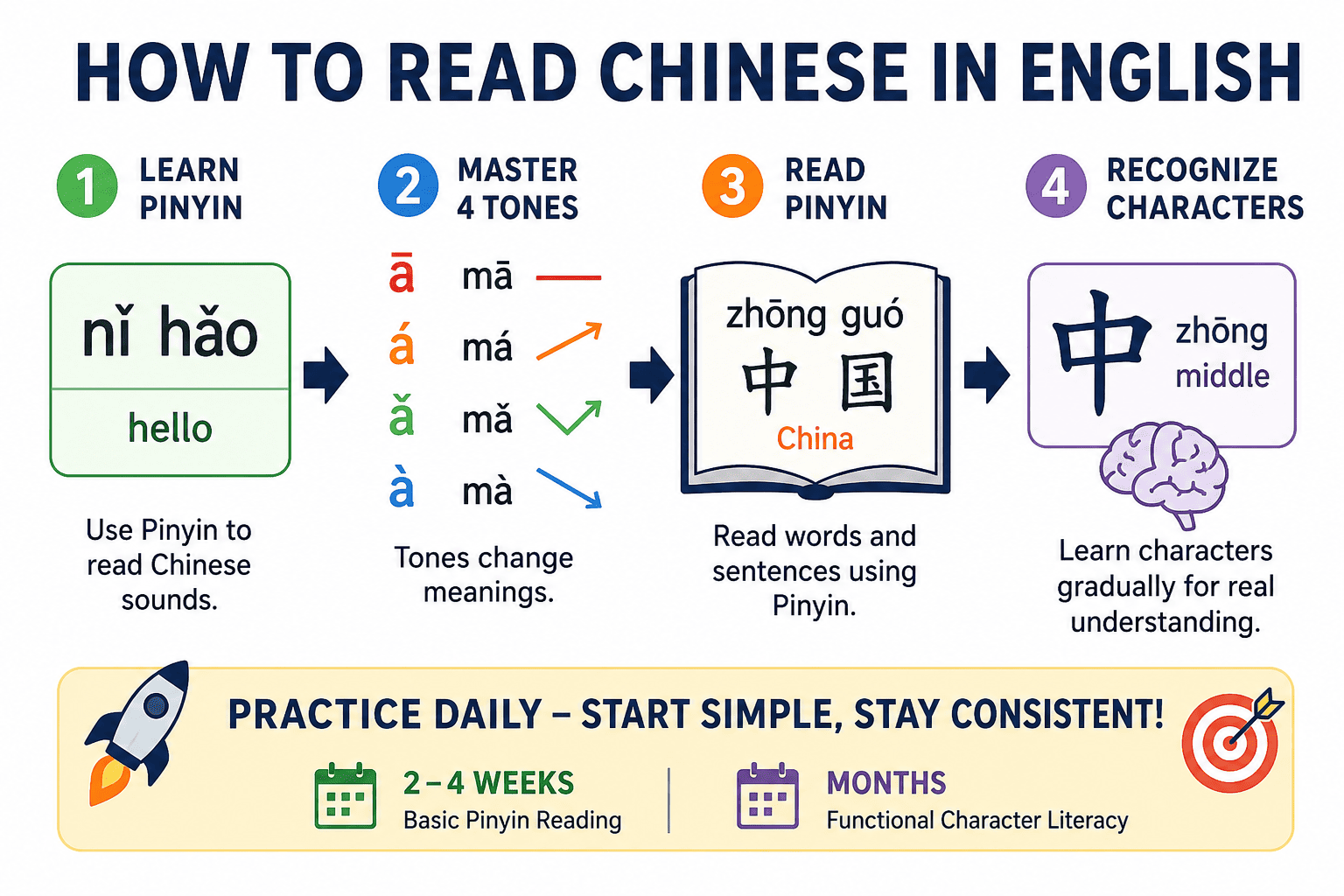
Learning to read Chinese as an English speaker might seem like an impossible challenge. The unfamiliar characters, tonal system, and completely different writing system can feel overwhelming. However, with the right approach, starting with Pinyin and gradually building character recognition, reading Chinese becomes an achievable and rewarding journey. This guide provides a proven pathway to Chinese literacy, combining practical strategies with systematic learning techniques.
Pinyin → Tones → Characters → Fluency. Master pronunciation first, then build character knowledge systematically. With consistent daily practice, English speakers can develop functional Chinese reading ability faster than ever before possible.
Pinyin (汉语拼音) is the official romanization system for Mandarin Chinese. Adopted in 1958, it uses the Latin alphabet to represent Chinese sounds, making pronunciation learnable for anyone familiar with Roman letters. Every Chinese character has a corresponding Pinyin spelling. Even native Chinese children learn Pinyin before characters, it’s used daily for typing on smartphones and computers, looking up words in dictionaries, and international communication.
Consonant sounds at syllable beginnings: b, p, m, f, d, t, n, l, g, k, h, j, q, x, zh, ch, sh, r, z, c, s.
Vowel or vowel-consonant combinations: a, o, e, i, u, ü, ai, ei, ui, ao, ou, iu, ie, üe, er, an, en, in, un, ün, ang, eng, ing, ong.
Tone marks above vowels indicate pitch patterns that distinguish word meanings. Same syllable + different tone = different word.
Pinyin is your essential bridge to spoken and written Chinese. It provides immediate pronunciation guidance while you build character recognition skills over time. Without Pinyin, beginners would have no way to know how to pronounce unfamiliar characters.
| Component | Description | Example |
|---|---|---|
| Initials | Consonant sounds at syllable beginning | b (like ‘p’ in ‘spot’), p (aspirated ‘p’), m, f |
| Finals | Vowel sounds at syllable end | a (like ‘ah’), o (like ‘or’), e (like ‘uh’) |
| Tones | Pitch patterns that change meaning | mā (mother), má (hemp), mǎ (horse), mà (scold) |
Several Pinyin sounds don’t exist in English, requiring focused practice. The letters c sounds like ‘ts’ in ‘cats’, q like ‘ch’ in ‘cheap’ but with tongue forward, x like ‘sh’ with tongue behind lower teeth. Pay special attention to these sounds as they are common in everyday Chinese.
zh, ch, sh, curl tongue back (retroflex)
z, c, s, tongue flat against teeth
j, q, x, tongue pressed against hard palate
e → sounds like ‘uh’ not long ‘e’
ui → sounds like ‘way’ not ‘wee’
ü → round lips while saying ‘ee’
✔ Confusing zh and z, retroflex vs. flat tongue
✔ Mispronouncing q as ‘k’, it’s closer to ‘ch’
✔ Forgetting the ü sound, round lips when saying ‘ee’
✔ Using English vowels instead of Chinese approximations
Tones are the most challenging aspect of Mandarin for English speakers. The same syllable with different tones creates entirely different words. For example: mā (mother 妈), má (hemp 麻), mǎ (horse 马), mà (scold 骂). Without correct tones, even simple sentences become incomprehensible to native speakers.
✅ Listen to tone pairs comparing different tones on the same syllable
✅ Record yourself speaking and compare with native pronunciations
✅ Use tone recognition apps that provide immediate feedback
✅ Practice exaggerating tones initially before naturalizing them
✅ Focus on tone patterns in two-syllable combinations
While Pinyin gives you pronunciation, authentic Chinese uses characters. No newspapers, books, or websites use Pinyin exclusively. Characters provide visual distinction that Pinyin cannot, the syllable shi corresponds to over 60 different characters! Learning characters is essential for real-world Chinese reading.
Components providing meaning clues. 妈 (mā – mother) combines 女 (woman radical) + 马 (mǎ – horse phonetic).
Create memorable stories connecting character appearance to meaning. Example: 休 (rest) = person 亻 + tree 木, a person resting against a tree.
Use apps like Anki, Pleco, or Skritter for optimized character review. Learn 5-10 new characters daily for sustainable progress.
| Character Learning Strategy | Why It Works |
|---|---|
| Start with high-frequency characters | The 500 most common characters cover ~75% of everyday written Chinese. |
| Learn by radical families | Related characters share components, making memorization systematic. |
| Practice writing characters | Muscle memory reinforces visual recognition. |
| Study in context | Learn characters within words and sentences, not in isolation. |
| Use simplified characters first | Fewer strokes than traditional, easier to write and recognize initially. |
Transitional materials show characters with Pinyin above them, allowing gradual weaning from romanization. Children’s books and graded readers provide controlled vocabulary at progressive difficulty levels. The key is to practice daily with materials at your level.
✅ Initially, read Pinyin for pronunciation
✅ Gradually shift focus to characters
✅ Use Pinyin only when uncertain
✅ Eventually cover Pinyin completely
✅ Learn 5-10 new characters with Pinyin
✅ Review 15-20 previously learned characters
✅ Read one short passage using target vocabulary
✅ Practice writing characters to reinforce memory
✔ Graded readers (HSK 1-6 levels) with Pinyin support
✔ Children’s picture books with simple vocabulary
✔ Bilingual texts with English translations
✔ News websites with Pinyin hover tools
✔ Social media posts in Chinese (Weibo, WeChat)
Pleco, dictionary with camera lookup, handwriting, flashcards
Anki / Skritter, spaced repetition for characters
DuChinese / The Chairman’s Bao, graded readers with Pinyin toggle
Type Pinyin on smartphone/computer, select characters from options. This reinforces character recognition while teaching which characters match which pronunciations.
Install Pinyin hover tools that display romanization when you mouse over Chinese text, perfect for reading websites independently.
| Challenge | Solution |
|---|---|
| Pinyin Dependency | Set progressive goals: read 1 sentence without Pinyin → then 1 paragraph → full passage. Cover Pinyin during practice sessions. |
| Tone Confusion | Focus on tone pairs in two-syllable words. Use apps with tone recognition feedback. Listen extensively to native content. |
| Character Overwhelm | Break into daily goals: 10 characters/day = 3,650/year. Celebrate milestones at 500, 1,000, and 2,000 characters. |
| Similar-looking characters | Compare pairs side-by-side. Note the distinguishing stroke. Create contrastive mnemonics. |
Reading Chinese is a marathon, not a sprint. Native speakers study characters throughout elementary and middle school. Start with Pinyin foundations, practice tones diligently, learn characters systematically, use technology strategically, and maintain consistent daily practice. These proven strategies help English speakers develop functional Chinese reading ability faster than ever before possible.
Learning to read Chinese through Pinyin provides a practical pathway to literacy that previously required years of character study before accessing authentic materials. Master Pinyin pronunciation including tones, use it as a bridge to character literacy, and combine both systems during the transitional period. Remember that reading Chinese is a marathon, not a sprint. Native speakers study characters throughout elementary and middle school. Start with Pinyin foundations, practice tones diligently, learn characters systematically, use technology strategically, and maintain consistent daily practice. These proven strategies help English speakers develop functional Chinese reading ability faster than ever before possible.
The journey to Chinese literacy is challenging but deeply rewarding. Every character you learn opens a door to a new world of understanding. Start small, stay consistent, and celebrate every milestone. You can do this, 加油 (jiāyóu)!
Master Pinyin, conquer the tones, and unlock the world of Chinese characters. With consistent practice and the right strategies, reading Chinese becomes achievable for any English speaker.
Explore More Language Guides → Try Our ToolsContinue your language learning journey with our guides on English phonetics, types of adjectives, and adjectives to describe yourself.

Belekar Sir is the founder and lead instructor at Belekar Sir’s Academy, a trusted name in English language education. With over a decade of teaching experience, he has helped thousands of students—from beginners to advanced learners—develop fluency, confidence, and real-world communication skills. Known for his practical teaching style and deep understanding of learner needs, Belekar Sir is passionate about making English accessible and empowering for everyone. When he’s not teaching, he’s creating resources and guides to support learners on their journey to mastering spoken English.