Quick Answer: Reading skills are the abilities to decode, comprehend, analyze, and interpret written text, from recognizing words to evaluating complex arguments. Writing skills are the abilities to compose clear, coherent, and effective written communication, from proper grammar and sentence structure to developing unique voice and persuasive arguments. Together, they form the foundation of literacy and reinforce each other in powerful, synergistic ways.
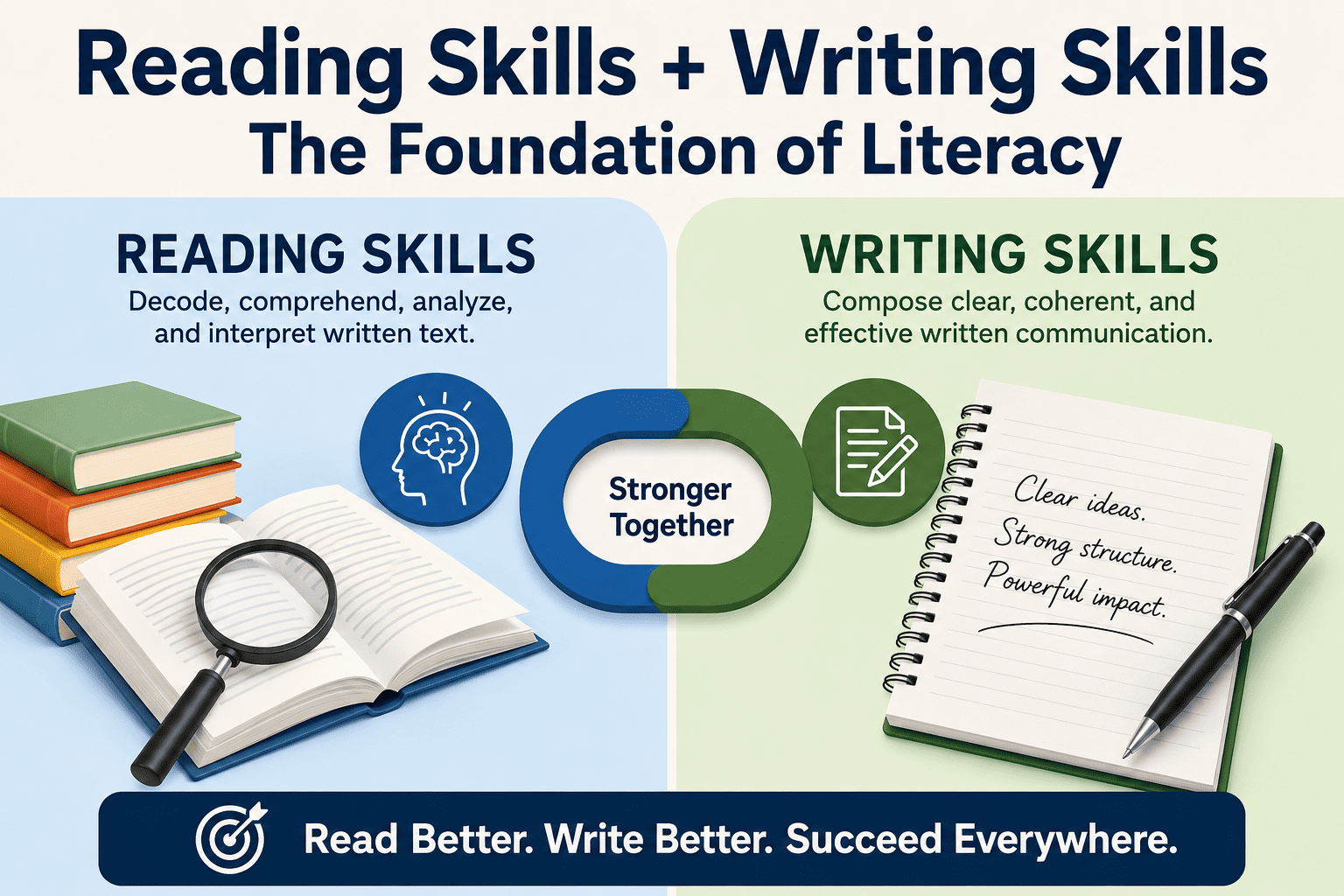
Reading is a complex cognitive process that integrates multiple skills working together seamlessly, from basic word recognition to sophisticated critical analysis.
Phonological awareness + phonics: breaking unfamiliar words into sounds and blending them together. The foundation of all reading.
Interpreting, analyzing, synthesizing, understanding not just words but relationships between ideas, inferences, and deeper meaning.
Reading accurately, at appropriate pace, with proper expression. Automatizing basics frees mental resources for comprehension.
Evaluating arguments, identifying bias, understanding metaphor, making connections, engaging deeply rather than passively absorbing.
| Type of Reading Skill | Description | Example Application |
|---|---|---|
| Literal Comprehension | Understanding explicit information directly stated | Identifying main characters or key facts |
| Inferential Reading | Drawing conclusions from implicit information | Understanding sarcasm or implied meanings |
| Evaluative Reading | Critically assessing content quality and validity | Analyzing author bias or argument strength |
| Appreciative Reading | Engaging emotionally and aesthetically with text | Connecting with characters or literary devices |
Writing demands active creation, coordinating numerous cognitive and physical processes. Strong writing transforms ideas into effective communication that resonates with readers.
Handwriting/keyboarding, spelling accuracy, punctuation, capitalization. These must become automatic to free cognitive resources for higher-level writing tasks.
Word choice, elaboration, clarity, organization, logical structure, translating thoughts into coherent written language.
Proper sentence structure, punctuation, eliminating run-ons and fragments. Essential for professional credibility and clarity.
Unique voice, adapting tone for audience, choosing appropriate style for purpose. What makes writing distinctly yours.
Vocabulary usage & word choice • Sentence variety & complexity • Paragraph organization & coherence • Logical flow of ideas • Research & synthesis • Editing & proofreading • Persuasive argumentation • Creative expression • Time management for writing tasks
Vocabulary Expansion, exposure to rich language in context builds your expressive range.
Text Structure Understanding, reading provides models for organization and genre conventions.
Grammar & Syntax Awareness, internalizing correct patterns through repeated exposure.
Creativity & Inspiration, reading offers frameworks for storytelling and rhetorical tactics.
Deeper Comprehension, writing about reading requires critical processing and synthesis.
Enhanced Decoding, spelling practice builds neural pathways that reinforce decoding.
Critical Engagement, understanding authorial choices makes you a more analytical reader.
Active Learning, transforms passive receiver into active meaning-maker.
| Area of Life | Impact of Strong Literacy |
|---|---|
| Academic Success | Consistently outperform peers across all subjects; effective learning across disciplines. |
| Professional Advancement | Competitive advantage; clear emails, proposals, and reports are essential in most fields. |
| Cognitive Development | Enhanced critical thinking, multiple perspectives, structured reasoning. |
| Emotional & Social | Journaling boosts well-being; reading builds empathy and self-awareness. |
| Practical Life Skills | Navigating contracts, medical info, instructions, self-advocacy in daily tasks. |
| Lifelong Learning | Fosters curiosity, independent learning, adaptation to new information and technologies. |
✅ Build phonemic awareness & systematic phonics
✅ Read widely across genres and topics daily
✅ Practice active reading (annotate, summarize, question)
✅ Discuss and analyze texts with others
✅ Gradually increase text complexity
✅ Use context clues and maintain vocabulary journals
✅ Start with strong sentence construction
✅ Write daily (journal, prompts, emails, creative pieces)
✅ Study mentor texts in your target genre
✅ Seek constructive feedback from peers or mentors
✅ Revise and edit in multiple passes
✅ Connect writing to real-world purposes
Analyze craft: vocabulary choices, sentence structures, organizational patterns, rhetorical strategies. Consider how to apply techniques in your own writing.
Write summaries, responses, analytical essays, or annotations about reading material. Deepens comprehension while practicing application of reading insights.
Write personal narratives about experiences, traditions, and perspectives. Stories make literacy personally meaningful and engaging.
Practice expanding basic sentences by adding details, modifiers, and complex structures. Builds both reading comprehension and writing variety.
| Challenge | Proven Solution |
|---|---|
| Poor decoding skills | Systematic phonics instruction; decodable texts; daily sound blending and segmentation practice. |
| Limited vocabulary | Extensive reading across topics; vocabulary journal with context sentences; use new words in writing. |
| Weak comprehension | Active reading strategies: preview, question, predict, summarize; build background knowledge before reading. |
| Writing organization | Graphic organizers and outlines; study mentor texts; start with clear topic sentences and supporting details. |
| Grammar & mechanics errors | Focus on one concept at a time; use editing checklists for personal common errors; read work aloud. |
| Lack of motivation | Connect to personal interests; choose engaging topics and genres; set achievable goals; celebrate progress. |
Access to vast libraries of digital texts • Interactive writing tools with immediate feedback • Collaborative writing and peer review • Multimedia integration for comprehension • Adaptive learning programs personalized to skill levels
Research shows handwriting practice strengthens neural pathways for literacy in ways typing cannot replicate. The physical act of forming letters supports reading development, memory, and idea generation. A balanced approach incorporating both handwriting and digital composition optimizes learning.
Keep diverse reading materials accessible • Provide comfortable spaces for reading and writing • Display writing materials to encourage spontaneous creation • Showcase writing to celebrate achievement.
Model reading and writing in daily life • Discuss books, articles, and ideas regularly • Value writing for authentic purposes • Celebrate creativity and individual voice • Normalize revision as part of the process.
Create safe spaces for risk-taking and experimentation • Provide constructive feedback focused on growth • Encourage persistence through challenges • Recognize literacy develops gradually • Support individual learning paths.
Strong reading and writing skills open doors to academic success, career advancement, and personal fulfillment. Start your literacy journey today with our comprehensive resources.
Explore All Literacy Guides →Reading and writing skills are far more than basic educational requirements, they are dynamic, interconnected abilities that empower individuals to communicate effectively, think critically, learn independently, and participate fully in society. From decoding simple words to crafting persuasive arguments, from understanding literal meanings to appreciating nuanced literature, these skills develop progressively throughout life. Start where you are, practice consistently, seek guidance when needed, and embrace the interconnected nature of reading and writing. The investment in literacy development pays dividends across every dimension of life.

Belekar Sir is the founder and lead instructor at Belekar Sir’s Academy, a trusted name in English language education. With over a decade of teaching experience, he has helped thousands of students—from beginners to advanced learners—develop fluency, confidence, and real-world communication skills. Known for his practical teaching style and deep understanding of learner needs, Belekar Sir is passionate about making English accessible and empowering for everyone. When he’s not teaching, he’s creating resources and guides to support learners on their journey to mastering spoken English.