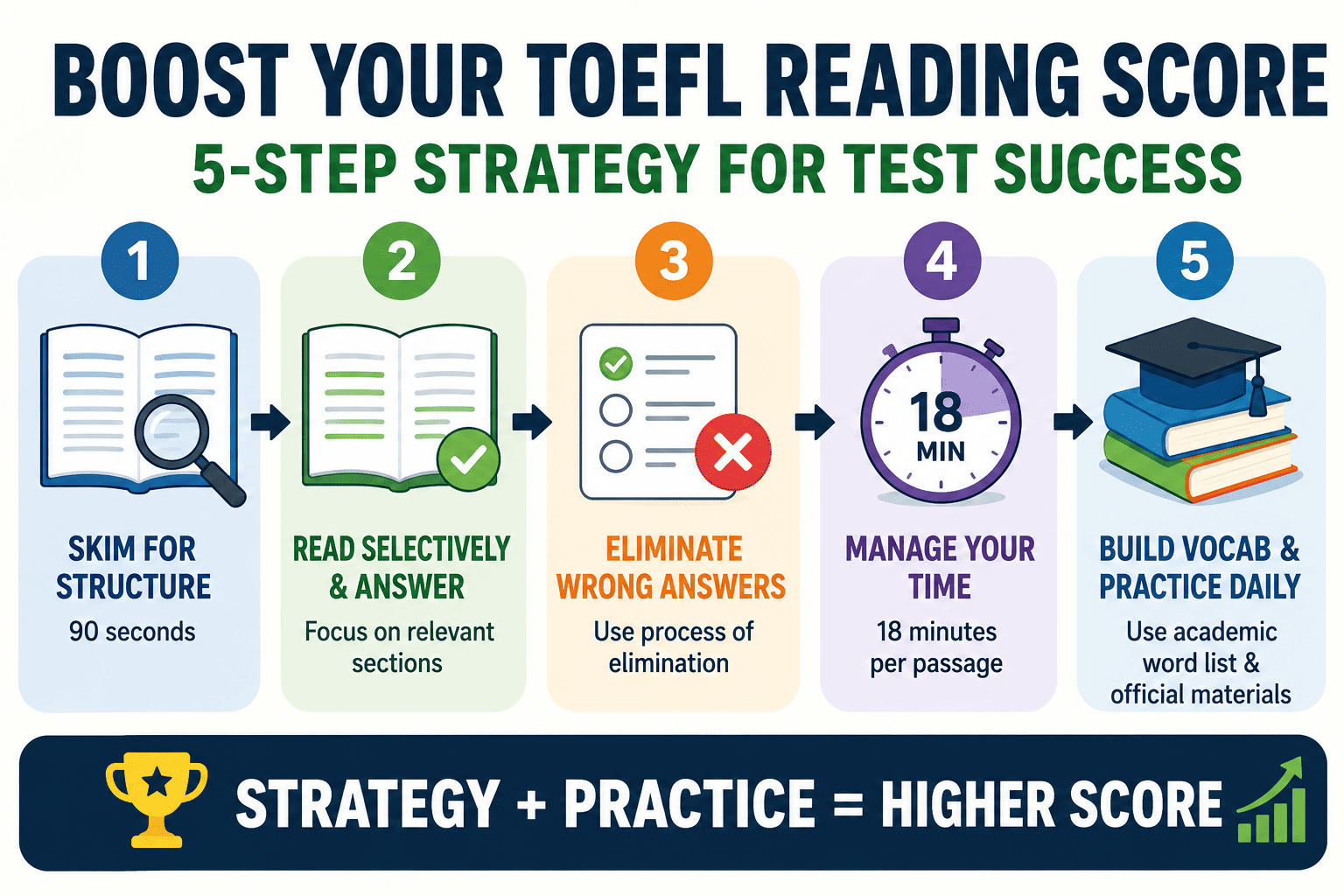
Quick Answer: Improve your TOEFL reading score by mastering the three-phase strategic approach: skim for structure (90 sec), then answer questions by reading relevant sections carefully, eliminating wrong answers systematically. Focus on time management, 18 minutes per passage, with specific targets per question type. Build academic vocabulary from the Academic Word List and practice daily with official materials.
You sit down at your computer, confident after weeks of preparation. The TOEFL reading section begins, and suddenly, the clock becomes your enemy. Dense academic passages blur together, questions feel deliberately tricky, and before you know it, time runs out with unanswered questions staring back at you. Sound familiar?
Thousands of test takers face this exact scenario every year. The TOEFL reading portion tests far more than your ability to understand English, it demands speed, precision, strategic thinking, and mental stamina under pressure. A single point can make the difference between acceptance and rejection from your target university.
The good news? The TOEFL reading section follows predictable patterns. Once you understand how the test works, which strategies actually improve scores, and how to practice effectively, you can transform your performance dramatically. This comprehensive guide provides battle-tested techniques that have helped countless students boost their reading scores.
The TOEFL reading section consists of two passages, each approximately 700 words long, drawn from academic texts you might encounter in university courses. Topics cover natural sciences, social sciences, arts, and humanities.
Following each passage, you will answer ten questions. The entire section must be completed in 36 minutes, meaning you have roughly 18 minutes per passage including reading time and answering all questions.
Vocabulary questions • Factual information questions • Negative factual information • Inference questions • Rhetorical purpose • Sentence simplification • Text insertion • Summary and table questions
The single biggest mistake test takers make is trying to read TOEFL passages the same way they read novels. This wastes precious time and overwhelms your working memory.
Read intro paragraph completely, first sentence of each body paragraph, and conclusion. Build a mental map of where information lives.
Read each question first, then return to the relevant passage section. Most questions follow chronological order.
Systematically eliminate wrong answers rather than hunting for the correct one. This dramatically improves accuracy.
Wrong answers follow predictable patterns: information mentioned but not answering the question, logical statements not supported by the text, small factual errors, or extreme language like “always” or “never.” Learn to spot these quickly.
| Question Type | Key Strategy | Time Target |
|---|---|---|
| Vocabulary | Use context, read surrounding sentences, substitute each choice | ≤60 sec |
| Factual Information | Locate keywords in passage, verify exact wording matches | 90 sec |
| Negative Factual | Check each choice against passage; correct answer is NOT mentioned | ≤2 min |
| Inference | Find what logically follows, small step, not giant leap | 90 sec |
| Rhetorical Purpose | Ask “why” the author includes this information, not “what” it says | 90 sec |
| Sentence Simplification | Identify core meaning; wrong answers change or omit essential info | ≤2 min |
| Text Insertion | Check pronouns and connecting words for logical flow | ≤2 min |
| Summary/Table | Eliminate too-specific details; worth more points | 2.5 min |
If you spend 90 seconds on a question and still feel uncertain, make your best guess and move forward. Do not skip questions planning to return, research shows first instincts are usually correct, and returning doubles the time investment.
The Academic Word List (AWL) contains 570 word families that appear frequently in academic texts across all disciplines. Words like analyze, concept, interpret, significant, circumstance appear repeatedly on the TOEFL.
Don’t just memorize definitions. Learn words in context, study synonyms and antonyms together, and pay attention to collocations, words that commonly appear together (e.g., “significant impact,” “statistically significant”).
Active reading means engaging with the text rather than passively absorbing words. Make predictions, ask questions continuously, visualize information, and summarize each paragraph in one sentence. Notice transition words like however, furthermore, consequently, they signal how ideas relate.
Spending too long on difficult questions leaves insufficient time for easier ones. All questions have equal value.
The TOEFL rewards straightforward reading, not creative interpretation. If you’re making complex arguments, stop.
Answer based on passage content, not what you personally know. If the passage contradicts common knowledge, go with the passage.
Choosing answers because they contain words from the passage, even when overall meaning differs.
First instincts are usually correct. Only change if you find clear evidence your first choice was wrong.
Trying to understand and remember every detail wastes time. You can return to the passage when answering questions.
Take a full-length practice test under exact conditions. Focus on review rather than new material. Reduce practice volume in the final days to arrive fresh.
Do no TOEFL practice. Relax, sleep at least 8 hours, and prepare everything you need for test day.
Eat a nutritious breakfast. Arrive early. Take deep breaths. Trust your preparation.
You’ve spent weeks or months building your skills. The TOEFL reading section is challenging, but it is also predictable and conquerable. With the right strategies and sufficient practice, you can achieve the score you need. Your dream of studying abroad is within reach, now go make it happen.
Explore more test preparation resources and vocabulary tools at Belekar Sir’s Academy.
Browse All Articles → Try Our ToolsImproving your TOEFL reading score requires more than simply reading English text. It demands strategic thinking, efficient time management, systematic vocabulary building, active reading skills, and targeted practice that addresses your specific weaknesses.
The strategies in this guide have helped thousands of students transform their reading performance. You now know how to approach each passage strategically, how to tackle every question type efficiently, and how to manage your time so you complete all questions confidently.
Start today. Implement one or two strategies from this guide during your next reading practice. Notice what works and what needs adjustment. Build your skills systematically through daily practice. Improvement happens gradually, trust the process, stay committed, and maintain confidence in your ability to improve.
Continue improving your English skills with our guides on nouns used as adjectives, positive adjectives for husbands, and adjectives for mom.

Belekar Sir is the founder and lead instructor at Belekar Sir’s Academy, a trusted name in English language education. With over a decade of teaching experience, he has helped thousands of students—from beginners to advanced learners—develop fluency, confidence, and real-world communication skills. Known for his practical teaching style and deep understanding of learner needs, Belekar Sir is passionate about making English accessible and empowering for everyone. When he’s not teaching, he’s creating resources and guides to support learners on their journey to mastering spoken English.