Complete Guide to Chinese Christmas Vocabulary: 100 Essential Words and Phrases
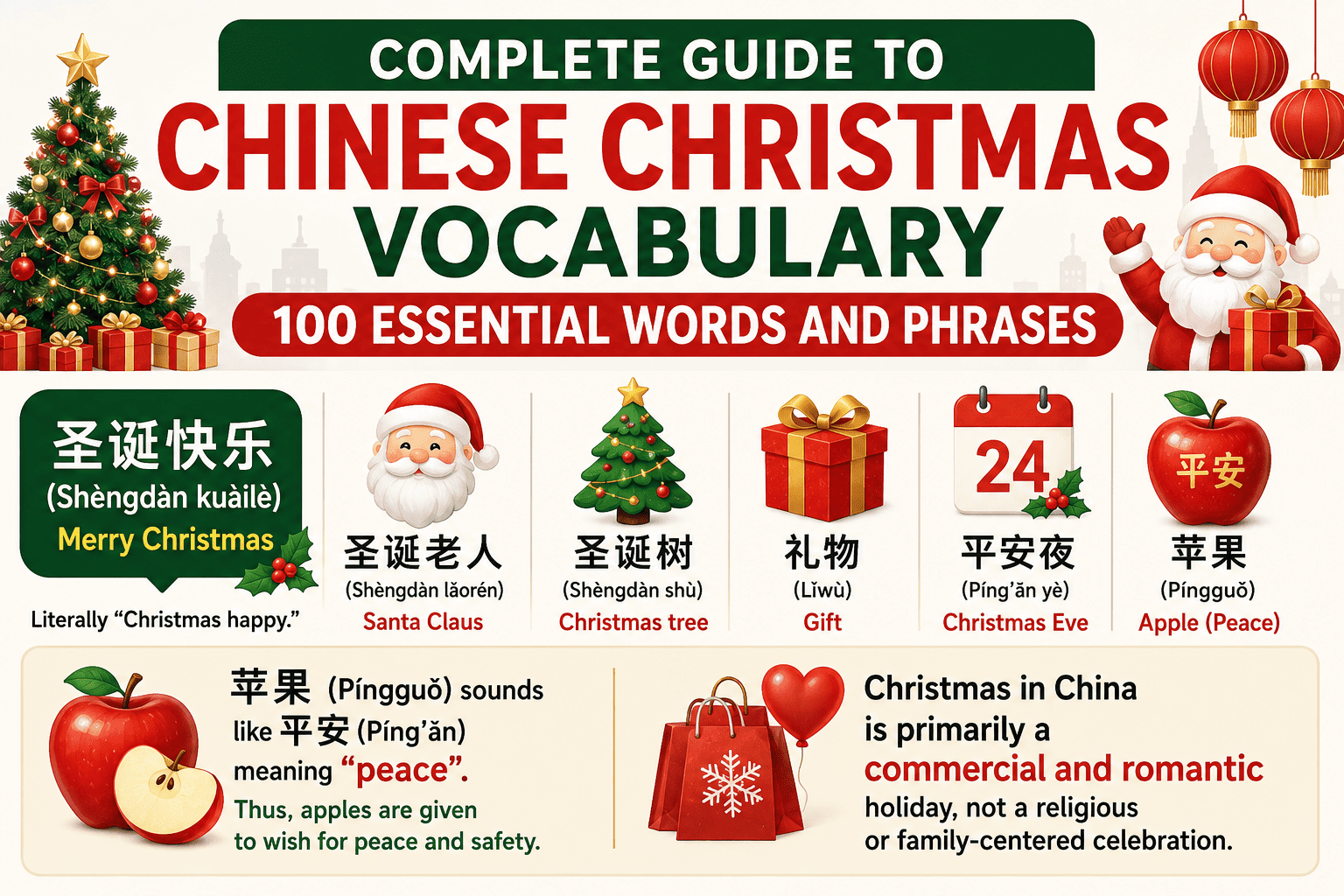
Quick Answer: The most common way to say “Merry Christmas” in Chinese is 圣诞快乐 (Shèngdàn kuàilè) — literally “Christmas happy.” Key vocabulary includes 圣诞老人 (Santa Claus), 圣诞树 (Christmas tree), 礼物 (gift), 平安夜 (Christmas Eve), and the uniquely Chinese tradition of giving 苹果 (apples) because 苹果 sounds like 平安 (peace). Christmas in China is primarily a commercial and romantic holiday, not a religious or family-centered celebration.
Essential Christmas Greetings in Chinese
🎄 Core Christmas Greeting
圣诞快乐 (Shèngdàn kuàilè) — Merry Christmas
圣诞 = holy birth (Christmas), 快乐 = happy/joyful
Literal translation: “Christmas happy” — follows standard Chinese grammar where descriptive elements come after nouns.
📝 Extended Greetings
圣诞节快乐 (Shèngdàn jié kuàilè) — Merry Christmas (more formal, adds 节 = festival)
新年快乐 (Xīnnián kuàilè) — Happy New Year (Western New Year, Jan 1)
祝你节日快乐 (Zhù nǐ jiérì kuàilè) — Wishing you happy holidays (inclusive greeting)
✨ Adding Personal Touch
祝你圣诞快乐 (Zhù nǐ Shèngdàn kuàilè) — I wish you a Merry Christmas
祝你和家人 (Zhù nǐ hé jiārén) — Wishing you and your family
致以节日的问候与温馨的祝福 (Zhì yǐ jiérì de wènhòu yǔ wēnxīn de zhùfú) — Season’s greetings and warm wishes (formal)
Characters and Figures
Decorations and Objects
Food and Treats
Activities and Traditions
Gifts and Presents
Weather and Nature
Religious and Traditional Concepts
On Christmas Eve (平安夜 Píng’ān yè — “Peaceful Night”), Chinese people give apples (苹果 píngguǒ) because the word for apple sounds similar to 平安 (peace/safety). This tradition symbolizes wishing someone peace and safety for the coming year. Apple prices spike during Christmas week as demand surges.
Pronunciation Guide & Tones
| Tone | Mark | Description | Example |
|---|---|---|---|
| First tone | āHigh, level pitch圣诞 (shèng — fourth tone)|||
| Second tone | áRising pitch (like asking a question)人 (rén)|||
| Third tone | ǎDips low then rises老 (lǎo)|||
| Fourth tone | àSharp falling pitch快乐 (kuài — fourth tone)
x in 雪 (xuě) — sounds like English “sh” with tongue further forward.
zh in 祝福 (zhùfú) — similar to English “j” but with retroflex tongue position.
ue in 快乐 (kuàilè) — round lips while pronouncing the vowel.
Practice with native audio and record yourself for comparison.
Cultural Context: Christmas in China
🎄 Commercial Rather Than Religious
Christmas in China functions primarily as a commercial and social celebration. Department stores transform into winter wonderlands, shopping malls host Santa appearances, and businesses run major sales events. Young people embrace Christmas as a romantic holiday similar to Valentine’s Day — couples exchange gifts, enjoy nice dinners, and attend Christmas-themed events together.
📅 Christmas as a Working Day
Despite widespread celebrations, Christmas is not a national holiday in China. December 25th remains a regular working day. Only international companies or foreign schools typically give employees the day off. Celebrations concentrate on Christmas Eve (December 24th evening).
📍 Regional Variations
Major metropolitan areas (Beijing, Shanghai, Guangzhou, Shenzhen) embrace Christmas most enthusiastically. Hong Kong and Taiwan, with longer Western cultural influence, celebrate more traditionally with extensive decorations and religious services.
Practical Conversation Examples
A: 圣诞节快到了,你准备好庆祝了吗?(Shèngdàn jié kuài dào le, nǐ zhǔnbèi hǎo qìngzhù le ma?) — Christmas is coming soon, have you made your plans?
B: 还在准备呢,我打算买一棵圣诞树,还要买一些装饰品。你呢?(Hái zài zhǔnbèi ne, wǒ dǎsuàn mǎi yī kē shèngdàn shù, hái yào mǎi yīxiē zhuāngshì pǐn. Nǐ ne?) — I’m still preparing. I plan to get a Christmas tree and some decorations. What about you?
A: 你知道中国人平安夜送苹果吗?(Nǐ zhīdào Zhōngguó rén píng’ān yè sòng píngguǒ ma?) — Do you know Chinese people give apples on Christmas Eve?
B: 知道!因为苹果的发音和平安很像。(Zhīdào! Yīnwèi píngguǒ de fāyīn hé píng’ān hěn xiàng.) — Yes! Because the pronunciation of apple sounds similar to peace.
Learning Tips & Card Writing
Spaced repetition: Review new vocabulary at increasing intervals (1 day, 3 days, 1 week, 1 month).
Create personal connections: Associate 礼物 (gift) with a meaningful present you received.
Practice through multiple channels: Write characters, speak phrases aloud, listen to native audio, use words in conversation.
Immerse in Chinese holiday content: Watch Christmas advertisements, read social media posts, listen to Mandarin carols.
Basic structure: 亲爱的 [name] (Dear…), 圣诞快乐!(Merry Christmas!), 祝你和家人幸福安康 (Wishing you and your family happiness and health), [Your name].
Frequently Asked Questions
Master Mandarin Vocabulary
Explore more Chinese language guides, vocabulary lessons, and cultural resources at Belekar Sir’s Academy.
Browse All Articles → Try Our ToolsRelated Articles You’ll Love
Conclusion: Spread Holiday Cheer in Chinese
Mastering Chinese Christmas vocabulary opens doors to cultural connection and language practice during one of the year’s most joyful seasons. The 100+ words and phrases in this guide provide comprehensive coverage from basic greetings like 圣诞快乐 (Shèngdàn kuàilè) to detailed descriptions of decorations, food, activities, and uniquely Chinese traditions like giving apples on Christmas Eve. The logical structure of Chinese vocabulary building — where Santa Claus becomes “Christmas old person” and snowman becomes “snow person” — reveals the elegant efficiency of the language. Whether you’re writing holiday cards, texting Christmas wishes, or discussing holiday plans, you now possess the vocabulary and cultural knowledge needed for confident communication. 圣诞快乐 from all of us to you and yours!
Continue your Mandarin journey with our guides on how to improve English speaking, adjectives to describe a friend, and list of adjectives for students.

Belekar Sir is the founder and lead instructor at Belekar Sir’s Academy, a trusted name in English language education. With over a decade of teaching experience, he has helped thousands of students—from beginners to advanced learners—develop fluency, confidence, and real-world communication skills. Known for his practical teaching style and deep understanding of learner needs, Belekar Sir is passionate about making English accessible and empowering for everyone. When he’s not teaching, he’s creating resources and guides to support learners on their journey to mastering spoken English.