The holiday season brings natural excitement and curiosity to classrooms, creating an ideal environment for vocabulary development. A Christmas vocabulary wordwall transforms this seasonal enthusiasm into meaningful learning opportunities while keeping students engaged during one of the most distracting times of the school year.
Word walls are proven literacy tools that provide constant visual reinforcement of vocabulary. When themed around Christmas, they become even more powerful by connecting new language to topics students find inherently interesting. Children encounter these festive words repeatedly through decorations, songs, stories, and family traditions, making them relevant and memorable.
This comprehensive guide provides everything educators and parents need to create and implement an effective Christmas vocabulary wordwall. You will discover curated word lists organized by difficulty level, practical setup strategies, engaging activities that bring words to life, and assessment techniques that measure vocabulary growth. Whether you teach preschoolers learning their first holiday words or upper elementary students exploring complex seasonal concepts, this resource will help you maximize the educational potential of Christmas vocabulary instruction.
What Is a Christmas Vocabulary Wordwall
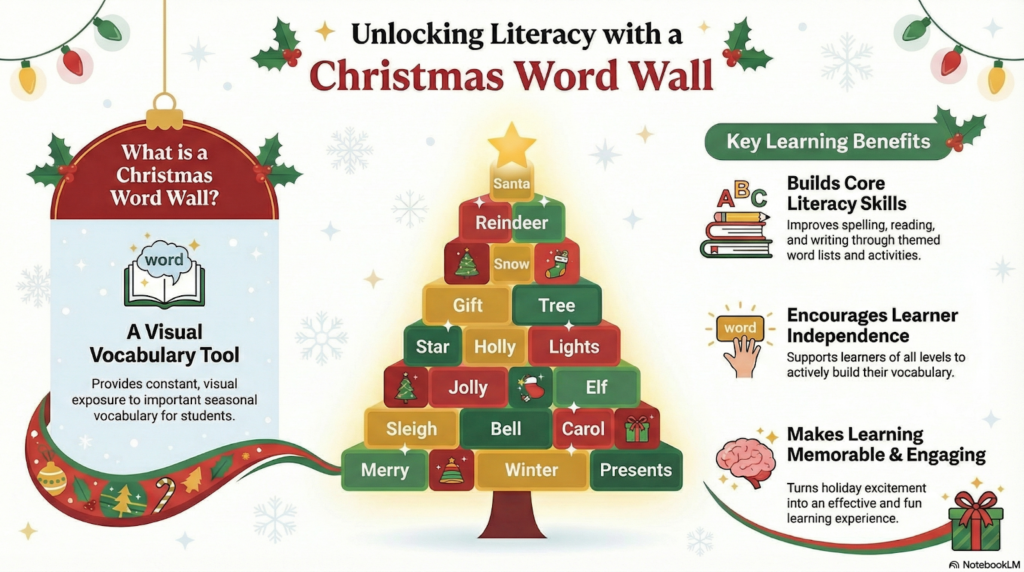
A Christmas vocabulary wordwall is a carefully curated display of holiday-themed words arranged in a designated classroom space to support literacy development. Unlike random decorations, word walls serve as functional teaching tools that students reference during reading, writing, and speaking activities throughout December.
Core Components
Effective Christmas word walls include printed word cards featuring clear, large text that students can read from their seats. Most teachers use cards measuring between 5 and 8 inches to ensure visibility. The words typically appear in easy-to-read fonts, often accompanied by relevant images or icons that help younger learners connect written words to their meanings.
Organization matters significantly in word wall effectiveness. Teachers typically arrange words alphabetically to support dictionary skills and word-finding abilities. Alternative arrangements include grouping by category such as decorations, traditions, characters, and activities. Some educators use color coding to distinguish between word types or difficulty levels.
Educational Purpose
Word walls function as reference tools during independent work, writing centers, and reading activities. When students need to spell ornament or describe a tradition, they glance at the word wall rather than interrupting their workflow to ask for help. This builds independence while ensuring correct spelling and expanding vocabulary options.
The constant visibility creates multiple exposures to each word without requiring direct instruction time. Students subconsciously absorb spelling patterns, word structures, and meanings through repeated visual contact with the display throughout their school day.
Essential Christmas Vocabulary Word Lists
Building an effective Christmas wordwall requires selecting vocabulary that balances familiarity with challenge while representing diverse aspects of the holiday. These curated lists organize 100 essential Christmas words by complexity level and thematic category.
Beginner Level Words (Ages 4-6)
These foundational words introduce young learners to basic Christmas concepts with simple spelling patterns and familiar objects.
| Category | Words |
| Decorations | tree, star, bell, light, bow |
| Colors | red, green, gold, white, silver |
| Characters | Santa, elf, angel, snowman |
| Actions | give, sing, wish, wrap, hang |
| Objects | gift, toy, card, sock, hat |
Intermediate Level Words (Ages 7-9)
Intermediate vocabulary introduces more specific terminology and slightly longer words that build on foundational knowledge.
| Category | Words |
| Decorations | ornament, wreath, garland, tinsel, ribbon, stocking, mistletoe |
| Characters | reindeer, Rudolph, Mrs. Claus, shepherd, wise men |
| Traditions | caroling, celebration, tradition, festival, parade |
| Food | cookies, candy cane, gingerbread, fruitcake, eggnog |
| Activities | decorate, celebrate, caroling, baking, shopping |
| Nature | snowflake, icicle, pinecone, evergreen, holly |
Advanced Level Words (Ages 10-12)
Advanced vocabulary challenges older students with complex terms, compound words, and abstract concepts related to Christmas celebrations.
| Category | Words |
| Religious | Nativity, manger, Bethlehem, frankincense, myrrh, advent, Christmas Eve |
| Abstract Concepts | generosity, gratitude, goodwill, merriment, rejoicing, anticipation |
| Specific Terms | poinsettia, frankincense, myrrh, sleigh, chimney, workshop |
| Traditions | commemoration, festivity, pageant, procession, midnight mass |
| Descriptive | glistening, twinkling, festive, merry, joyous, magical |
Specialized Vocabulary Categories
Christmas Around the World Feliz Navidad, Noel, Hanukkah, Kwanzaa, Boxing Day, Epiphany, Three Kings Day, Yule, Winter Solstice, Las Posadas
Sensory Descriptions fragrant, aromatic, sparkling, shimmering, cozy, warm, bright, sweet, crunchy, soft
Action Words unwrapping, preparing, gathering, sharing, delivering, trimming, illuminating, nestling, roasting, toasting
Subject-Specific Vocabulary
Teachers can extend word walls across curriculum areas by including Christmas vocabulary relevant to different subjects.
Math Terms: dozen, half, quarter, measurement, symmetry, pattern, calendar, budget
Science Words: evergreen, deciduous, hibernate, migration, winter, temperature, frost, crystallization
Social Studies Concepts: culture, tradition, heritage, custom, celebration, community, family, giving
Setting Up Your Christmas Wordwall
Creating an effective Christmas vocabulary wordwall requires thoughtful planning regarding placement, materials, and visual design. These practical steps ensure your word wall becomes a valuable learning tool rather than just decorative filler.
Location and Placement
Choose a wall space that remains visible throughout instruction time. Avoid placing word walls behind teacher desks, inside cabinets, or in corners where furniture blocks visibility. The ideal location allows students to reference words from their seats during writing activities without craning their necks or standing up.
Consider height carefully. Word cards should sit at student eye level when they are seated at their desks. This typically means positioning the bottom edge of the display between 3 and 4 feet from the floor for elementary classrooms. Adjust higher or lower based on your specific student population and furniture arrangement.
Ensure adequate lighting reaches the word wall area. Words positioned in shadowy corners or against windows with glare become difficult to read, reducing their educational value. If necessary, add a small lamp or reposition existing lighting to illuminate the display properly.
Materials and Design
Select card stock or laminated paper for durability since word walls remain displayed for several weeks. White or light-colored backgrounds with dark text provide maximum contrast and readability. Fancy fonts might look festive but often reduce legibility from a distance. Stick with clear, simple fonts like Arial, Century Gothic, or Comic Sans for younger students.
Size matters significantly for visibility. Cards measuring 5 by 8 inches work well for most elementary classrooms. Larger spaces or rooms with distant seating may require 8 by 10-inch cards. Test visibility by placing a sample card on the wall and checking whether students in the back corners can read it easily.
Include simple, clear images alongside words for younger learners or English language learners. A small picture of a reindeer next to the word helps create mental connections between symbols and meanings. Avoid cluttered or overly detailed illustrations that distract from the word itself.
Organization Systems
Alphabetical arrangement remains the most practical organization method for elementary students who are learning dictionary skills. Create sections for each letter, leaving room to add words as the unit progresses. Some teachers use different colored paper for vowel and consonant letters to reinforce phonics concepts.
Categorical organization works well for thematic units where students need to find related words quickly. Create distinct sections for Characters, Decorations, Traditions, Food, and Activities. Use borders, background colors, or labels to clearly distinguish between categories.
Consider creating a two-tier system with a permanent classroom word wall and a seasonal addition. Keep high-frequency words and commonly used vocabulary on the main wall year-round, then add a Christmas supplement that can be easily removed in January without dismantling your entire word wall structure.
Digital Word Wall Options
Virtual learning environments or technology-rich classrooms can implement digital word walls using presentation software, interactive whiteboards, or learning management systems. Create slides with one word per page, allowing you to display different sections during various activities.
Digital formats offer advantages including easy updating, the ability to include audio pronunciation, and links to definitions or example sentences. Students can access digital word walls from home during virtual learning or homework sessions. Tools like Google Slides, Padlet, or Wakelet work well for creating shareable digital word walls.
Maintain both physical and digital versions when possible. The constant physical presence of a traditional word wall provides different learning benefits than digital versions that require active searching or clicking.
Interactive Activities Using Christmas Vocabulary
Transforming word walls from passive displays into active learning tools requires intentional activities that engage students with the vocabulary repeatedly in varied contexts. These research-backed strategies work across different age groups and learning styles.
Daily Word Wall Rituals
Word of the Day Focus Each morning, select one Christmas vocabulary word for deep exploration. Display it prominently, discuss its meaning, identify its syllables, find rhyming words, and use it in multiple sentences. Students create illustrations, write stories, or find examples of the word in holiday books throughout the day.
Quick Recognition Games Spend three to five minutes during transitions having students locate words based on clues. Say words like find a word that starts with R and means a large deer with antlers or locate the longest word on our word wall. This builds automatic recognition and keeps vocabulary fresh in students’ minds.
Morning Message Integration Incorporate word wall vocabulary into your daily morning message or agenda. Underline or highlight the Christmas words appearing in the message and have students identify them during morning meeting. This demonstrates authentic word usage in context.
Writing Activities
Seasonal Story Starters Provide story prompts that require students to incorporate specific numbers of word wall vocabulary. For example, write a story about a lost ornament using at least eight words from our Christmas word wall. This encourages creative writing while building vocabulary application skills.
Word Wall Writing Challenges Create timed challenges where students write as many sentences as possible using different word wall words. Award points for correct spelling, proper usage, and creative combinations. This gamification motivates students to engage with vocabulary while building fluency.
Personal Christmas Dictionaries Have students create individual vocabulary notebooks where they copy word wall words, add definitions in their own words, draw illustrations, and write example sentences. This personal reference tool supports differentiated learning since students can include additional words that interest them.
Reading Integration
Word Hunts in Holiday Literature During read-alouds of Christmas books, have students listen for word wall vocabulary. Keep a tally of how many times each word appears across different texts. This builds awareness of high-frequency seasonal vocabulary and reinforces recognition in context.
Prediction Activities Before reading a new Christmas story, have students predict which word wall words might appear in the book based on the cover and title. After reading, verify predictions and discuss why certain vocabulary fit the story while others did not.
Kinesthetic and Game-Based Learning
Word Wall Relay Races Divide the class into teams. Call out a word and have one student from each team race to touch the correct word card on the wall. The first student to reach it wins a point for their team. This physical activity breaks up sedentary instruction while reinforcing word recognition.
Four Corners Vocabulary Assign a Christmas category to each corner of the room such as decorations, characters, food, and traditions. Call out word wall words and have students move to the corner representing that word’s category. This combines movement with categorical thinking and vocabulary reinforcement.
Christmas Charades Students draw word wall vocabulary cards and act them out without speaking while classmates guess. This works particularly well with action words and concrete nouns. The physical representation helps cement meaning and creates memorable learning experiences.
Word Wall Bingo Create bingo cards featuring Christmas vocabulary from the word wall. Call out definitions, show pictures, or give clues instead of saying the words directly. Students must identify the correct word on their card and mark it. First to complete a row wins.
Technology-Enhanced Activities
Digital Matching Games Use free platforms like Wordwall or Quizlet to create digital matching games, flashcards, or quiz-style activities using your word wall vocabulary. Students can practice independently on computers or tablets during centers or at home.
Voice Recording Practice Have students use tablets or computers to record themselves reading word wall words, defining them, and using them in sentences. This builds fluency and allows for self-assessment as students listen to their recordings and identify areas for improvement.
QR Code Scavenger Hunts Create QR codes that link to images, definitions, or audio pronunciations of word wall words. Post codes around the classroom and have students scan them with devices, match them to the correct word wall card, and complete related tasks.
Multi-Sensory Learning
Tactile Word Building Provide magnetic letters, letter tiles, or letter stamps for students to physically construct word wall vocabulary. The tactile experience reinforces spelling patterns and builds muscle memory for letter sequences.
Playdough Word Formation Students roll playdough into letter shapes to spell Christmas vocabulary words from the word wall. This combines fine motor skill development with spelling practice in an engaging, low-pressure format.
Rainbow Writing Have students trace word wall words multiple times using different colored pencils or crayons. The repetition builds automaticity while the color variation maintains engagement and creates visually appealing final products.
Assessment and Progress Monitoring
Measuring vocabulary acquisition ensures your Christmas wordwall achieves educational objectives beyond simply decorating your classroom. These assessment strategies provide concrete data about student learning while maintaining the joy of seasonal activities.
Informal Assessment Methods
Observation Checklists Create simple charts listing all word wall vocabulary down one side and student names across the top. During writing activities, reading time, and class discussions, note when students correctly use, read, or spell Christmas words. This ongoing documentation reveals patterns in vocabulary acquisition without formal testing.
Work Sample Analysis Review student writing samples from various activities throughout the Christmas unit. Highlight instances where students correctly incorporated word wall vocabulary independently. Track growth by comparing early December writing with later samples to see vocabulary expansion and spelling improvement.
Oral Language Monitoring During show and tell, class discussions, or small group activities, listen for students using Christmas vocabulary appropriately in speech. Note which words transfer naturally into oral language versus which remain confined to written activities. This reveals depth of understanding beyond simple memorization.
Formal Assessment Options
Weekly Spelling Tests Select 5 to 10 word wall words each week for traditional spelling assessments. Include a mix of words at different difficulty levels to appropriately challenge all learners. Consider providing word banks for students who struggle with recall while still assessing recognition and copying skills.
Vocabulary Matching Tests Create assessments where students match word wall vocabulary to pictures, definitions, or example sentences. This tests comprehension beyond spelling ability and works well for English language learners or students with spelling difficulties.
Writing Prompts with Required Vocabulary Assign writing tasks that require students to use specific numbers of word wall words correctly in context. Provide a Christmas-themed prompt and a list of 6 to 8 words students must incorporate. This assesses both vocabulary knowledge and application skills.
Differentiated Assessment Approaches
Tiered Assessment Options Offer different assessment levels based on student readiness. Provide word banks for struggling students, moderate difficulty words for on-level learners, and advanced vocabulary with contextual application requirements for advanced students. All students engage with Christmas vocabulary at appropriate challenge levels.
Alternative Demonstration Methods Allow students to demonstrate vocabulary knowledge through various formats including oral presentations, illustrated dictionaries, recorded explanations, or dramatic performances. This accommodates different learning styles and abilities while still measuring vocabulary mastery.
Self-Assessment Tools Teach students to evaluate their own progress with Christmas vocabulary using simple checklists or rating scales. Questions like can I spell this word correctly, do I know what it means, can I use it in a sentence, and have I used it in my writing help students develop metacognitive awareness about their vocabulary growth.
Using Assessment Data
Track which words prove most challenging across your class and provide additional instruction, visual supports, or practice opportunities for those terms. If most students struggle with words like frankincense or poinsettia, incorporate more activities specifically targeting those vocabulary items.
Identify students requiring intervention by noting those who consistently score below 70 percent on vocabulary assessments or who rarely use word wall vocabulary independently. Provide small group support, peer tutoring, or additional practice materials for these learners.
Celebrate growth rather than just accuracy by recognizing students who show improvement even if they have not mastered all vocabulary. Acknowledging progress motivates continued effort and builds confidence in developing readers and writers.
Differentiation Strategies for All Learners
An effective Christmas vocabulary wordwall serves every student in your diverse classroom through intentional differentiation that meets varied needs without creating separate displays for different ability levels.
Supporting Struggling Readers
Position high-frequency and personally relevant words at eye level where struggling readers can easily locate them. Move more challenging vocabulary slightly higher on the display. This creates a hierarchy that helps developing readers find the words they need most often without feeling overwhelmed by difficult terms.
Include picture supports consistently for concrete nouns. A small, clear image of a stocking next to the word provides crucial context clues for students who cannot yet decode independently. Avoid clipart that might be culturally specific or unfamiliar to some students.
Create personal word rings or mini word walls for students who benefit from individualized support. Print smaller versions of the most essential vocabulary on index cards, punch a hole in the corner, and connect with a ring. Students keep these at their desks for immediate reference during independent work.
Provide letter tiles or magnetic letters during word wall activities so students can physically manipulate letters to spell words rather than writing them. This reduces the cognitive load and allows focus on word structure and spelling patterns rather than letter formation.
Challenging Advanced Learners
Add extended vocabulary beyond basic Christmas words for students ready for greater challenge. Include terms like iridescent, evergreen, coniferous, or hibernation that connect to science concepts. Advanced students can research these words independently and teach them to classmates.
Require advanced students to use word wall vocabulary in more sophisticated ways such as writing complex sentences, incorporating multiple vocabulary words per sentence, or using words figuratively. Challenge them to find synonyms or antonyms for word wall words and explain subtle meaning differences.
Encourage vocabulary leadership by having advanced students create additional word cards, develop activities using the word wall, or tutor peers who need support with Christmas vocabulary. This deepens their own understanding while providing valuable classroom assistance.
English Language Learner Support
Include cognates on word wall cards when available. Note Spanish equivalents like Navidad for Christmas or angel for angel. This builds on existing language knowledge and helps ELL students make connections between languages.
Add pronunciation guides using simple phonetic spelling or diacritical marks on word cards. This supports students learning to decode English sound patterns. Consider including audio recordings accessible via QR codes for independent pronunciation practice.
Provide additional visual supports beyond simple pictures. Use real photographs instead of illustrations when possible, show multiple representations of the same concept, and include gesture or motion cues for action words to build comprehensive understanding.
Partner ELL students with language buddies who can model correct usage, provide translations when appropriate, and support participation in word wall activities. Choose buddies who demonstrate patience and clear communication skills rather than just the highest academic performers.
Accommodations for Special Needs
Consider sensory needs when designing your word wall. Some students with visual processing difficulties benefit from increased spacing between words, larger font sizes, or specific color combinations like black text on yellow backgrounds. Create modified versions for individual students when necessary.
For students with attention difficulties, highlight or border the 5 to 10 most important words in a distinctive way. This focuses attention on essential vocabulary without the overwhelming visual input of 50 or more words displayed simultaneously.
Provide alternative ways to interact with word wall vocabulary for students with motor difficulties. Consider vertical displays at wheelchair-accessible heights, digital versions operable with adaptive technology, or desktop word cards that can be manipulated without approaching the wall.
Common Implementation Mistakes to Avoid
Even well-intentioned Christmas vocabulary wordwalls can fail to deliver educational benefits when certain pitfalls occur. Recognizing these common mistakes helps educators maximize the effectiveness of this powerful literacy tool.
Display-Only Syndrome
The most frequent error is creating a beautiful word wall display that serves only decorative purposes. If students never reference the words during authentic reading and writing tasks, vocabulary acquisition remains minimal despite the impressive appearance.
Avoid this by explicitly teaching students when and how to use the word wall. Model looking up words during writing demonstrations. Point to word wall vocabulary during read-alouds. Create activities requiring word wall interaction multiple times weekly. Active engagement transforms decoration into education.
Overcrowding the Display
Adding too many words simultaneously overwhelms students and reduces the effectiveness of individual vocabulary items. A wall crammed with 80 words provides less learning value than a curated display of 25 well-chosen terms that students actually learn and use.
Introduce words gradually throughout December rather than displaying everything at once. Start with 10 to 15 foundational words and add 5 to 10 more weekly as you explore different Christmas themes. This scaffolded approach supports retention and prevents cognitive overload.
Ignoring Accessibility
Word walls positioned too high, in poor lighting, or blocked by furniture serve no functional purpose regardless of their vocabulary quality. If students cannot easily see and reference the words, learning does not occur.
Conduct a visibility check from multiple student desk locations before finalizing your word wall placement. Sit at desks in different areas of the room and verify that you can read the words clearly. Adjust positioning, sizing, or lighting as needed to ensure universal accessibility.
Neglecting Word Selection
Including vocabulary that is too difficult, too easy, or not genuinely useful in students’ reading and writing creates missed learning opportunities. Word walls should target vocabulary students need for authentic tasks rather than impressive-sounding words they will never use.
Review your Christmas unit plans and identify vocabulary that actually appears in the texts students will read and the writing tasks they will complete. Focus on words students will encounter repeatedly rather than obscure terms they might see once.
Failing to Update or Refresh
Leaving the same static word wall display unchanged for weeks causes it to fade into background scenery that students stop noticing. Regular updates maintain interest and engagement with the vocabulary.
Rotate featured words weekly, add new terms as you explore different Christmas topics, or create interactive elements that change regularly. Even small modifications like moving word positions or adding student-created illustrations keep the display fresh and noticeable.
Inconsistent Use Across Curriculum
When word walls function only during English language arts instruction but never during math, science, or social studies, students miss opportunities for repeated exposure and cross-curricular connections. Vocabulary learning strengthens when students encounter words in varied contexts.
Reference Christmas vocabulary during all subject areas when relevant. Use word wall terms in math word problems, science experiments, or social studies discussions. This integrated approach deepens understanding and demonstrates authentic word usage across disciplines.
Conclusion
A thoughtfully implemented Christmas vocabulary wordwall transforms seasonal excitement into powerful literacy learning that extends far beyond December. This educational tool builds spelling skills, expands vocabulary, supports writing development, and creates enthusiasm for language exploration during one of the most engaging times of the school year.
Success requires more than simply displaying festive words on classroom walls. Effective implementation involves careful word selection appropriate for student ability levels, strategic placement for optimal visibility, intentional activities that engage students with vocabulary repeatedly, and ongoing assessment that measures genuine learning rather than temporary memorization.
The strategies outlined in this guide provide everything educators and parents need to create wordwalls that function as active learning tools rather than passive decorations. From curated word lists spanning beginner to advanced levels, through practical setup advice and dozens of interactive activities, to differentiation strategies ensuring every student benefits regardless of ability level, this comprehensive approach maximizes the educational value of Christmas vocabulary instruction.
The investment in creating and using Christmas wordwalls pays dividends that extend beyond holiday vocabulary acquisition. Students develop word consciousness, practice using reference tools independently, build confidence in their literacy abilities, and associate positive emotions with reading and writing. These foundational skills and attitudes support literacy development throughout the school year and beyond.
As you prepare your classroom for December learning, remember that the most beautiful wordwall means nothing without student engagement. Focus your energy on creating interactions with the vocabulary through writing activities, reading connections, games, and authentic language use. When students actively reference, discuss, and apply Christmas vocabulary throughout their school day, your wordwall fulfills its educational purpose while bringing seasonal joy to literacy learning.
Frequently Asked Questions:
How many words should a Christmas vocabulary wordwall include?
Between 25 and 50 words works best for most classrooms, with fewer words for younger students and more for older grades.
When should I set up the Christmas wordwall?
Begin the first week of December to maximize learning time, or late November if December includes minimal school days.
Can I use the same wordwall for multiple grade levels?
Basic word lists work across grades, but add age-appropriate complexity and adjust activity difficulty for different levels.
Should I include religious Christmas vocabulary?
This depends on your school setting. Public schools should include diverse winter holiday words beyond only Christian terminology.
How long do activities with wordwall vocabulary take?
Most activities require 10 to 20 minutes, perfect for morning meetings, transitions, or literacy center rotations.
What if students already know most Christmas words?
Add challenging synonyms, related science terms, or Christmas vocabulary from other cultures to extend learning.
How do I assess vocabulary learning informally?
Observe word usage in writing samples, note correct spelling in independent work, and listen for vocabulary in oral language.
Can wordwalls work for virtual learning?
Yes, create digital versions using slides or online tools that students access during video calls or independent work time.
Should I keep the wordwall up after Christmas?
Remove it soon after winter break to maintain classroom organization and prepare space for January learning themes.
How can parents support wordwall learning at home?
Share the word list with families and suggest using words during holiday activities, shopping, decorating, and conversations.

Belekar Sir is the founder and lead instructor at Belekar Sir’s Academy, a trusted name in English language education. With over a decade of teaching experience, he has helped thousands of students—from beginners to advanced learners—develop fluency, confidence, and real-world communication skills. Known for his practical teaching style and deep understanding of learner needs, Belekar Sir is passionate about making English accessible and empowering for everyone. When he’s not teaching, he’s creating resources and guides to support learners on their journey to mastering spoken English.