The holiday season sparkles with magic, nostalgia, and storytelling potential. From twinkling lights to family traditions, from mysterious gifts to acts of unexpected kindness, Christmas provides endless inspiration for writers of all ages. Yet even during this imaginative time of year, many students, aspiring writers, and creative minds find themselves staring at blank pages, unsure where to begin.
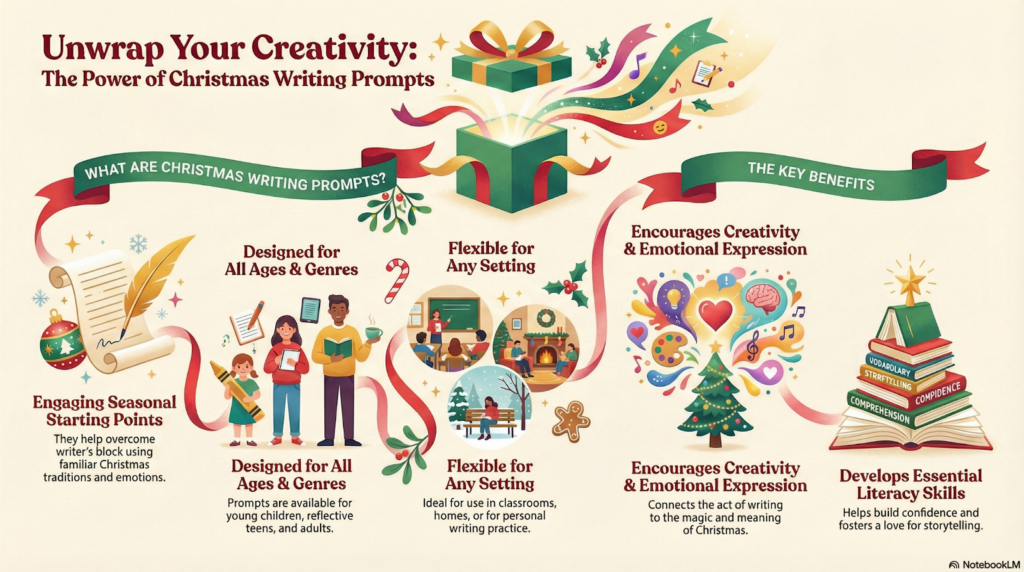
Christmas writing prompts offer the perfect solution. These creative starting points transform empty pages into opportunities for exploration, helping writers overcome blocks while engaging with the themes, emotions, and wonder that define the holiday season. Whether you are a teacher seeking engaging classroom activities, a parent encouraging your child’s creativity, or a writer looking for seasonal inspiration, these 25 Christmas writing prompts spark imagination while developing essential writing skills.
This collection includes prompts for various age groups and writing styles, from whimsical fiction perfect for elementary students to thoughtful reflections suited for teens and adults. Each prompt invites exploration of Christmas themes through different lenses: magical adventures, family traditions, charitable acts, humorous situations, and meaningful reflections. Use these prompts in journals, classroom assignments, family activities, or personal writing projects to capture the spirit of the season while building literacy skills and creative confidence.
Why Christmas Writing Prompts Work
Before diving into the prompts themselves, understanding why these creative starters prove so effective helps maximize their impact.
Seasonal Engagement
Christmas naturally excites children and adults alike. Connecting writing activities to this inherently interesting topic makes the task feel less like work and more like play. Students who resist traditional writing assignments often eagerly tackle holiday themed prompts because the subject matter already captures their attention and imagination.
Personal Connection
Everyone has Christmas experiences, whether celebrating traditionally, observing differently, or simply witnessing the season’s cultural presence. This universal familiarity gives every writer a starting point. Even students without extensive writing experience can draw from personal observations, family traditions, or cultural exposure to Christmas themes.
Emotional Resonance
The holiday season evokes strong emotions: joy, nostalgia, gratitude, anticipation, sometimes loneliness or stress. These feelings provide rich material for authentic writing. Prompts that tap into emotional experiences help writers create work with depth and genuine voice rather than superficial descriptions.
Genre Flexibility
Christmas prompts accommodate multiple writing genres: fiction, personal narrative, persuasive writing, poetry, letter writing, descriptive passages, and reflective essays. This versatility allows teachers to meet specific curriculum objectives while students explore genres that match their interests and strengths.
Built-in Imagery
Christmas comes with vivid sensory details: the scent of pine trees and cinnamon, the visual spectacle of lights and decorations, the taste of hot cocoa and cookies, the sound of carols and sleigh bells. These pre-loaded sensory elements help writers create descriptive, engaging prose without extensive scaffolding.
25 Christmas Writing Prompts
Prompts for Elementary Students (Ages 5 to 10)
These prompts encourage imagination, personal expression, and beginning narrative skills while keeping concepts age appropriate and accessible.
1. If You Were One of Santa’s Elves
Imagine you work in Santa’s workshop. What job do you have? Are you making toys, caring for reindeer, baking cookies, or wrapping presents? Describe a typical day at the North Pole from morning until bedtime. Include details about what you make, who your elf friends are, what you eat for lunch, and what makes your job special or challenging.
2. The Christmas Tree’s Story
Write from the perspective of a Christmas tree. Start in the forest where you grew, describe being chosen by a family, explain what it feels like being decorated, and share what you see and hear on Christmas morning. How do you feel when children open presents beneath your branches? What happens to you after the holidays end?
3. Your Perfect Christmas Day
If you could design the perfect Christmas Day from the moment you wake up until you fall asleep, what would happen? Include who you would spend time with, what you would eat, what activities you would do, and what would make the day absolutely perfect for you.
4. A Magical Ornament
One ornament on your Christmas tree is magical. When you touch it, something incredible happens. What is the ornament? What magic does it create? Write an adventure story about what happens when you discover its special power.
5. Reindeer Training School
Santa needs a new reindeer to join his team. Write a story about a young reindeer going through flying school, learning to navigate, practicing takeoffs and landings, and preparing for their first Christmas Eve journey. What challenges do they face? How do they prove they are ready?
6. The Best Christmas Gift Ever
Write about the best gift you ever received for Christmas. Describe what it was, who gave it to you, how you felt when you opened it, and why it was so special. If you have not received your best gift yet, write about what it would be and why it would mean so much to you.
7. When Christmas Decorations Come Alive
Late at night, all the Christmas decorations in your house come to life. The snowman ornament can walk and talk, the angel can fly, and the nutcracker soldier becomes real. Write a story about what they do while everyone sleeps.
Prompts for Middle School Students (Ages 11 to 13)
These prompts invite more complex thinking, character development, and exploration of Christmas themes beyond surface level observations.
8. The Christmas Time Capsule
You are creating a time capsule that will not be opened for 50 years. It should capture what Christmas is like in your time and community. What ten items would you include? Write about each item and explain why it represents something important about Christmas in the present day.
9. Stranded on Christmas Eve
A family traveling for Christmas gets stranded at an airport, closed highway rest stop, or small town because of a snowstorm. They will not make it to their destination for Christmas. Write about how they make the best of the situation and create an unexpected holiday celebration with strangers who become friends.
10. The Secret Santa Mystery
Someone at your school has been leaving anonymous gifts and kind notes for students who seem to need encouragement. Write a mystery story about trying to discover who the secret Santa is, including clues, false leads, and the surprising reveal of the gift giver’s identity and motivation.
11. Christmas Around the World
Research how one country celebrates Christmas differently than yours. Write an informative piece comparing and contrasting traditions, foods, timing, and customs. Include why these differences exist and what you find most interesting about the other culture’s celebration.
12. A Letter from Mrs. Claus
Write a letter from Mrs. Claus to the newspaper editor addressing how Santa gets all the credit and attention while she manages operations at the North Pole. Use a humorous tone as she describes everything she does behind the scenes to make Christmas happen successfully every year.
13. When Christmas Almost Did Not Happen
Write a story where something threatens to cancel or ruin Christmas: a blizzard, a power outage, someone getting sick, or a family conflict. Show how characters work together to overcome the obstacle and save the celebration. Focus on problem solving and cooperation.
14. Outgrowing Christmas?
A middle school student feels they are getting too old for Christmas traditions their family has always done. Write about the internal conflict between wanting to seem grown up and not wanting to hurt family members’ feelings or lose the magic they secretly still enjoy.
Prompts for High School Students and Adults (Ages 14+)
These prompts encourage critical thinking, sophisticated narrative development, and reflection on deeper Christmas meanings.
15. The Evolution of Christmas in Your Life
Write a reflective essay examining how your understanding and experience of Christmas has changed from early childhood through your current age. What remained constant? What transformed? What do these changes reveal about your personal growth and shifting values?
16. Commercialism vs. Meaning
Explore the tension between Christmas as a commercial holiday focused on spending and gifts versus Christmas as a time of spiritual significance, family connection, or charitable giving. Where do you see this tension in modern society? How do you personally navigate this balance?
17. A Christmas Dinner Conversation
Write a realistic scene of an extended family Christmas dinner where different generations and personalities interact. Include natural dialogue that reveals character, addresses a conflict or misunderstanding, and captures authentic family dynamics both touching and humorous.
18. The Gift That Changed Everything
Write a story about someone receiving an unexpected gift that fundamentally changes their perspective, relationship, or life direction. The gift could be material or intangible. Focus on character development and the transformation that occurs.
19. Working Christmas
Write about someone who must work on Christmas Day: a nurse, firefighter, retail employee, airline pilot, or other professional. Explore their feelings about missing family celebrations and what they discover about meaning and connection through their work and the people they encounter.
20. A Childhood Christmas Memory
Write a detailed personal narrative about one specific Christmas memory from your childhood. Use sensory details to recreate the experience: what you saw, heard, smelled, tasted, and touched. Reflect on why this memory persists and what it reveals about that time in your life.
21. The Christmas Letter Unsent
A character writes a letter at Christmas they never intend to send: to an estranged family member, a lost love, a deceased person, or their future self. Write the letter revealing their honest thoughts and feelings. Alternatively, write what happens if they accidentally send it.
Creative and Unique Prompts for All Ages
These imaginative prompts work across age groups with adaptation based on writing sophistication.
22. If Animals Celebrated Christmas
Choose an animal species and imagine how they would celebrate Christmas in ways that fit their nature and habitat. Would birds decorate trees with shiny objects? Would bears hibernate through it? Would dolphins have underwater light displays? Be creative and humorous.
23. A Christmas in the Future
Write a story set 100 years in the future. How do people celebrate Christmas in this imagined world? What traditions survived? What new customs developed? How has technology changed celebrations? Let your imagination explore futuristic possibilities while maintaining recognizable Christmas themes.
24. The Christmas Wish That Came True Differently
A character makes a Christmas wish that comes true, but not in the way they expected or hoped. Write about what they wished for, how it actually manifests, and what they learn from getting what they wanted in an unexpected form.
25. Creating a New Christmas Tradition
Invent a completely new Christmas tradition that does not currently exist. Describe what it involves, why people would want to do it, and tell the story of a family celebrating this new tradition for the first time. Make it something that could realistically catch on and spread.
How to Use These Prompts Effectively
Simply providing prompts does not guarantee quality writing. Implementation strategies maximize their effectiveness.
Classroom Applications
Daily Writing Warm-ups
Begin class with a 10 minute quick write responding to one prompt. This establishes routine, builds writing stamina, and creates low stakes practice. Students share their work with partners or small groups, building community.
Genre Study Focus
Choose prompts that align with genre units. If teaching narrative writing, select story based prompts. During persuasive writing units, use prompts requiring opinion and argumentation. This connects seasonal content with curriculum objectives.
Differentiation Tool
Offer choice among several prompts so students select topics matching their interests and comfort levels. Alternatively, provide the same prompt but adjust expectations: emerging writers focus on clear ideas and organization while advanced writers develop complex plots and sophisticated language.
Assessment Alternatives
Use prompt responses as formative assessments showing growth over time rather than summative tests. Collect responses in portfolios demonstrating skill development throughout the holiday season.
Home and Family Use
Journal Prompts
Establish a December journaling tradition where family members respond to one prompt weekly. Share responses at dinner or during holiday gatherings. These journals become treasured keepsakes documenting family members’ thoughts and writing development across years.
Story Creation Together
Choose a story prompt and collaborate on creating the narrative. Parents or older siblings can scribe for young children who verbally compose stories. This models the writing process while building literacy skills.
Letter Writing Practice
Letter focused prompts provide authentic writing purposes. Actually mail letters generated from prompts to relatives, teaching formal letter conventions while maintaining personal connections.
Individual Writing Practice
Overcoming Writer’s Block
When stuck, choose any prompt and write without stopping for 15 minutes. The goal is generating ideas and momentum, not perfection. This freewriting often sparks inspiration applicable to other projects.
Skill Development
Focus on specific skills through prompts. Practice descriptive language with prompts requiring sensory details. Develop dialogue skills with conversation focused prompts. Build characterization through prompts featuring specific personalities.
Portfolio Building
Writers building portfolios need diverse samples. Christmas prompts generate varied pieces showcasing different genres, styles, and sophistication levels.
Tips for Strong Writing
Regardless which prompt you choose, these strategies improve writing quality.
Show, Don’t Tell
Rather than stating “The room was decorated for Christmas,” show readers through specific details: “Garland draped the staircase railing, releasing pine scent with each brush past. Red and gold ornaments caught lamplight, casting colored shadows across the wall.”
Use Sensory Details
Engage all five senses. What does Christmas smell like? Sound like? Taste like? Feel like? Look like? Rich sensory language makes writing vivid and immersive.
Include Dialogue
Conversations reveal character and advance plots more dynamically than exposition. Use dialogue to show relationships, conflicts, and emotions naturally.
Create Specific Settings
Move beyond generic “house” or “school” settings. Is it a tiny apartment where the tree barely fits? A farmhouse with a fireplace? A suburban home with elaborate outdoor lights? Specific settings create authenticity.
Develop Characters
Even brief stories benefit from characters who feel real. Give them distinct personalities, motivations, quirks, and voices. Readers connect with dimensional characters rather than cardboard cutouts.
Establish Conflict
All compelling stories involve conflict: character vs. character, character vs. self, character vs. nature, or character vs. society. Even heartwarming Christmas stories need tension that characters resolve.
Revise and Edit
First drafts are for getting ideas down. Revision transforms adequate writing into strong writing. Read pieces aloud, cut unnecessary words, strengthen verb choices, and correct errors before considering work finished.
Age Appropriate Adaptations
The same prompt works for multiple ages with appropriate adaptation.
For Younger Children
Provide sentence frames or story starters. Reduce length expectations. Allow drawing to supplement writing. Accept inventive spelling while encouraging sound based attempts. Focus on idea generation over technical perfection.
For Struggling Writers
Offer graphic organizers for planning. Provide word banks with relevant vocabulary. Allow dictation for students with writing difficulties but strong oral expression. Break prompts into smaller steps.
For Advanced Writers
Add complexity requirements: include specific literary devices, write from unusual perspectives, achieve minimum word counts, incorporate multiple subplots, or address sophisticated themes. Challenge them to elevate craft, not just complete assignments.
For English Language Learners
Pre teach relevant vocabulary. Allow first language use during planning. Provide sentence frames with transition words. Pair with fluent English speaking partners for conferencing. Celebrate multilingual perspectives on Christmas traditions.
Extension Activities
Maximize prompt value through follow-up activities.
Illustration
Students create artwork accompanying their writing. This appeals to visual learners while reinforcing the connection between written description and visual representation.
Dramatic Reading
Students perform their pieces for classmates or family. This builds public speaking skills while providing authentic audience for their work.
Publication
Compile class writings into a book, create a blog featuring student work, or submit pieces to student literary magazines. Real publication motivates quality work.
Peer Feedback
Students exchange writings and provide structured feedback using rubrics or specific focus questions. This develops critical reading skills alongside writing abilities.
Multimedia Extension
Transform written work into other formats: create book trailers for stories, design infographics for informational pieces, or compose songs based on poems.
Conclusion
These 25 Christmas writing prompts transform the holiday season into a rich opportunity for literacy development, creative expression, and meaningful reflection. Whether you are guiding elementary students through their first narrative attempts, challenging high schoolers to explore complex themes, or seeking personal writing inspiration during the festive season, these prompts provide structured starting points that honor both the magic of Christmas and the craft of writing.
The true gift these prompts offer extends beyond completed pieces or checked assignments. They create space for imagination, build confidence in expressing ideas, develop essential literacy skills, and capture thoughts and experiences that might otherwise disappear. Years from now, these writings become treasured documents showing growth, preserving memories, and revealing the writers your students or children were becoming during these formative years.
As you use these prompts, remember that the goal is not perfection but rather engagement, exploration, and expression. Some responses will surprise you with their insight and creativity. Others will reveal struggles and areas for growth. All provide valuable glimpses into young minds grappling with ideas, developing voices, and learning that they have stories worth telling. This holiday season, give the gift of writing opportunities. The magic you help create on the page will last far longer than any present under the tree.
Frequently Asked Questions:
How long should responses to these prompts be?
Length depends on age and purpose, ranging from a paragraph for young children to several pages for high school students or multiple drafts for serious writing projects.
Can these prompts work for students who do not celebrate Christmas?
Yes, many prompts work universally. Focus on winter, giving, family, or imagination themes. Always offer alternatives respecting diverse celebrations.
Should I correct every error in student writing from prompts?
Focus on content and ideas first, especially in early drafts. Address errors based on learning objectives and student development levels.
How often should I use Christmas prompts?
Use throughout December as warm ups, journaling, or special projects without overwhelming regular curriculum. One to three times weekly works well.
What if students produce low quality work?
Provide models, break prompts into smaller steps, conference individually, or revisit skills needed. Sometimes students need permission to take risks without perfection pressure.
Can adults use these prompts personally?
Absolutely. Many adults enjoy creative writing, journaling, or blogging during holidays. These prompts spark personal reflection and creativity.
Should writing from prompts be graded?
This depends on purpose. Use formatively for practice or summatively if part of formal assessment. Clear expectations and rubrics help either way.
How do I prevent plagiarism with prompts?
Monitor during writing time, require drafts showing development, and make prompts specific enough that generic online content would not fit.
What if my child resists writing?
Make it playful, reduce length requirements, allow verbal storytelling, pair with drawing, or choose prompts matching their interests.
Can I modify these prompts?
Absolutely. Adapt language, adjust complexity, combine multiple prompts, or use them as inspiration for creating your own tailored to specific needs.

Belekar Sir is the founder and lead instructor at Belekar Sir’s Academy, a trusted name in English language education. With over a decade of teaching experience, he has helped thousands of students—from beginners to advanced learners—develop fluency, confidence, and real-world communication skills. Known for his practical teaching style and deep understanding of learner needs, Belekar Sir is passionate about making English accessible and empowering for everyone. When he’s not teaching, he’s creating resources and guides to support learners on their journey to mastering spoken English.