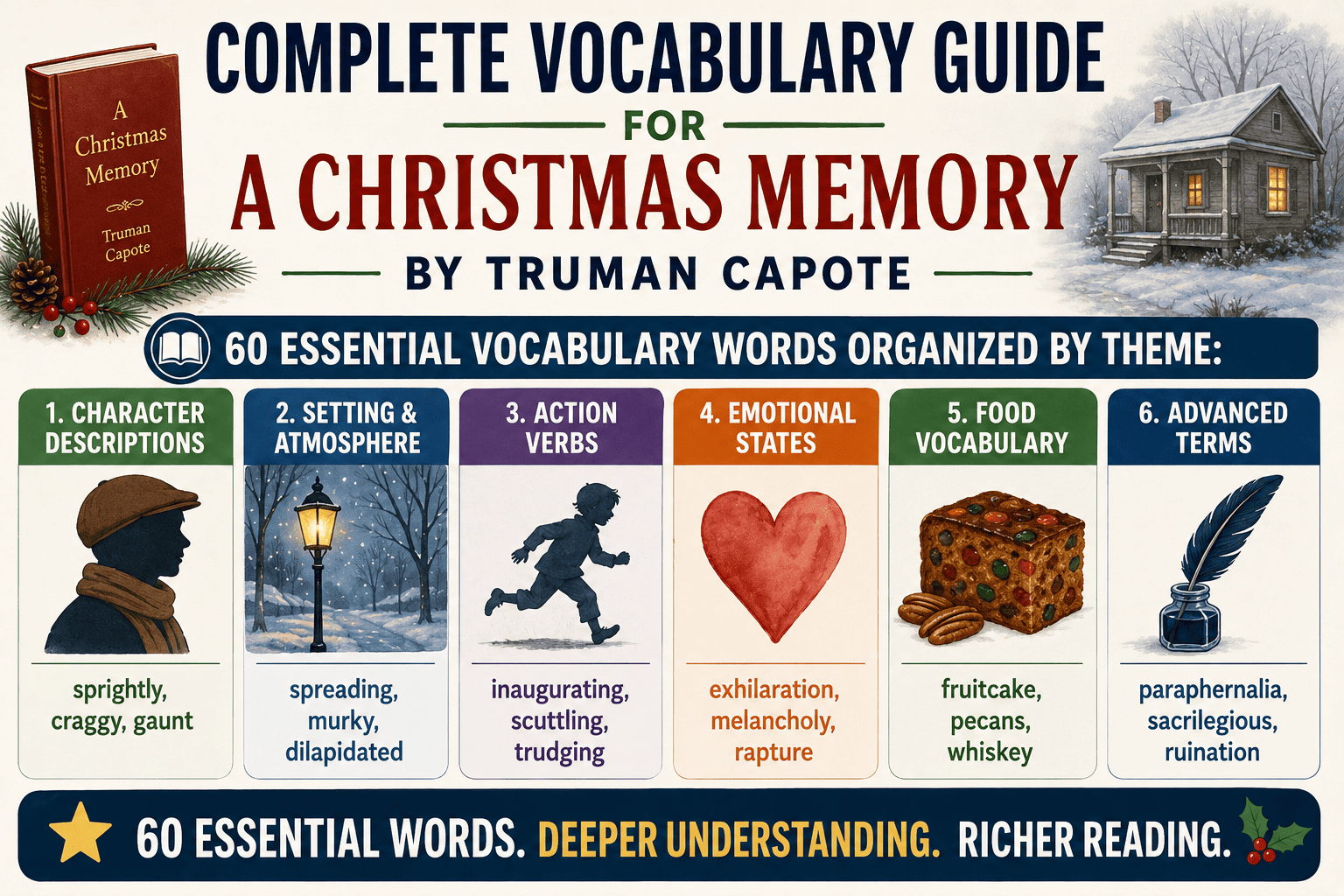
This guide covers 60 essential vocabulary words from Truman Capote’s “A Christmas Memory,” organized by theme: character descriptions (sprightly, craggy, gaunt), setting and atmosphere (spreading, murky, dilapidated), action verbs (inaugurating, scuttling, trudging), emotional states (exhilaration, melancholy, rapture), food vocabulary (fruitcake, pecans, whiskey), and advanced terms (paraphernalia, sacrilegious, ruination). Each word includes pronunciation, definition, and story context to help students and teachers fully appreciate Capote’s rich, evocative language.
“A Christmas Memory” by Truman Capote stands as one of American literature’s most beloved holiday tales, captivating readers for nearly seven decades with its poignant portrayal of friendship, innocence, and the joy of giving. Published in 1956, this autobiographical story recounts the special bond between seven-year-old Buddy and his elderly cousin Sook as they prepare for Christmas in rural Alabama during the 1930s Depression era.
This guide provides everything students, teachers, and literature enthusiasts need to fully appreciate Capote’s rich, evocative vocabulary. Each word is presented with pronunciation, definition, and specific story context to show exactly how Capote uses language to create his unforgettable holiday masterpiece.
Capote’s careful word choices create the story’s bittersweet tone, vivid sensory imagery, and deep emotional resonance. Understanding these words unlocks a richer reading experience and deeper appreciation of his literary craftsmanship.
“A Christmas Memory” takes place in rural Alabama during the early 1930s Great Depression. This setting influences vocabulary choices, words describing poverty, rural life, and Depression-era realities appear frequently. The story unfolds in a spreading old house inhabited by multiple generations, with the kitchen as the central gathering place.
Capote employs first-person narration from an adult Buddy looking back on childhood memories, creating layers where vocabulary choices reflect both child-like wonder and adult understanding. The largely present-tense narration despite being a memory creates immediacy that favors active, sensory language.
First-person narration from adult Buddy looking back creates dual layers, child-like wonder filtered through adult understanding. This influences word choices throughout the story.
Great Depression era (1930s) influences vocabulary describing poverty, rural life, and limited resources. Words like “barren” and “windfall” carry economic as well as literal meaning.
Rural Alabama setting brings regional vocabulary, Southern dialect appears in dialogue and some descriptions, adding authenticity and flavor to the narrative.
| Word | Pronunciation | Definition | Story Context |
|---|---|---|---|
| Sprightly | SPRITE-lee | Lively and energetic despite age | Describes Sook as small and sprightly, like a bantam hen |
| Craggy | KRAG-ee | Rough and uneven in texture | Her face is craggy like Lincoln’s, weathered by sun and wind |
| Gaunt | GAWNT | Thin and bony, often from suffering | Describes physical appearance showing hardship |
| Bantam | BAN-tum | Small but spirited, like a bantam chicken | Compares Sook’s small stature to this chicken breed |
| Hunched | HUNCHD | Bent forward with rounded shoulders | Her shoulders are pitifully hunched from childhood illness |
| Shorn | SHAWRN | Cut very short | Describes Sook’s white hair as closely cropped |
| Delicate | DEL-ih-kit | Fragile, fine in texture or construction | Her face is finely boned and delicate despite being weathered |
| Word | Pronunciation | Definition | Story Context |
|---|---|---|---|
| Spreading | SPRED-ing | Extended over a large area | Describes the rambling old house |
| Commenced | kuh-MENST | Began or started | The fireplace commenced its seasonal roar |
| Murky | MUR-kee | Dark and gloomy, difficult to see through | Describes dim lighting and shadows |
| Silhouette | sil-oo-ET | Dark outline against lighter background | Trees or figures outlined against sky |
| Dilapidated | dih-LAP-ih-day-ted | In disrepair, falling apart | Describes the old baby buggy they use |
| Barren | BAIR-un | Empty, without vegetation or life | Describes winter landscapes |
| Stark | STARK | Bare, harsh, or plain without decoration | Winter trees and landscapes |
| Word | Pronunciation | Definition | Story Context |
|---|---|---|---|
| Inaugurating | in-AW-gyuh-ray-ting | Beginning formally, initiating | Sook inaugurates the Christmas season |
| Exhilarates | ig-ZIL-uh-rayts | Fills with excitement and energy | Christmas exhilarates Sook’s imagination |
| Puttering | PUT-er-ing | Moving or acting in an aimless way | Sook putters around the kitchen |
| Scuttling | SKUT-ling | Moving quickly with short steps | Describes hurried, busy movement |
| Laboring | LAY-bor-ing | Working hard with great effort | They labor to collect pecans |
| Hauling | HAWL-ing | Pulling or dragging with effort | Hauling the Christmas tree home |
| Trudging | TRUJ-ing | Walking slowly with heavy steps | Trudging through snow or difficult terrain |
| Loitering | LOI-ter-ing | Standing around idly | Describes aimless waiting or wandering |
| Word | Pronunciation | Definition | Story Context |
|---|---|---|---|
| Exhilaration | ig-zil-uh-RAY-shun | Feeling of excitement and happiness | Christmas preparations fill Sook with exhilaration |
| Melancholy | MEL-un-kol-ee | Deep sadness or depression | The ending carries melancholy as Buddy reflects on loss |
| Rapture | RAP-chur | Intense pleasure or joy | Moments of pure happiness feel like rapture |
| Conspiratorial | kun-speer-uh-TOR-ee-ul | Secretive, like planning together | Buddy and Sook have conspiratorial friendship |
| Wrathful | RATH-ful | Full of anger and fury | Describes relatives’ angry scolding |
| Mortified | MOR-tuh-fyed | Deeply embarrassed or ashamed | How characters feel after being caught with whiskey |
| Forlorn | for-LORN | Sad and lonely, pitifully abandoned | Describes Sook’s situation after Buddy leaves |
| Word | Pronunciation | Definition | Story Context |
|---|---|---|---|
| Fruitcake | FROOT-kayk | Dense cake containing dried fruits and nuts | The central project of their Christmas preparations |
| Pecans | pih-KANZ | Oval nuts with sweet flavor | Main ingredient they gather for fruitcakes |
| Whiskey | WISS-kee | Distilled alcoholic spirit | Bought from bootlegger for fruitcake flavoring |
| Ingredient | in-GREE-dee-ent | Component of a mixture or recipe | Various items needed for fruitcakes |
| Vanilla | vuh-NIL-uh | Flavoring extracted from vanilla beans | One of the fruitcake ingredients |
| Raisins | RAY-zinz | Dried grapes | Fruitcake ingredient |
| Citron | SIT-run | Candied citrus peel | Traditional fruitcake ingredient |
| Word | Pronunciation | Definition | Story Context |
|---|---|---|---|
| Bleached | BLEECHT | Whitened by exposure to sun or chemicals | Describes winter grass and landscapes |
| Frosted | FRAWST-ed | Covered with thin layer of ice crystals | Morning grass and windows |
| Windfall | WIND-fawl | Fruit or nuts blown down by wind | Pecans fallen naturally from trees |
| Boughs | BOWZ | Tree branches, especially main ones | Pine boughs used for decoration |
| Thicket | THIK-it | Dense group of bushes or trees | Where they search for the Christmas tree |
| Undergrowth | UN-der-grohth | Plants growing beneath taller trees | Forest floor vegetation |
| Word | Pronunciation | Definition | Story Context |
|---|---|---|---|
| Paraphernalia | pair-uh-fer-NAYL-yuh | Miscellaneous equipment or items | The various tools and items they use |
| Sacrilegious | sak-rih-LIJ-us | Disrespectful toward sacred things | How relatives view the whiskey incident |
| Ruination | roo-ih-NAY-shun | Complete destruction or downfall | Relatives worry about Buddy’s moral ruination |
| Reveille | REV-uh-lee | Morning bugle call to wake soldiers | Mentioned when Buddy goes to military school |
| Subsequently | SUB-see-kwent-lee | Happening afterward, later | Describes sequence of events |
| Suffice | suh-FYCE | Be enough or adequate | Checking if resources suffice for needs |
Imagery & Sensory Language: Capote engages all five senses, visual (sherry-colored eyes), tactile (crisp, warm), olfactory (whiskey, pine), auditory (jingle, roar), and taste (food descriptions).
Mood & Tone: Happy words (exhilarate, rapture) contrast with melancholy terms (forlorn, weeping), creating the story’s bittersweet tone.
Characterization: Sook’s simple language reflects her childlike perspective; Buddy’s narrative voice combines child-like observations with adult vocabulary.
Symbolism: Fruitcake represents love and giving; kites embody freedom and aspiration; the buggy symbolizes shared adventures and passing time.
Context Clues: Practice extracting meanings from surrounding sentences before checking definitions.
Word Association: Connect new vocabulary to familiar concepts, recall energetic elderly people for “sprightly.”
Application Practice: Write diary entries from Sook’s perspective or compose letters describing the fruitcake process.
Etymology: Explore word origins, “inaugurate” comes from Latin “inaugurare” (to take omens).
Understanding the vocabulary of “A Christmas Memory” opens up deeper appreciation of Truman Capote’s literary artistry. Each carefully chosen word contributes to the story’s enduring power, its ability to make readers feel the warmth of friendship, the ache of loss, and the enduring hope of the holiday season.
Whether you’re a student preparing for a literature class, a teacher designing a vocabulary unit, or a reader seeking richer understanding of this beloved classic, this guide provides the foundation for meaningful engagement with Capote’s masterwork.
The words of “A Christmas Memory” remind us that language can capture the most precious moments of human connection. As you study these words, remember that vocabulary isn’t just about definitions, it’s about understanding and sharing the stories that make us human.
Explore more vocabulary guides, literary resources, and teaching tools at Belekar Sir’s Academy.
Browse All Articles → Try Our Free ToolsContinue building your literary vocabulary with our guides on types of adjectives, adjectives for students, and adjectives to describe yourself.

Belekar Sir is the founder and lead instructor at Belekar Sir’s Academy, a trusted name in English language education. With over a decade of teaching experience, he has helped thousands of students—from beginners to advanced learners—develop fluency, confidence, and real-world communication skills. Known for his practical teaching style and deep understanding of learner needs, Belekar Sir is passionate about making English accessible and empowering for everyone. When he’s not teaching, he’s creating resources and guides to support learners on their journey to mastering spoken English.