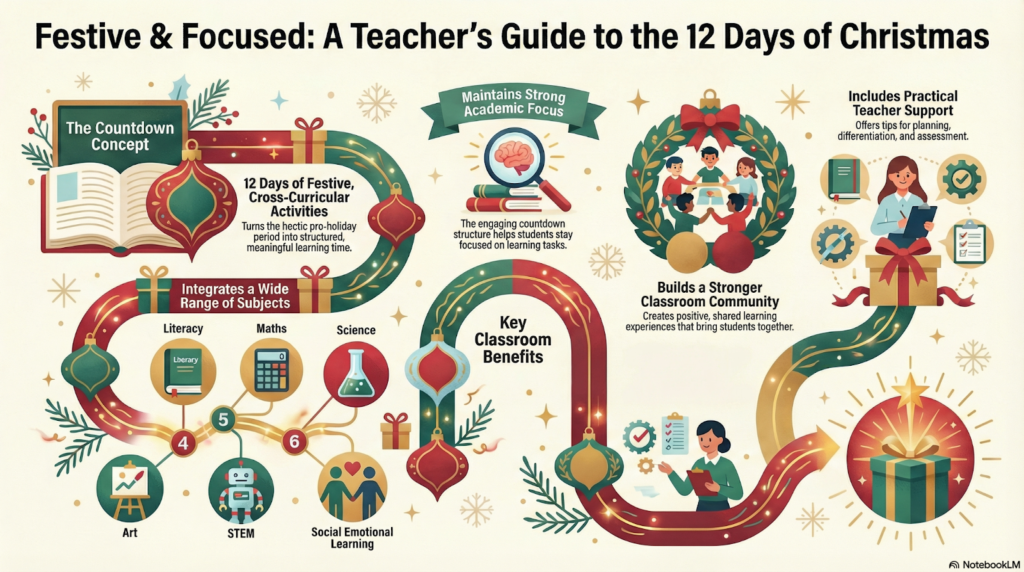
The weeks leading up to winter break can be challenging for educators. Students are excited about the holidays, attention spans shorten, and maintaining academic engagement feels like an uphill battle. However, this period doesn’t have to mean sacrificing quality education for basic time fillers.
The 12 Days of Christmas theme offers a perfect framework for creating structured, educational activities that capture the festive spirit while reinforcing core academic skills. By organizing your final weeks around daily themed activities, you can transform the pre-holiday chaos into a countdown that students actually look forward to attending.
This comprehensive guide presents 12 classroom ready activities that span multiple subject areas including literacy, mathematics, science, arts, and social emotional learning. Each activity is designed to be engaging, educational, and adaptable for different grade levels, ensuring that learning continues right up until the final bell rings before winter break.
12 Engaging Christmas Classroom Activities
Day 1: Snowflake Mathematics and Geometry
Begin your countdown with a hands on exploration of symmetry and geometric principles through paper snowflakes. This activity combines art with mathematical concepts in ways students find genuinely exciting.
Students learn the mathematical properties of folding by creating squares from rectangular paper, exploring angles through cutting techniques, and understanding symmetry by observing how patterns repeat across fold lines. The activity reinforces spatial reasoning while producing beautiful decorations for your classroom.
Learning Objectives:
- Understanding rotational and reflective symmetry
- Measuring and creating precise folds
- Recognizing geometric patterns
- Developing fine motor skills through cutting
Have students measure their snowflakes to compare sizes, count the number of symmetrical sections, and document the folding process through written or illustrated instructions. Advanced students can calculate the perimeter and area of their creations or design snowflakes with specific symmetrical properties.
Day 2: The Science of Candy Canes
Transform candy canes from simple treats into educational tools by exploring their scientific properties and manufacturing process. This multi subject approach covers chemistry, history, and procedural writing.
Begin with a discussion about how candy canes are made, covering the science of sugar crystallization and temperature changes. Students can watch educational videos showing the manufacturing process and take notes on the steps involved. Follow this with a candy cane science experiment where students observe what happens when candy canes are placed in different liquids such as water, vinegar, or oil.
Experiment Setup:
| Liquid | Prediction | Observation Time | Results |
| Water | 10 minutes | ||
| Vinegar | 10 minutes | ||
| Oil | 10 minutes | ||
| Hot Water | 10 minutes |
Students document their predictions, observations, and conclusions, reinforcing the scientific method while exploring dissolution rates and chemical reactions.
Day 3: Reindeer Research and Illustration
Combine science education with artistic expression through a comprehensive study of reindeer. This activity develops research skills, scientific literacy, and artistic technique.
Students begin by illustrating a reindeer based on their current knowledge, then engage in research using age appropriate texts or videos to learn accurate information about reindeer anatomy, habitat, diet, and behavior. After researching, students create a second illustration and write a reflection comparing their initial and informed drawings.
Research Topics:
- Physical characteristics and adaptations
- Geographic distribution and habitat
- Diet and feeding behaviors
- Role in Arctic ecosystems
- Cultural significance across different societies
This before and after approach helps students understand how research improves accuracy and challenges assumptions.
Day 4: Holiday Around the World Research Project
Expand cultural awareness by having students explore how different countries celebrate winter holidays. This activity builds research skills, cultural competency, and presentation abilities.
Assign each student or small group a different country to research. They investigate traditional foods, decorations, music, customs, and the historical origins of celebrations. Students then present their findings through posters, digital presentations, or creative demonstrations.
Countries to Explore:
- Mexico (Las Posadas)
- Germany (Christkindlmarkt traditions)
- Sweden (St. Lucia Day)
- India (regional winter festivals)
- Japan (KFC Christmas tradition)
- Ethiopia (Ganna celebration)
This activity naturally integrates geography, history, and cultural studies while promoting respect for diversity.
Day 5: Gingerbread Engineering Challenge
Transform gingerbread into a STEM learning opportunity by challenging students to design and build structures using gingerbread pieces or graham crackers as building materials.
Provide students with a specific challenge such as building the tallest freestanding tower, creating a bridge that spans a specific distance, or designing a structure that can support a certain weight. Students must plan their designs, test their constructions, and modify their approaches based on results.
Engineering Process:
- Define the problem and constraints
- Brainstorm possible solutions
- Create a blueprint or design plan
- Build and test the structure
- Evaluate results and identify improvements
- Redesign and rebuild if time permits
This activity reinforces engineering principles including stability, weight distribution, and structural integrity while incorporating measurement and problem solving skills.
Day 6: Christmas Carol Mathematics
Use the 12 Days of Christmas song as a springboard for mathematical problem solving and computational thinking. This classic carol offers surprising depth for mathematical exploration.
Challenge students to calculate the total number of gifts given across all 12 days of the song. This requires understanding cumulative addition and can be solved through multiple strategies including making tables, drawing diagrams, or using multiplication patterns.
Sample Problems:
- How many total gifts were given by the end of the song?
- On which day were the most gifts given?
- If each gift cost a specific amount, what would the total cost be?
- Create a graph showing the number of gifts given each day
- What patterns do you notice in the gift giving sequence?
For advanced students, introduce algebraic thinking by having them create formulas to represent the gift giving pattern or calculate totals for extended versions of the song.
Day 7: Winter Writing Workshop
Dedicate a day to holiday themed writing across multiple genres. This activity strengthens writing skills while maintaining festive engagement.
Offer students a choice of writing formats including procedural writing on how to build a snowman or decorate a tree, narrative stories about winter adventures, persuasive essays about the best winter holiday traditions, or descriptive poems capturing the sensory experience of winter.
Writing Prompts:
- Describe your perfect snow day from beginning to end
- Write instructions for someone who has never seen snow
- Create a story from the perspective of a snowflake
- Persuade your readers why winter is the best season
- Write a descriptive paragraph about hot chocolate using all five senses
Provide structured time for brainstorming, drafting, peer reviewing, and revising. Display finished pieces around the classroom or compile them into a class book.
Day 8: Paper Snowball Math Games
Combine physical activity with mathematical practice through interactive paper snowball games that get students moving while reinforcing computational skills.
Students write math problems on pieces of paper, crumple them into snowballs, and engage in a structured snowball fight. When time is called, each student picks up nearby snowballs and solves the problems written on them. This kinesthetic approach particularly benefits students who struggle with traditional seat work.
Variations by Grade Level:
- Primary: Addition and subtraction facts
- Intermediate: Multiplication and division
- Upper Elementary: Fractions, decimals, and word problems
- Middle School: Algebraic equations and geometric problems
The combination of movement and learning helps maintain engagement while providing necessary skills practice.
Day 9: Holiday Card Design and Distribution
Merge art, writing, and social emotional learning by having students design and create holiday cards for community members who might feel isolated during the season.
Students design original cards incorporating festive artwork and heartfelt messages. Discuss appropriate greetings for diverse audiences and the importance of spreading kindness. Coordinate with local nursing homes, hospitals, or community centers to distribute the cards.
Card Components:
- Original artwork on the front
- Thoughtful message inside
- Student signature or class designation
- Optional: Include interesting facts or jokes
This activity develops empathy, community connection, and practical writing skills while showing students how their efforts can bring joy to others.
Day 10: Christmas STEM Stations
Set up multiple STEM themed stations that students rotate through in small groups. This approach provides variety while allowing students to explore different concepts at their own pace.
Station Ideas:
| Station | Activity | Skills Developed |
| Ornament Design | Create ornaments using specific materials and weight limits | Engineering, creativity |
| Holiday Circuits | Build simple circuits with LED lights | Basic electricity concepts |
| Snowflake Coding | Program digital snowflake patterns | Computational thinking |
| Wrapper Bridge | Build bridges from gift wrap materials | Structural engineering |
| Jingle Bell Sorting | Sort and graph jingle bells by attributes | Data analysis |
Each station should include clear instructions, necessary materials, and a reflection component where students document their learning.
Day 11: Rewrite the 12 Days Song
Challenge students to create modern versions of the 12 Days of Christmas song by replacing the traditional gifts with contemporary items. This activity develops creativity, rhythm awareness, and cultural literacy.
Working individually or in small groups, students brainstorm gifts that make sense for today’s world while maintaining the syllabic structure of the original song. They might create versions based on specific themes such as technology, sports, environmental conservation, or local community features.
Guidelines:
- Maintain the same rhythmic structure as the original
- Create rhyming or near rhyming alternatives
- Ensure gifts are appropriate and creative
- Illustrate the new gifts
- Perform the new version for classmates
This activity reinforces syllable counting, rhythm, creative thinking, and presentation skills.
Day 12: Classroom Celebration and Reflection
Conclude your countdown with a structured celebration that includes both fun activities and meaningful reflection on the learning that occurred throughout the countdown.
Begin with a classroom game such as holiday charades, bingo with vocabulary from activities completed during the countdown, or a quiz game reviewing concepts learned. Follow with a reflection session where students share their favorite activities and describe what they learned.
Reflection Questions:
- Which activity taught you something completely new?
- What surprised you most during our countdown?
- Which activity challenged you in a good way?
- What would you want to do again next year?
- How did these activities change your understanding of the holiday season?
End with a simple treat or special privilege as a reward for their engagement and learning throughout the countdown period.
Implementation Tips for Success
Successfully executing a 12 day countdown requires thoughtful planning and preparation. Consider these practical strategies to maximize engagement and minimize stress.
Planning and Organization
Create a dedicated storage system for each day’s materials using gift bags, labeled boxes, or file folders. Prepare all materials at least one week in advance to avoid last minute rushing. Consider enlisting parent volunteers to help with preparation or facilitation of more complex activities.
Communicate your plans with families through newsletters or emails so they understand the educational value of the countdown and can support learning at home. Some activities may benefit from homework extensions where students continue exploring concepts with family members.
Differentiation Strategies
Build flexibility into each activity to accommodate diverse learning needs and abilities. Provide multiple entry points by offering choices in how students demonstrate learning, varying the complexity of tasks based on readiness, and grouping students strategically to provide peer support.
For students who need additional challenges, prepare extension activities that deepen exploration of concepts. For students who struggle, create modified versions with additional scaffolding or visual supports.
Time Management
Be realistic about what can be accomplished in your available time. Some activities work well as full lessons taking 45 to 60 minutes, while others serve as 15 to 20 minute warm ups or closing activities. Consider your schedule constraints and adjust accordingly.
Build in buffer time for activities that may take longer than anticipated, and have backup plans ready for days when schedules change unexpectedly due to assemblies, weather delays, or other interruptions.
Assessment Opportunities
While the countdown emphasizes engagement and fun, don’t overlook opportunities for formative assessment. Observe student participation, collect work samples, conduct brief conferences, and use exit tickets to gauge understanding.
Consider creating a simple rubric for evaluating participation, effort, and learning across the 12 days. This helps maintain academic rigor while celebrating the festive spirit.
Benefits Beyond the Holidays
Implementing a structured countdown provides benefits that extend well beyond the holiday season itself. Students learn that school remains a place of meaningful learning regardless of external distractions. They experience how structure and routine can coexist with creativity and fun.
The countdown model can be adapted for other times of year when engagement typically wanes such as the final weeks before spring break or the last days of the school year. By creating positive memories associated with school during typically challenging periods, you strengthen student teacher relationships and classroom community.
The academic skills practiced through these activities have lasting value. Students develop stronger problem solving abilities, improve their collaborative skills, and build confidence in their capacity to engage with complex tasks. The integration of multiple subject areas helps students see connections between disciplines and understand how learning applies to real world situations.
Conclusion
The 12 Days of Christmas countdown transforms the potentially chaotic pre holiday period into a structured, engaging, and educationally valuable experience. By thoughtfully planning activities that blend festive themes with academic content, you maintain high expectations while honoring the excitement and energy students bring to school during this special time.
These activities prove that holiday themed learning doesn’t mean abandoning educational goals. Instead, it means finding creative ways to teach essential skills within contexts that resonate with students. The memories created through these shared experiences strengthen classroom community and remind students why they love learning.
As you implement your countdown, remain flexible and responsive to your students’ needs and interests. The suggested activities serve as a starting point, but the most successful countdowns are those adapted to reflect your unique classroom culture, student population, and teaching style.
Begin planning your countdown today, and discover how the final weeks before winter break can become some of the most memorable and productive days of the entire school year.
Frequently Asked Questions
What grade levels are these activities appropriate for?
Most activities can be adapted for grades K through 6 by adjusting complexity and expectations.
How long does each activity take?
Activities range from 20 minutes to full hour long lessons depending on depth and extensions chosen.
Do I need special materials for these activities?
Most activities use common classroom supplies though some require basic craft materials or recyclables.
Can these activities be done virtually?
Many activities adapt well to distance learning with modifications for digital tools and home materials.
How do I manage behavior during exciting activities?
Establish clear expectations before starting, use timers for transitions, and maintain consistent routines throughout.
What if my school doesn’t celebrate Christmas? Adapt activities to winter themes or cultural celebrations relevant to your school community.
Should I do all 12 days consecutively?
Consecutive days create momentum but spacing activities throughout December works well too.
How can I assess learning during fun activities?
Use observation notes, collect work samples, and include brief reflection components in each activity.
What if students finish activities at different rates?
Prepare extension challenges and have related books or activities available for early finishers.
Can parent volunteers help with these activities?
Parent assistance is helpful for preparation, managing stations, and providing one on one support during activities.

Belekar Sir is the founder and lead instructor at Belekar Sir’s Academy, a trusted name in English language education. With over a decade of teaching experience, he has helped thousands of students—from beginners to advanced learners—develop fluency, confidence, and real-world communication skills. Known for his practical teaching style and deep understanding of learner needs, Belekar Sir is passionate about making English accessible and empowering for everyone. When he’s not teaching, he’s creating resources and guides to support learners on their journey to mastering spoken English.