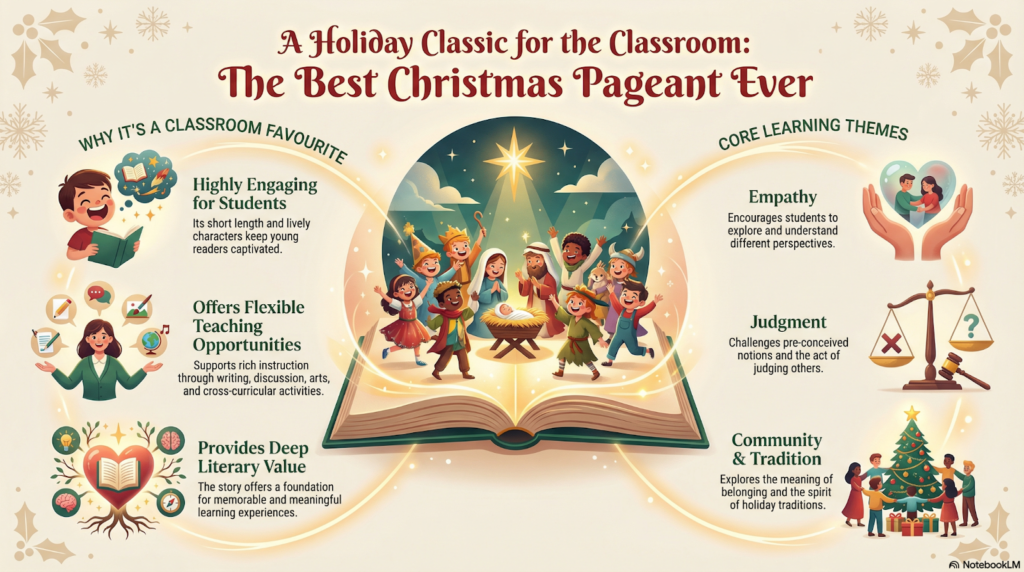
The Best Christmas Pageant Ever by Barbara Robinson has delighted generations of readers since its publication in 1972. This timeless story follows the notorious Herdman children who take over their town’s annual Christmas pageant, bringing chaos and unexpected lessons about the true meaning of the holiday. The novel’s perfect blend of humor, heart, and meaningful themes makes it an ideal choice for December classroom reading.
Teachers and parents appreciate this book because it maintains student engagement during one of the most distracting times of the school year. The outrageous antics of Imogene, Ralph, Leroy, Claude, Ollie, and Gladys Herdman generate genuine laughter while opening doors to discussions about empathy, judgment, tradition, and faith. With only seven chapters, the book provides a manageable read-aloud that fits perfectly into busy December schedules.
This comprehensive guide offers 25 classroom-tested activities organized by subject area and skill focus. From creative writing exercises and character analysis to hands-on art projects and cross-curricular connections, these engaging activities deepen comprehension while honoring the spirit of Barbara Robinson’s beloved classic. Whether you teach third grade or middle school, homeschool your children, or lead a literature circle, you will find activities that transform reading into memorable learning experiences.
Why Teach The Best Christmas Pageant Ever?
This novel offers unique educational opportunities that extend far beyond simple holiday entertainment. Understanding its pedagogical value helps teachers maximize instructional time during December when every minute counts.
Literary Merit and Awards
The Best Christmas Pageant Ever earned recognition as an ALA Notable Children’s Book and won numerous state reading awards including the Georgia Children’s Book Award and Young Hoosier Book Award. This literary credibility ensures parents and administrators recognize the book’s educational value rather than dismissing it as mere holiday fluff.
Barbara Robinson’s masterful use of first-person narration through Beth’s voice introduces students to unreliable narrators, distinctive voice, and perspective in ways that feel accessible and entertaining. The author’s comedic timing, vivid characterization, and skillful pacing provide excellent models for student writers developing their own narrative skills.
Universal Themes with Modern Relevance
The novel tackles timeless themes including prejudice, assumptions, poverty, family dysfunction, and finding meaning in tradition. These concepts remain relevant decades after publication, allowing students to connect the Herdmans’ experiences to contemporary issues like bullying, socioeconomic differences, and cultural understanding.
The story subtly addresses how communities respond to outsiders and challenges students to examine their own biases. When the town initially judges the Herdmans as hopeless troublemakers, readers recognize their own tendencies to make snap judgments based on appearance or reputation. The transformation that occurs when people truly listen to each other’s perspectives offers powerful lessons about empathy and understanding.
Manageable Length for December
With only seven chapters totaling about 80 pages, this novel fits realistic December reading schedules when class time competes with performances, parties, and shortened weeks. Teachers can complete the entire book in 10 to 15 days of reading sessions, leaving time for meaningful extension activities without sacrificing other curriculum areas.
The short chapter structure works perfectly for daily read-aloud sessions lasting 15 to 20 minutes. Each chapter provides natural stopping points with built-in cliffhangers that keep students eagerly anticipating the next installment. This structure supports struggling readers while maintaining the interest of advanced students who might otherwise rush ahead independently.
Writing Activities That Deepen Understanding
Writing activities encourage students to engage deeply with characters, themes, and narrative techniques while developing composition skills. These exercises range from creative fiction to analytical writing appropriate for different grade levels.
Perspective and Point of View Activities
Rewrite from Imogene’s Perspective
Barbara Robinson tells the story through Beth’s first-person narration, filtering events through her perspective and judgments. Challenge students to select a pivotal scene and rewrite it from Imogene Herdman’s point of view. How would Imogene describe the first rehearsal, the visit from Mrs. Armstrong, or the final performance? This exercise builds understanding of perspective, characterization, and narrative voice.
Students must consider Imogene’s background, motivations, and limited understanding of church traditions when crafting her narrative voice. Does she recognize that people fear her? How does she interpret the Christmas story having never heard it before? This activity naturally differentiates as struggling writers might rewrite a single paragraph while advanced students tackle entire chapters.
Multiple Character Diary Entries
Assign students to maintain diary entries from their chosen character’s perspective throughout the reading. After each chapter, students write 5 to 10 sentences exploring their character’s thoughts, feelings, and reactions to events. This ongoing activity builds comprehension, encourages prediction, and develops character analysis skills.
Distribute a variety of characters to ensure diverse perspectives including Beth, Mrs. Bradley, Reverend Hopkins, Alice Wendleken, Charlie Bradley, or individual Herdman children. Share selected entries aloud periodically to help students understand how different characters experience the same events differently based on their backgrounds and beliefs.
Creative Extension Writing
Epilogue Creation
The novel concludes with the pageant performance, leaving readers wondering about the Herdmans’ future and the lasting impact of their involvement. Challenge students to write epilogues answering questions like what happens when school resumes in January, does the church invite the Herdmans back next year, how do the Herdman children change or stay the same, and what becomes of the relationships formed during the pageant preparation.
Encourage students to maintain Barbara Robinson’s distinctive narrative style, continuing Beth’s voice and the book’s humorous yet heartfelt tone. Advanced students might write multi-scene epilogues exploring long-term consequences years later, while younger writers focus on immediate next steps.
Alternative Scene Development
Ask students to imagine and write scenes that occur off-page in the original story. What happens during the Herdman family dinners? How do the Herdman children prepare for their roles without adult supervision at home? What conversations occur between Reverend Hopkins and Mrs. Hopkins about the chaotic rehearsals? These scenes build inference skills while exercising creative writing abilities.
Holiday Greeting Card Messages
Students create holiday cards for book characters, personalizing messages based on character traits, relationships, and story events. A card for Mrs. Armstrong might reference her broken leg and thank her for the opportunity it created. A card for Gladys might acknowledge her unique portrayal of the angel. This quick activity combines character analysis with creative expression perfect for hectic December schedules.
Analytical and Persuasive Writing
Character Defense Essays
The Herdmans face constant criticism from the community despite their poverty and neglect being beyond their control. Students write persuasive essays defending the Herdmans against specific accusations, using text evidence to explain how circumstances shaped their behavior. This teaches argumentation, text citation, and empathy while addressing themes of judgment and socioeconomic prejudice.
Alternatively, students can argue that the Herdmans genuinely change by the story’s end versus maintaining that circumstances forced temporary good behavior. Both positions find support in the text, creating meaningful debate opportunities.
Theme Analysis Essays
Upper elementary and middle school students benefit from formal theme analysis examining how Robinson develops concepts like outsiders challenging traditions, poverty affecting behavior, authentic versus performative faith, or community transformation through understanding. Students identify theme statements, locate supporting evidence, and analyze how characters and plot events reinforce central ideas.
Character Analysis and Development Activities
Deep character study helps students understand motivation, growth, and the complexity of Robinson’s creations. These activities work across grade levels with appropriate modifications.
Visual Character Analysis
Character Trait Charts
Create comprehensive character charts comparing the six Herdman children across categories including physical descriptions, typical behaviors, notable quotes, relationships with others, and evidence of change. This visual organization helps students track details and recognize patterns in characterization.
| Character | Defining Traits | Key Actions | Evidence of Growth |
| Imogene | Tough, leader, curious | Asks about Jesus’s father, carries baby tenderly | Shows gentleness with baby Jesus doll |
| Ralph | Fighter, loud, physical | Crashes into manger, asks challenging questions | Engages thoughtfully with Nativity story |
| Leroy | Secretive, sneaky | Hides in church, observes silently | Demonstrates interest despite acting indifferent |
| Claude | Youngest Herdman boy, imitates siblings | Brings cat, makes noise | Participates without causing major disruption |
| Ollie | Middle brother | Follows Ralph’s lead | Shows up consistently |
| Gladys | Youngest, tough despite size | Smokes cigars, speaks roughly | Delivers powerful angel message |
Character Sketch Illustrations
Students create detailed character sketches based on textual descriptions, filling in details Robinson leaves to imagination. Include written annotations explaining artistic choices and connecting illustrations to specific passages. Display these around the classroom to create a visual character gallery that supports comprehension and discussion.
For added challenge, assign students to illustrate how characters change from beginning to end, creating before and after portraits that visually represent character growth and transformation.
Comparative Character Analysis
Herdmans vs. Townspeople Venn Diagrams
Use Venn diagrams to compare and contrast the Herdmans with other families in the story, identifying similarities that characters overlook due to prejudice. Both the Herdmans and the regular pageant participants care about their roles, want to do well, and bring their own perspectives to the Christmas story. This visual comparison challenges students to look beyond surface differences.
Character Growth Timelines
Create timelines tracking how specific characters change throughout the seven chapters. Mark key moments that spark realization or growth, particularly for Imogene, Beth, Mrs. Bradley, and the congregation members. This visual representation helps students recognize that character development occurs gradually through accumulated experiences rather than sudden transformations.
Creative and Performing Arts Activities
Artistic activities engage different learning styles while reinforcing comprehension and allowing creative expression during the festive season.
Visual Arts Projects
Comic Strip Scene Summaries
Students select memorable scenes and create comic strips with 4 to 8 panels illustrating the action. Include dialogue bubbles with character quotes and caption boxes for narration. This activity particularly appeals to visual learners and reluctant writers while building summarization skills and understanding of sequential events.
Focus on chapters with high visual potential such as Claude bringing his cat to the pageant, the Herdmans arriving at their first rehearsal, or the chaotic moments during the actual performance. The humor in Robinson’s writing translates perfectly into comic format.
Movie Poster Design
With the 2024 film release generating renewed interest, students can design promotional movie posters incorporating key story elements, character images, and taglines that capture the book’s essence. Evaluate posters based on visual appeal, accuracy to the story, and effectiveness in enticing viewers while avoiding spoilers.
This activity teaches visual communication and marketing concepts while reinforcing plot and theme comprehension. Display completed posters to create an engaging classroom environment celebrating the novel.
Paper Bag Nativity Scenes
Create three-dimensional Nativity scenes using paper bags, construction paper, and basic craft supplies, recreating the unique elements of the Herdmans’ pageant. Include the ham baby Jesus wrapped in Alice Wendleken’s father’s bathrobe, the angel Gladys without the customary tinsel halo, and other distinctive details that make the Herdmans’ version memorable.
This hands-on project works well for elementary students and homeschool settings where tactile activities provide breaks from seated reading and writing work.
Performance-Based Activities
Readers Theater Scripts
Transform favorite chapters into readers theater scripts where students perform without memorization or elaborate staging. Assign roles including narrator, Beth, Imogene, Mrs. Bradley, and others depending on the scene. This oral reading practice builds fluency, expression, and confidence while making the story come alive through performance.
Focus on chapters with significant dialogue such as the first rehearsal when the Herdmans ask questions, the scene where Imogene learns about Jesus’s poverty, or the moments backstage before the pageant begins. Students naturally practice reading with appropriate emotion and pacing when inhabiting characters.
Scene Dramatization
Groups of students select scenes to fully dramatize with memorized lines, simple props, and movement. Unlike readers theater, this requires deeper engagement with the text as students internalize character voices and relationships. Perform these dramatizations for other classes, parents, or as a culminating activity celebrating the completed novel.
Movie Trailer Creation
Students work in teams to create 2 to 3 minute movie trailers using simple video recording technology. They must decide which scenes to include, write voiceover narration, and edit footage to build excitement without revealing the ending. This integrates technology skills, collaboration, and deep understanding of narrative structure and pacing.
Cross-Curricular Connections
Extending the novel across subject areas maximizes instructional time while showing students how literature connects to broader learning.
Social Studies Integration
Historical Context Research
The novel was published in 1972 and references cultural elements from that era and earlier. Students research differences between then and now including church attendance patterns, small town community structures, childhood freedom and supervision norms, and typical family sizes. This builds historical thinking skills while explaining why certain story elements might seem unusual to modern readers.
Community Service Project Planning
The Herdmans’ poverty and neglect highlight real issues facing children in every community. Connect reading to action by planning service projects that address local needs such as food drives, warm clothing collections, toy donations, or volunteering at community organizations. This transforms the novel’s themes into concrete compassionate action.
Students research local organizations, identify specific needs, plan logistics, and implement projects that help families experiencing hardship. This develops citizenship skills, empathy, and real-world problem-solving abilities while honoring the book’s message about seeing beyond surface judgments to recognize shared humanity.
Science Connections
Star of Bethlehem Research
When the Herdmans express fascination with the star leading the wise men, extend learning through astronomy research. Students investigate historical and scientific theories about the Star of Bethlehem including planetary conjunctions, comets, and supernovas. They create presentations explaining different hypotheses and evaluating evidence, building scientific literacy and critical thinking skills.
Pageant Engineering Challenge
Challenge students to design and build stable structures for Nativity scene elements using engineering principles. Create mangers that hold specific weights, design stable star structures, or engineer pulley systems for lowering angels. This STEM integration reinforces story events while teaching practical physics and engineering concepts.
Mathematics Activities
Budget Planning for Pageant Production
Students create realistic budgets for producing a Christmas pageant, researching costs for costumes, sets, lighting, and programs. They calculate total expenses, determine ticket prices needed to cover costs, and create spreadsheets tracking income and expenses. This practical math application builds financial literacy while connecting to story events.
Herdman Family Calculations
The six Herdman children span elementary and middle school ages. Students create word problems based on the family such as calculating age differences, determining birth years, or figuring out combined ages. This personalizes math practice while reinforcing comprehension of character details.
Discussion-Based Activities
Structured discussions build critical thinking and communication skills while exploring complex themes in the novel.
Socratic Seminar Topics
Organize formal Socratic seminars around essential questions including:
- Did the Herdmans ruin or improve the Christmas pageant?
- Should tradition be preserved exactly or adapted for new perspectives?
- How does poverty affect the way communities judge families?
- What responsibility do privileged people have toward struggling neighbors?
- When is it appropriate to challenge religious or cultural traditions?
Students prepare by locating text evidence, formulating opinions, and anticipating counterarguments. During seminars, they engage in student-led discussion following established protocols that ensure respectful dialogue and evidence-based reasoning.
Small Group Literature Circles
Divide the class into literature circles that meet regularly throughout the reading. Assign rotating roles including discussion director, literary luminary finding powerful passages, connector relating events to real life, illustrator creating visual responses, and summarizer recapping key points.
This structure ensures all students actively participate in literary analysis rather than passively listening to teacher-led discussions. It builds leadership skills, accountability, and deeper engagement with the text.
Character Hot Seat
One student sits in the hot seat as a specific character while classmates ask questions about their actions, motivations, and feelings. The student must answer in character, using text knowledge to inform responses while improvising details Robinson does not explicitly provide.
This interactive activity builds character understanding, perspective-taking, and improvisational thinking. It works particularly well with controversial characters like Mrs. Armstrong, Reverend Hopkins, or Imogene Herdman where students must defend complex decisions or viewpoints.
Reading Comprehension and Vocabulary Activities
These focused literacy activities build foundational skills while supporting struggling readers and challenging advanced students.
Comprehension Strategies
Chapter Prediction Journals
Before reading each chapter, students write predictions about upcoming events based on previous action and chapter titles. After reading, they evaluate predictions, identify what surprised them, and refine their forecasting skills. This metacognitive strategy builds engagement and teaches students to think ahead while reading.
Sequence Strips
Create strips describing major events from a chapter. Students physically arrange strips in correct chronological order, then verify accuracy by referencing the text. This kinesthetic activity particularly helps struggling readers organize story events and understand plot progression.
Question-Answer-Relationship Charts
Teach students to categorize comprehension questions as right there answered explicitly in text, think and search requiring information synthesis from multiple passages, author and me combining text evidence with prior knowledge, or on my own based primarily on personal experience and opinion.
Students practice identifying question types and locating appropriate evidence, building strategic reading skills that transfer across texts and subject areas.
Vocabulary Development
Context Clue Detective Work
Select challenging vocabulary from each chapter. Students locate words in context, identify surrounding clues, hypothesize meanings, verify definitions, and create original sentences demonstrating understanding. Track words in vocabulary journals with illustrations, synonyms, and personal connections.
Focus on words like pageant, chaos, rehearsal, manger, frankincense, myrrh, and congregation that appear frequently in the story and have utility beyond this single novel.
Word Wall Creation
Display story vocabulary on a dedicated word wall organized alphabetically or by chapter. Reference these words during discussions, require their use in written responses, and play games targeting word wall vocabulary. This constant visual reinforcement supports retention and encourages rich word usage in student writing.
Assessment Activities
Measure comprehension and skill development through varied assessment formats that accommodate different learning styles and abilities.
Traditional Assessments
Chapter Quizzes
Short quizzes after each chapter verify basic comprehension with multiple choice, short answer, and true/false questions. Focus on key plot points, character actions, and significant details. Keep quizzes brief to avoid overwhelming students during busy December schedules.
Unit Test Options
Comprehensive tests might include multiple choice questions about plot and characters, short answer responses explaining themes or character development, essay questions requiring text evidence, and creative components like designing book covers or writing new scenes.
Alternative Assessment Formats
Character Scrapbooks
Students create scrapbooks for chosen characters including diary entries, photographs the character might take, ticket stubs from events, letters to other characters, and artifacts representing their personality and experiences. This creative assessment demonstrates deep character understanding while allowing artistic expression.
Book Talk Presentations
Students prepare 3 to 5 minute book talks recommending the novel to peers. They must summarize the plot without spoilers, analyze themes, explain why particular audiences would enjoy it, and read favorite passages aloud. This assessment builds public speaking skills while measuring comprehension and analytical thinking.
Digital Book Trailers or Podcasts
Technology-savvy classes can create digital book trailers using video editing software or record podcast episodes discussing themes, characters, and personal responses to the novel. These multimedia assessments engage 21st century skills while demonstrating literary understanding.
Differentiation Strategies for Diverse Learners
Ensure all students access the novel’s richness through intentional modifications and extensions.
Supporting Struggling Readers
Provide audio versions of the novel for students who struggle with decoding but possess strong comprehension skills. The 1983 television adaptation and 2024 film also support visual learners and help struggling readers follow the plot.
Chunk reading assignments into smaller sections with frequent comprehension checks. Offer graphic organizers for note-taking, character tracking, and plot sequencing. Pair struggling readers with strong reading buddies for collaborative activities.
Simplify writing assignments by reducing length requirements, providing sentence frames, offering word banks, or allowing oral responses that you transcribe. The goal is measuring comprehension rather than penalizing students for writing difficulties.
Challenging Advanced Learners
Advanced readers benefit from comparative analysis examining how the 2024 film adaptation differs from the novel, exploring directorial choices and their effects on meaning. They can research the 1972 historical context, comparing it to today’s culture.
Assign independent research projects exploring topics like poverty’s effects on childhood development, the psychology of prejudice, or the history of Christmas pageants. Encourage creative extensions like writing sequels, creating board games based on the story, or developing lesson plans teaching the novel to younger students.
Challenge advanced writers to experiment with different narrative techniques such as writing scenes in third person omniscient, present tense, or through multiple alternating perspectives beyond simple character diary entries.
English Language Learner Support
Preview chapters by pre-teaching essential vocabulary and discussing key plot points. Provide visual aids including character illustrations, scene sketches, and cultural context explanations for references ELL students might not understand.
Allow extra processing time for discussions and written responses. Pair ELL students with patient buddies who can clarify confusing passages. Permit the use of translation tools for reading support while encouraging English production in activities and assignments.
Celebrate cultural diversity by having ELL students share Christmas or winter holiday traditions from their home cultures, connecting their experiences to the novel’s themes of tradition and celebration.
Conclusion
The Best Christmas Pageant Ever remains a beloved classroom staple because it accomplishes the rare feat of being genuinely entertaining while teaching profound lessons about empathy, judgment, tradition, and faith. Barbara Robinson’s perfect balance of humor and heart keeps students engaged while opening doors to meaningful discussions that extend far beyond the final page.
The 25 activities in this guide provide diverse entry points into the novel, ensuring that visual learners, kinesthetic students, analytical thinkers, and creative minds all find ways to connect deeply with the story. From perspective-shifting writing exercises to hands-on art projects, from Socratic seminars to service learning initiatives, these activities transform reading into comprehensive learning experiences that honor the complexity of Robinson’s deceptively simple tale.
The most effective approach combines daily read-aloud sessions that build classroom community through shared laughter and discussion with carefully selected activities that deepen comprehension without overwhelming your December schedule. Choose activities matching your instructional goals, student needs, and available time rather than attempting to implement everything simultaneously.
Remember that the novel’s greatest gift is sparking conversations about how we treat people who are different, how tradition can both unite and exclude, and how fresh perspectives sometimes reveal truths that familiarity obscures. These themes resonate powerfully in our diverse classrooms and complex world, making The Best Christmas Pageant Ever far more than pleasant holiday entertainment.
As you guide students through the Herdmans’ chaotic journey from town troublemakers to unexpected teachers about the true meaning of Christmas, you create memorable learning experiences that students carry forward long after December ends. The laughter, discussions, projects, and insights generated by this remarkable novel remind us why literature matters and why the best teaching happens when we combine rigorous academics with genuine joy in learning.
Frequently Asked Questions:
What grade level is The Best Christmas Pageant Ever appropriate for?
The novel works best for grades 3 through 6, though mature 2nd graders and younger middle schoolers also enjoy it with appropriate support.
How long does it take to read the entire book?
Most classes complete the seven chapters in 10 to 15 class periods with 15 to 20 minute daily read-aloud sessions.
Are there religious themes that might concern some families?
The book centers on a church Christmas pageant and the Nativity story, which may not align with all families’ beliefs. Preview content and offer alternatives if needed.
Can I show the movie instead of reading the book?
The movies complement but shouldn’t replace reading. Consider watching after finishing the novel for comparison and discussion.
What if students find the Herdmans’ behavior inappropriate?
Use their misbehavior as discussion opportunities about context, circumstances, and how judgment affects our treatment of struggling children. The book ultimately promotes empathy.
How do I handle discussions about poverty and neglect?
Address these topics sensitively, emphasizing systemic issues rather than individual blame. Connect to service learning opportunities showing compassionate responses to need.
Are there extension books you recommend?
Students who enjoy this book often like Ramona Quimby by Beverly Cleary, Tales of a Fourth Grade Nothing by Judy Blume, or Because of Winn-Dixie by Kate DiCamillo.
What if December gets too hectic for a full novel study?
Prioritize read-aloud time and choose 3 to 5 favorite activities rather than attempting everything. The book itself provides value even without extensive activities.
Can I use this in a public school setting?
Yes, though be mindful that it includes religious content. Frame as literature study examining themes and cultural traditions rather than religious instruction.
How does the 2024 film compare to the book?
The new film expands certain scenes and updates some elements while maintaining the core story. Use differences as opportunities for media literacy discussions.

Belekar Sir is the founder and lead instructor at Belekar Sir’s Academy, a trusted name in English language education. With over a decade of teaching experience, he has helped thousands of students—from beginners to advanced learners—develop fluency, confidence, and real-world communication skills. Known for his practical teaching style and deep understanding of learner needs, Belekar Sir is passionate about making English accessible and empowering for everyone. When he’s not teaching, he’s creating resources and guides to support learners on their journey to mastering spoken English.