Christmas in Germany, or Weihnachten, is a deeply cherished celebration that transforms the entire country into a winter wonderland of twinkling lights, aromatic spices, and centuries old traditions. From the first Sunday of Advent through January 6th, German speaking countries immerse themselves in a month long holiday season filled with unique customs that have influenced Christmas celebrations worldwide. Understanding German Christmas vocabulary opens doors not only to language proficiency but also to appreciating the rich cultural heritage behind these beloved traditions.
Whether you are planning to spend the holidays in Germany, Austria, or Switzerland, have German speaking friends or family, or simply wish to expand your language skills, mastering German Christmas vocabulary enables you to participate authentically in one of Europe’s most magical holiday celebrations. This comprehensive guide provides over 100 essential words and phrases organized by category, complete with pronunciation guidance, cultural context, and practical usage examples that will help you navigate everything from Weihnachtsmärkte to Heiligabend celebrations like a native speaker.
Essential Christmas Greetings and Wishes
The foundation of German Christmas communication starts with knowing how to extend warm wishes during the festive season.
Primary Holiday Greetings
Frohe Weihnachten Pronunciation: FRO-uh VY-nahk-ten Meaning: Merry Christmas This is the most universal Christmas greeting in German. Frohe means joyful or merry, and Weihnachten comes from the Middle High German meaning holy nights. You will hear this greeting from early December through early January.
Fröhliche Weihnachten Pronunciation: FRUR-lih-uh VY-nahk-ten Meaning: Merry Christmas, slightly more formal This variation adds an extra layer of festivity and is commonly used in written greetings and formal settings.
Besinnliche Weihnachten Pronunciation: buh-ZIN-lih-uh VY-nahk-ten Meaning: Peaceful, reflective Christmas This greeting emphasizes the contemplative, spiritual aspect of Christmas, wishing someone a thoughtful holiday season.
Ein gesegnetes Weihnachtsfest Pronunciation: ine guh-ZAYG-nuh-tess VY-nahkts-fest Meaning: A blessed Christmas celebration This religious greeting is perfect for church communities and those who emphasize the spiritual significance of Christmas.
Frohes Fest Pronunciation: FRO-ess FEST Meaning: Happy celebration or Happy holidays A shortened, casual greeting appropriate for the entire holiday season, not specific to Christmas Day alone.
Einen schönen Advent Pronunciation: I-nen SHUR-nen ahd-VENT Meaning: Have a beautiful Advent season Use this greeting throughout December before Christmas arrives.
New Year Greetings
Guten Rutsch ins neue Jahr Pronunciation: GOO-ten RUTSH ins NOY-uh yar Meaning: Good slide into the new year This quirky German expression wishes someone a smooth transition into the new year. Rutsch literally means slide, creating a charming image of slipping into the new year.
Prosit Neujahr Pronunciation: PRO-zit NOY-yar Meaning: Cheers to the New Year Used when toasting on New Year’s Eve, this traditional expression comes from Latin.
Ein gutes neues Jahr Pronunciation: ine GOO-tess NOY-ess yar Meaning: A good new year The standard way to wish someone well in the coming year.
Key German Christmas Dates and Their Names
Understanding the timeline of German Christmas helps contextualize vocabulary and traditions that unfold over weeks rather than a single day.
Advent Season
| German Term | English Translation | Date | Significance |
| Die Adventszeit | Advent season | Four Sundays before December 25 | Period of anticipation and preparation |
| Der erste Advent | First Advent | Fourth Sunday before Christmas | Lighting first candle on Advent wreath |
| Der zweite Advent | Second Advent | Third Sunday before Christmas | Lighting second candle |
| Der dritte Advent | Third Advent | Second Sunday before Christmas | Lighting third candle |
| Der vierte Advent | Fourth Advent | Last Sunday before Christmas | Lighting fourth and final candle |
Major Christmas Days
Der Nikolaustag December 6th, Saint Nicholas Day Children place their boots or shoes outside their doors on the evening of December 5th. If they have been good, Nikolaus fills them with sweets, nuts, and small gifts. Naughty children traditionally receive a switch or Rute from his companion Knecht Ruprecht.
Der Heilige Abend or Heiligabend December 24th, Christmas Eve This is the centerpiece of German Christmas celebrations, far more important than December 25th. Families gather for elaborate dinners, attend midnight Mass called Christmette, and exchange gifts after dinner. The Christmas tree is traditionally decorated only on this day.
Der erste Weihnachtstag December 25th, First Christmas Day A quieter day spent with close family, often featuring leftovers from the Heiligabend feast and leisurely activities.
Der zweite Weihnachtstag December 26th, Second Christmas Day Also called Stephanstag, this public holiday extends the celebration. Many people visit extended family or friends they did not see on Christmas Eve.
Silvester December 31st, New Year’s Eve Germans celebrate with elaborate fireworks displays, champagne, and the tradition of Bleigießen, melting small lead figures and interpreting their shapes to predict the coming year’s fortunes.
Der Dreikönigstag January 6th, Epiphany or Three Kings Day This day commemorates when the Three Wise Men visited baby Jesus. Children dress as the kings and go house to house as Sternsinger, singing carols and chalking blessings above doorways.
Christmas Decorations and Symbols
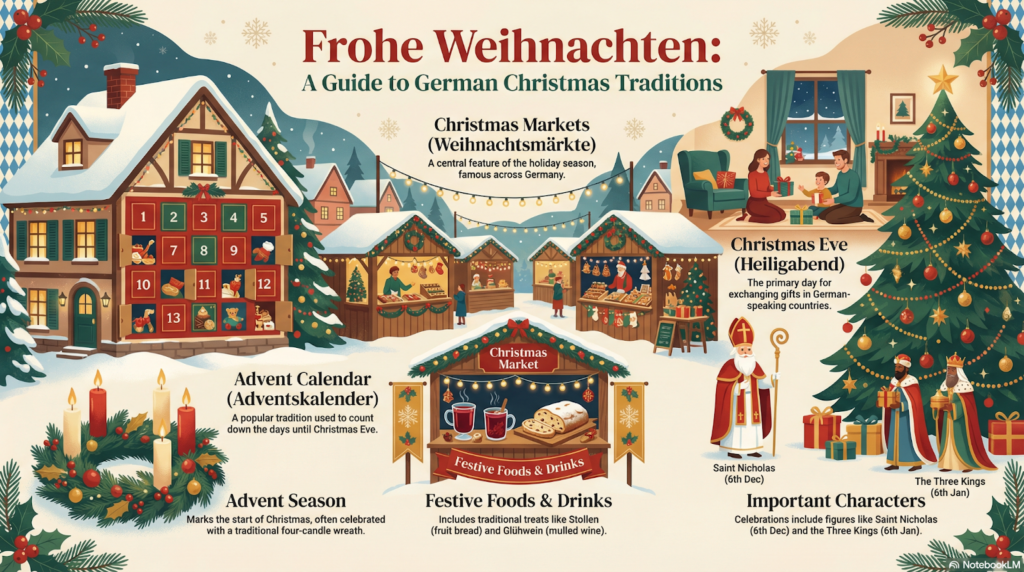
German Christmas decorations blend centuries of tradition with modern festivity, each item carrying cultural significance.
Essential Decoration Vocabulary
Der Weihnachtsbaum or Der Tannenbaum The Christmas tree Germans traditionally use real fir trees, preferring Nordmanntannen or Blaufichten. The custom of decorating evergreen trees at Christmas originated in Germany in the 16th century and spread worldwide.
Der Adventskranz The Advent wreath This iconic decoration features an evergreen wreath with four candles, one lit on each Sunday of Advent. The progressive lighting symbolizes the growing anticipation of Christmas and the coming of light into the world.
Der Adventskalender The Advent calendar Germany invented this beloved tradition. Originally simple chalk marks on doors, modern versions contain 24 tiny doors hiding chocolates, toys, or treats, one opened each day from December 1st through December 24th.
Die Weihnachtskrippe or Die Krippe The nativity scene Also called der Bethlehem Stall, elaborate nativity scenes are central to German Christmas decorations, featuring handcrafted figures of Mary, Joseph, Jesus, shepherds, animals, and the Three Wise Men.
Der Schwibbogen The candle arch This traditional Saxon decoration is a wooden arch with candles or lights, often depicting mining scenes or Christmas imagery. Originally created by miners, these arches symbolize their longing for daylight during long underground shifts.
Der Weihnachtsstern The Christmas star or poinsettia This decorative star hangs in windows, symbolizing the Star of Bethlehem. The term also refers to the poinsettia plant.
Die Christbaumkugeln or Die Kugeln Christmas tree ornaments Glass ornaments, particularly those from the town of Lauscha in Thuringia, are prized decorations. Traditional colors are red, gold, and silver.
Die Lichterkette String of lights Electric lights have largely replaced traditional candles on Christmas trees for safety, though some families maintain the custom of real Christbaumkerzen.
Das Lametta Tinsel Shiny metallic strands draped on trees, though less common now than in previous generations.
Der Nussknacker The nutcracker Wooden nutcracker figures, particularly soldier shaped ones from the Erzgebirge region, are iconic German Christmas decorations popularized worldwide by Tchaikovsky’s ballet.
Der Räuchermann Smoking man incense burner These wooden figures, when filled with incense cones, emit fragrant smoke from their mouths, filling rooms with Christmas scents.
Die Weihnachtspyramide Christmas pyramid A wooden carousel structure with tiers of figures that rotate when heat from candles rises, causing the propeller blades at the top to spin.
Christmas Characters and Figures
German Christmas features unique characters that differ significantly from Anglo American traditions.
Gift Bringers
Das Christkind The Christ Child In Catholic regions of southern Germany, Austria, and Switzerland, the Christkind, depicted as a golden haired angel with wings, delivers presents on Christmas Eve. Children never see the Christkind, adding to the mystery. Martin Luther created this tradition as a Protestant alternative to Saint Nicholas.
Der Weihnachtsmann Santa Claus or Father Christmas In northern and eastern Germany, particularly Protestant regions, the Weihnachtsmann delivers gifts. He resembles the international Santa Claus figure but has distinctly German characteristics.
Der Nikolaus Saint Nicholas Appearing on December 6th, Nikolaus wears bishop’s robes and carries a golden book recording children’s behavior throughout the year. He rewards good children with treats and gently admonishes those who misbehaved.
Companions and Helpers
Knecht Ruprecht The companion of Nikolaus who carries switches to threaten naughty children, though he rarely uses them in modern celebrations.
Der Krampus In Alpine regions of southern Germany and Austria, this horned, demonic creature accompanies Nikolaus, punishing truly naughty children. Krampusnacht on December 5th features parades of people dressed as Krampus.
Traditional German Christmas Foods
German Christmas cuisine features rich, spiced foods that have become internationally beloved.
Main Dishes
| German Name | English Translation | Description |
| Die Weihnachtsgans | Christmas goose | Traditional roasted goose, the classic Christmas main dish |
| Die Ente | Duck | Alternative to goose, also popular for Christmas dinner |
| Der Karpfen | Carp | Traditional fish served on Christmas Eve in some regions |
| Die Würstchen mit Kartoffelsalat | Sausages with potato salad | Simple Christmas Eve meal in many families |
| Der Sauerbraten | Marinated pot roast | Special occasion meat dish with sweet sour sauce |
Side Dishes
Der Rotkohl or Das Rotkraut Red cabbage Sweet and sour red cabbage braised with apples, a classic accompaniment to roasted meats.
Die Klöße or Die Knödel Dumplings Bread or potato dumplings soaking up rich gravies.
Die Bratensauce Gravy Rich meat gravy essential for Christmas dinners.
Christmas Baked Goods and Sweets
Die Plätzchen or Die Weihnachtsplätzchen Christmas cookies The general term for the dozens of cookie varieties baked during Advent. Popular types include:
Vanillekipferl: Vanilla crescent cookies Zimtsterne: Cinnamon stars Lebkuchen: Spiced gingerbread cookies Spekulatius: Spiced shortcrust cookies with images pressed into them Kokosmakronen: Coconut macaroons Spritzgebäck: Spritz cookies piped into shapes
Der Christstollen or Der Stollen Christmas stollen Dense fruit bread from Dresden filled with nuts, spices, dried fruits, and covered with powdered sugar representing baby Jesus wrapped in swaddling clothes. Traditional stollen contains marzipan in the center.
Der Lebkuchen Gingerbread Spiced cookies or cakes, with Nürnberger Lebkuchen being the most famous variety. Some are soft and cake like, others crisp like cookies.
Die Dominosteine Layered chocolate treats with gingerbread base, jelly layer, and marzipan, covered in chocolate.
Der Weihnachtsstollen Another name for Stollen, emphasizing its Christmas association.
Christmas Beverages
Der Glühwein Mulled wine Hot spiced red wine served at Christmas markets, made with cinnamon, cloves, star anise, and orange peel. White wine versions called Weißer Glühwein also exist.
Der Kinderpunsch Children’s punch Non alcoholic hot spiced fruit juice for children at Christmas markets.
Der Feuerzangenbowle Flaming rum punch Dramatic drink where rum soaked sugarloaf is set on fire and drips into mulled wine below.
Die heiße Schokolade Hot chocolate Rich, thick hot chocolate often topped with whipped cream.
Der Eierpunsch Egg punch, similar to eggnog Creamy beverage made with eggs, sugar, vanilla, and rum.
Christmas Activities and Traditions
Understanding verbs and activities helps you discuss and participate in German Christmas customs.
Christmas Verbs
Weihnachten feiern To celebrate Christmas Example: Wir feiern Weihnachten mit der ganzen Familie (We celebrate Christmas with the whole family).
Den Adventskranz anzünden To light the Advent wreath Example: Jeden Sonntag zünden wir eine weitere Kerze am Adventskranz an (Every Sunday we light another candle on the Advent wreath).
Plätzchen backen To bake Christmas cookies Example: Am Wochenende backen wir Plätzchen (On the weekend we bake cookies).
Den Weihnachtsbaum schmücken To decorate the Christmas tree Example: Am Heiligabend schmücken wir den Weihnachtsbaum (On Christmas Eve we decorate the Christmas tree).
Geschenke verpacken To wrap presents Example: Ich muss noch alle Geschenke verpacken (I still have to wrap all the presents).
Die Bescherung Gift giving ceremony This unique German word describes the specific moment when families gather to exchange and open presents on Christmas Eve. There is no direct English equivalent.
Zur Christmette gehen To go to midnight Mass Example: Viele Familien gehen zur Christmette (Many families go to midnight Mass).
Weihnachtslieder singen To sing Christmas carols Example: Die Kinder singen Weihnachtslieder unter dem Baum (The children sing Christmas carols under the tree).
Den Weihnachtsmarkt besuchen To visit the Christmas market Example: Möchtest du mit mir den Weihnachtsmarkt besuchen? (Would you like to visit the Christmas market with me?)
Christmas Markets and Shopping
Der Weihnachtsmarkt or Der Christkindlmarkt Christmas market These enchanting outdoor markets, dating back to the Middle Ages, appear in town squares throughout Germany from late November through Christmas. Each city claims to have the best market, with famous ones in Nuremberg, Dresden, and Cologne.
Market Vocabulary
Die Bude or Der Stand Stall or booth Individual vendor stands selling goods.
Das Glühwein Tasse Mulled wine mug Decorative ceramic mugs that vendors charge a deposit for, which many visitors keep as souvenirs.
Die gebrannten Mandeln Roasted sugared almonds Popular sweet snack sold at markets, coated in cinnamon sugar.
Die Bratwurst Grilled sausage Essential Christmas market food.
Der Reibekuchen Potato pancake Crispy fried potato pancakes served with applesauce.
Die Handwerkskunst Handicrafts Traditional crafts sold at markets including wooden toys, ornaments, and decorations.
Music and Carols
Die Weihnachtslieder Christmas carols German has a rich tradition of Christmas music, from medieval carols to modern songs.
Famous German Carols
Stille Nacht, heilige Nacht: Silent Night, Holy Night O Tannenbaum: O Christmas Tree Alle Jahre wieder: Every Year Again Ihr Kinderlein kommet: Oh Come Little Children Kling, Glöckchen: Ring Little Bells Schneeflöckchen, Weißröckchen: Little Snowflake
Regional Variations and Cultural Notes
Christmas vocabulary and traditions vary across German speaking regions.
Northern vs Southern Germany
Gift Bringer: Northern Germany predominantly has Weihnachtsmann, while southern regions, Austria, and Switzerland favor Christkind.
Terminology: Northern Germans say Plätzchen for cookies while Bavarians and Austrians say Kekse. The Christmas tree is Weihnachtsbaum in the north but often Christbaum in the south.
Markets: Southern Germany and Austria call them Christkindlmarkt while northern regions use Weihnachtsmarkt.
Austrian Specialties
Austrians celebrate Krampusnacht more intensely, with elaborate parades and costumes. They have unique market foods like Maroni (roasted chestnuts) and Kartoffelpuffer (potato pancakes).
Swiss Traditions
Switzerland adds French and Italian influences depending on region. In French speaking areas, you might hear Joyeux Noël alongside Frohe Weihnachten.
Practical Conversation Examples
Putting vocabulary into realistic contexts solidifies learning.
At the Christmas Market
Ich hätte gerne einen Glühwein, bitte. I would like a mulled wine, please.
Was kostet eine Tasse gebrannte Mandeln? How much does a cup of roasted almonds cost?
Bekomme ich das Pfand zurück? Do I get the deposit back?
Diese Holzfiguren sind wunderschön! These wooden figures are beautiful!
Discussing Plans
Was machst du an Heiligabend? What are you doing on Christmas Eve?
Wir feiern mit der Familie zu Hause. We are celebrating at home with family.
Gehst du zur Christmette? Are you going to midnight Mass?
Wann schmückt ihr euren Weihnachtsbaum? When do you decorate your Christmas tree?
Expressing Appreciation
Das Essen war köstlich! The food was delicious!
Vielen Dank für das schöne Geschenk. Thank you very much for the beautiful gift.
Die Bescherung war sehr schön. The gift giving ceremony was very nice.
Learning Strategies for German Christmas Vocabulary
Immersion Techniques
Listen to German Christmas music on repeat. Songs like Stille Nacht and O Tannenbaum reinforce vocabulary through melody and repetition.
Watch German Christmas movies with German subtitles. Classic films include Drei Haselnüsse für Aschenbrödel and Die Feuerzangenbowle.
Visit German Christmas markets if possible. Nothing reinforces vocabulary like authentic experience.
Memory Aids
Create flashcards with images of Christmas items on one side and German terms on the other.
Label your own Christmas decorations with German vocabulary words using sticky notes.
Keep a German Christmas journal, describing your holiday preparations and celebrations in German.
Cultural Connection
Research specific German regions and their unique Christmas traditions. Understanding why traditions exist makes vocabulary more memorable. Learning that Stollen represents baby Jesus in swaddling clothes or that Schwibbögen were created by miners makes these words richer and easier to remember.
Conclusion
Mastering German Christmas vocabulary unlocks access to one of Europe’s most enchanting holiday traditions. From the contemplative beauty of Adventskranz candles being lit each Sunday to the joyful chaos of Weihnachtsmärkte filled with Glühwein and gebrannte Mandeln, from the anticipation of opening Adventskalender doors to the magic of Heiligabend Bescherung, German Christmas traditions offer language learners rich cultural experiences alongside vocabulary acquisition.
The over 100 words and phrases in this guide provide a comprehensive foundation for understanding, discussing, and participating in authentic German Christmas celebrations. Whether you use these terms to wish German speaking friends Frohe Weihnachten, navigate Christmas markets confidently, understand traditional carols, appreciate regional variations, or simply enrich your German language skills, this vocabulary connects you to centuries of cultural heritage and modern festive joy.
Remember that language learning thrives when connected to meaningful cultural context, so as you practice these terms, explore the traditions behind them, taste Stollen, listen to Weihnachtslieder, and immerse yourself in the warmth that defines die schönste Zeit des Jahres, the most beautiful time of the year. Frohe Weihnachten und einen guten Rutsch ins neue Jahr!
Frequently Asked Questions
How do you say Merry Christmas in German?
Frohe Weihnachten is the standard greeting, literally meaning joyful or merry Christmas.
What is the difference between Heiligabend and Weihnachten?
Heiligabend is Christmas Eve (December 24th), the main celebration day, while Weihnachten refers to Christmas Day (December 25th) or the entire Christmas period.
When do Germans open presents?
Germans traditionally open presents on Christmas Eve after dinner, not on Christmas morning like in many other countries.
Who brings gifts in Germany, Santa or the Christ Child?
It depends on the region. Northern Germany has Weihnachtsmann (Santa), while southern Germany, Austria, and Switzerland have Christkind (Christ Child).
What is a Weihnachtsmarkt?
A traditional outdoor Christmas market featuring food, drinks, handicrafts, and holiday atmosphere, dating back to medieval times.
What is Glühwein?
Mulled wine, a hot spiced wine drink served at Christmas markets, made with red wine, cinnamon, cloves, and citrus.
Why is Christmas Eve more important than Christmas Day in Germany?
Historical and religious tradition places emphasis on Heiligabend as the time of Jesus’s birth, making it the primary celebration day with family gatherings and gift exchanges.
What are Plätzchen?
Christmas cookies baked in dozens of varieties during Advent, essential to German Christmas tradition.
What is Stollen?
A dense fruit bread from Dresden filled with dried fruits, nuts, and spices, covered in powdered sugar, symbolizing baby Jesus.
When does the German Christmas season start?
Officially with the first Advent Sunday, four Sundays before December 25th, though Christmas markets often open in late November.
What is the Adventskranz?
An Advent wreath with four candles, one lit on each Sunday of Advent, marking the countdown to Christmas.
Is Silvester the same as New Year’s Eve?
Yes, Silvester is the German name for December 31st, New Year’s Eve, named after Pope Sylvester I.

Belekar Sir is the founder and lead instructor at Belekar Sir’s Academy, a trusted name in English language education. With over a decade of teaching experience, he has helped thousands of students—from beginners to advanced learners—develop fluency, confidence, and real-world communication skills. Known for his practical teaching style and deep understanding of learner needs, Belekar Sir is passionate about making English accessible and empowering for everyone. When he’s not teaching, he’s creating resources and guides to support learners on their journey to mastering spoken English.