Introduction:
Telling the time is one of the most practical communication skills in English. Whether you’re travelling, attending classes, taking exams, or having everyday conversations, knowing how to read a clock helps you understand and respond correctly. English uses both digital clocks and analog clocks, and each follows simple patterns that anyone can learn with the right guidance.
In this step-by-step lesson, Belekarsir’s Academy will walk you through all the basics—how the hour hand works, how to count minutes, how to use “past” and “to,” and how to confidently say the time like a native speaker. By the end, you won’t just “read” the time… you’ll understand it.
Why Learning to Read the Clock in English Matters?
Learning to read the clock in English is a key everyday skill for travel, study, and work. It helps you understand schedules, be on time, and join natural conversations about plans, meetings, and daily routines.
Why this skill matters?
- Travel: You need to read timetables, boarding times, and hotel check‑in/check‑out times, which are almost always written in English numbers and formats.
- Exams and study: School and language exams often include listening or reading questions about time, and classes, tests, and deadlines all follow strict timetables.
- Work and business: Meetings, shifts, appointments, and online calls are all organized by time, so understanding and saying times clearly in English prevents mistakes and delays.
- Everyday conversations: People constantly ask and answer questions like What time is it?, Let’s meet at three thirty, or The movie starts at quarter past seven, so you need to understand and reply quickly.
- Confidence in speaking: Practising times helps you use common English phrases such as o’clock, half past, quarter to, and quarter past, which makes your speech sound more natural and fluent.
By the end of a good step‑by‑step guide, you should be able to look at any clock and say the time naturally in English, without translating in your head, very close to how native speakers do it.
Types of clocks
There are two main clock types you will see: analog clocks and digital clocks. Both show the same information (hours and minutes), but the way they display time is different, so it is important to understand both.
Analog clock basics
An analog clock is the traditional round clock with hands and the numbers 1 to 12 around the circle.
- Shape and numbers: The clock face is a circle with the numbers 1, 2, 3, …, 12 placed around the edge.
- Hands: It usually has two or three moving “hands” (thin lines that rotate around the center).
The three hands
- Hour hand
- The hour hand is the short, thick hand.
- It points to the current hour (1–12), and it moves slowly from one number to the next during the hour.
- Minute hand
- The minute hand is the long hand.
- It shows the minutes; when it goes all the way around the clock once, 60 minutes (one hour) have passed.
- Second hand
- The second hand is often the thinnest and sometimes a different color.
- It moves quickly; when it goes around once, 60 seconds (one minute) have passed.
Numbers and minutes (simple mental “diagram”)
On an analog clock, each number also represents minutes.
- The clock has 12 big numbers, but there are 60 minutes in one full circle.
- Between each number, there are usually 5 small minute steps.
- When the minute hand points to a number, you can multiply that number by 5 to find the minutes:
- 1 = 5 minutes
- 2 = 10 minutes
- 3 = 15 minutes
- 4 = 20 minutes
- 5 = 25 minutes
- 6 = 30 minutes
- 7 = 35 minutes
- 8 = 40 minutes
- 9 = 45 minutes
- 10 = 50 minutes
- 11 = 55 minutes
- 12 = 0 minutes (exact o’clock)
A simple way to “see” the clock in your mind:
- Imagine a circle.
- Put at the top, on the right, at the bottom, and on the left.
- Now imagine the long minute hand moving from around the circle, counting.
This helps you connect the position of the minute hand with the number of minutes past the hour.
Digital clock basics
A digital clock shows the time with numbers only, usually in this format:
- HH:MM (hours and minutes), for example 09:30 or 21:15.
Digital clocks can use two main systems: 12‑hour format and 24‑hour format.
12‑hour format
The 12‑hour system uses the numbers 1 to 12 for hours and adds AM or PM.
- AM (from midnight to just before noon):
- From 12:00 AM (midnight) to 11:59 AM.
- Example: 7:30 AM = half past seven in the morning.
- PM (from noon to just before midnight):
- From 12:00 PM (midday) to 11:59 PM.
- Example: 7:30 PM = half past seven in the evening.
Key ideas:
- There are two “7:30” times in a full day: 7:30 AM and 7:30 PM.
- 12:00 PM is noon (middle of the day), and 12:00 AM is midnight (middle of the night).
24‑hour format
The 24‑hour system counts hours from 0 to 23, without using AM or PM.
- Times from 00:00 to 11:59 are the morning.
- 12:00 to 23:59 are the afternoon, evening, and night.
Some useful conversions:
- 13:00 = 1:00 PM
- 14:00 = 2:00 PM
- 15:00 = 3:00 PM
- 18:30 = 6:30 PM
- 21:15 = 9:15 PM
A quick rule:
- For times from 13:00 to 23:59, subtract 12 from the hour to say it in 12‑hour English with PM.
- Example: 18:45 → 6:45 PM.
AM vs PM explained simply
- Use AM for times from midnight until before midday:
- Early night to morning: 1:00 AM, 2:00 AM, 6:15 AM.
- Late morning: 10:30 AM, 11:45 AM.
- Use PM for times from midday until before midnight:
- Afternoon: 1:00 PM, 3:30 PM, 5:15 PM.
- Evening and night: 7:00 PM, 9:45 PM, 11:59 PM.
If you combine this understanding of analog clocks (hands and minutes) with digital formats (12‑hour and 24‑hour, AM/PM), you will be ready to move on to the next step: using natural English phrases like half past six, quarter to nine, and ten past three in everyday conversation.
Two Main Ways to Tell the Time in English
There are two main ways to say the time in English:
- hour + minutes and 2) minutes + past/to + hour.
You also need some special phrases such as quarter past, quarter to, half past, o’clock, noon, midday, and midnight to sound natural.
Method 1: Hour + Minutes
This is the simplest and most international way to say the time in English.
You say It’s + hour + minutes.
Structure
- It’s + hour + minutes
- Use normal number words for the minutes: ten, twenty, thirty‑four, etc.
Examples
- 6:25 → It’s six twenty‑five.
- 8:05 → It’s eight oh five. (also written O‑five)
- 9:11 → It’s nine eleven.
- 2:34 → It’s two thirty‑four.
How to say “0” minutes
When the minutes are from 01 to 09 (like 8:05 or 12:08), English speakers often say oh (the letter O) for the zero.
- 8:05 → It’s eight oh five.
- 12:09 → It’s twelve oh nine.
You can also say five or nine without oh (for example, It’s eight five), but oh five and oh nine sound more natural.
Method 2: Minutes + Past/To + Hour
This method is very common in everyday English and sounds more “native.”
You say the minutes first, then past or to, then the hour.
Basic rules
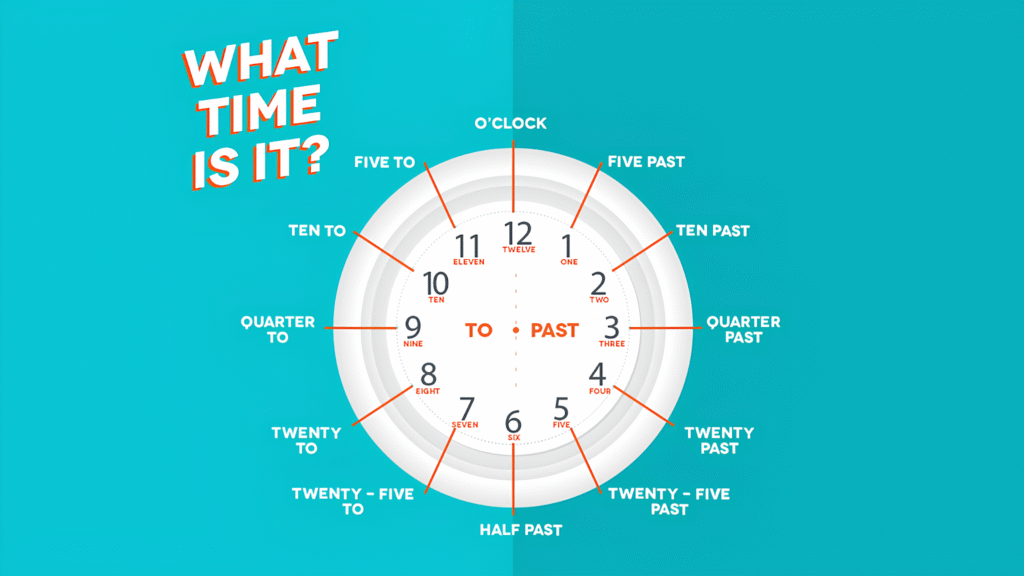
- For minutes 1–30: use past (or after) + the current hour.
- For minutes 31–59: use to + the next hour.
So:
- Right side of the clock (from to ) → past.
- Left side of the clock (from to ) → to (the next hour).
Examples with breakdown
- 3:10 → 10 minutes after 3 → It’s ten past three.
- 8:20 → 20 minutes after 8 → It’s twenty past eight. (or twenty after eight)
- 4:25 → 25 minutes after 4 → It’s twenty‑five past four.
- 5:40 → 20 minutes before 6 → It’s twenty to six.
- 9:50 → 10 minutes before 10 → It’s ten to ten.
- 7:55 → 5 minutes before 8 → It’s five to eight.
Remember that once you pass minutes, you “look forward” to the next hour with to.
Visual Table: Digital → Past/To Style
Here is a clear table showing common times in digital form and how to say them with past and to.
| Digital time | Spoken form (minutes + past/to + hour) |
| 1:05 | It’s five past one. |
| 1:10 | It’s ten past one. |
| 1:20 | It’s twenty past one. |
| 1:25 | It’s twenty‑five past one. |
| 1:30 | It’s half past one. |
| 1:35 | It’s twenty‑five to two. |
| 1:40 | It’s twenty to two. |
| 1:45 | It’s a quarter to two. |
| 1:50 | It’s ten to two. |
| 1:55 | It’s five to two. |
These patterns follow the standard rule: 1–30 = past, 31–59 = to.
Special Time Expressions
Native speakers use a small group of very common phrases to describe times with 00, 15, 30, and 45 minutes.
Quarter past
- Quarter means 15 minutes (a quarter of an hour).
- Quarter past = 15 minutes after the hour (minute hand on 3).
Examples:
- 7:15 → It’s (a) quarter past seven.
- 10:15 → It’s (a) quarter past ten.
Quarter to
- Quarter to = 15 minutes before the next hour (minute hand on 9).
Examples:
- 12:45 → It’s (a) quarter to one. (15 minutes before 1:00)
- 5:45 → It’s (a) quarter to six.
Half past
- Half past = 30 minutes after the hour (minute hand on 6).
Examples:
- 3:30 → It’s half past three. (also three‑thirty)
- 10:30 → It’s half past ten.
O’clock
Use o’clock when the time is exactly on the hour (minutes = 00).
Examples:
- 6:00 → It’s six o’clock.
- 10:00 → It’s ten o’clock.
In casual speech, people often add the part of the day: It’s six o’clock in the morning, It’s ten o’clock at night.
Noon / Midday / Midnight
These three words are very common and important to understand clearly.
- Noon / Midday = 12:00 PM (middle of the day).
- Midnight = 12:00 AM (middle of the night).
Examples:
- 12:00 PM → It’s noon. / It’s midday.
- 12:00 AM → It’s midnight.
These words are often used in schedules: The bus arrives at midday, The shop closes at midnight.
Table: Digital Time → Common Spoken Forms
This table shows both the simple hour + minutes method and the more natural past/to or special expressions.
| Digital time | Simple form (hour + minutes) | Natural spoken form |
| 6:00 | It’s six o’clock. | It’s six o’clock. |
| 6:05 | It’s six oh five. | It’s five past six. |
| 6:15 | It’s six fifteen. | It’s a quarter past six. |
| 6:30 | It’s six thirty. | It’s half past six. |
| 6:45 | It’s six forty‑five. | It’s a quarter to seven. |
| 6:55 | It’s six fifty‑five. | It’s five to seven. |
| 12:00 PM | It’s twelve o’clock. | It’s noon. / It’s midday. |
| 12:00 AM | It’s twelve o’clock. | It’s midnight. |
These patterns match the standard explanations used in English‑teaching materials: using hour + minutes as the basic structure and minutes + past/to + hour with quarter past, half past, quarter to, and o’clock for natural, fluent time expressions.
The “Say Any Time” Formula
Use this step‑by‑step system every time you see a new clock time.
Step 1: Check the minutes
- If minutes = : use o’clock or special words like noon, midday, midnight.
- If minutes = 01–09: think of oh (for example oh five, oh nine).
- If minutes = 10–30: you can use either hour + minutes or minutes past hour.
- If minutes = 31–59: usually use minutes to next hour.
Step 2: Decide “past/to” or direct
You always have two main options:
- Direct style: It’s + hour + minutes (easier, always correct).
- Native style:
- 1–30 minutes → It’s X past hour.
- 31–59 minutes → It’s X to next hour.
Use special phrases when possible:
- minutes → a quarter past/a quarter to.
- minutes → half past.
Step 3: Identify the hour
- For past: use the current hour on the clock (the one you see in the digital time).
- For to: use the next hour (current hour + 1).
- Example: 5:40 is “20 minutes to 6,” so say It’s twenty to six.
Step 4: Add AM or PM (if needed)
- Morning (night‑early morning‑late morning) → AM.
- Afternoon, evening, night → PM.
You can say:
- It’s six fifteen AM. or It’s a quarter past six in the morning.
- It’s eight forty‑five PM. or It’s a quarter to nine at night.
Ten example times with full explanations
- 2:00
- Direct: It’s two o’clock.
- With period of day: It’s two o’clock in the afternoon.
- 6:05
- Direct with “oh”: It’s six oh five.
- Past/to style: It’s five past six.
- 9:11
- Direct: It’s nine eleven.
- (Usually we don’t use past/to for “11 minutes,” but you could say It’s eleven past nine. if you want.)
- 8:20
- Direct: It’s eight twenty.
- Past style: It’s twenty past eight.
- 3:30
- Direct: It’s three thirty.
- Special phrase: It’s half past three.
- 7:15
- Direct: It’s seven fifteen.
- Special phrase: It’s a quarter past seven.
- 10:45
- Direct: It’s ten forty‑five.
- “To” style (next hour is 11): It’s a quarter to eleven.
- 5:40
- Direct: It’s five forty.
- “To” style (60 − 40 = 20 minutes to 6): It’s twenty to six.
- 11:55
- Direct: It’s eleven fifty‑five.
- “To” style (5 minutes to 12): It’s five to twelve.
- 12:00
- Neutral: It’s twelve o’clock.
- Daytime: It’s noon. or It’s midday.
- Night: It’s midnight.
You can extend this to any time:
- Look at minutes.
- Choose direct or past/to.
- Pick the right hour (current or next).
- Add AM/PM or a phrase like in the morning, in the evening when needed.
Asking for the Time in English
There are three main situations: casual questions, polite questions, and asking about the time of an event.
Casual questions
Use these with friends, family, and people you know well.
- What time is it?
- What’s the time?
Example mini‑dialogue:
- What time is it?
- It’s half past four.
Both questions are very common and natural in everyday English.
Polite questions
Use these with strangers, in formal situations, or when you want extra politeness.
- Could you tell me the time, please?
- Do you have the time?
- Do you know what time it is?
Example mini‑dialogues:
- Excuse me, could you tell me the time, please?
- Sure, it’s ten to three.
- Do you have the time?
- Yes, it’s a quarter past nine.
Adding please and excuse me makes your question softer and more polite.
Asking about the time of an event
Use these when you want to know when something starts, finishes, arrives, or leaves.
Common patterns:
- What time does + event + verb?
- When does + event + verb?
Examples:
- What time does the bus arrive?
- Answer: It arrives at five thirty. / It arrives at half past five.
- What time does the movie start?
- Answer: It starts at seven o’clock. / It starts at a quarter past seven.
- What time does the meeting finish?
- Answer: It finishes at ten to four.
- When does the train leave?
- Answer: It leaves at six fifteen AM. / It leaves at a quarter past six in the morning.
You can replace the event word with anything you need:
- What time does school start?
- What time does the shop close?
- When does the concert begin?
If you combine:
- the two main ways of saying time (hour + minutes and minutes past/to hour),
- the special phrases (o’clock, half past, quarter past, quarter to, noon, midnight), and
- these question patterns,
you will be able to ask and answer questions about any time in clear, natural English.
Giving the Time in English
Using “It’s…” (the current time)
Use It’s… to answer questions like What time is it? or What’s the time?.
Structure:
- It’s + time
Examples:
- It’s three o’clock.
- It’s ten past five.
- It’s half past seven.
- It’s a quarter to nine.
- It’s six twenty‑five.
- It’s eight oh five.
- It’s eleven fifty‑nine.
You can add AM/PM or a time‑of‑day phrase:
- It’s six fifteen AM.
- It’s a quarter past six in the morning.
- It’s nine thirty PM.
- It’s half past nine at night.
Using “At…” for schedules
Use at + time when you talk about timetables, routines, and events.
Structure:
- Subject + verb + at + time
Examples:
- The bus arrives at six o’clock.
- The train leaves at a quarter to eight.
- The movie starts at seven thirty PM.
- The meeting begins at half past three.
- I start work at nine AM.
- We have lunch at midday.
- The shop closes at ten PM.
Tip: at is for specific times; in is for periods:
- I work in the morning, but the meeting is at nine o’clock.
Comparison chart: “It’s…” vs “At…”
| Situation | Question | Correct pattern | Example answer |
| Telling the time now | What time is it? | It’s + time | It’s ten past four. |
| Telling the time now | What’s the time? | It’s + time | It’s half past nine. |
| Talking about a schedule | What time does the class start? | … at + time | It starts at eight thirty AM. |
| Talking about a timetable | What time does the bus arrive? | … at + time | It arrives at a quarter to six. |
| Daily routine | When do you get up? | … at + time | I get up at six o’clock. |
| Appointment | When is your doctor’s appointment? | … at + time | It’s at two fifteen PM. |
AM vs PM: The Full Breakdown
Morning, afternoon, evening, night
In the 12‑hour system, you use AM and PM to show whether a time is before or after midday.
- AM = from just after midnight to just before midday.
- PM = from midday to just before midnight.
A simple, useful division:
- 12:00 AM = midnight.
- Around 1:00 AM–11:59 AM → night/early morning/morning.
- 6:00 AM = early morning.
- 10:30 AM = late morning.
- 12:00 PM = noon / midday.
- 1:00 PM–4:59 PM = afternoon.
- 3:00 PM = three in the afternoon.
- 5:00 PM–8:59 PM = evening (roughly).
- 7:30 PM = half past seven in the evening.
- 9:00 PM–11:59 PM = night (late evening/night).
- 11:00 PM = eleven at night.
You can combine these with 12‑hour times:
- It’s seven o’clock in the morning. → 7:00 AM
- It’s three in the afternoon. → 3:00 PM
- It’s nine thirty at night. → 9:30 PM
Common mistakes with AM/PM
- Mixing up 12 AM and 12 PM
- Many learners think 12 AM is noon and 12 PM is midnight, but it is the opposite.
- Correct:
- 12:00 AM = midnight.
- 12:00 PM = noon / midday.
- Forgetting AM/PM when needed
- Writing 7:00 in the 12‑hour system is unclear.
- Better: 7:00 AM (morning) or 7:00 PM (evening).
- Using AM/PM with 24‑hour times
- 18:00 PM is wrong.
- Use either 18:00 or 6:00 PM, not both together.
- Using o’clock with 24‑hour style
- 18 o’clock is not natural; say 6 o’clock or 6 PM.
Fixing the 12 AM vs 12 PM confusion
A very simple memory trick:
- AM starts at midnight and goes up to noon.
- PM starts at noon and goes up to midnight.
So:
- 12:00 AM → the start of the day → midnight.
- 12:00 PM → the middle of the day → noon/midday.
You can also remember:
- Night party ends at midnight → 12:00 AM.
- Lunch is at noon → 12:00 PM.
Table: 24‑hour → 12‑hour conversions
Use this pattern:
- For 00:00–11:59, keep the hour the same and use AM.
- For 12:00–12:59, keep and use PM.
- For 13:00–23:59, subtract 12 from the hour and use PM.
| 24‑hour time | 12‑hour time | Spoken form example |
| 00:00 | 12:00 AM | It’s midnight. |
| 01:15 | 1:15 AM | It’s a quarter past one in the morning. |
| 07:30 | 7:30 AM | It’s half past seven in the morning. |
| 11:45 | 11:45 AM | It’s a quarter to twelve. |
| 12:00 | 12:00 PM | It’s noon. / It’s midday. |
| 13:05 | 1:05 PM | It’s five past one in the afternoon. |
| 15:30 | 3:30 PM | It’s half past three in the afternoon. |
| 18:20 | 6:20 PM | It’s six twenty in the evening. |
| 21:15 | 9:15 PM | It’s a quarter past nine at night. |
| 23:55 | 11:55 PM | It’s five to midnight. |
If you practise converting from 24‑hour to 12‑hour and then saying the time with It’s… or at…, you will be able to understand timetables, make plans, and answer time questions naturally in English.
Common Mistakes Learners Make (and How to Fix Them)
Learners usually make the same few mistakes with English time: using past and to incorrectly, saying o’clock at the wrong times, confusing AM/PM, and writing minutes like 0–9 in a strange way. Fixing these is mostly about following a few simple rules and then practising with lots of examples.
Mixing up “past” vs “to”
Mistake:
Using past when the minute hand is on the “left side” of the clock, or using to when it is still the first half of the hour.
Rule to fix it:
- If the minutes are from 1–30, use past + current hour.
- 3:10 → ten past three
- 4:25 → twenty‑five past four
- If the minutes are from 31–59, use to + next hour.
- 5:40 → twenty to six
- 7:55 → five to eight
Tip:
Think in terms of “how many minutes after?” (use past) and “how many minutes before?” (use to).
Saying “o’clock” incorrectly
Mistake:
Using o’clock with minutes, or with 24‑hour‑style times.
- Wrong: It’s six thirty o’clock.
- Wrong: It’s eighteen o’clock.
Rule to fix it:
- Use o’clock only with whole hours (minutes = ) in 12‑hour style.
- 6:00 → It’s six o’clock.
- 10:00 → It’s ten o’clock.
Tip:
If there are any minutes, do not say o’clock. Say It’s six thirty or It’s half past six.
Confusing AM and PM
Mistake:
Reversing AM and PM, especially at 12:00.
- Wrong: 12:00 AM = noon.
- Wrong: 12:00 PM = midnight.
Rule to fix it:
- 12:00 AM = midnight (the very beginning of the day).
- 12:00 PM = noon / midday.
- Times with AM are before noon; times with PM are after noon.
Visual memory:
- Midnight party → 12:00 AM.
- Lunch at noon → 12:00 PM.
Not spelling minutes correctly (“O-five”)
Mistake:
Writing or saying the zero minutes from 01–09 in an unusual way, for example:
- Wrong: 8:05 → eight zero five (too mathematical).
- Wrong: 8:05 → eight five (missing the zero sound).
Rule to fix it:
- For minutes 01–09, say oh + number.
- 8:05 → It’s eight oh five.
- 12:09 → It’s twelve oh nine.
In writing, both 8:05 and It’s eight oh five are fine; just keep the “oh” sound in speech.
Practice Section (Interactive for Learners)
Below are practice questions. Learners can cover the answers at the bottom and then check.
Easy Practice
Say these times in English in two ways:
- hour + minutes
- past/to (if possible)
- 3:00
- 9:15
- 6:30
- 1:05
- 4:20
- Analog: hour hand on 2, minute hand on 12
- Analog: hour hand on 5, minute hand on 3
- Analog: hour hand on 7, minute hand on 6
- Analog: hour hand on 9, minute hand on 9
- Analog: hour hand on 11, minute hand on 12
(For analog ones, imagine the digital time first, then say it.)
Medium Practice (use quarter past, half past, etc.)
Say these times using special phrases like quarter past, half past, quarter to, plus a “simple” version.
- 2:15
- 10:30
- 7:45
- 11:15
- 4:30
- 5:45
- 1:30
- 12:15
Hard Practice (tricky times)
Here you can ask learners to give:
- a simple form (hour + minutes)
- a past/to form, and
- a full sentence with It’s… and AM/PM where it makes sense.
- 12:59
- 5:47
- 1:03
- 10:38
- 11:55
- 0:04 (24‑hour → 12‑hour)
- 13:20 (24‑hour → 12‑hour)
- 22:45 (24‑hour → 12‑hour)
Answers Section (for learners to check)
Learners should compare their answers, but accept small variations that still follow the rules (for example, ten thirty vs half past ten).
Answers for 10.1 Easy Practice
- 3:00
- Simple: It’s three o’clock.
- Past/to: (same) It’s three o’clock.
- 9:15
- Simple: It’s nine fifteen.
- Past/to: It’s a quarter past nine.
- 6:30
- Simple: It’s six thirty.
- Past/to: It’s half past six.
- 1:05
- Simple: It’s one oh five.
- Past/to: It’s five past one.
- 4:20
- Simple: It’s four twenty.
- Past/to: It’s twenty past four.
- Analog (2:00)
- Simple: It’s two o’clock.
- Analog (5:15)
- Simple: It’s five fifteen.
- Past/to: It’s a quarter past five.
- Analog (7:30)
- Simple: It’s seven thirty.
- Past/to: It’s half past seven.
- Analog (9:45)
- Simple: It’s nine forty‑five.
- Past/to: It’s a quarter to ten.
- Analog (11:00)
- Simple: It’s eleven o’clock.
Answers for 10.2 Medium Practice
- 2:15
- Simple: It’s two fifteen.
- Special: It’s a quarter past two.
- 10:30
- Simple: It’s ten thirty.
- Special: It’s half past ten.
- 7:45
- Simple: It’s seven forty‑five.
- Special: It’s a quarter to eight.
- 11:15
- Simple: It’s eleven fifteen.
- Special: It’s a quarter past eleven.
- 4:30
- Simple: It’s four thirty.
- Special: It’s half past four.
- 5:45
- Simple: It’s five forty‑five.
- Special: It’s a quarter to six.
- 1:30
- Simple: It’s one thirty.
- Special: It’s half past one.
- 12:15
- Simple: It’s twelve fifteen.
- Special: It’s a quarter past twelve.
Answers for 10.3 Hard Practice
- 12:59
- Simple: It’s twelve fifty‑nine.
- Past/to: It’s one minute to one.
- Full: It’s one minute to one in the afternoon. (if you mean 12:59 PM)
- 5:47
- Simple: It’s five forty‑seven.
- Past/to: It’s thirteen minutes to six.
- Full: It’s thirteen minutes to six in the morning.
- 1:03
- Simple: It’s one oh three.
- Past/to: It’s three minutes past one.
- Full: It’s three minutes past one at night. (or in the afternoon, depending on context)
- 10:38
- Simple: It’s ten thirty‑eight.
- Past/to: It’s twenty‑two minutes to eleven.
- Full: It’s twenty‑two minutes to eleven in the morning.
- 11:55
- Simple: It’s eleven fifty‑five.
- Past/to: It’s five to twelve.
- Full: It’s five to twelve at night. (or before noon, depending on AM/PM)
- 0:04 (24‑hour)
- 12‑hour: 12:04 AM.
- Simple: It’s twelve oh four.
- Past/to: It’s four minutes past twelve.
- 13:20 (24‑hour)
- 12‑hour: 1:20 PM.
- Simple: It’s one twenty PM.
- Past/to: It’s twenty past one in the afternoon.
- 22:45 (24‑hour)
- 12‑hour: 10:45 PM.
- Simple: It’s ten forty‑five PM.
- Past/to: It’s a quarter to eleven at night.
With these mistake‑fixing tips and graded practice sets, the blog not only teaches time in English but also keeps learners actively engaged all the way to the answer section at the bottom.
Real-Life Dialogues for Speaking Practice
Using short, realistic dialogues helps learners move from “knowing the rules” to actually speaking about time in English.
Dialogue 1: Asking the time (informal)
Use this type of conversation between friends, classmates, or people of the same age.
A: Hey, what time is it?
B: It’s half past three.
A: Really? I thought it was later.
B: No, it’s only three thirty. Why?
A: I have a class at four o’clock.
B: Don’t worry, you still have thirty minutes.
Variation with another casual question:
A: What’s the time?
B: It’s ten to six.
A: Oh no, my bus leaves at six o’clock!
B: Then you need to hurry.
Learners can practise:
- Swapping roles (A/B).
- Changing the times: half past three → a quarter to five, ten to six, etc.
- Adding AM/PM or in the morning / at night to make it more precise.
Dialogue 2: At the airport or train station
This models polite but simple questions to staff or strangers.
Passenger: Excuse me, what time does the train to London leave?
Staff: It leaves at ten twenty‑five AM.
Passenger: What time is it now?
Staff: It’s ten past ten.
Passenger: So I have fifteen minutes?
Staff: Yes, that’s right. The train leaves from platform five.
Second version (airport, using 24‑hour times on the board):
Passenger: Excuse me, could you tell me the time, please?
Staff: It’s six forty‑five PM.
Passenger: What time does the flight to Paris board?
Staff: Boarding starts at seven fifteen, at gate twelve.
Passenger: So boarding starts in thirty minutes?
Staff: Yes, you have about half an hour.
Learners can:
- Replace London / Paris with other cities.
- Change the times and recalculate the difference.
- Practise switching between 7:15 PM and nineteen fifteen (24‑hour format).
Dialogue 3: Scheduling a meeting
Useful for business English and online calls.
A: When are you free for a meeting?
B: I’m free tomorrow morning.
A: How about nine thirty?
B: Sorry, I start work at nine o’clock.
A: Okay, what time do you finish?
B: I finish at five PM.
A: Let’s meet at five thirty in the afternoon then.
B: Perfect. So the meeting is at half past five.
Alternative with time‑zone clarification (great for advanced learners):
A: Can we have a call at three PM your time?
B: That’s fine. For me it’s ten AM.
A: Great, I’ll send you an invite for three o’clock.
B: Thanks. See you at three.
Learners can:
- Swap morning, afternoon, evening and change the times.
- Practise confirming: So the meeting is at… + restate the time.
FAQ Section (Crucial for Featured Snippets)
How do you say 7:45 in English?
You can say it as a quarter to eight or seven forty-five.
Is it “quarter to” or “quarter till”?
Both are understood, but the standard and most common phrase in English is quarter to. Some speakers say quarter till informally, but it’s less common and may sound regional.
Do English speakers use 24-hour time?
Yes, but mostly in formal contexts such as transportation timetables, military, hospitals, and some workplaces. Everyday conversations mostly use the 12-hour clock with AM and PM.
How do you teach kids to read a clock?
Start by teaching analog clocks focusing on the short (hour) and long (minute) hands, and how numbers correspond to hours and minutes. Use simple phrases like o’clock, half past, and quarter past/to. Combine visuals, interactive games, and lots of practice with real clocks or analog clock drawings.
Conclusion
Learning to tell the time in English is an essential life skill used in travel, work, schooling, and everyday conversations. With practice of the two main methods (hour + minutes and minutes past/to hour), mastering special phrases (quarter past, half past, o’clock), and understanding AM/PM distinctions, you will become confident and natural in speaking and understanding time.
Keep practising with real-life dialogues, interactive exercises, and asking and answering time questions daily. The more you use it, the easier it becomes.
Ready for the next step? Dive into prepositions of time like at, on, and in to help you talk about when things happen with more precision.
This completes a comprehensive, step-by-step guide to reading and speaking about time in English with clear examples, common mistakes, practice exercises, and real-world dialogues—all designed to help learners become fluent and confident in English time expressions.

Belekar Sir is the founder and lead instructor at Belekar Sir’s Academy, a trusted name in English language education. With over a decade of teaching experience, he has helped thousands of students—from beginners to advanced learners—develop fluency, confidence, and real-world communication skills. Known for his practical teaching style and deep understanding of learner needs, Belekar Sir is passionate about making English accessible and empowering for everyone. When he’s not teaching, he’s creating resources and guides to support learners on their journey to mastering spoken English.