December brings a unique energy to preschool classrooms as young learners buzz with excitement about the upcoming holidays. This natural enthusiasm creates perfect teaching moments when channeled into purposeful learning activities. Christmas-themed lessons capture attention during one of the most distracting times of the school year while building essential developmental skills.
Preschool teachers face the challenge of maintaining educational rigor while honoring the festive spirit that dominates children’s thoughts and conversations. The key lies in selecting activities that feel like play but deliver meaningful learning outcomes. When 3 to 5 year olds sort ornaments by color, they practice classification skills. When they trace letters to spell Santa, they develop pre-writing abilities. When they measure gingerbread cookies with non-standard units, they explore early math concepts.
This comprehensive guide provides 30 classroom-tested Christmas activities organized by learning center and developmental focus. Each activity includes materials lists, setup instructions, learning objectives, and differentiation strategies to meet diverse needs. Whether you teach in a traditional preschool, Montessori environment, or homeschool setting, these engaging activities will transform your December curriculum into a joyful learning experience children will remember long after the decorations come down.
Why Christmas Activities Work for Preschool Learning
Understanding the educational value of holiday-themed activities helps teachers justify instructional time and communicate benefits to parents and administrators who might view December as academically unproductive.
Developmental Appropriateness
Preschoolers learn best through concrete, hands-on experiences connected to familiar contexts. Christmas provides rich sensory experiences including textures like cotton and pine, scents like cinnamon and peppermint, and sounds like bells and carols. These sensory connections anchor abstract concepts and make learning tangible for young minds still developing symbolic thinking abilities.
Holiday activities naturally incorporate repetition and variation, two essential elements of early childhood learning. Children practice counting repeatedly as they count ornaments, presents, and reindeer across different activities. They explore patterns through wrapping paper designs, stocking stripes, and light sequences. This repetition within meaningful contexts builds mastery without monotony.
Motivation and Engagement
The excitement surrounding Christmas creates intrinsic motivation that keeps preschoolers engaged even during challenging tasks. A child who resists writing practice during regular lessons might eagerly trace letters in a Santa letter. The emotional connection to holiday traditions provides the extra push needed to persevere through difficult learning moments.
Christmas activities also offer natural opportunities for choice, a crucial element in preschool classrooms. When you set up multiple holiday centers, children select activities matching their interests and current developmental levels. One child might spend 20 minutes at the ornament sorting center while another gravitates toward the dramatic play gift wrapping station. This autonomy supports independence and self-directed learning.
Social-Emotional Development
Holiday activities emphasize sharing, taking turns, and cooperative play as children work together to decorate classroom trees, prepare holiday treats, or act out Nativity scenes. These interactions build social skills and emotional regulation in low-pressure, joyful contexts where children feel safe practicing new behaviors.
Discussing different family traditions creates opportunities for diversity education and cultural awareness. When children share how their families celebrate, they learn that people honor special occasions in various ways. This exposure builds respect and curiosity about differences rather than judgment or exclusion.
Literacy Activities That Build Reading Readiness
Christmas-themed literacy activities develop phonological awareness, letter recognition, print concepts, and vocabulary through engaging seasonal contexts that maintain preschooler attention.
Alphabet and Letter Recognition
Wreath Letter Matching
Cut circular wreaths from green construction paper and write uppercase letters on each one. Create ornament cards featuring corresponding lowercase letters. Children match lowercase ornaments to uppercase wreaths, building letter recognition and understanding of alphabetic principles. This activity works well as an independent center or small group game.
For differentiation, create multiple sets featuring different letter combinations. Beginners work with letters in their names while advanced students tackle the complete alphabet. Add a self-checking element by placing matching stickers on the backs of coordinating pairs.
Santa’s Alphabet Tracker
Design a simple map showing Santa’s route with stops at 26 houses, each labeled with a letter from A to Z. Provide small Santa figures or cutouts. Children move Santa from house to house, identifying each letter along the journey. This game-based activity makes alphabet sequence practice feel like festive play rather than rote drilling.
Extend the activity by having children find objects in the classroom beginning with each letter sound as Santa arrives at that house. This phonemic awareness component deepens learning beyond simple letter naming.
Christmas Letter Formation Trays
Fill shallow trays with colored salt, sand, or shaving cream tinted with food coloring. Children use their fingers or candy canes to practice forming letters in the sensory material. The tactile experience reinforces muscle memory for letter shapes while the Christmas theme maintains engagement.
Set out letter cards showing proper formation with numbered arrows. Children reference these models as they practice, building independence and correct technique from the beginning. Take photographs of children’s letter formations for documentation and family communication.
Phonological Awareness
Jingle Bell Rhyme Basket
Collect small objects or pictures representing Christmas vocabulary like bell, tree, star, car, light, kite, bow, snow. Children sort items into rhyming pairs by matching ending sounds. The concrete nature of physical objects makes the abstract concept of rhyming more accessible for preschoolers.
Play the game during circle time by having children shake jingle bells when they hear rhyming pairs. This auditory signal helps children focus attention on sound patterns rather than meaning, an essential phonological awareness skill.
Christmas Syllable Clapping
Say Christmas vocabulary words and have children clap the syllables in each one. Start with two-syllable words like San-ta, pres-ent, and stock-ing before progressing to longer terms like gin-ger-bread, cel-e-brate, and dec-o-rate. This explicit instruction in syllable segmentation builds foundational decoding skills.
Create a visual chart sorting words by syllable count. Children place picture cards in the correct column based on how many claps each word requires. This concrete representation helps preschoolers understand that words are composed of smaller sound units.
Print Concepts and Writing
Letters to Santa Writing Center
Set up a writing center with special letter paper, envelopes, Christmas stickers, and writing tools. Provide a word wall featuring high-frequency words like dear, Santa, want, please, and love. Children practice authentic writing as they compose their wish lists, building understanding of written communication purposes.
Accept all developmental writing stages from random scribbles to letter strings to phonetic spelling. The goal is encouraging written expression rather than conventional spelling. Take dictation for children who want to communicate more than they can write independently, modeling the writing process.
Name Writing on Ornaments
Cut ornament shapes from cardstock and provide markers, crayons, or glitter glue. Children practice writing their names on ornaments that will decorate the classroom tree. This personally meaningful task motivates reluctant writers to attempt challenging name writing practice.
Create dotted name templates for children who need additional support. Advanced students can write family members’ names or practice writing classmates’ names as they create ornaments for friends.
Math Activities for Early Number Sense
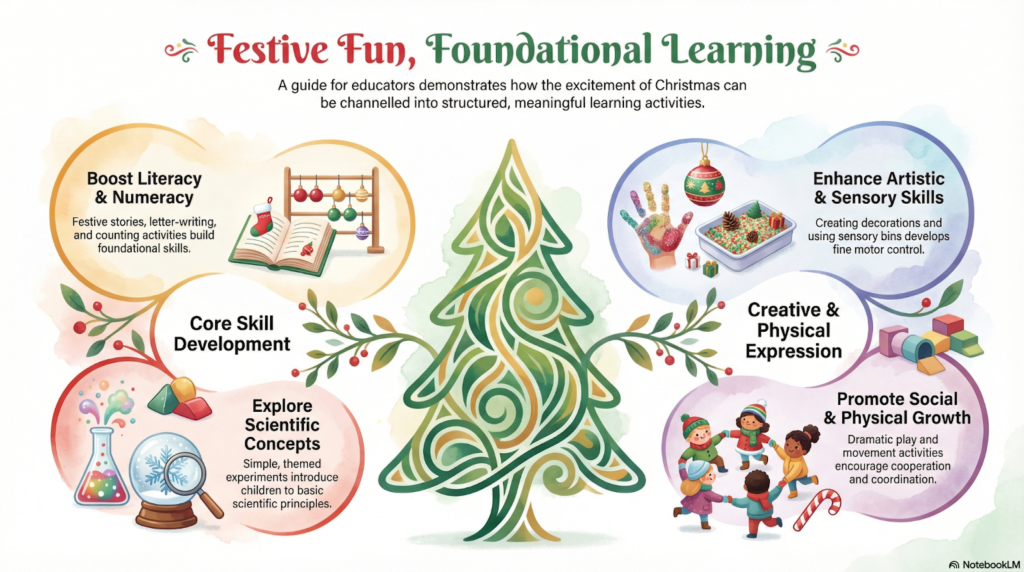
Christmas-themed math activities make abstract concepts concrete through manipulatives and contexts that feel like play rather than formal instruction.
Counting and Number Recognition
Stocking Number Match
Create numbered stockings from 1 to 10 using felt or construction paper. Provide small objects like pom poms, buttons, or mini erasers representing presents. Children count out the corresponding number of items and place them in each stocking. This one-to-one correspondence practice builds counting accuracy and number sense.
Add complexity by providing number cards separately from stockings. Children must match the numeral to the stocking, then count the correct quantity of items. This three-step process builds executive function skills alongside math concepts.
Ornament Pattern Strips
Design strips showing simple AB or ABC patterns using ornament shapes in different colors or designs. Children continue the patterns using actual ornaments, colored chips, or stickers. Pattern recognition forms the foundation for algebraic thinking and helps children predict and analyze sequences.
Progress from simple AB patterns like red, green, red, green to more complex patterns including AAB, ABB, or ABC sequences. Challenge advanced students to create their own patterns for classmates to extend.
Christmas Tree Addition
Cut tree shapes from green felt or construction paper and attach to walls or place flat on tables. Provide sets of pom pom ornaments. Call out simple addition problems like 2 plus 3 and have children place the corresponding numbers of ornaments on their trees, then count the total. This concrete representation makes abstract arithmetic concepts accessible to preschoolers.
For younger students, focus on number combinations to 5. Older preschoolers can explore sums to 10. Always emphasize the language of addition using words like add, plus, altogether, and in all.
Measurement and Comparison
Present Measurement Station
Wrap boxes of various sizes in festive paper and provide measuring tools including cubes, paper clips, or ornament cutouts. Children measure the length, width, and height of each present using non-standard units. Record measurements on simple charts, building data collection skills alongside measurement concepts.
Encourage comparative language as children work by asking which present is longest, which is shortest, which uses more cubes to measure. This vocabulary development supports mathematical thinking and precise communication.
Santa’s Beard Estimation
Create a Santa face outline and provide cotton balls. Before starting, have children estimate how many cotton balls they think will cover Santa’s beard area. Then work together to fill in the beard and count the actual amount. Compare estimates to actuals, introducing the concept of estimation as an important math skill.
Vary the activity by changing the material used such as white pom poms, paper circles, or marshmallows. Children discover that measurement depends on the unit used, a fundamental measurement principle.
Sorting and Classification
Ornament Sort by Attribute
Collect diverse ornaments or cut shapes varying by color, size, and design. Children sort the collection using self-selected criteria. This open-ended approach encourages critical thinking as children decide meaningful ways to group items. Listen to their explanations to assess logical thinking development.
Progress to teacher-directed sorts where you specify the attribute like sort by color or find all the round ornaments. This guided practice builds classification vocabulary and helps children notice specific attributes.
Gift Box Size Sequencing
Wrap 5 to 7 boxes in graduated sizes. Children arrange them in order from smallest to largest or reverse. This seriation activity builds understanding of relative size and comparison concepts. Add challenge by including boxes with similar sizes requiring careful visual discrimination.
Extend to three-dimensional thinking by discussing how larger boxes can hold smaller ones. Demonstrate nesting and have children predict which boxes will fit inside others based on size.
Art and Fine Motor Activities
Art activities develop hand strength, bilateral coordination, and creative expression while producing festive decorations that transform classroom environments and create keepsakes for families.
Process Art Experiences
Christmas Tree Painting
Provide triangle sponges, green paint, and white paper. Children stamp Christmas trees and add decorations using cotton swabs dipped in various paint colors. This process-focused activity emphasizes exploration and technique over producing identical products.
Extend the activity by providing additional materials like glitter, sequins, or torn paper pieces that children glue onto dried trees. These mixed-media experiences build decision-making skills as children choose materials and placement.
Wrapping Paper Design
Give each child a large sheet of white butcher paper and various printing tools including cookie cutters, sponges, blocks, and stamps. Children create custom wrapping paper using holiday colors. This large-scale project builds gross motor coordination and creative confidence.
Use the finished paper to actually wrap classroom items, donate to families who need wrapping supplies, or display as a collaborative mural. Functional art projects demonstrate that creativity serves purposes beyond decoration.
Handprint Wreaths
Trace children’s hands multiple times on green construction paper. Children cut out handprints with supervision and arrange them in circles to create wreaths. Add red pom poms or buttons for berries. This project builds cutting skills, spatial awareness, and transforms simple shapes into recognizable holiday symbols.
Create templates for children who struggle with hand tracing. The goal is developing scissor control rather than perfect tracing. Celebrate wobbly cuts as evidence of learning in progress.
Fine Motor Skill Development
Jingle Bell Threading
Provide pipe cleaners and jingle bells of various sizes. Children thread bells onto pipe cleaners to create bracelets, ornaments, or decorative garlands. This bilateral coordination task strengthens small hand muscles essential for writing development.
Create patterns by alternating different colored bells or varying sizes. This combines math patterning practice with fine motor development for integrated learning.
Ornament Playdough Decorating
Roll playdough into ball shapes and provide materials like beads, sequins, pipe cleaner pieces, and buttons. Children press decorations into playdough ornaments, building pincer grasp strength and hand-eye coordination. The three-dimensional nature of this activity engages spatial reasoning alongside motor skills.
Add cookie cutters and rolling pins so children can create flat ornament shapes before decorating. Vary the challenge by providing tweezers or tongs for placing tiny decorations, increasing difficulty for developing hand strength.
Pom Pom Christmas Tree Transfer
Set up Christmas tree outlines on paper or felt boards. Provide pom poms in holiday colors and tools like tongs, clothespins, or tweezers. Children transfer pom poms from a container onto the tree using the tools, building grasp strength and hand control.
Create a color-matching element by labeling tree sections with color names or providing a color key. Children must place pom poms in designated areas, adding cognitive challenge to the motor task.
Sensory Activities for Exploration and Discovery
Sensory experiences support brain development, language acquisition, and emotional regulation while engaging preschoolers’ natural curiosity about textures, scents, and materials.
Sensory Bins and Tables
Peppermint Sensory Rice
Dye rice in red and white using food coloring and peppermint extract. Fill a sensory table with the scented rice and add scoops, funnels, small containers, and Christmas-themed objects to hide and find. Children develop vocabulary describing scents, textures, and actions as they explore.
Introduce math concepts by providing numbered containers and having children count scoops to fill each one. Discuss measurement vocabulary like full, empty, more, and less as children manipulate the materials.
Cotton Ball Snow Sensory Bin
Fill a large container with cotton balls representing snow. Add pinecones, small trees, toy animals, and vehicles. Children create winter scenes and stories, building narrative skills and imaginative play alongside sensory exploration.
Provide tweezers or tongs for cotton ball transfer to containers or onto outline scenes. This adds fine motor challenge to sensory play. Discuss soft, fluffy, and light as descriptive vocabulary.
Jingle Bell Sound Bottles
Fill clear bottles with varying quantities of jingle bells. Seal tightly with hot glue for safety. Children shake bottles and compare sounds, ordering them from quietest to loudest. This auditory discrimination activity builds listening skills and comparative thinking.
Create matching games where children find bottles with identical sounds. This careful listening develops auditory memory and discrimination essential for phonological awareness and language development.
Scent and Texture Exploration
Christmas Scent Jars
Place different holiday scents like cinnamon sticks, pine needles, peppermint extract on cotton balls, vanilla, and cloves in separate containers with holes in lids. Children smell each container and describe what they notice, building descriptive vocabulary and olfactory awareness.
Create a matching game by making duplicate scent jars. Children smell containers and find matches using only their sense of smell. This isolates sensory input and develops concentration.
Texture Ornament Matching
Create ornament pairs covered in different textures including sandpaper, felt, bubble wrap, aluminum foil, and corrugated cardboard. Children match pairs by feeling textures, developing tactile discrimination and descriptive language.
Play with eyes closed or use a texture bag where children reach in without seeing. This increases challenge and focus on tactile sensations rather than visual cues.
Dramatic Play Scenarios for Social Development
Dramatic play builds social skills, emotional understanding, language development, and imaginative thinking through pretend scenarios connected to familiar Christmas experiences.
Post Office Dramatic Play
Transform your dramatic play area into a Christmas post office complete with envelopes, stamps or stickers, a mailbox, a scale, writing supplies, and wrapped packages. Children role-play mailing letters and packages, practicing social scripts like greetings, questions, and thank yous.
Add literacy elements by providing address labels, Christmas cards to sort, and a simple zip code system. Children practice writing names and numbers in authentic contexts that demonstrate purposes for literacy skills.
Gift Wrapping Station
Provide wrapping paper scraps, small boxes, tape, ribbons, bows, scissors, and gift tags. Children wrap presents for pretend giving, developing spatial reasoning as they figure out how to cover boxes, and fine motor skills as they manipulate tape and tie ribbons.
Encourage social interaction by having children work in pairs where one person holds while the other tapes. This cooperation builds communication skills and teaches the value of helping. Discuss gift giving and thoughtfulness to develop empathy and perspective-taking.
Santa’s Workshop
Set up a workshop area with toy tools, blocks, boxes, ribbons, and craft materials. Children pretend to be elves building and preparing toys. This imaginative play develops narrative skills as children create stories about their work.
Add literacy by providing toy order forms, clipboards, and writing tools. Children write or draw toys they are building and check off completed items. Incorporate math by counting how many toys are ready and how many still need work.
Science and STEM Explorations
Christmas-themed science activities introduce process skills like observation, prediction, experimentation, and analysis through investigations that feel magical to preschoolers.
Simple Science Experiments
Candy Cane Dissolving Experiment
Place candy canes in cups of water at different temperatures including cold, room temperature, and warm water. Children predict which will dissolve fastest and observe changes over time. This introduces cause and effect thinking and the scientific method at an age-appropriate level.
Document observations through drawings or photographs at timed intervals. Discuss why warm water dissolves candy faster, introducing basic concepts about molecular movement in simple language like the warm water makes the candy cane break apart faster.
Melting Snowman Exploration
Create small snowmen using marshmallows and toothpicks or use purchased snowman figures. Place them in different locations like near a heater, in sunlight, in shade, and in the refrigerator. Children predict and observe which snowmen melt fastest, learning about heat and temperature effects.
Graph results to integrate math and science. Create simple bar graphs showing how long snowmen lasted in each location, building data collection and representation skills.
Engineering Challenges
Gingerbread House Structures
Provide graham crackers, frosting for adhesive, and various candies. Challenge children to build the tallest or most stable gingerbread house structure they can create. This engineering design process includes planning, building, testing, and revising based on results.
Discuss why some structures stand while others fall, introducing concepts like balance, base width, and weight distribution in simple terms. Encourage testing and rebuilding rather than expecting success on first attempts.
Christmas Tree Tower Building
Challenge children to build the tallest possible Christmas tree using blocks, magnetic tiles, or other building materials. Add constraints like trees must be triangular or must stand independently to increase engineering challenge.
Provide photos of real Christmas trees and discuss how their shape provides stability. Have children test different designs and determine which features make trees stable versus tippy. This hands-on exploration builds spatial reasoning and engineering thinking.
Movement and Music Activities
Active learning experiences support gross motor development, body awareness, rhythm, and listening skills while providing necessary movement breaks during December’s shortened days and frequent indoor recess.
Movement Games and Songs
Jingle Bell Freeze Dance
Play Christmas music while children dance holding jingle bells. When music stops, children freeze in position. This game builds listening skills, impulse control, and creative movement. Vary the game by calling out specific body positions during freezes or having children dance like different Christmas characters.
Reindeer Races
Set up a simple obstacle course and have children move through it using reindeer movements like galloping, prancing, or hopping. Time races or focus on following the course correctly rather than speed. This gross motor activity builds coordination, balance, and listening to multi-step directions.
Santa Says
Play this Christmas version of Simon Says using holiday-themed actions like wrap a present, hang ornaments high, ring bells, or fly like an elf. This game develops body awareness, listening skills, and impulse control in a playful format.
Music and Rhythm
Jingle Bell Band
Provide rhythm instruments including jingle bells, tambourines, and shakers. Teach simple Christmas songs and have children accompany singing with instruments. This musical experience builds rhythm awareness, following beat, and listening skills.
Create patterns with instrument sounds like bell, bell, shake, bell, bell, shake. Children follow rhythmic patterns, building early mathematical thinking through musical experience.
Christmas Freeze Music
Play various Christmas songs with different tempos. Children move to match the music’s speed, freezing when music stops. Discuss fast, slow, loud, and quiet to build musical vocabulary and listening discrimination.
Classroom Management Tips for December
Successfully implementing Christmas activities requires thoughtful planning that maintains educational focus while honoring holiday excitement.
Creating Manageable Schedules
Introduce one or two new Christmas activities weekly rather than transforming your entire classroom overnight. This gradual approach prevents overstimulation while maintaining novelty and excitement. Rotate activities through centers so children experience variety without overwhelming your preparation time.
Keep daily routines consistent even when activities are themed. Maintain regular circle time, center time, snack time, and outdoor play schedules. The predictable structure provides security for children while allowing festive content within familiar frameworks.
Inclusive Holiday Practices
Recognize that not all families celebrate Christmas. Use inclusive language like winter holidays or end-of-year celebrations when appropriate. Offer alternative activities for children whose families prefer they not participate in Christmas-specific content. Invite families to share their own holiday traditions, creating multicultural learning opportunities.
Focus on universal themes like kindness, generosity, family time, and gratitude that resonate across traditions. These values-based approaches maintain the spirit of the season without requiring specific religious or cultural participation.
Materials and Preparation
Gather materials gradually throughout November to spread out costs and preparation time. Use dollar stores, thrift shops, and recyclable materials to keep expenses low. Many effective Christmas activities require only paper, crayons, and basic craft supplies you already have.
Create activity kits in plastic bins or bags with all materials included. This organization makes rotating activities through centers efficient and reduces setup time. Take photos of completed setups for quick reference when preparing areas.
Assessment Through Christmas Activities
Holiday activities provide rich assessment opportunities when teachers observe purposefully and document learning.
Observational Assessment
Watch children during Christmas activities and note developmental progress in areas including fine motor control during cutting and gluing, counting accuracy during math activities, letter knowledge during writing tasks, social interaction quality during dramatic play, problem-solving approaches during building challenges, and language use during discussions and play.
Keep simple checklists organized by learning domain. Quick check marks during activities build assessment data without requiring additional formal testing time.
Portfolio Documentation
Photograph children engaged in Christmas activities and collect samples of their work. These artifacts demonstrate learning to families and provide concrete evidence of progress. Include brief written descriptions explaining what skills each activity develops.
Let children select pieces for their portfolios, building self-reflection and pride in accomplishments. Their selections reveal what they value and find meaningful.
Conclusion
Christmas activities transform December from a potentially lost instructional month into a rich learning period where preschoolers develop essential skills through joyful, meaningful experiences. The activities in this guide demonstrate that educational rigor and festive fun are not mutually exclusive but rather complementary when approached thoughtfully.
The most effective Christmas activities balance multiple developmental domains simultaneously. A simple ornament sorting task builds math classification skills, fine motor control as children manipulate objects, language development through descriptive conversations, and social skills when completed cooperatively. This integrated approach maximizes learning within limited instructional time.
Remember that the goal extends beyond keeping children busy during an exciting time of year. Each activity serves specific developmental purposes while honoring the magic and wonder that make early childhood education both challenging and deeply rewarding. When children count ornaments, they are not just practicing numbers but building mathematical foundations that support years of future learning. When they dictate letters to Santa, they discover that writing communicates thoughts and desires to others.
As you implement these Christmas activities, observe your students carefully. Notice which activities capture sustained attention, generate rich language, or spark creative problem-solving. These observations guide future planning and help you understand each child’s unique strengths and interests. The informal assessment opportunities embedded in play-based activities reveal learning that formal tests cannot capture.
The memories created through Christmas activities extend beyond December. Years later, former students may not remember specific academic lessons but will recall the joy of creating ornaments, the excitement of dramatic play in Santa’s workshop, or the fascination of watching candy canes dissolve. These positive associations with learning build lifelong curiosity and love of discovery.
Create space for wonder, embrace the messiness of hands-on learning, celebrate process over product, and let the natural magic of the season enhance rather than overshadow your educational mission. When you do, December becomes not a month to survive but a time to treasure as both teacher and learners grow together through shared experiences that honor both childhood and learning.
Frequently Asked Questions:
How many Christmas activities should I do daily?
Incorporate 2 to 3 themed activities into regular center rotations rather than dedicating entire days to Christmas programming.
What if some families do not celebrate Christmas?
Use inclusive winter holiday themes and offer alternative activities while inviting families to share their traditions for cultural learning.
How long should preschoolers spend on each activity?
Allow 10 to 20 minutes per activity with flexibility for highly engaged children to continue longer as attention spans allow.
Can I use these activities with 2 year olds?
Simplify activities by reducing steps, increasing adult support, and focusing on sensory exploration rather than academic outcomes.
How do I manage excitement levels during December? Maintain consistent routines, provide plenty of movement breaks, and balance high-energy activities with calm sensory or art experiences.
What Christmas books work best for preschoolers?
Choose books with simple text, clear pictures, and relatable themes like The Polar Express, How the Grinch Stole Christmas, or The Night Before Christmas.
Should activities be teacher-directed or child-led?
Offer both structured teacher-led activities during circle time and open-ended exploration in centers where children direct their learning.
How do I differentiate Christmas activities for mixed abilities?
Provide multiple entry points within activities using varied materials, adjusting complexity, and allowing different completion levels.
What if I teach in a Montessori program?
Use natural materials, real tools, and self-correcting activities while emphasizing process and independence over product.
How early should I start Christmas activities?
Begin the first week of December to maximize learning time while preventing burnout before winter break arrives.

Belekar Sir is the founder and lead instructor at Belekar Sir’s Academy, a trusted name in English language education. With over a decade of teaching experience, he has helped thousands of students—from beginners to advanced learners—develop fluency, confidence, and real-world communication skills. Known for his practical teaching style and deep understanding of learner needs, Belekar Sir is passionate about making English accessible and empowering for everyone. When he’s not teaching, he’s creating resources and guides to support learners on their journey to mastering spoken English.