Yes, reading transforms children’s lives. Research shows that children who read regularly develop larger vocabularies, stronger empathy, and better academic outcomes than non-readers. Reading literally shapes brain architecture, building neural connections that support cognition and emotional intelligence. Just 10-20 minutes of daily reading provides measurable benefits, with effects that last a lifetime. The single most important activity for eventual reading success is reading aloud to children.
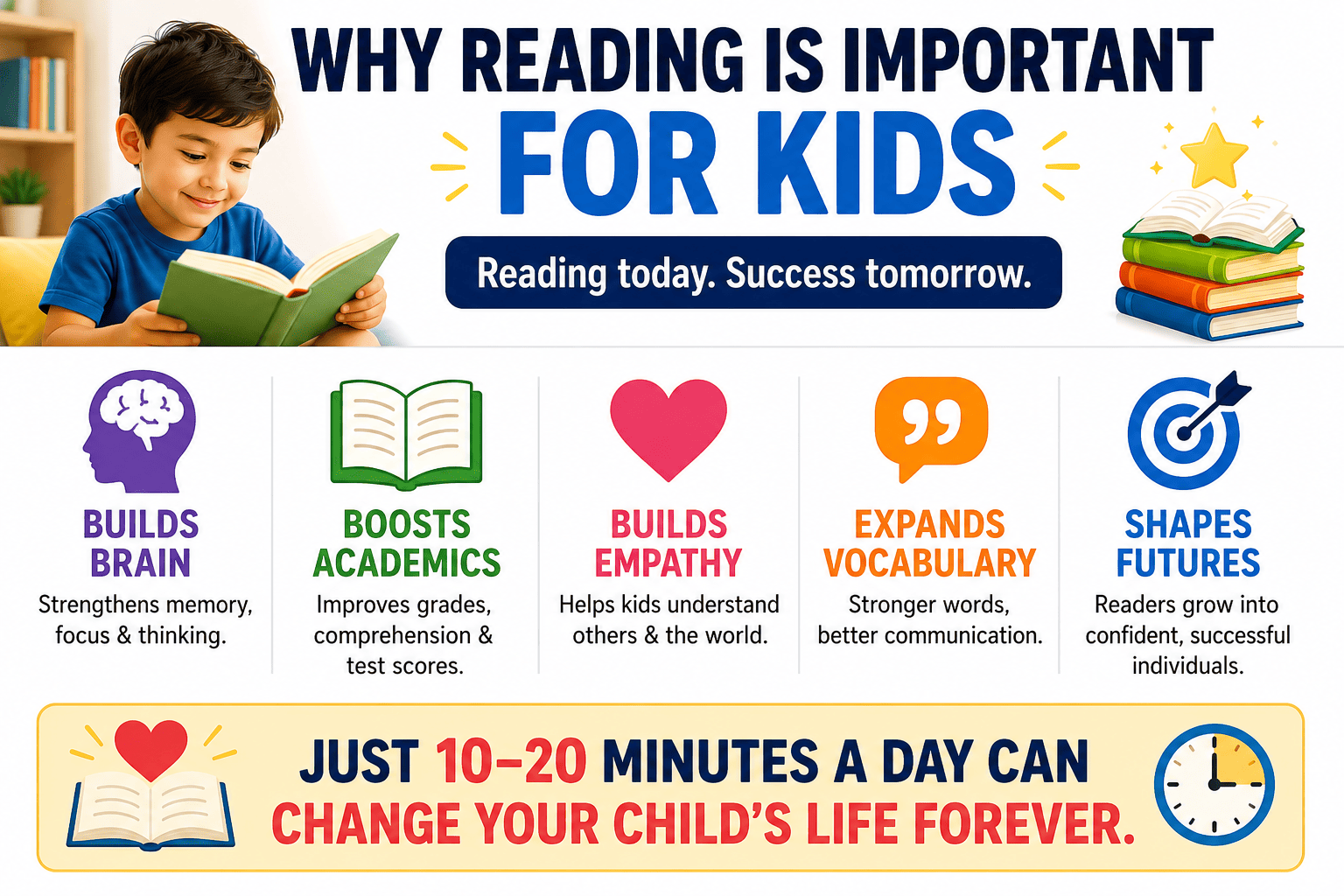
You tuck your child into bed, pick up a picture book, and begin to read. Something magical happens. Their eyes widen. They point at pictures. They ask questions. They snuggle closer. What seems like a simple bedtime ritual is actually one of the most powerful investments you can make in their future. Research consistently shows that reading to children transforms brain development, builds emotional intelligence, and predicts academic success with stunning accuracy.
While many parents understand reading is “good” for children, few realize just how profound and far-reaching the benefits truly are. Reading doesn’t just teach letters and words, it builds the very architecture of the brain, shapes how children understand themselves and others, and creates neural pathways that support learning across every subject. The evidence is overwhelming: reading to children is the single most important activity for building the knowledge and skills they need for success.
Reading activates far more extensive neural networks than passive screen time. Multiple brain regions engage simultaneously: the left temporal cortex processes language, the frontal lobe handles comprehension, the visual cortex creates mental imagery, and emotional centers respond to story content. Most significantly, reading strengthens the neural connections that support cognitive flexibility, empathy, and abstract thinking, skills essential for success in school and life.
Reading engages both logical and creative brain processing simultaneously, strengthening integration between analytical and emotional thinking.
Children who read regularly develop stronger neural connections in areas associated with language, cognition, and emotional regulation.
The first three years see over one million neural connections form every second. Reading shapes which connections grow stronger, literally building the brain’s architecture.
University of Cambridge research found that children who read for pleasure show larger cortical surface areas in brain regions tied to cognition and mental health. These structural differences appear regardless of socioeconomic background, suggesting reading can help overcome disadvantage.
The largest international reading study found that time spent reading books predicts academic success more powerfully than economic status, across every subject including math and science.
Children who have been read to regularly enter school with stronger pre-reading skills, greater vocabulary, and better attention spans, all predictors of kindergarten success.
More than one-third of American children start kindergarten without the skills needed to learn to read. Regular reading closes this gap, providing equalizing benefits across socioeconomic lines.
| Age Range | Daily Reading Goal | Focus Area |
|---|---|---|
| 0–12 months | 5–10 min | Rhythm, bonding, sensory development |
| 1–2 years | 10–15 min | Picture naming, repetition, vocabulary |
| 3–4 years | 15–20 min | Questions, vocabulary, comprehension |
| 5–7 years | 20–30 min | Chapter books, comprehension, discussion |
| 8+ years | 30+ min | Complex texts, critical thinking |
Studies consistently show that children who read for pleasure outperform peers academically, develop stronger concentration, spend less time on screens, and show greater engagement in class. Even more: reading skills underpin every subject, science word problems, history assignments, and art instructions all require reading comprehension.
When children follow a character’s journey, they practice feeling what others feel. Research confirms fiction readers show stronger empathy and social understanding across all ages.
Books provide safe spaces to explore fear, sadness, and anxiety. Characters model coping strategies and emotional regulation that children absorb and apply to their own lives.
Shared reading provides physical closeness, predictable routines, and windows into your child’s inner thoughts. Those “what would you do?” conversations build trust and emotional security that lasts a lifetime.
✔ Recognizing and naming emotions • ✔ Understanding cause/effect in relationships • ✔ Appreciating diversity and different perspectives • ✔ Developing patience and delayed gratification • ✔ Managing difficult feelings through character modeling
Children’s vocabulary at age 3 predicts later academic achievement. Books contain 3x more rare words than daily conversation, building a rich mental dictionary naturally.
Reading aloud develops recognition of sounds, rhymes, and language patterns, foundational skills for learning to read independently.
Children absorb complex sentence structures naturally through books, developing sophisticated language patterns that support writing skills and communication.
Books introduce rare words like bounding, meadow, scruffy, terrier that rarely appear in daily talk. This exposure to sophisticated vocabulary creates a strong foundation for reading comprehension, writing, and academic success. The language-rich environment of reading creates what researchers call a “language explosion” that continues throughout early childhood.
Studies show reading reduces stress more effectively than listening to music or walking. A few quiet pages can calm anxiety and ease bedtime transitions.
Reading requires sustained attention, stronger than fragmented screen activities. Children who read regularly develop longer focus spans that transfer to homework and class participation.
Children who read before bed fall asleep faster, sleep longer, and wake less frequently than those using screens in the evening.
Even newborns benefit from the sound of your voice and the rhythm of language. Board books with high-contrast images work beautifully from day one.
Ten minutes daily beats one hour once a week. Anchor reading to existing routines like bath time, meal time, or bedtime.
Ask: “What do you think happens next?” “How would you feel?” Point to pictures, use silly voices, act out scenes, and follow your child’s lead.
Reread favorites without guilt. Repetition deepens understanding, builds confidence, and children discover new details each time.
Follow their interests, trucks, dinosaurs, fairies, space. Engagement drives learning. Your child’s natural curiosity is your greatest ally.
Stories build empathy; nonfiction builds knowledge and critical thinking. Both are essential for well-rounded development.
Week 1: Read 10 minutes daily at the same time each day. Week 2: Add one interactive question per page. Week 3: Visit the library together and let your child choose books. Week 4: Create a cozy reading nook with pillows and blankets. Make reading something your child looks forward to every day.
Develops listening skills, bonds with caregiver, establishes language rhythm, and builds early print awareness. High-contrast board books are ideal.
Builds vocabulary, develops comprehension, introduces story structure, and creates foundation for reading. Repetition is your best friend at this age.
Develops pre-reading skills, builds world knowledge, sparks imagination, and prepares for school. Conversations about stories accelerate learning.
Builds independent reading, develops comprehension strategies, expands vocabulary, and deepens empathy. Chapter books become a new adventure.
Builds critical thinking, develops advanced vocabulary, creates lifelong reading habit, and supports academic success across all subjects.
| Obstacle | Solution |
|---|---|
| Child won’t sit still | Start with 2-3 minute sessions; use interactive books; read during bath time; let them wiggle while you read aloud |
| Too tired at bedtime | Read earlier in the day; try morning reading; keep it short; use audiobooks in the car |
| No time as a parent | Incorporate reading into existing routines; delegate to another family member; use audiobooks during commutes |
| Child prefers screens | Make reading a special one-on-one time; pair screen time with reading time; use interactive book apps together |
| Limited book access | Use the library; access free digital books; visit used bookstores; borrow from friends and family |
| Child says reading is boring | Let them choose books about topics they love; try graphic novels; use audiobooks; make it a game |
Reading to children provides unparalleled benefits: brain development, academic achievement, emotional intelligence, and deep parent-child connection. Every moment spent with a book is an investment in your child’s future, one that outperforms many costly interventions and creates lasting bonds that no technology can replicate.
You don’t need special training or money. Just a library card, a few minutes, and your loving presence. The research is clear: the single most important activity for building the knowledge and skills children need for eventual success is reading aloud to them. Start tonight. Pick a book, snuggle close, and begin. The neural connections, the empathy, the vocabulary growth, they all start with you turning the page.
Your daily read-aloud is the most powerful investment you’ll ever make. Every page turned is a door opened.
Explore more articles on literacy, parenting, and learning at Belekar Sir’s Academy.
Browse All Articles → Try Our ToolsContinue exploring literacy and learning with our guides on English phonetics, types of adjectives, and adjectives to describe yourself.

Belekar Sir is the founder and lead instructor at Belekar Sir’s Academy, a trusted name in English language education. With over a decade of teaching experience, he has helped thousands of students—from beginners to advanced learners—develop fluency, confidence, and real-world communication skills. Known for his practical teaching style and deep understanding of learner needs, Belekar Sir is passionate about making English accessible and empowering for everyone. When he’s not teaching, he’s creating resources and guides to support learners on their journey to mastering spoken English.