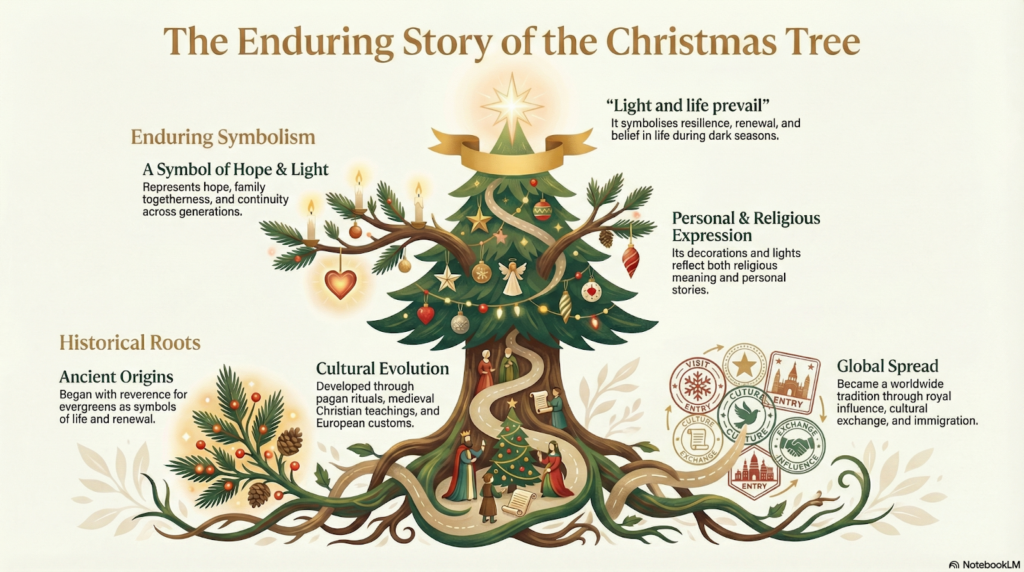
The Christmas tree stands as one of the most universally recognized symbols of the holiday season. From towering evergreens in public squares to modest trees in living rooms, this decorated centerpiece brings families together and transforms ordinary spaces into festive celebrations. Yet behind its twinkling lights and colorful ornaments lies a fascinating history that spans thousands of years, cultures, and continents. The journey of the Christmas tree from ancient pagan ritual to modern holiday tradition reveals how human societies adapt, preserve, and share meaningful customs across generations.
Understanding the Christmas tree requires looking beyond its current form as a seasonal decoration. This evergreen symbol connects us to ancestors who worshipped trees as sacred beings, medieval Christians who used them to teach biblical stories, Protestant reformers who added candles to represent divine light, Victorian royalty who popularized the tradition across continents, and countless families who have made tree decorating a cherished annual ritual. The Christmas tree is not merely decoration but a living tradition that carries forward ancient wisdom about hope, renewal, and the persistence of life through darkness.
The origins of the Christmas tree tradition reach far deeper than Christianity itself. Long before the birth of Christ, ancient civilizations recognized something profound and mysterious in evergreen plants. While other trees shed their leaves and appeared lifeless during winter, evergreens remained vibrant and green, seemingly immune to the season’s harshness. This remarkable quality elevated them to sacred status across diverse cultures who viewed them as symbols of eternal life, divine power, and the promise that spring would eventually return.
Ancient Egyptians brought green date palm fronds into their homes during the winter solstice, celebrating the sun god Ra’s recovery from illness. They believed these green plants held protective powers that could ward off death and disease. Similarly, the Romans honored Saturn during their week long Saturnalia festival by decorating homes and temples with evergreen boughs. These decorations symbolized the triumph of life over death and served as reminders that warmth and growth would return after winter’s cold grip loosened.
In Northern Europe, Celtic Druids considered evergreens sacred and used them extensively in religious ceremonies. They believed these plants possessed magical properties that could repel evil spirits, heal illnesses, and protect homes during winter’s vulnerability. The Druids decorated their temples with evergreen branches as symbols of everlasting life and hung them over doorways as spiritual protection. The Vikings associated evergreens with Balder, their beloved god of light and goodness, and incorporated them into Yule celebrations that honored the winter solstice.
Tree worship itself was common among pagan Europeans. The Germanic peoples believed that gods and spirits inhabited trees, particularly oak trees which they considered most sacred. This reverence for trees would later influence how Christianity adapted and transformed pagan customs into new religious traditions. Rather than completely eliminating these deeply rooted beliefs, Christian missionaries often reinterpreted them within a Christian framework, creating continuity between old practices and new faith.
The transformation of evergreen reverence into the Christmas tree tradition as we know it began in medieval Germany, where several distinct customs merged into something new. During the Middle Ages, Germans celebrated the feast day of Adam and Eve on December 24 with mystery plays that depicted biblical stories for largely illiterate populations. The central prop in these performances was the Paradise Tree, a fir decorated with red apples representing the Tree of Knowledge in the Garden of Eden from which Adam and Eve ate the forbidden fruit.
These Paradise Trees served both theatrical and devotional purposes. The apples symbolized sin and the fall of humanity, while the evergreen tree itself represented the promise of salvation and eternal life through Christ. When church authorities eventually banned these public religious plays, German families began setting up Paradise Trees in their own homes as private devotional symbols, keeping the tradition alive in domestic rather than public spaces.
Simultaneously, German households erected Christmas Pyramids, wooden structures shaped like pyramids and decorated with evergreen branches, candles, a star on top, and figurines depicting the Nativity scene. The pyramids pointed upward toward heaven, the candles represented Christ as the light of the world, and the evergreen decorations symbolized eternal life. The pyramid shape itself held symbolic significance, with its broad base representing earth and its point reaching toward God’s dwelling in heaven.
By the 16th century, these two separate traditions had merged. Germans began bringing whole evergreen trees indoors and decorating them with apples, nuts, cookies, wafers symbolizing the Eucharist, and candles. This fusion created the first recognizable Christmas tree, combining the Paradise Tree’s symbolic fruit with the Christmas Pyramid’s lights and devotional purpose. The tradition spread among German Protestant families who saw the decorated tree as both a celebration of Christ’s birth and a teaching tool for children about biblical stories and Christian theology.
One of the most enduring legends surrounding Christmas trees involves Martin Luther, the Protestant Reformer who sparked the Reformation in 1517. According to popular tradition, Luther was walking home on a clear winter evening when he became enchanted by the sight of stars twinkling through evergreen branches. Inspired to recreate this magical scene for his family, he brought a small tree indoors, attached candles to its branches, and lit them to simulate starlight.
Whether this story is historically accurate or embellished folklore matters less than what it represents. The addition of candles transformed Christmas trees from static decorations into illuminated spectacles that captured the imagination. The flickering candlelight symbolized Christ as the light of the world, driving away spiritual darkness just as physical light dispels the night. This innovation, whether by Luther or someone else, fundamentally changed how people experienced Christmas trees, making them not just symbolic objects but sources of wonder and beauty.
The Christmas tree tradition spread beyond Germany slowly, encountering resistance in some places before eventually achieving universal acceptance. In England, the tradition gained traction through royal influence. Prince Albert, the German born husband of Queen Victoria, grew up with Christmas trees and introduced the custom to the British royal family after his marriage in 1840. In 1848, the Illustrated London News published an image of Queen Victoria, Prince Albert, and their children gathered around a decorated Christmas tree at Windsor Castle.
This single image revolutionized Christmas celebrations throughout the British Empire. The royal endorsement made Christmas trees fashionable and socially desirable. If the beloved Queen and her family celebrated with a decorated tree, it became appropriate and even prestigious for others to adopt the practice. The tradition spread rapidly from aristocratic homes to middle class households, transforming British Christmas customs within a single generation. By the 1850s, Christmas trees had become standard features of British holiday celebrations.
In America, the Christmas tree faced stronger initial resistance rooted in religious objections. German immigrants brought Christmas trees to Pennsylvania as early as the 1700s, establishing the tradition in their communities. However, many Americans, particularly those of Puritan heritage, viewed Christmas trees as pagan symbols incompatible with Christian worship. The Puritans had historically opposed elaborate Christmas celebrations of any kind, viewing them as Catholic corruptions of religious observance that lacked biblical justification.
This opposition was not merely theological preference but sometimes became law. In 1659, the General Court of Massachusetts actually made observing Christmas a criminal offense, fining anyone who decorated their homes or failed to work on December 25. William Bradford, the second governor of Plymouth Colony, worked aggressively to stamp out what he called pagan mockery of sacred events. For nearly two centuries, this Puritan influence kept Christmas celebrations, including trees, suppressed in much of New England and other regions with strong Puritan populations.
The gradual softening of American attitudes toward Christmas trees occurred through multiple influences. German and Irish Catholic immigrants continued their traditions despite opposition, slowly normalizing practices that had been considered suspicious or un American. When images of Queen Victoria’s Christmas tree reached American publications in the 1850s, they influenced public opinion just as powerfully as they had in Britain. If British royalty could embrace Christmas trees without compromising their Christian faith or social standing, perhaps Americans could do likewise.
The Civil War period and subsequent decades saw Christmas trees become increasingly mainstream in American culture. By the 1870s, Christmas trees appeared in churches, schools, and public spaces throughout the country. The rise of consumer culture and mass production made decorations affordable for middle class families. German glass ornament makers found eager American markets, and entrepreneurs like F.W. Woolworth made fortunes importing decorations. By 1890, Woolworth’s stores alone sold approximately 25 million dollars worth of German glass ornaments annually, demonstrating how thoroughly Christmas trees had penetrated American holiday culture.
The symbolism of the Christmas tree contains multiple layers that have accumulated across centuries and cultures. For Christians, the evergreen nature represents eternal life offered through faith in Jesus Christ. Just as the tree remains alive and green through winter when other plants appear dead, believers possess the promise of eternal life that transcends physical death. The tree serves as a living reminder that death is not the end but a transition to everlasting life in God’s presence.
The triangular shape of many Christmas trees points upward toward heaven, directing thoughts away from earthly concerns toward spiritual matters and God’s dwelling above. This symbolic geometry reinforces the idea that Christmas is fundamentally about divine events rather than merely earthly celebrations. The tree’s upward reach reminds observers to lift their hearts and minds toward higher purposes and eternal truths rather than remaining focused solely on material gifts and festivities.
Lights decorating the tree symbolize Christ as the light of the world who came to illuminate humanity’s darkness both spiritual and physical. The original candles have been replaced by safer electric lights, but the theological meaning remains unchanged. Each glowing bulb represents divine light penetrating the darkness of sin, ignorance, and death. The lit tree stands as a beacon of hope, proclaiming that light has entered the world and darkness cannot overcome it, echoing the opening verses of John’s Gospel.
The star or angel traditionally placed atop Christmas trees carries specific biblical significance. The star represents the Star of Bethlehem that guided the Wise Men to the infant Jesus, serving as a celestial announcement of the Messiah’s birth. The angel represents Gabriel who announced Christ’s coming to Mary and the angels who proclaimed his birth to shepherds. Either ornament crowns the tree with a reminder that Christmas celebrates God’s intervention in human history through miraculous events.
Beyond specifically Christian interpretations, Christmas trees embody universal human themes that resonate across different faiths and cultures. The tree represents hope during darkness, appearing in homes precisely when nights are longest and days shortest. Its presence assures us that light and warmth will return, that winter’s harshness is temporary, and that renewal follows every period of cold and darkness. This message of hope speaks to fundamental human needs regardless of religious background.
The ritual of decorating the Christmas tree brings families together in shared activity and celebration. Parents and children collaborate in untangling lights, hanging ornaments, and deciding where each decoration should go. These moments create lasting memories and strengthen family bonds through cooperation toward a common goal. The decorated tree becomes a focal point for family gatherings throughout the season, drawing people together physically and emotionally.
Many families pass ornaments down through generations, creating tangible connections between past, present, and future. A grandmother’s antique glass ornaments, a child’s handmade decorations from preschool, a commemorative ornament marking a wedding or birth, all hang together on the tree, telling the family’s story through objects. This continuity connects individuals to their history and traditions, providing a sense of belonging and identity that extends beyond the present moment.
The tradition of placing gifts beneath the tree symbolizes the spirit of generosity that characterizes the season. The practice recalls the gifts the Wise Men brought to the infant Jesus and embodies the Christian teaching that God gave humanity the gift of his Son. The gift giving tradition reinforces values of generosity, thoughtfulness, and love that extend beyond material objects to encompass how we treat one another throughout the year.
The decorated Christmas tree creates an atmosphere of beauty, magic, and wonder that enchants children and adults alike. The sparkle of ornaments catching light, the fragrance of fresh pine needles, the soft glow of lights in a darkened room, all combine to create sensory experiences that define the season’s special quality. This aesthetic beauty serves purposes beyond decoration, nurturing the human spirit and creating space for joy, reflection, and celebration.
Christmas tree decorations have evolved dramatically from their medieval origins to contemporary expressions of personal style and cultural identity. The earliest German Christmas trees were decorated with items that held both practical and symbolic significance. Apples represented the Paradise Tree’s forbidden fruit and the fall of humanity into sin. Nuts symbolized the mystery of God’s providence and the difficulty of understanding divine ways. Cookies and wafers shaped like stars, hearts, and flowers represented heavenly blessings and the sweetness of salvation. Candles provided light and symbolized Christ illuminating the world.
The 1870s brought a revolutionary innovation when German and Bohemian craftsmen began producing blown glass ornaments. These delicate spheres, figurines, and icicles added sparkle and elegance that homemade decorations could not match. Initially expensive luxuries affordable only by wealthy families, glass ornaments became more accessible as production expanded and prices dropped. The ornaments came in increasingly elaborate forms including animals, fruits, vegetables, buildings, vehicles, and fantastical shapes that turned trees into displays of artistic creativity.
The development of electric Christmas lights in the 1880s eliminated the fire hazard posed by candles while enabling more spectacular displays. Edward Johnson, an associate of Thomas Edison, created the first electrically lit Christmas tree in 1882 by hand wiring 80 red, white, and blue bulbs. By the early 20th century, companies began manufacturing strings of electric lights that middle class families could afford, making illuminated trees standard rather than exceptional. Electric lights allowed trees to remain lit for hours without constant supervision, fundamentally changing how families used and enjoyed their trees.
Today, Christmas tree decorating reflects diverse personal styles and cultural influences. Traditional themes emphasize red and gold colors, religious ornaments depicting angels and Nativity scenes, and classic designs passed down through generations. Rustic farmhouse styles feature natural materials like burlap ribbons, wooden ornaments, and decorations made from pinecones and dried fruits. Minimalist modern trees use monochromatic color schemes, simple geometric shapes, and streamlined designs that emphasize clean lines over ornate detail.
Cultural decorations incorporate ethnic traditions from around the world, with Polish families hanging colorful paper stars, Mexican families adding handmade tin ornaments, Swedish families placing straw goats and red wooden horses, and Filipino families displaying parol lanterns shaped like stars. These culturally specific decorations maintain connections to heritage while participating in the broader Christmas tree tradition shared across cultures.
Personalized trees display family photos in ornament frames, handmade crafts created by children, commemorative ornaments marking significant life events, and collections reflecting personal interests like sports, hobbies, or favorite characters. These personalized decorations transform the tree from generic seasonal decoration into a unique expression of family identity and individual personality.
While Christmas trees originated as a specific cultural tradition, they have spread globally and been adapted to local customs and circumstances. Some cities receive annual Christmas trees as diplomatic gifts symbolizing international friendship and gratitude. Since 1947, Norway has given London a large Christmas tree displayed in Trafalgar Square, thanking Britain for support during World War II when the Norwegian government in exile found refuge in London. Boston receives a tree annually from Nova Scotia, expressing gratitude for rapid aid following the devastating 1917 Halifax explosion.
These gift trees transcend mere decoration to become symbols of enduring relationships between peoples and nations. The annual ceremonies surrounding their arrival, installation, and lighting create opportunities for diplomatic speeches, public celebrations, and renewed commitments to friendship. The trees themselves physically embody the bonds connecting distant places through shared history and mutual support.
The Christmas tree industry represents significant economic activity supporting thousands of farms, workers, and businesses. In the United States alone, approximately 25 to 30 million real Christmas trees are sold annually, generating hundreds of millions in revenue for growers, retailers, and transportation companies. The industry provides employment in rural communities where alternative economic opportunities may be limited. Tree farms cultivate various species including Douglas fir, Fraser fir, Noble fir, Balsam fir, and Scotch pine, each with distinct characteristics appealing to different consumer preferences.
The debate between real versus artificial trees continues with environmental advocates and industry representatives presenting competing arguments. Real tree proponents emphasize that trees are renewable crops grown specifically for harvest, absorb carbon dioxide while growing, and decompose naturally or can be recycled into mulch. Artificial tree advocates argue that reusable trees eliminate annual environmental impacts of harvesting and transportation while reducing allergen exposure for sensitive individuals. The debate reflects broader environmental consciousness and consumer choices balancing convenience, cost, and ecological considerations.
Community Christmas trees have become centerpieces of public celebrations in cities worldwide. The Rockefeller Center tree in New York City, illuminated annually since 1933, attracts millions of visitors and marks the official start of the holiday season for many Americans. The tree lighting ceremony features live entertainment, celebrity appearances, and nationwide television broadcast, transforming a local event into a shared national experience. Cities from London to Sydney to Tokyo host similar tree lighting ceremonies that unite communities in collective celebration.
The Christmas tree has profoundly influenced popular culture, appearing prominently in holiday films, television specials, music, and literature. The 1965 television special A Charlie Brown Christmas transformed cultural perceptions by celebrating a small, humble tree rejected by others as inadequate. Charlie Brown’s choice of the pathetic tree over flashy artificial ones, and his friends’ transformation of it through love and decoration, taught that authenticity and meaning matter more than perfection and commercialism. The special’s enduring popularity reflects how deeply its message about the true spirit of Christmas resonates across generations.
Christmas songs celebrate the tree as a symbol of holiday joy and family togetherness. O Christmas Tree, originally a German folk song about the constancy of fir trees, has been adapted across cultures and languages. Rockin’ Around the Christmas Tree captures 1950s American optimism and the tree’s role in holiday parties and celebrations. These songs and countless others embed the Christmas tree deeply in our collective cultural consciousness, making it inseparable from how we imagine and experience the holiday season.
The Christmas tree represents far more than festive decoration or seasonal custom. It embodies humanity’s eternal quest for meaning, hope, and connection during life’s darkest and most challenging moments. From ancient peoples who worshipped evergreens as manifestations of divine power through medieval Christians who used them to teach biblical truths to modern families who gather around them to exchange gifts and create memories, the Christmas tree has evolved while maintaining its essential purpose of bringing light, hope, and joy into human experience.
The journey of the Christmas tree from sacred grove to living room centerpiece demonstrates how cultures adapt and preserve meaningful traditions across time. What began as pagan reverence for nature’s persistence became Christian theology made visible, which transformed into family ritual and commercial enterprise, yet somehow retained its capacity to inspire wonder and unite people in celebration. This remarkable evolution shows that truly meaningful symbols transcend their origins to speak to fundamental human needs and aspirations.
As we decorate our trees each December, we participate in a living tradition connecting us to countless others across history who found comfort, hope, and joy in evergreen branches. We stand in continuity with ancient Egyptians carrying palm fronds home during winter, Roman celebrants decorating for Saturnalia, Celtic Druids honoring sacred groves, medieval Germans staging Paradise plays, Protestant reformers adding candles, Victorian families gathering around their first trees, and generations of parents and children creating memories through shared decoration rituals.
The Christmas tree will continue evolving in future generations, adapting to new technologies, aesthetic preferences, and cultural contexts while maintaining its core significance as a symbol of hope, renewal, and celebration. Whether decorated with expensive designer ornaments or humble handmade crafts, standing in grand public squares or modest apartments, made from real evergreens or artificial materials, the Christmas tree fulfills its ancient purpose of reminding us that light persists through darkness, life endures through hardship, and hope survives through the longest winter nights.
This year, as you select, decorate, and admire your Christmas tree, remember that you participate in a tradition thousands of years in the making, a tradition that spans cultures, continents, and centuries, a tradition that will continue bringing light and hope to future generations just as it illuminates our present celebration. The evergreen branches reaching upward, the lights twinkling in darkness, the ornaments reflecting our stories and histories, all combine to create something greater than decoration, something that touches the deepest human longings for meaning, beauty, connection, and transcendence. The Christmas tree, in all its varied forms across all its long history, speaks to what is most essential and enduring in the human spirit, the belief that light will always overcome darkness, that life will always triumph over death, and that hope will always persist no matter how long and cold the winter.
Conclusion
In conclusion, the Christmas tree is much more than a decorative symbol of the holiday season. It represents joy, hope, togetherness, and the spirit of giving that Christmas brings to people around the world. Decorating the tree brings families closer, creates lasting memories, and fills homes with warmth and happiness. Whether it is a real tree or an artificial one, the Christmas tree reminds us of love, peace, and new beginnings. Its glowing lights and ornaments inspire positivity and celebration, making the Christmas tree an enduring and meaningful part of the festive season.

Belekar Sir is the founder and lead instructor at Belekar Sir’s Academy, a trusted name in English language education. With over a decade of teaching experience, he has helped thousands of students—from beginners to advanced learners—develop fluency, confidence, and real-world communication skills. Known for his practical teaching style and deep understanding of learner needs, Belekar Sir is passionate about making English accessible and empowering for everyone. When he’s not teaching, he’s creating resources and guides to support learners on their journey to mastering spoken English.