A Christmas Memory by Truman Capote stands as one of American literature’s most beloved holiday tales, captivating readers for nearly seven decades with its poignant portrayal of friendship, innocence, and the joy of giving. Published in Mademoiselle magazine in December 1956, this largely autobiographical story recounts the special bond between seven-year-old Buddy and his elderly cousin Sook as they prepare for Christmas in rural Alabama during the 1930s Depression era.
The story’s enduring appeal stems partly from Capote’s masterful use of rich, evocative vocabulary that brings the Depression-era South to life. His precise word choices create vivid imagery, establish authentic regional atmosphere, and convey complex emotions through deceptively simple prose. Understanding this vocabulary deepens comprehension of the narrative while revealing how Capote’s linguistic craftsmanship transforms a personal memory into universal literature.
This comprehensive vocabulary guide provides everything students, teachers, and literature enthusiasts need to fully appreciate Capote’s language choices. You will discover 60 essential vocabulary words organized by theme and difficulty, explore detailed definitions with story context, learn pronunciation guides for challenging terms, understand how vocabulary contributes to literary techniques like mood and characterization, and gain strategies for vocabulary retention and analysis. Whether you are preparing for a test, teaching the story, or simply enriching your reading experience, this guide illuminates the linguistic beauty of A Christmas Memory.
Understanding the Story Context
Before diving into specific vocabulary, understanding the story’s setting and narrative structure provides essential context for why Capote chose particular words and how they function within the text.
Historical and Geographic Setting
A Christmas Memory takes place in rural Alabama during the early 1930s, a time when the Great Depression gripped America and traditional Southern culture remained largely unchanged by modernization. This setting influences vocabulary choices throughout the story. Words describing poverty, rural life, and Depression-era realities appear frequently. Regional dialect and Southern speech patterns color the dialogue. Religious terminology reflects the Bible Belt culture of the Deep South.
The story unfolds in a spreading old house inhabited by multiple generations of relatives, with the kitchen serving as the central gathering place. This domestic setting generates vocabulary related to cooking, household items, and family dynamics that ground readers in the intimate world Buddy and Sook inhabit.
Narrative Style and Voice
Capote employs first-person narration from an adult Buddy looking back on childhood memories. This retrospective voice creates layers of meaning where vocabulary choices reflect both child-like wonder and adult understanding. Simple words take on poignancy when readers recognize what the child narrator cannot yet comprehend. Sophisticated vocabulary appears seamlessly alongside colloquial speech, mirroring how memory blends impression with reflection.
The largely present-tense narration despite being a memory creates immediacy that makes readers feel present in the scenes. This stylistic choice affects vocabulary by favoring active, sensory language that puts readers in the moment rather than passive descriptions of past events.
Essential Vocabulary by Category
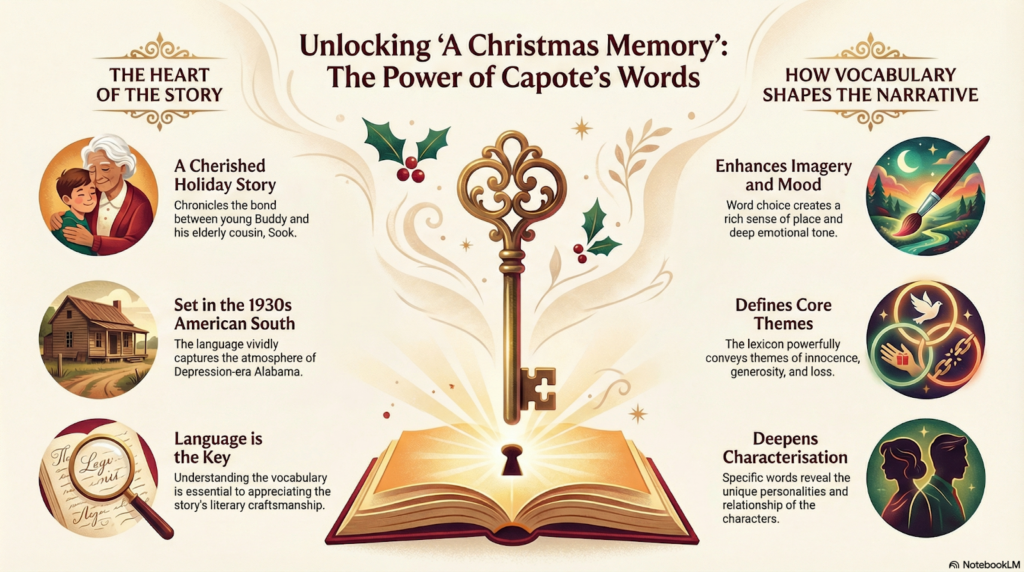
Organizing vocabulary by theme helps students understand how words work together to create atmosphere, develop characters, and advance the narrative.
Character Description Words
| Word | Pronunciation | Definition | Story Context |
| Sprightly | SPRITE-lee | Lively and energetic despite age | Describes Sook as small and sprightly, like a bantam hen |
| Craggy | KRAG-ee | Rough and uneven in texture | Her face is craggy like Lincoln’s, weathered by sun and wind |
| Gaunt | GAWNT | Thin and bony, often from suffering | Describes physical appearance showing hardship |
| Bantam | BAN-tum | Small but spirited, like a bantam chicken | Compares Sook’s small stature to this chicken breed |
| Hunched | HUNCHD | Bent forward with rounded shoulders | Her shoulders are pitifully hunched from childhood illness |
| Shorn | SHAWRN | Cut very short | Describes Sook’s white hair as closely cropped |
| Delicate | DEL-ih-kit | Fragile, fine in texture or construction | Her face is finely boned and delicate despite being weathered |
These descriptive terms create a vivid portrait of Sook, emphasizing the contrast between her small, delicate frame and her spirited, energetic personality. Capote carefully balances words suggesting fragility with those conveying strength, reflecting Sook’s complex characterization as childlike yet resilient.
Setting and Atmosphere Words
| Word | Pronunciation | Definition | Story Context |
| Spreading | SPRED-ing | Extended over a large area | Describes the rambling old house |
| Commenced | kuh-MENST | Began or started | The fireplace commenced its seasonal roar |
| Murky | MUR-kee | Dark and gloomy, difficult to see through | Describes dim lighting and shadows |
| Silhouette | sil-oo-ET | Dark outline against lighter background | Trees or figures outlined against sky |
| Dilapidated | dih-LAP-ih-day-ted | In disrepair, falling apart | Describes the old baby buggy they use |
| Barren | BAIR-un | Empty, without vegetation or life | Describes winter landscapes |
| Stark | STARK | Bare, harsh, or plain without decoration | Winter trees and landscapes |
Setting vocabulary establishes the Depression-era rural South through words suggesting age, decay, and simplicity. These terms create an atmosphere of humble poverty that makes the Christmas preparations and gift-giving even more meaningful.
Action and Movement Verbs
| Word | Pronunciation | Definition | Story Context |
| Inaugurating | in-AW-gyuh-ray-ting | Beginning formally, initiating | Sook inaugurates the Christmas season |
| Exhilarates | ig-ZIL-uh-rayts | Fills with excitement and energy | Christmas exhilarates Sook’s imagination |
| Puttering | PUT-er-ing | Moving or acting in an aimless way | Sook putters around the kitchen |
| Scuttling | SKUT-ling | Moving quickly with short steps | Describes hurried, busy movement |
| Laboring | LAY-bor-ing | Working hard with great effort | They labor to collect pecans |
| Hauling | HAWL-ing | Pulling or dragging with effort | Hauling the Christmas tree home |
| Trudging | TRUJ-ing | Walking slowly with heavy steps | Trudging through snow or difficult terrain |
| Loitering | LOI-ter-ing | Standing around idly | Describes aimless waiting or wandering |
Action verbs throughout the story emphasize physical labor and effort, highlighting how Buddy and Sook work hard for their Christmas preparations despite limited resources. These words contrast energetic activity with quieter moments, creating narrative rhythm.
Emotional and Mental State Words
| Word | Pronunciation | Definition | Story Context |
| Exhilaration | ig-zil-uh-RAY-shun | Feeling of excitement and happiness | Christmas preparations fill Sook with exhilaration |
| Melancholy | MEL-un-kol-ee | Deep sadness or depression | The ending carries melancholy as Buddy reflects on loss |
| Rapture | RAP-chur | Intense pleasure or joy | Moments of pure happiness feel like rapture |
| Conspiratorial | kun-speer-uh-TOR-ee-ul | Secretive, like planning together | Buddy and Sook have conspiratorial friendship |
| Wrathful | RATH-ful | Full of anger and fury | Describes relatives’ angry scolding |
| Mortified | MOR-tuh-fyed | Deeply embarrassed or ashamed | How characters feel after being caught with whiskey |
| Forlorn | for-LORN | Sad and lonely, pitifully abandoned | Describes Sook’s situation after Buddy leaves |
Emotional vocabulary reveals the story’s heart, contrasting joyful Christmas preparations with underlying loneliness and the poignant knowledge of eventual separation. These words help readers understand characters’ inner lives beyond surface actions.
Food and Cooking Vocabulary
| Word | Pronunciation | Definition | Story Context |
| Fruitcake | FROOT-kayk | Dense cake containing dried fruits and nuts | The central project of their Christmas preparations |
| Pecans | pih-KANZ or PEE-kanz | Oval nuts with sweet flavor | Main ingredient they gather for fruitcakes |
| Whiskey | WISS-kee | Distilled alcoholic spirit | Bought from bootlegger for fruitcake flavoring |
| Ingredient | in-GREE-dee-ent | Component of a mixture or recipe | Various items needed for fruitcakes |
| Vanilla | vuh-NIL-uh | Flavoring extracted from vanilla beans | One of the fruitcake ingredients |
| Raisins | RAY-zinz | Dried grapes | Fruitcake ingredient |
| Cherries | CHAIR-eez | Small red stone fruits | Used to decorate fruitcakes |
| Citron | SIT-run | Candied citrus peel | Traditional fruitcake ingredient |
Food vocabulary centers on fruitcake-making, the story’s central activity that symbolizes love, giving, and shared tradition. Capote’s detailed attention to ingredients and preparation emphasizes how this humble cooking project carries enormous emotional significance for Buddy and Sook.
Nature and Weather Terms
| Word | Pronunciation | Definition | Story Context |
| Bleached | BLEECHT | Whitened by exposure to sun or chemicals | Describes winter grass and landscapes |
| Frosted | FRAWST-ed | Covered with thin layer of ice crystals | Morning grass and windows |
| Windfall | WIND-fawl | Fruit or nuts blown down by wind | Pecans fallen naturally from trees |
| Boughs | BOWZ | Tree branches, especially main ones | Pine boughs used for decoration |
| Thicket | THIK-it | Dense group of bushes or trees | Where they search for the Christmas tree |
| Undergrowth | UN-der-grohth | Plants growing beneath taller trees | Forest floor vegetation |
Nature vocabulary grounds the story in rural life where people interact directly with the land. These terms emphasize Buddy and Sook’s connection to the natural world and how they gather what they need from surrounding countryside rather than purchasing from stores.
Difficult and Advanced Vocabulary
| Word | Pronunciation | Definition | Story Context |
| Paraphernalia | pair-uh-fer-NAYL-yuh | Miscellaneous equipment or items | The various tools and items they use |
| Sacrilegious | sak-rih-LIJ-us | Disrespectful toward sacred things | How relatives view the whiskey incident |
| Ruination | roo-ih-NAY-shun | Complete destruction or downfall | Relatives worry about Buddy’s moral ruination |
| Reveille | REV-uh-lee | Morning bugle call to wake soldiers | Mentioned when Buddy goes to military school |
| Subsequently | SUB-see-kwent-lee | Happening afterward, later | Describes sequence of events |
| Suffice | suh-FYCE | Be enough or adequate | Checking if resources suffice for needs |
Advanced vocabulary reveals Capote’s sophisticated prose despite the story’s simple surface. These words add literary depth while remaining accessible within context, demonstrating how strong writing educates readers naturally through engaging narrative.
Literary Techniques Enhanced by Vocabulary
Understanding how Capote’s vocabulary choices support specific literary techniques deepens appreciation for his craftsmanship and helps students analyze the story more effectively.
Imagery and Sensory Language
Capote employs rich sensory vocabulary that engages all five senses, creating vivid mental pictures that immerse readers in Buddy and Sook’s world. Visual imagery dominates with color words like sherry-colored eyes, white hair, and black stove. Tactile descriptions include words like crisp, cold, warm, and smooth. Olfactory language appears in references to whiskey scent, pine fragrance, and baking smells. Auditory words like jingle, roar, and chiming establish soundscapes. Taste vocabulary emerges during food descriptions.
This multi-sensory approach makes readers feel present in scenes rather than merely observing from distance. The combination of concrete sensory words with abstract emotional vocabulary creates layers of meaning where physical experiences carry symbolic weight.
Mood and Tone Development
Vocabulary choices establish the story’s bittersweet tone that blends joy with underlying sadness. Happy words like exhilarate, rapture, and celebration contrast with melancholy terms like forlorn, weeping, and loss. This juxtaposition reflects the story’s central tension between present happiness and knowledge of eventual separation.
Capote carefully controls emotional pacing through vocabulary. Energetic action verbs during fruitcake preparation create excitement. Quieter, more reflective words during the ending shift mood toward contemplation and sorrow. This vocabulary modulation guides readers’ emotional journey through the narrative.
Characterization Through Word Choice
Character vocabulary reveals personality and values without explicit explanation. Sook uses simple, direct language reflecting her childlike perspective. Her excitement shows through words like exhilarate and rapture. Religious vocabulary appears when relatives scold, revealing their moral strictness. Buddy’s narrative voice combines child-like observations with adult vocabulary, showing his retrospective perspective.
The contrast between Sook’s simple speech and the narrator’s sophisticated descriptions emphasizes the difference between experiencing events as a child and understanding them as an adult. This vocabulary gap creates poignancy as readers recognize meanings invisible to the young Buddy.
Symbolism and Deeper Meaning
Key vocabulary items carry symbolic weight beyond literal definitions. Fruitcake represents love, effort, and giving. The buggy symbolizes their shared adventures and the passage of time. Kites embody freedom, aspiration, and the connection between earth and heaven. Understanding these symbolic layers requires attention to how Capote introduces and develops vocabulary items throughout the narrative.
Vocabulary Study Strategies
Effective strategies help students master A Christmas Memory vocabulary while developing broader language skills applicable to other literary works.
Context Clues Techniques
A Christmas Memory provides rich context that helps readers determine word meanings without constantly consulting dictionaries. Train students to identify definition clues where Capote explains terms directly, synonym clues where similar words clarify meaning, antonym clues where opposite terms help define words, example clues where specific instances illustrate concepts, and inference clues requiring combining multiple story details.
Practice extracting context clues by selecting unfamiliar words and examining surrounding sentences. Discuss how much meaning students can determine before checking definitions, building confidence in using context effectively.
Word Association Methods
Connect new vocabulary to familiar concepts through personal associations. When learning sprightly, recall energetic elderly people you know. For craggy, visualize rocky cliff faces or weathered tree bark. These personal connections create stronger memory pathways than abstract definitions alone.
Create vocabulary webs showing how related words connect. Group cooking vocabulary together, link character description words, and connect emotional terms. These visual organizations reveal patterns and relationships that aid retention.
Application and Usage Practice
Move beyond passive recognition to active usage by incorporating vocabulary into writing and speaking. Assign creative exercises like writing diary entries from Sook’s perspective using story vocabulary, composing letters describing the fruitcake process with specific terms, creating character sketches employing descriptive vocabulary, or discussing story themes using emotional and abstract words from the text.
Regular usage in varied contexts cements understanding and develops facility with sophisticated vocabulary beyond test preparation.
Etymology and Word Origins
Explore word origins to deepen understanding and build connections across vocabulary. Many A Christmas Memory words derive from Latin, Greek, or Old English roots. Understanding these origins reveals meaning patterns and helps students decode unfamiliar words by recognizing root elements.
For example, inaugurate comes from Latin inaugurare meaning to take omens, revealing how beginning something significant once involved religious ceremony. This etymological understanding adds richness to appreciating why Capote chose inaugurating to describe how Sook begins the Christmas season.
Teaching Applications and Classroom Activities
Teachers can leverage A Christmas Memory vocabulary through engaging activities that build language skills while exploring literary themes.
Vocabulary Journals
Have students maintain vocabulary journals throughout the reading, documenting new words with definitions, story context, personal sentences, sketches or visual representations, and connections to other texts or experiences. This ongoing engagement promotes active learning and creates personalized study resources.
Vocabulary Acting and Tableaux
Assign vocabulary words and have students create frozen tableaux or brief skits demonstrating word meanings. Physical embodiment helps kinesthetic learners master abstract concepts while making vocabulary study interactive and memorable. Words like trudging, scuttling, and puttering work particularly well for physical demonstration.
Word Choice Analysis
Examine specific passages and discuss why Capote chose particular words over alternatives. For example, why sprightly rather than energetic when describing Sook? How would the tone change if he used skinny instead of gaunt? This analysis develops critical thinking about language choices and their effects.
Vocabulary Categorization Games
Create card games where students sort vocabulary by part of speech, emotional connotation, difficulty level, or thematic connection. This active categorization builds understanding of how words function and relate while making review engaging.
Creative Writing with Constraints
Challenge students to write original scenes or character descriptions using specified numbers of story vocabulary words. This application exercise builds both vocabulary mastery and creative writing skills while deepening connection to Capote’s style.
Vocabulary Quiz and Assessment Ideas
Effective assessment measures genuine understanding beyond simple memorization while providing useful feedback for continued learning.
Multiple Choice with Context
Present vocabulary words in new sentences and ask students to select correct definitions. This tests whether students truly understand words rather than simply memorizing story-specific usage. Include plausible distractors that test nuanced understanding.
Matching with Synonyms
Provide vocabulary words in one column and synonyms or brief definitions in another. This straightforward format quickly assesses basic understanding and works well for formative assessment during reading.
Fill in the Blank with Word Banks
Create passages about the story with missing vocabulary words. Provide word banks and have students select appropriate terms. This tests understanding of both definition and contextual usage.
Application Essays
Assign brief essays requiring incorporation of specific vocabulary words. For example, analyze Buddy and Sook’s relationship using five emotional vocabulary terms. This assesses deeper understanding and ability to use words in original contexts.
Visual Vocabulary Demonstrations
Have students create illustrations, diagrams, or graphic organizers demonstrating vocabulary meanings. This alternative assessment accommodates visual learners while revealing conceptual understanding beyond verbal definitions.
Vocabulary and Literary Analysis Connection
Strong vocabulary knowledge enables sophisticated literary analysis by providing precise language for discussing themes, techniques, and meanings.
Theme Discussion Vocabulary
Analyzing A Christmas Memory themes requires vocabulary beyond the story’s own words. Terms like innocence, nostalgia, companionship, poverty, generosity, isolation, and mortality describe central concepts. Teaching this analytical vocabulary alongside story vocabulary develops critical thinking and discussion skills.
Literary Device Terminology
Discussing Capote’s techniques requires literary vocabulary including imagery, symbolism, foreshadowing, characterization, tone, mood, and narrative voice. Explicit instruction in these terms while reading creates frameworks for sophisticated analysis.
Comparative Analysis Language
When comparing A Christmas Memory to other texts, students need comparative language including similarly, in contrast, whereas, likewise, and alternatively. Developing this academic vocabulary supports higher-level thinking and writing across the curriculum.
Conclusion
Mastering the vocabulary of A Christmas Memory unlocks deeper appreciation for Truman Capote’s literary artistry and the story’s enduring emotional power. The 60 essential words explored in this guide represent just the surface of Capote’s rich linguistic tapestry, where every word choice contributes to creating a world that feels both historically specific and universally meaningful. Understanding terms ranging from simple descriptors like sprightly to complex concepts like sacrilegious allows readers to grasp the full texture of Depression-era Alabama and the bittersweet beauty of Buddy and Sook’s friendship.
Strong vocabulary knowledge serves purposes beyond test preparation or academic analysis. These words provide tools for expressing emotions, describing experiences, and understanding human relationships with precision and nuance. When students learn exhilarate, they gain language for their own feelings of excitement. Mastering melancholy gives them vocabulary for complex sadness. Understanding conspiratorial helps them recognize special bonds in their own lives. Literature vocabulary becomes life vocabulary.
The study strategies, teaching applications, and assessment ideas presented throughout this guide offer frameworks for approaching vocabulary in any literary work, not just A Christmas Memory. The skills developed through context clue analysis, word association, active usage, and etymological exploration transfer across texts and disciplines. Students who master these techniques become independent vocabulary learners capable of extracting meaning from challenging texts without constant teacher intervention.
Most importantly, vocabulary study should enhance rather than overshadow the reading experience. While analyzing word choices and mastering definitions deepens understanding, the ultimate goal remains connecting emotionally with Buddy and Sook’s story. The vocabulary serves Capote’s narrative purpose of sharing a profound childhood memory that speaks to universal themes of love, loss, and the transformative power of human connection. When vocabulary knowledge helps readers feel more deeply what Capote felt and see more clearly what he saw, the study has succeeded.
As you read or teach A Christmas Memory, let vocabulary illuminate rather than obscure the simple truth at the story’s heart: the most meaningful gifts we can give are our time, attention, and love to those who need them. This message transcends sophisticated vocabulary and complex literary technique, reminding us that great literature uses beautiful language to express timeless human truths. The words matter because the story matters, and the story matters because it touches something essential in all of us.
Frequently Asked Questions:
What reading level is A Christmas Memory vocabulary?
The vocabulary ranges from middle school to early college level, with most terms accessible to grades 7-10 with context support.
How many vocabulary words should students learn from this story?
Focus on 30-50 essential words that appear frequently or carry significant meaning rather than every unfamiliar term.
Should I pre-teach vocabulary before reading?
Pre-teach 5-10 critical words that lack sufficient context clues while allowing students to infer most vocabulary during reading.
How does regional dialect affect vocabulary?
Southern dialect appears in dialogue and some descriptions, adding authenticity and requiring attention to regional word usage and pronunciation.
What are the most difficult vocabulary words in the story?
Advanced terms include paraphernalia, sacrilegious, inaugurating, exhilarates, and subsequently, which benefit from direct instruction.
How long should vocabulary study take?
Integrate vocabulary study throughout the 1-2 week reading period rather than isolating it as a separate unit.
What vocabulary teaching method works best?
Combine context-based learning during reading with explicit instruction for key terms and application through writing and discussion.
Should students memorize definitions or understand usage?
Prioritize understanding words in context and using them correctly over memorizing dictionary definitions.
How do I assess vocabulary understanding effectively?
Use varied assessments including context application, creative writing, oral discussion, and traditional quizzes to measure different understanding levels.
Why does Capote use such sophisticated vocabulary for a simple story?
The sophisticated vocabulary creates literary depth and artistic beauty while the simple story maintains emotional accessibility.

Belekar Sir is the founder and lead instructor at Belekar Sir’s Academy, a trusted name in English language education. With over a decade of teaching experience, he has helped thousands of students—from beginners to advanced learners—develop fluency, confidence, and real-world communication skills. Known for his practical teaching style and deep understanding of learner needs, Belekar Sir is passionate about making English accessible and empowering for everyone. When he’s not teaching, he’s creating resources and guides to support learners on their journey to mastering spoken English.