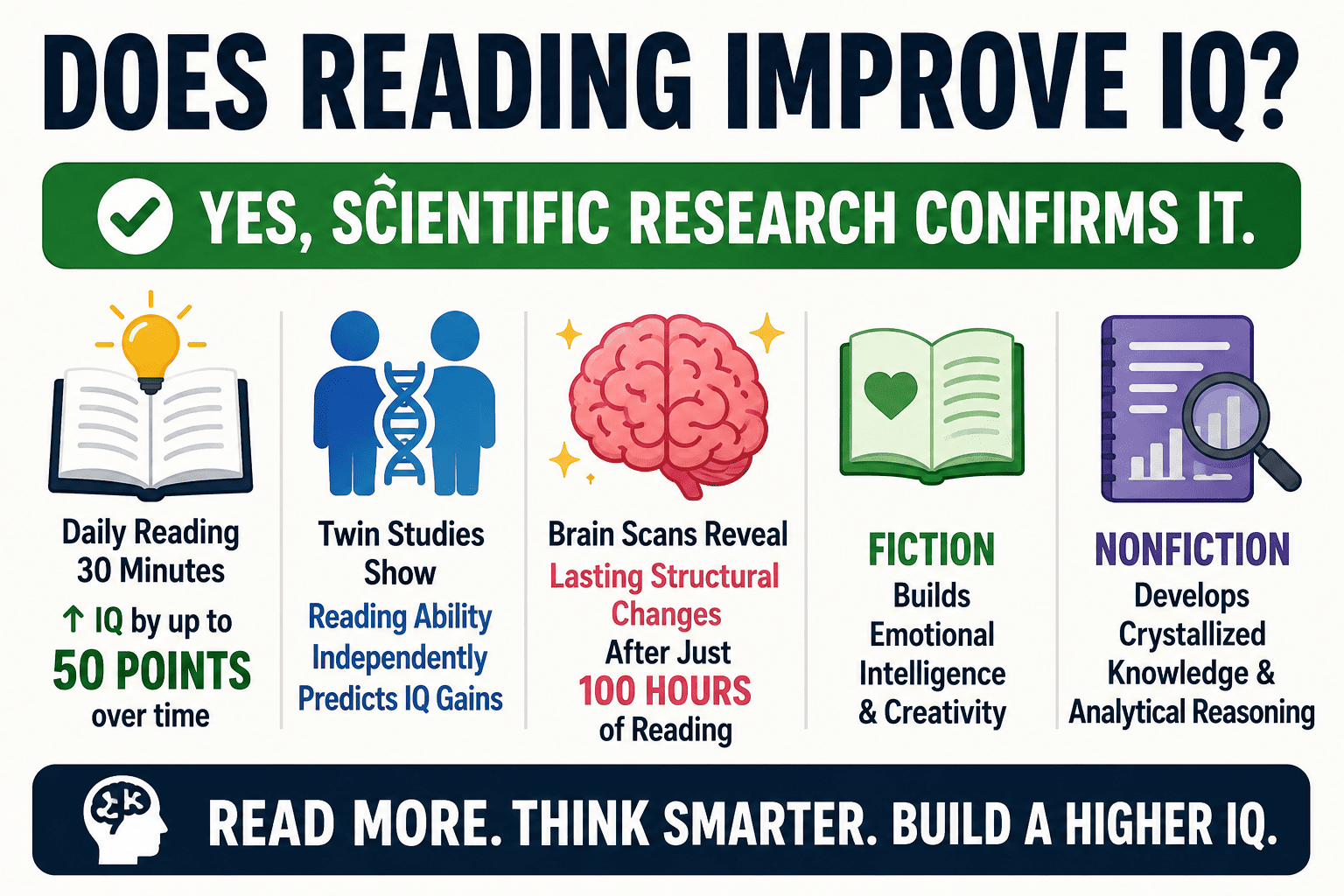
Yes, decades of neuroscience and psychology research confirm that reading systematically increases IQ. Reading for 30 minutes daily can raise IQ by up to 50 points over time. Twin studies show reading ability independently predicts intelligence gains. Brain scans reveal lasting structural changes after just 100 hours of reading practice. Both fiction and nonfiction improve IQ through different pathways, fiction builds emotional intelligence and creativity, while nonfiction develops crystallized knowledge and analytical reasoning.
Potential IQ gain with 30 min daily reading
Average IQ increase from 1 book/week (99 → 106)
Vocabulary acquisition explained by print exposure
Reading training → significant white matter increase
In our digital age of endless scrolling, the humble act of reading a book might seem outdated. Yet beneath the pages lies a cognitive powerhouse. The question that captivates researchers worldwide is simple yet profound: does reading improve IQ? The answer is a resounding yes, and the evidence is more compelling than ever. Reading for just 30 minutes daily can increase IQ by up to 50 points over time, rewire neural pathways, and build cognitive reserve that lasts a lifetime.
IQ (Intelligence Quotient) measures cognitive abilities relative to age. But intelligence is multi‑faceted: Crystallized intelligence (accumulated knowledge) grows with reading; Fluid intelligence (novel problem-solving) is strengthened by cognitive engagement; and Emotional intelligence (empathy, social awareness) is boosted by literary fiction. Reading directly enhances all three.
Intelligence is not fixed. Neuroplasticity means your daily reading habit literally reshapes your brain architecture, regardless of age.
Twin studies reveal reading’s independent impact. A landmark study of 1,890 twin pairs (ages 7–16) found that even when genetic factors are identical, differences in reading ability predicted subsequent differences in intelligence. Reading ability independently influences intellectual development, and benefits extend beyond verbal domains to broader cognitive skills.
Verbal IQ & structural brain changes. University College London research showed that teens who are good readers experience relative improvements in verbal IQ over time, coupled with structural changes in brain regions responsible for language. Most striking: reading for pleasure early in life correlates with larger total brain area and volume.
| Reading Practice | Measured IQ/Brain Effect |
|---|---|
| 30 minutes daily reading | Up to 50 point IQ increase over time |
| 1 book per week | Average IQ rise from 99 to 106 (+7.07%) |
| 100 hours reading training | Significant white matter quality increase (faster neural transmission) |
| Reading a novel (fMRI study) | Lasting increased connectivity in left temporal lobe, central sulcus, somatosensory regions |
Reading triggers neuroplasticity. After 100 hours of reading practice, children show dramatic white matter improvement, white matter carries signals between grey matter regions, making the brain faster and more efficient.
The brain develops a dedicated “letterbox” region that becomes specialized for recognizing written words. This area’s precise location can be predicted by existing neural connections before a child learns to read.
fMRI studies tracking readers over three weeks found increased connectivity in language-processing areas, and these changes remained elevated days after finishing the book.
Reading simultaneously activates visual cortex, auditory cortex (inner voice), language areas (Broca/Wernicke), hippocampus (memory), and executive function regions. It’s a comprehensive neural workout that strengthens multiple cognitive systems.
Books contain 3x more rare words than conversation. Print exposure accounts for approximately 45% of lifetime vocabulary growth.
Following plots, predicting outcomes, and evaluating arguments strengthens real-world problem-solving and analytical reasoning.
Complex narratives exercise working memory and long-term recall; hippocampus activation improves both memory systems.
Reading counteracts digital distraction, training sustained attention and strengthening executive control functions.
Literary fiction improves theory of mind, perspective-taking, and social cognition through narrative transportation.
Fiction excels at emotional intelligence, creativity, and narrative processing. Getting lost in characters’ minds builds empathy. Non‑fiction directly builds crystallized intelligence, knowledge, analytical skills, specialized vocabulary. The verdict: read both. Alternate between a novel and a work of history/science/philosophy for balanced cognitive growth.
| Genre | Primary IQ Benefit | Best For |
|---|---|---|
| Literary Fiction | Emotional intelligence, empathy, ambiguity tolerance | Social reasoning, creativity |
| Non‑fiction (science, history) | Crystallized intelligence, analytical thinking, domain vocabulary | Knowledge acquisition, critical analysis |
| Genre fiction (mystery, sci‑fi) | Pattern recognition, prediction, problem-solving | Fluid reasoning, engagement |
Minimum effective dose: 30 minutes daily. This reduces stress, improves sleep, and builds cognitive reserve. Optimal reading time: 30–60 minutes per day. Consistency trumps intensity, 30 minutes every day yields better results than 3 hours once a week.
If you understand everything effortlessly, increase difficulty. If you’re lost, dial back just a notch. Aim for books where you encounter new vocabulary and concepts but can follow the main thread.
Beginners: 15–20 minutes in enjoyable genres. Intermediate: 30–45 minutes with varied genres. Advanced: 45–60+ minutes, deliberately including dense non‑fiction and classic literature.
While speed reading increases volume, deep comprehension and vocabulary retention may suffer. For IQ benefits, prioritize understanding over raw speed. Use speed techniques only for light material.
Anchor reading to an existing routine (morning coffee, commute, before bed). Consistency builds the neural changes that drive IQ gains.
Better retention, less blue light, spatial memory of content location. Physical books provide a richer reading experience for deep comprehension.
Active engagement dramatically increases recall and transfer. Write questions, connections, and insights as you read.
Book clubs or even casual conversations consolidate understanding and surface new insights you might have missed.
One week fiction, next week history or biography. Cross‑domain reading builds cognitive flexibility and broader knowledge.
Use one new word from your reading each day in conversation or writing. Active usage cements vocabulary gains.
The scientific evidence is clear and compelling: reading systematically increases IQ. Through vocabulary expansion, neural pathway strengthening, cognitive flexibility development, and knowledge acquisition, every page you read builds your intellectual capacity. The 30-minute daily investment compounds over time, creating lasting cognitive reserves that serve you throughout life.
Whether you choose fiction or nonfiction, physical books or digital pages, the key is consistency. Start where you are, read what engages you, and gradually expand your horizons. Your future intelligence depends not on any single book, but on the cumulative effect of a lifelong reading habit.
Start today. Pick up a book. Read for 30 minutes. Your brain will thank you, today, tomorrow, and for decades to come.
Explore our library of cognitive science resources, book recommendations, and learning strategies.
Explore All Guides → Try Our ToolsContinue exploring learning and development with our guides on reading and creativity, English phonetics, and types of adjectives.
The evidence is settled: reading transforms intelligence. Turn the page, your future IQ thanks you.

Belekar Sir is the founder and lead instructor at Belekar Sir’s Academy, a trusted name in English language education. With over a decade of teaching experience, he has helped thousands of students—from beginners to advanced learners—develop fluency, confidence, and real-world communication skills. Known for his practical teaching style and deep understanding of learner needs, Belekar Sir is passionate about making English accessible and empowering for everyone. When he’s not teaching, he’s creating resources and guides to support learners on their journey to mastering spoken English.