Many English learners have the same question: Does reading actually help you speak better? After all, reading is a silent, passive activity, while speaking requires real-time thinking, pronunciation, confidence, and conversation skills. So is there a real connection between the two?
The short answer is yes, reading can significantly improve your speaking skills, but only when used the right way.
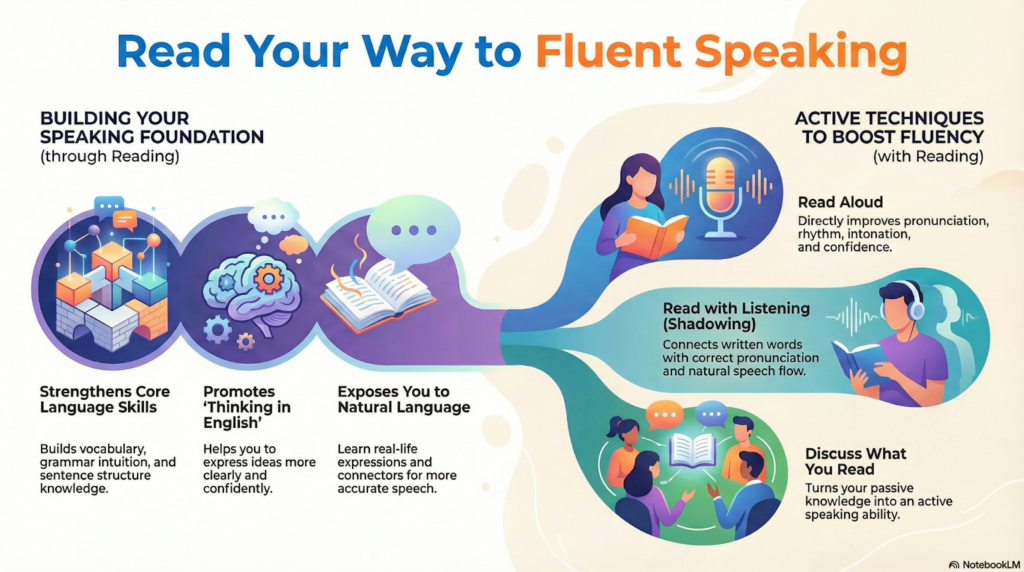
Reading exposes you to richer vocabulary, correct grammar patterns, natural expressions, and real-world sentence structures. When combined with active techniques like reading aloud, listening while reading, or shadowing, it transforms into one of the most powerful tools for improving speech clarity, fluency, and confidence.
In this article, you’ll learn exactly how reading influences speaking, what the competitors rarely explain fully, and the best methods to turn reading into speaking improvement. By the end, you’ll understand why reading is considered a foundation of strong spoken English and how to use it effectively to see real-world results.
How Reading Helps Improve Speaking Skills? (The Science Behind It)
While reading and speaking are different skills, they are deeply connected. Reading builds the language “input” your brain needs so that speaking becomes easier, faster, and more natural. Here are the key ways reading directly and indirectly improves speaking:
1. Builds Strong Vocabulary and Natural Expression
Reading exposes you to far more words, idioms, and sentence patterns than you hear in daily conversation. Unlike memorizing random vocabulary lists, reading teaches you how words are used in real contexts making it easier to use them correctly when speaking. This leads to more expressive, precise, and confident speech.
2. Internalizes Grammar and Sentence Structure Automatically
You don’t need to memorize grammar rules to speak correctly. Through regular reading, your brain absorbs grammar patterns like connectors, tense usage, transitions, and word order. Over time, you naturally begin forming better sentences while speaking without consciously thinking about grammar.
3. Helps You Think in English Instead of Translating
One of the biggest barriers to fluent speaking is mental translation. Reading trains your brain to process ideas directly in English. The more you read, the faster your brain becomes at generating English sentences making speaking smoother and more spontaneous.
4. Improves Comprehension and Topic Knowledge (More to Talk About)
Good speakers have content to talk about. Reading gives you exposure to new ideas, current events, and different perspectives enriching your knowledge and giving you more confidence to participate in conversations, debates, or interviews.
5. Shapes, Tone, Style, and Context Awareness
Through reading dialogue, stories, news, essays, and opinions, you learn how English is used in formal, informal, persuasive, humorous, and descriptive ways. This helps you adjust your speaking tone to suit different situations a skill that many learners struggle with.
Reading Aloud: The Most Direct Way Reading Improves Speaking (Pronunciation, Fluency & Confidence)
While silent reading strengthens vocabulary and grammar, reading aloud is where reading directly transforms into speaking practice. It forces your mouth, tongue, and vocal cords to work just like in real conversation which makes it one of the most effective ways to use reading to boost speaking.
Improves pronunciation and articulation:
Reading aloud makes you consciously produce each sound. Over time, your tongue gets used to English sounds that may not exist in your native language. This muscle training increases clarity, sharpens articulation, and reduces pronunciation mistakes.
Builds natural rhythm, stress, and intonation:
English is a stress-timed language. By reading aloud even simple sentences you naturally develop a better sense of tone, pausing, and emphasis, which are essential for sounding fluent and confident.
Enhances fluency by reducing hesitation:
The more you read aloud, the more automatic speaking becomes. Words begin to flow without stopping to think, making your spoken English smoother and faster.
Boosts confidence through repeated exposure:
Many learners hesitate to speak because they fear mistakes. Reading aloud provides a safe environment to hear yourself speak English frequently, which dramatically improves confidence in real conversations.
Overall, reading aloud bridges the gap between passive knowledge and active speaking ability making it a cornerstone of improving spoken English.
How Reading Combined with Listening Strengthens Speaking Skills (Shadowing & Multisensory Learning)
Reading becomes even more powerful when paired with listening, especially through techniques like shadowing. This approach exposes you to correct pronunciation while giving you a model to imitate.
Shadowing helps you sound more natural:
Shadowing involves listening to a native speaker (news clip, audiobook, speech) and immediately repeating the same words while reading the text. It trains your brain to sync with native pacing, tone, and intonation something reading alone cannot provide.
Strengthens sound-to-word connection:
Many learners know vocabulary visually but struggle to recognize or pronounce it when they hear it. Reading while listening helps you link written words to their correct pronunciation, reducing misunderstandings and boosting listening comprehension.
Improves automaticity and natural flow:
By repeatedly hearing and speaking the same phrases, your brain processes English patterns faster. This leads to smoother speech, fewer pauses, and more natural expression.
Supports memory retention:
Multisensory learning seeing, hearing, and speaking the same content creates stronger connections in the brain. This accelerates vocabulary acquisition and helps you remember and use new expressions in conversation.
Together, reading + listening creates a complete language input-output cycle, making it one of the most effective strategies for improving speaking skills through reading.
How Reading Improves Vocabulary for Better Speaking?
A strong vocabulary is one of the foundations of good speaking skills. Reading exposes you to thousands of words, expressions, and sentence structures that you naturally absorb over time.
Exposure to High-Frequency and Advanced Words
- Books, articles, and stories introduce words used in real conversations.
- You learn synonyms, descriptive phrases, idioms, and context-based meanings.
- A richer vocabulary helps you express thoughts more clearly and confidently while speaking.
Understanding How Words Function in Sentences
- Reading shows how words are used naturally in different contexts formal, informal, emotional, persuasive, etc.
- This helps you choose the right words while speaking and avoid awkward phrasing.
Learning Pronunciation Through Phonetic Awareness
- Even silent reading improves “mental pronunciation,” helping create a sound-spelling connection.
- When you later hear the word spoken or say it aloud, you recognize it faster and pronounce it more accurately.
How Reading Enhances Grammar and Sentence Structure in Speaking?
Good speakers don’t just know words they know how to put them together. Reading is one of the most effective ways to absorb natural, fluent grammar patterns.
Implicit Learning of Grammar Rules
- Instead of memorizing grammar charts, you learn grammar intuitively by seeing it used correctly in stories, articles, and dialogues.
- This helps you speak with fewer mistakes and greater fluency.
Internalizing Natural Sentence Flow
- Reading exposes you to how native speakers form questions, statements, opinions, and emotions.
- Over time, these patterns become internal templates you naturally use while speaking.
Improved Understanding of Connectors and Transitions
- Words like however, therefore, although, meanwhile, and on the other hand make your speech clearer and more professional.
- Reading frequently helps you use these connectors correctly in speaking.
Types of Reading That Improve Speaking the Most
Not all reading contributes equally to speaking improvement. Different reading styles enhance different areas of speech pronunciation, fluency, vocabulary, and confidence. Choosing the right type of reading can speed up progress.
1. Reading Aloud for Pronunciation and Fluency
- Reading aloud forces your brain to connect text → sound → speech mechanics.
- Helps you practice intonation, stress, rhythm, and pacing.
- Improves mouth muscle coordination, making natural speech easier.
- Builds confidence for real-life conversations.
Best for: pronunciation, clarity, confidence, fluency.
2. Silent Reading for Vocabulary and Sentence Patterns
- Helps you absorb new words, expressions, sentence structures, and grammar patterns.
- Improves mental processing and understanding of how fluent speakers form ideas.
- Silent reading also supports faster comprehension, which improves speaking spontaneity.
Best for: vocabulary, grammar, complex sentence formation.
3. Guided or Assisted Reading
- Reading while listening to an audio version helps match spelling with pronunciation.
- Reduces fear of mispronunciation and improves listening–speaking connection.
- This method is especially effective for beginners or those with anxiety about speaking.
Best for: accurate pronunciation, natural rhythm, confidence.
4. Interactive Reading
- Involves reading and then discussing the text with someone.
- Boosts speaking practice while reinforcing comprehension and vocabulary.
How Reading Enhances Vocabulary and Expression? (Impact on Speaking Skills)
Reading is one of the fastest ways to build a strong vocabulary and expressive ability both essential for effective speaking.
You Learn Words in Context
- Reading shows how words are used in real sentences, making them easy to understand and remember.
- Context-based learning improves the ability to use words naturally when speaking.
- Helps avoid common mistakes like incorrect word usage or unnatural phrasing.
You Absorb Better Sentence Structures
- Regular reading exposes you to native-like grammar, transitions, connectors, and idiomatic expressions.
- You naturally start using similar patterns in your speech.
- This leads to smoother, more confident speaking with fewer pauses.
Improves Thought Organization
- Reading teaches how ideas are developed logically.
- When you speak, you can structure your thoughts more clearly and confidently.
- Helps you avoid rambling or losing track mid-sentence.
Expands Your Range of Expressions
- Provides access to synonyms, descriptive phrases, and varied vocabulary.
- Makes your speech richer, more engaging, and more precise.
How Reading Expands Your Vocabulary for Better Speaking?
One of the strongest links between reading and speaking is vocabulary growth. The more words you encounter while reading, the easier it becomes to express your thoughts clearly and confidently when speaking.
Exposure to New Words in Context
Reading exposes you to words in real, practical contexts dialogues, descriptions, emotions, and arguments. This helps you:
- Understand not just the meaning, but also tone, usage, and emotion behind words.
- Learn collocations (words commonly used together), such as make a decision, strong argument, deep concern, which are essential for natural speech.
Improved Word Recall
When you repeatedly see a word across different articles or books, it sticks in your memory. This improves:
- Fluency
- Ease of expression
- Ability to speak without pausing to “search” for words
Richer and More Precise Expression
With a wider vocabulary, you can:
- Speak more accurately
- Avoid repeating basic words
- Express ideas more clearly, which boosts confidence
Reading Improves Grammar and Sentence Structure for Clearer Speech
Reading doesn’t just teach you words it teaches you how sentences flow, how ideas connect, and how English is structured in real communication. All these directly improve your speaking skills.
Learning Natural Sentence Patterns
By reading stories, articles, and conversations, you absorb natural sentence structures like:
- How to build questions
- How to use tenses correctly
- How to form complex sentences
This helps you speak more naturally without sounding robotic or memorized.
Understanding Rhythm and Intonation Through Reading Aloud
When you read aloud, you practice:
- Stress patterns
- Intonation
- Pauses and rhythm
- Pronunciation
This mirrors real spoken English and significantly improves clarity and confidence when speaking.
Internalizing Correct Grammar Instinctively
Frequent reading helps you develop a sense of what “sounds right.”
This improves:
- Error-free speech
- Faster responses
- More natural conversational flow
Conclusion: Reading Is One of the Most Powerful Tools for Better Speaking
Reading whether silently, aloud, or interactively is one of the most effective and accessible ways to improve your speaking skills. It strengthens vocabulary, sentence structure, pronunciation, fluency, confidence, and overall communication ability. Unlike passive listening, reading actively engages the mind and helps you internalize the rhythm, tone, and style of natural language.
Why Reading Helps You Speak Better
- You learn new words and expressions you can immediately use in conversations.
- You observe correct sentence formation, which improves grammar while speaking.
- Reading aloud trains your mouth muscles, intonation, and articulation.
- You gain confidence because you understand the context behind words and phrases.
- It builds both spoken and mental fluency essential for speaking smoothly without hesitation.
How to Turn Reading Into a Speaking-Improvement Habit
- Read 10–15 minutes daily, alternating between silent reading and reading aloud.
- Keep a notebook of new words and speaking-friendly phrases.
- Record yourself reading aloud once a week to track improvement.
- Pair reading with listening and speaking practice for faster progress.
- Use stories, news, conversations, and dialogues that mirror real-life speech.
Final Thought
If you want to speak better clearer, quicker, and more confidently reading is one of the simplest habits to start. It requires no special tools, no partner, no expensive classes. Just a book, an article, and your voice. With consistent practice, you’ll notice your speaking skills transforming naturally and steadily.
FAQs: Does Reading Really Improve Speaking?
1. Can reading alone make me a fluent speaker?
Reading improves vocabulary, sentence structure, and confidence, but it cannot make you fluent on its own. Speaking requires active practice, listening, and real conversations.
2. How exactly does reading help with spoken English?
Reading exposes you to new words, natural phrasing, grammar patterns, and ideas. This expands what you can say, helping you form clearer and more accurate sentences while speaking.
3. What type of reading improves speaking the most?
Materials with natural conversational tone like newspapers, blogs, dialogues, and novels are most helpful. Academic or overly formal texts may not reflect everyday spoken English.
4. Does reading out loud improve speaking skills?
Yes. Reading aloud strengthens pronunciation, pacing, articulation, and confidence. It also trains your mouth muscles for English sounds.
5. How much should I read daily to notice improvement?
Even 15–20 minutes a day is enough to see noticeable improvements in vocabulary, clarity, and sentence structure within a few weeks.
6. Why do some people read a lot but still struggle to speak?
Because they lack active output. Speaking is a physical skill that develops only through practice, interaction, and feedback passive reading.
7. What should I do along with reading to improve speaking?
Combine reading with:
- shadowing (imitating native speakers)
- recording yourself
- speaking with others
- summarizing what you read verbally
This transforms passive knowledge into active speaking ability.
8. Can beginners use reading to improve speaking?
Absolutely. Beginners benefit from simple storybooks, graded readers, and children’s books to build foundational vocabulary and confidence.
9. Does reading improve accent?
Reading helps with rhythm, intonation, and clarity especially when reading aloud with audio but accent improvement requires listening practice and phonetic awareness.
10. What is the fastest way to convert reading into speaking improvement?
After reading anything, speak about it: summarize it, explain it, or express your opinion. This activates new vocabulary and strengthens speaking fluency quickly.