Most people forget up to 90% of what they read within a week because reading is often passive. Without active engagement, purposeful reading, note-taking, self-testing, and spaced repetition, the brain doesn’t transfer information from short-term to long-term memory. The fix: read with intention, use active recall, review at intervals, and teach what you’ve learned to others.
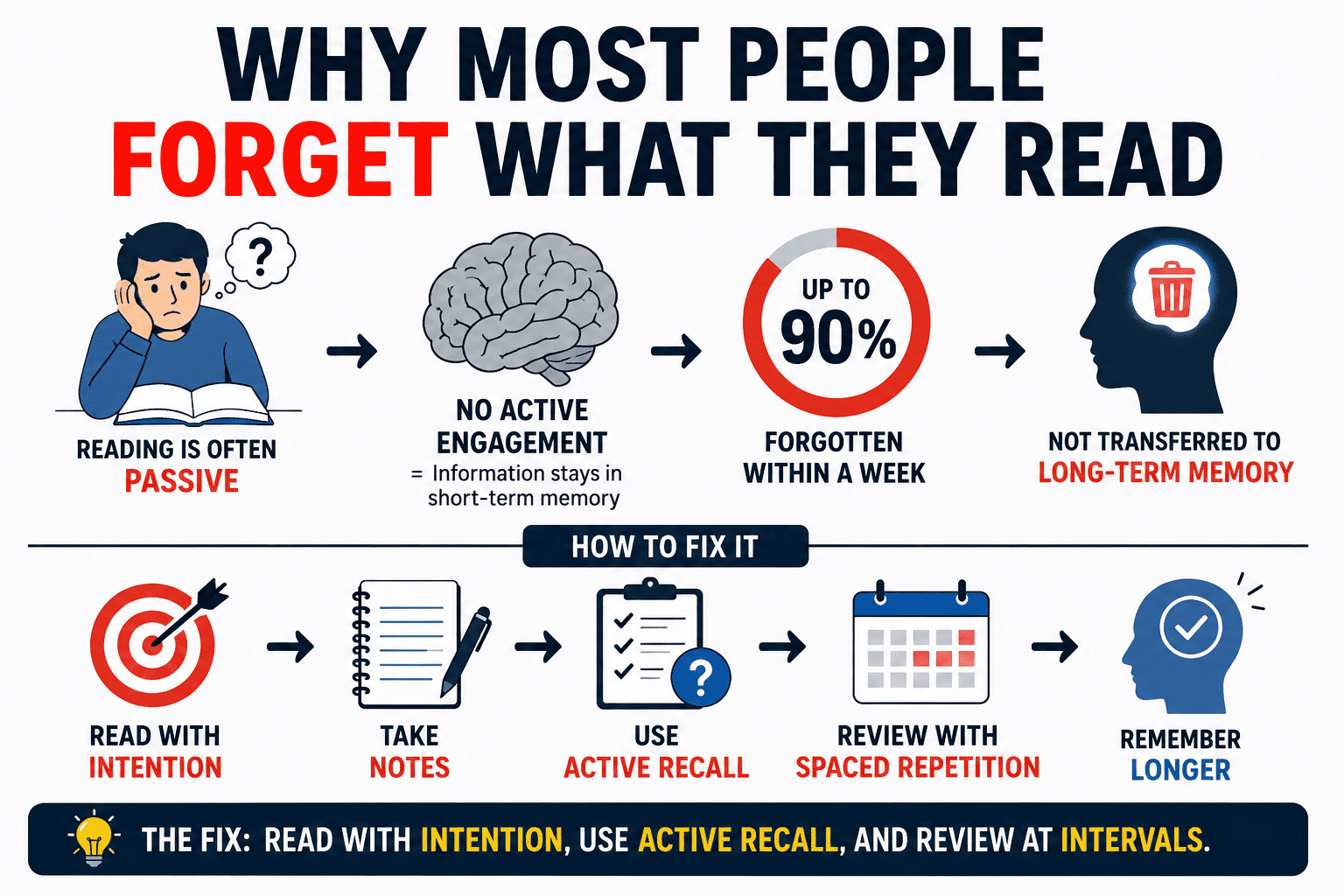
Have you ever finished a book only to realize days later that you barely remember what it was about? You’re not alone. Research shows that people forget up to 90% of what they read within a week, a phenomenon known as the “forgetting curve.” This happens not because you’re a bad reader, but because reading is often a passive activity. Without active engagement, your brain treats most of what you read as short-term, disposable information.
The good news? This can be fixed. By understanding how memory works and applying proven techniques like active reading, spaced repetition, and self-testing, you can transform how much you retain from every book, article, or document you read. This guide will show you exactly how.
The goal: Move from passive reading to active learning. Implement just 2-3 techniques from this guide, like the SQ3R method or spaced repetition, and you’ll dramatically improve how much you remember from everything you read.
Before improving reading memory, it helps to understand how memory actually works. Reading information is only the first step, your brain must process it through encoding, consolidation, and retrieval to store it long-term.
Your brain remembers only what it pays attention to. If you read while distracted or half-aware, the information never gets encoded. That’s why reading when tired, stressed, or multitasking leads to poor recall. Focused attention = stronger memory encoding.
After encoding, your brain must consolidate the information, usually during sleep or quiet reflection. Spaced repetition, reviewing notes, and reflecting on what you read dramatically increase retention.
Memory becomes stronger every time you recall it. That’s why summarizing, teaching, or practicing self-quizzing works so well.
Don’t try to capture everything. Focus on the 20% of ideas that will give you 80% of the understanding: main arguments, surprising facts, connections to what you already know, and actionable insights.
| Technique | How It Works | Best For |
|---|---|---|
| Spaced Repetition | Review at increasing intervals: 1 day, 3 days, 1 week, 1 month | Vocabulary, key concepts, facts |
| Mnemonic Devices | Acronyms, rhymes, memory palaces, attach new info to familiar patterns | Lists, sequences, dates |
| Teach What You Read | Explain aloud to someone else (or yourself), forces organization and gap identification | Deep understanding, complex ideas |
| Self-Testing (Retrieval Practice) | Close the book and recall key points without looking | All material, far stronger than rereading |
After reading a chapter: review notes after 1 day → after 3 days → after 1 week → after 1 month. Each review takes only a few minutes but multiplies retention exponentially.
Day 1: Read one article or chapter with a clear purpose. Take smart notes (main ideas + one connection).
Day 2: Without looking at notes, recall and summarize what you read. Then check your notes.
Day 4: Review your notes and teach the concept aloud to yourself.
Day 7: Self-test: write down everything you remember. Spaced repetition done! Repeat for the next text.
Improving reading memory is not about reading faster or reading more, it’s about reading smarter and engaging your brain effectively. Active reading, memory techniques like spaced repetition and self-testing, consistent habits, and avoiding common mistakes all work together to transform how much you retain.
Start with one short article today: take notes, review tomorrow, and explain it aloud. Over time, your reading memory will improve dramatically, and you’ll retain and apply knowledge more effectively. Remember: your brain remembers what you actively engage with.
You don’t need to apply every technique at once. Choose one strategy, like taking smart notes or using spaced repetition, and practice it consistently for a month. You’ll notice the difference in how much you remember.
Explore more learning strategies, vocabulary builders, and memory tools at Belekar Sir’s Academy.
Browse All Articles → Try Our ToolsContinue building your learning skills with our guides on adjectives to describe a friend, list of adjectives for students, and positive adjectives for doctors.

Belekar Sir is the founder and lead instructor at Belekar Sir’s Academy, a trusted name in English language education. With over a decade of teaching experience, he has helped thousands of students—from beginners to advanced learners—develop fluency, confidence, and real-world communication skills. Known for his practical teaching style and deep understanding of learner needs, Belekar Sir is passionate about making English accessible and empowering for everyone. When he’s not teaching, he’s creating resources and guides to support learners on their journey to mastering spoken English.