In today’s fast-paced, screen-dominated world, cultivating a reading habit in children can feel like a challenge. Yet, reading remains one of the most valuable gifts we can give our child — not just for academics, but for imagination, empathy, and lifelong learning. The question many parents ask is: how much reading per day is enough?
Based on decades of research and expert recommendations, this post offers a clear, age-wise guide to daily reading time for kids, practical advice for making reading enjoyable, and strategies to help build strong reading habits that last.
Why Daily Reading Matters for Children
Daily reading is not just an academic exercise. It shapes multiple areas of a child’s development, reinforcing cognitive, emotional, and social growth. When reading becomes a daily part of life, children naturally absorb vocabulary, develop stronger memory, learn to think critically, and gain a deeper understanding of the world.
Here are some of the most important benefits of consistent daily reading time.
1. Improved Vocabulary and Language Development
Children who read regularly are exposed to new words and sentence structures far more often than children who rely only on spoken language. Over time, this results in better communication skills, stronger grammar, and more advanced expressive abilities.
2. Higher Academic Performance
Studies consistently show that children who engage in daily reading outperform their peers in school. This applies not only to language arts but also to subjects like science and mathematics. Reading improves comprehension and analytical thinking, which transfers across academic areas.
3. Stronger Imagination and Creativity
Books expand a child’s inner world. They introduce ideas from different cultures, historical periods, and imaginary worlds. This fuels creativity and helps children think beyond their immediate environment.
4. Emotional Awareness and Empathy
Stories often highlight characters experiencing challenges, emotions, and growth. Children learn empathy when they understand different perspectives and feelings, making reading an important emotional development tool.
5. Cognitive Development
Regular reading strengthens memory, attention, pattern recognition, problem solving, and mental endurance. It essentially functions as exercise for the brain, helping children sharpen focus and maintain stronger cognitive health over time.
6. A Positive Habit That Supports Lifelong Learning
Perhaps the greatest benefit of daily reading is that it establishes a habit that can last a lifetime. Children who read regularly are more likely to become independent learners, curious thinkers, and confident students as they grow older.
Recommended Daily Reading Time for Children by Age
Parents often assume that more reading is always better, but the key is to set realistic and age appropriate goals. Different ages require different levels of engagement, stamina, and content.
Below is a clear and practical daily reading time chart for ages 2 through 12.
| Age Range | Recommended Daily Reading Time | Weekly Target |
| Ages 2 to 4 | 5 to 10 minutes of shared reading | Around 1 hour |
| Ages 5 to 7 | 15 to 20 minutes | Around 1.5 to 2 hours |
| Ages 8 to 10 | 20 to 30 minutes | Around 2.5 to 3.5 hours |
| Ages 11 to 12 | 30 minutes or more | Around 3.5 hours or more |
Below is a deeper look at what these time recommendations mean developmentally and how parents can apply them.
Ages 2 to 4 Years
Recommended Reading Time: 5 to 10 minutes a day
For toddlers and preschoolers, reading is primarily about bonding and early language exposure. At this age, children learn through repetition, rhythm, images, and sound. A short daily session is enough to support vocabulary development, strengthen listening skills, and help children associate reading with comfort and enjoyment.
Tips for Parents
- Choose short, colorful, and interactive books.
- Use expressive voices and gestures to keep attention.
- Allow your toddler to turn the pages, point to pictures, or name objects.
- Keep sessions playful and pressure free.
- Create a nightly bedtime reading ritual to build consistency.
Children at this age rarely sit still for long, so it is more important to keep reading sessions fun and engaging instead of focusing on how long they last.
Ages 5 to 7 Years
Recommended Reading Time: 15 to 20 minutes a day
Children in early elementary school transition from decoding words to building fluency. This is a crucial age for forming reading habits that can last throughout childhood. A daily reading time of 15 to 20 minutes helps strengthen vocabulary, confidence, comprehension, and storytelling skills.
Tips for Parents
- Combine shared reading with early independent reading.
- Choose simple storybooks, early reader books, or beginner chapter books.
- Allow children to pick their own reading materials.
- Ask gentle questions about the story to support comprehension.
- Celebrate small reading milestones such as finishing a book or reading a new word.
Maintaining consistency during this age is essential for strengthening literacy.
Ages 8 to 10 Years
Recommended Reading Time: 20 to 30 minutes a day
At this stage, children develop greater stamina for reading. They are ready for longer books, more complex stories, and richer vocabulary. Reading for 20 to 30 minutes a day exposes children to thousands of words and helps them expand their knowledge, curiosity, and imagination.
Tips for Parents
- Offer a variety of materials such as chapter books, comics, adventure stories, and science themed books.
- Encourage children to explore different genres.
- Provide a quiet reading space away from screens.
- Use reading journals or book talks to spark deeper engagement.
Children who regularly read during these years often show improved writing skills, stronger focus, and significantly higher academic confidence.
Ages 11 to 12 Years
Recommended Reading Time: 30 minutes or more a day
Preteens face increasing academic demands, extracurricular activities, and digital distractions. Daily reading becomes especially beneficial at this age because it helps maintain vocabulary growth, comprehension development, and cognitive strength. Children in this age group should aim for at least 30 minutes of pleasure reading each day.
Tips for Parents
- Allow longer form books such as series, fantasy novels, biographies, or historical fiction.
- Encourage reading before bed to reduce screen exposure.
- Create structured reading routines such as evening quiet time.
- Invite preteens to join discussions about books and themes.
This age group can read independently with very little guidance, but they still benefit greatly from parental involvement and encouragement.
Why Joy and Consistency Matter More Than Long Sessions
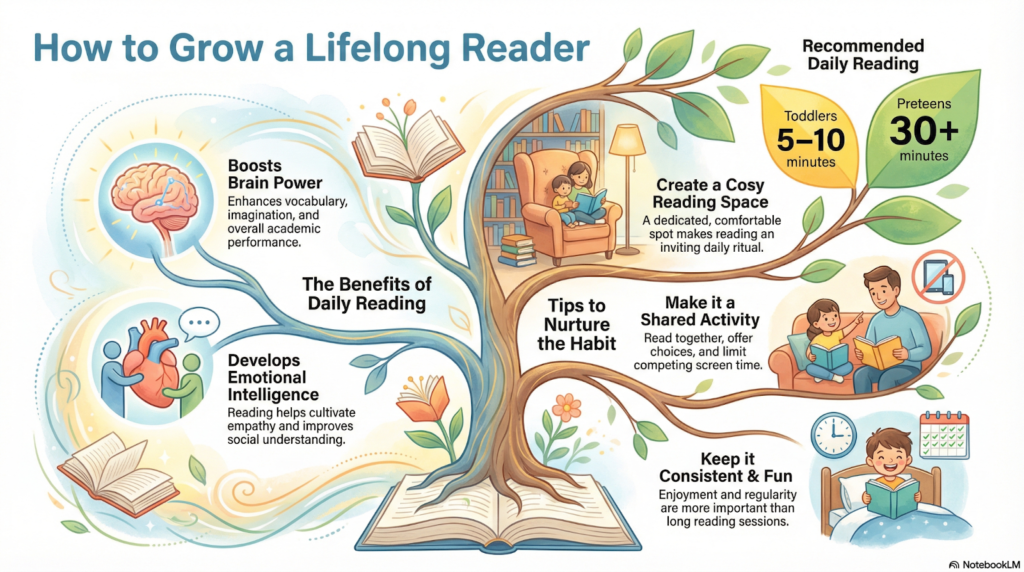
Some parents attempt to compensate for missed reading days by scheduling long reading sessions on weekends. While this may seem helpful, research shows that short and consistent daily reading is far more effective.
Children benefit more from a steady reading habit than from long but infrequent sessions. Consistency helps build comprehension, memory, routine, and mental stamina. Most importantly, it keeps reading enjoyable.
Ways to Keep Reading Joyful
- Let children choose what they want to read.
- Avoid turning reading into a chore or punishment.
- Introduce fun reading materials such as graphic novels or short fact books.
- Read together as a family.
- Celebrate reading milestones.
When reading feels enjoyable instead of forced, children naturally gravitate toward books.
Below are common obstacles and practical solutions.
1. Busy Schedules
Solution: Integrate reading into existing routines. Bedtime, after school, breakfast, and car rides are opportunities for short reading sessions.
2. Short Attention Spans
Solution: Start with short books or comics. Use pictures to support understanding. Gradually increase reading duration over time.
3. Competing Digital Distractions
Solution: Reduce screen time during evenings. Create a dedicated reading corner with comfortable seating and good lighting.
4. Limited Access to Books
Solution: Visit local libraries. Use book swaps with friends or family. Explore second hand bookstores. Build a small but diverse home library.
5. Lack of Reading Confidence
Solution: Choose books that match the child’s reading level. Use shared reading to build confidence. Praise effort, not just accuracy.
Addressing these challenges with patience and creativity can transform a struggling reader into an enthusiastic one.
Practical Strategies to Build Strong Daily Reading Habits
Here are proven strategies that parents can use to make reading a natural part of daily life.
- Create a special reading corner with cozy cushions and good lighting.
- Build a home library filled with a variety of genres.
- Give children ownership by letting them choose their books.
- Read aloud together even if children can read independently.
- Reduce screen time before bed to encourage nighttime reading.
- Model reading yourself so children see it as a normal activity.
- Use bookmarks, reading trackers, or reading journals for motivation.
- Encourage conversations about books to deepen interest.
- Mix different reading materials such as magazines, comics, short stories, and non-fiction books.
Small steps taken consistently can result in powerful long term results.
Conclusion
Daily reading is one of the most valuable gifts parents can offer their children. It builds language skills, nurtures imagination, strengthens emotional intelligence, and boosts academic success. The good news is that it does not require hours each day. Simple and consistent routines are far more effective than intense or lengthy sessions.
Whether your child is a toddler exploring picture books or a preteen diving into long novels, the goal is to create a positive relationship with reading. When reading becomes enjoyable, children grow into strong, confident, and curious lifelong learners.
Start small. Stay consistent. Keep reading joyful. Over time, daily reading can shape your child’s future in remarkable ways.
Frequently Asked Questions
1. Is ten minutes a day enough for young children?
Yes. For toddlers and preschoolers, ten minutes of shared reading is an excellent start. The goal at this age is exposure and enjoyment rather than duration.
2. Should school assigned reading count as daily reading?
It depends. School reading supports learning but may not always promote relaxation or pleasure. Ideally, children should have separate time for pleasure reading to build a positive emotional connection to books.
3. What should I do if my child dislikes reading?
Explore different formats. Many children prefer comics, humorous books, or short fact based books. Avoid forcing difficult books. Celebrate small successes and keep sessions fun.
4. Can reading be split into smaller sessions throughout the day?
Yes. Two short sessions of ten to fifteen minutes can be more effective than one long session, especially for young children.
5. Should parents read aloud even when children can read independently?
Absolutely. Reading aloud builds vocabulary, comprehension, and emotional connections. It also exposes children to more complex stories they might not yet read alone.

Belekar Sir is the founder and lead instructor at Belekar Sir’s Academy, a trusted name in English language education. With over a decade of teaching experience, he has helped thousands of students—from beginners to advanced learners—develop fluency, confidence, and real-world communication skills. Known for his practical teaching style and deep understanding of learner needs, Belekar Sir is passionate about making English accessible and empowering for everyone. When he’s not teaching, he’s creating resources and guides to support learners on their journey to mastering spoken English.