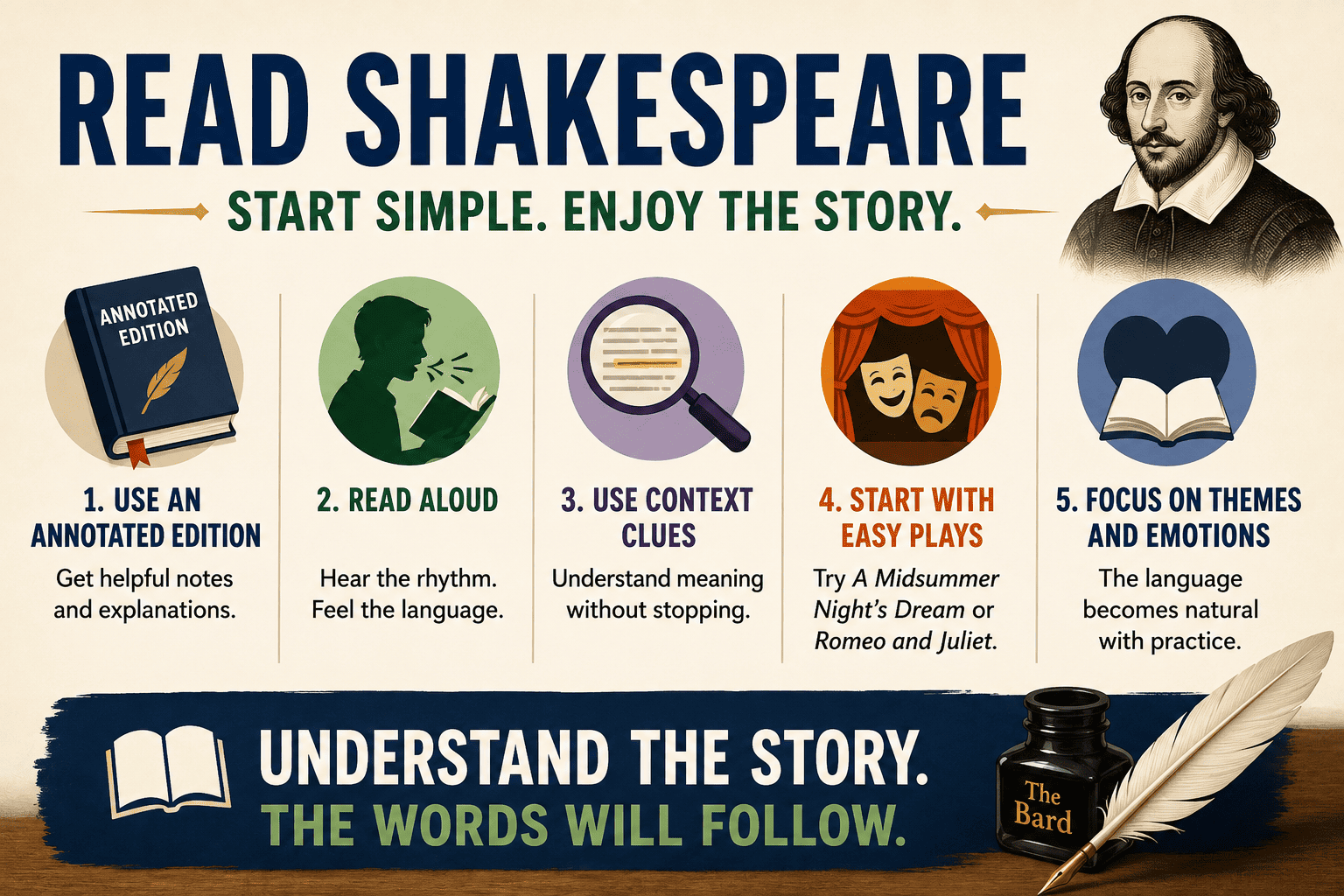
Yes, you can learn to read Shakespeare with confidence. The key is shifting from fearful decoding to active engagement. Start with annotated editions, read aloud to feel the rhythm, use context clues instead of stopping for every unfamiliar word, and begin with accessible plays like A Midsummer Night’s Dream or Romeo and Juliet. Focus on themes and emotions, the language becomes natural with practice. With just 15-20 minutes of active reading daily, most beginners find Shakespeare increasingly accessible within weeks.
Shakespeare’s plays explore universal themes: love, ambition, betrayal, grief, jealousy, hope, courage. These experiences are familiar to everyone, which means his stories still resonate today. What often creates the barrier is not the meaning, but the unfamiliar style. When approached the right way, Shakespeare becomes much more accessible. With the right techniques, context, and mindset, anyone can read and enjoy his work.
Shakespeare did NOT write in Old English. He wrote in Early Modern English, the foundation of the English we use today. While vocabulary and sentence patterns may feel unfamiliar, they are not as far removed as many people think.
Shakespeare’s English uses archaic vocabulary, inverted sentence structures, and poetic devices that are unfamiliar to modern readers. However, it’s Early Modern English, not Old English, and becomes more intuitive with practice. The payoff is immense: reading Shakespeare builds vocabulary, deepens understanding of grammar and syntax, sharpens analytical thinking, and connects you to timeless human experiences.
✔ Archaic vocabulary → unfamiliar words disrupt flow
✔ Inverted sentence structures → unusual word order
✔ Poetic devices → metaphors, puns, and double meanings
✔ Performance vs. reading → written for speaking, not silent reading
Choose the right edition: Modern-spelling, annotated, or side-by-side editions decode unfamiliar vocabulary and references. Start with accessible plays: Comedies and shorter plays like A Midsummer Night’s Dream have lighter language and simpler plots. Decide how to experience: Reading aloud brings rhythm and energy to life, Shakespeare wrote for performance.
Try this: read a short speech aloud, then paraphrase it line by line in your own words. This trains your brain to connect Shakespeare’s phrasing with modern speech. Over time, you’ll need to paraphrase less.
Once comfortable with the language, understanding universal themes, love, ambition, power, betrayal, identity, revenge, makes the story far more meaningful. Before reading, think about the play’s central idea. Macbeth explores how ambition destroys, while Romeo and Juliet examines intense young love. Recognizing these themes upfront helps you understand character actions. Also, watch for motifs (recurring elements like dreams, disguises, or supernatural signs), they offer important clues about deeper meaning.
| Play | Central Theme | Key Motif |
|---|---|---|
| Macbeth | Ambition & guilt | Blood, darkness, supernatural |
| Romeo and Juliet | Love & fate | Light vs. dark, stars |
| Hamlet | Revenge & madness | Death, decay, deception |
| A Midsummer Night’s Dream | Love & illusion | Dreams, magic, transformation |
| Structural Element | What It Does |
|---|---|
| Five Acts | Exposition → rising action → climax → falling action → resolution. Act III often contains the turning point. |
| Soliloquy | A character speaks alone, revealing private thoughts and inner conflict. |
| Aside | A short comment heard by the audience but not other characters, like a secret. |
| Dramatic Irony | Audience knows something characters don’t, creating tension or humor. |
Instead of “I love thee,” Shakespeare might write “Thee I love.” Recognizing this pattern helps you mentally rearrange sentences to find meaning. With practice, you’ll read inversions naturally.
Shakespeare frequently inverts sentence order for poetic effect. For example, “Gives sorrow words” simply means “Give words to your sorrow.” Once you recognize these patterns, reading becomes smoother.
Comedies: A Midsummer Night’s Dream, The Tempest, Much Ado About Nothing, lively dialogue, magical or humorous situations, clear motivations.
Dramas: Romeo and Juliet, universal themes of love and conflict, poetic but not excessively complex.
Start here to build confidence before moving to Hamlet, Macbeth, or King Lear.
Research shows that reading Shakespeare aloud significantly improves comprehension and enjoyment. The rhythm, rhyme, and emotional cues embedded in the language become immediately apparent when spoken. Silent reading simply cannot capture the full experience.
Reading Shakespeare is not about perfection, it’s about immersion. With an annotated edition, an open mind, and an understanding of rhythm, vocabulary, and themes, Shakespeare’s language becomes accessible and enjoyable. Focus on progress, trust the process, and let the stories speak to you.
Reading Shakespeare may seem intimidating at first, but with the right approach, it becomes enriching and enjoyable. The challenges of archaic language, poetic structure, and historical context can be overcome through patience, active reading, and supportive tools like annotated editions and performances. By starting with beginner-friendly plays, reading aloud, and gradually exploring more complex works, you’ll unlock the depth of Shakespeare’s themes, characters, and language. Ultimately, reading Shakespeare is not about perfection or understanding every word immediately, it’s about immersion, curiosity, and connecting with timeless human experiences.
The best way to learn to read Shakespeare is to just start reading. Choose a play, find a good edition, and read it aloud. You’ll be surprised how quickly the language begins to feel natural. You are exactly the reader Shakespeare has been waiting for.
Explore more literature guides, vocabulary builders, and reading strategies at Belekar Sir’s Academy.
Browse All Articles → Try Our ToolsContinue building your literary skills with our guides on adjectives to describe a friend, positive adjectives for doctors, and list of adjectives for students.

Belekar Sir is the founder and lead instructor at Belekar Sir’s Academy, a trusted name in English language education. With over a decade of teaching experience, he has helped thousands of students—from beginners to advanced learners—develop fluency, confidence, and real-world communication skills. Known for his practical teaching style and deep understanding of learner needs, Belekar Sir is passionate about making English accessible and empowering for everyone. When he’s not teaching, he’s creating resources and guides to support learners on their journey to mastering spoken English.