A skilled reader is someone who goes beyond basic decoding and fluency to actively analyze, interpret, evaluate, and connect ideas. They read with purpose, adapt their approach to different texts, use metacognition to monitor understanding, and effortlessly combine cognitive, linguistic, and critical thinking skills for deep comprehension. Skilled reading is both a science, requiring cognitive efficiency, and an art, requiring thoughtful engagement and perspective.
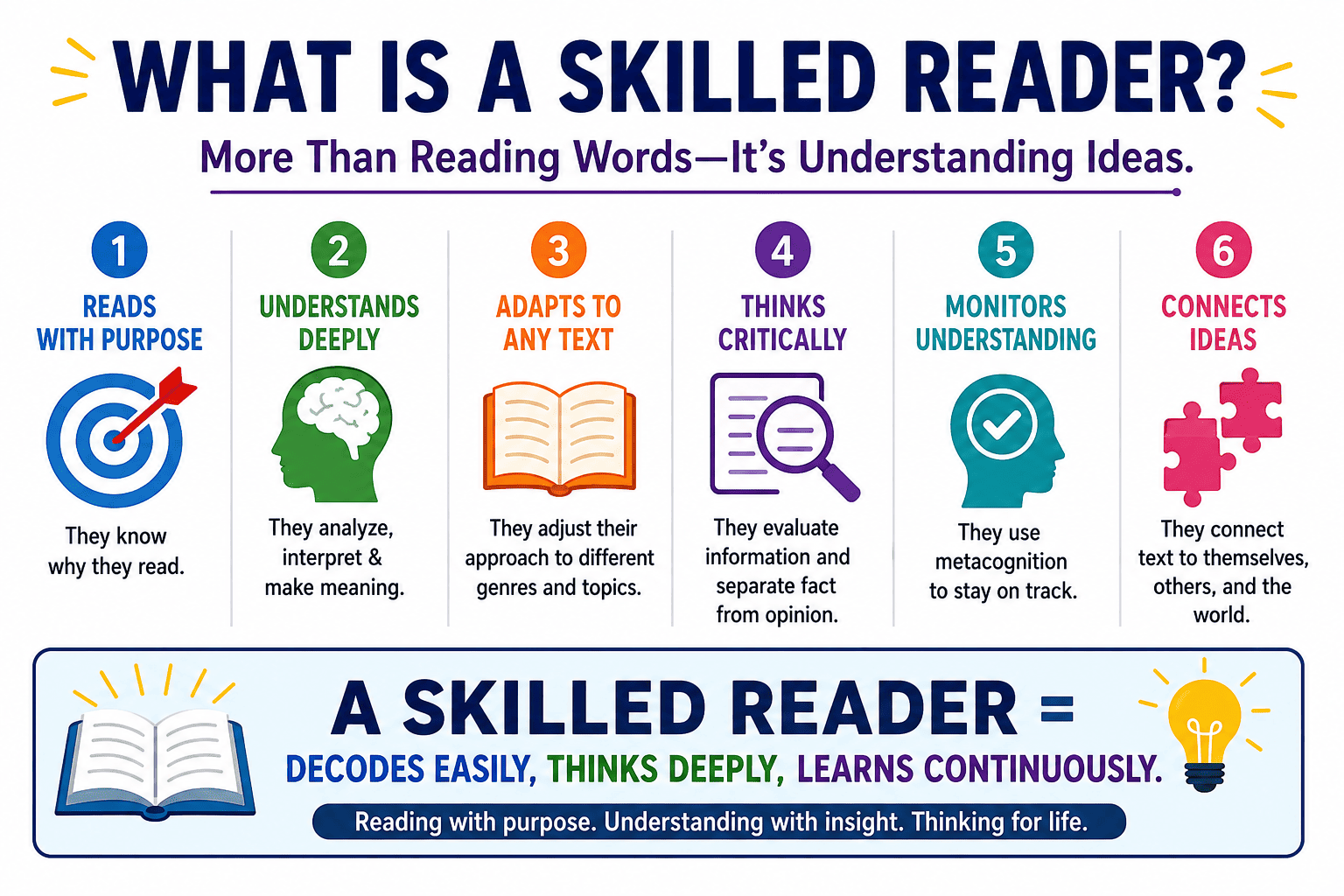
Reading is one of the most fundamental skills in education and life. Yet not all readers are the same. Some people can read words fluently but struggle to grasp deeper meaning, while others read with depth, clarity, and insight. The difference lies in what it means to be a skilled reader.
Skilled reading is the result of multiple cognitive and linguistic processes working together seamlessly. It is an active, purposeful, and strategic approach where the reader understands not just what the text says, but also why it says it, how information fits together, and what it means within a broader context.
This guide explores the cognitive foundations, key characteristics, and practical strategies that define skilled reading, and shows you how to develop these abilities in yourself or your students.
Skilled reader: Someone who reads with automatic word recognition, fluent processing, strong working memory, and strategic adaptability, enabling deep comprehension, critical analysis, and meaningful connection with texts across genres and purposes.
A skilled reader does not struggle with basic decoding or vocabulary. Instead, they focus on interpreting ideas, evaluating arguments, and drawing connections. They move fluidly between surface meaning and deeper insight, adjusting their reading approach depending on the complexity of the material.
Skilled reading is not a single ability but a constellation of skills that work together: word recognition, fluency, vocabulary knowledge, comprehension strategies, and critical thinking. These components are interdependent, strength in one area supports growth in others, creating a virtuous cycle of reading development.
Skilled reading is less about speed and more about strategic flexibility. A skilled reader knows when to skim, when to slow down, when to reread, and when to question, always adapting to the text and purpose.
Instantly recognizes familiar words without sounding them out, freeing mental energy for comprehension and analysis.
Moves through text smoothly with appropriate pacing, adjusting speed based on text difficulty to maintain meaning and engagement.
Holds information long enough to connect sentences, track complex arguments, synthesize ideas, and build mental models.
Shifts seamlessly between skimming, scanning, careful analysis, and critical evaluation as needed for different reading purposes.
Studies show that skilled readers use less cognitive energy on word recognition, freeing up mental resources for higher-order thinking. This automaticity is developed through extensive reading practice and exposure to diverse texts.
Always has a reason for reading, to learn, analyze, evaluate, or enjoy, which guides focus and determines reading strategies.
Interacts with text by asking questions, making predictions, noting patterns, forming opinions, and having internal conversations while reading.
Adjusts approach based on genre, difficulty, and purpose, knows when to skim for main ideas, slow down for analysis, or reread for clarity.
Notices subtle cues like tone, word choice, text structure, implications, and hidden assumptions that casual readers miss.
Persists through complexity, breaks down challenging passages, uses prior knowledge, and seeks understanding rather than giving up.
| Linguistic Ability | Role in Skilled Reading |
|---|---|
| Strong Vocabulary | Enables quick interpretation of ideas; skilled readers infer unknown words using context clues, roots, and affixes. |
| Grammar & Syntax Awareness | Decodes complex sentence structures, identifies relationships between ideas, extracts meaning from dense or unfamiliar text. |
| Semantic Knowledge | Understands literal and figurative meaning, metaphors, idioms, tone, nuance, and deeper messages beyond surface text. |
| Phonological & Orthographic Awareness | Supports automatic word recognition and fluent reading, even if used unconsciously in the background. |
Grasps the central message quickly and understands how supporting details contribute to the overall meaning and argument.
Reads between the lines to identify implied meaning, unstated assumptions, and conclusions not explicitly stated in the text.
Identifies text patterns like cause-effect, compare-contrast, problem-solution, and chronological order to organize understanding.
Critically assesses claims, evidence, reasoning, and potential bias, distinguishing fact from opinion and strong evidence from weak.
Combines new knowledge with prior knowledge, connects ideas across texts, and builds integrated understanding of topics.
Skilled readers don’t just absorb information, they interrogate it. They ask questions like: Is this argument logical? What assumptions is the author making? What evidence supports the claims? What perspectives are missing?
This critical orientation transforms reading from a passive activity into an active dialogue with the text. Skilled readers recognize that texts are constructed by authors with particular purposes, biases, and audiences in mind. They read with healthy skepticism while remaining open to new ideas.
A skilled reader reading a news article doesn’t just absorb facts, they ask: Who wrote this? What sources are cited? What counterarguments exist? Is the language neutral or loaded? This questioning leads to deeper understanding and better judgments.
Follows plot, understands character motivation and development, recognizes themes and symbolism, and appreciates author’s craft and style.
Identifies main arguments and supporting evidence, evaluates credibility, distinguishes facts from interpretations, and extracts key information.
Handles discipline-specific terminology, follows complex reasoning, and connects new ideas to prior knowledge in the field.
Identifies rhetorical strategies, evaluates claims and evidence, recognizes emotional appeals, and forms independent judgments.
Reads across genres, subjects, and formats, building background knowledge, vocabulary, and adaptability to different text structures.
Marks key passages, writes questions in margins, and records reactions and insights while reading for deeper engagement.
Discusses reading with others, sharing interpretations and challenging ideas, which deepens understanding and reveals new perspectives.
Returns to challenging passages, reconsiders interpretations, and reflects on what they’ve learned after finishing a text.
Metacognition, thinking about one’s own thinking, is a hallmark of skilled reading. Skilled readers constantly monitor their comprehension while reading. They notice when something doesn’t make sense, pause to clarify, adjust their reading pace, or reread complex sections.
This self-awareness keeps comprehension strong from start to finish. Rather than plowing through a text they don’t understand, skilled readers recognize the breakdown and take corrective action. This ability to “think about reading while reading” distinguishes skilled readers from less proficient ones.
Self-Monitoring: “Do I understand this?” Fix-up Strategies: “I need to reread that part.” Self-Questioning: “Why did that character do that?” Summarizing: “The main idea of this section is…”
Ensure automatic word recognition and fluency so cognitive energy can focus on comprehension rather than decoding individual words.
Practice with fiction, nonfiction, academic texts, and technical documents to build adaptability and broaden background knowledge.
Annotate, summarize, question the text, make predictions, and visualize while reading to maintain active engagement.
Monitor understanding, reread when confused, and reflect on what you’ve learned after finishing each text or section.
Becoming a skilled reader is a lifelong journey, not a destination. Even expert readers continue to learn and grow, discovering new ways to engage with texts, understand complex ideas, and appreciate the richness of written language. With consistent practice, strategic habits, and genuine curiosity, anyone can move from basic reading to skilled, expert-level reading.
Skilled reading is one of the most powerful tools for learning, personal growth, and professional success. It enables us to understand complex ideas, evaluate arguments, appreciate literature, and navigate the information-rich world we live in.
Whether you’re a student aiming to improve your reading abilities, a teacher looking to support your students, or a lifelong learner seeking to deepen your engagement with texts, the strategies outlined in this guide provide a clear path forward. The journey to skilled reading begins with a single step, and every step builds toward a richer, more meaningful relationship with the written word.
The best readers are made, not born. With consistent practice, strategic effort, and genuine curiosity, anyone can develop the cognitive, linguistic, and critical thinking abilities that define truly skilled reading.
Explore our guides, tools, and resources to become a more skilled, confident reader.
Explore More Guides → Try Our ToolsContinue supporting your learning journey with our guides on 3rd grade reading comprehension, reading and creativity, and motivating kids to read.

Belekar Sir is the founder and lead instructor at Belekar Sir’s Academy, a trusted name in English language education. With over a decade of teaching experience, he has helped thousands of students—from beginners to advanced learners—develop fluency, confidence, and real-world communication skills. Known for his practical teaching style and deep understanding of learner needs, Belekar Sir is passionate about making English accessible and empowering for everyone. When he’s not teaching, he’s creating resources and guides to support learners on their journey to mastering spoken English.