Irregular comparison refers to adjectives and adverbs that do not follow the standard -er / -est or more / most pattern. Instead, they change their root form entirely. The most important irregular sets are: good → better → best, bad → worse → worst, far → further/farther → furthest/farthest, little → less → least, and much/many → more → most.
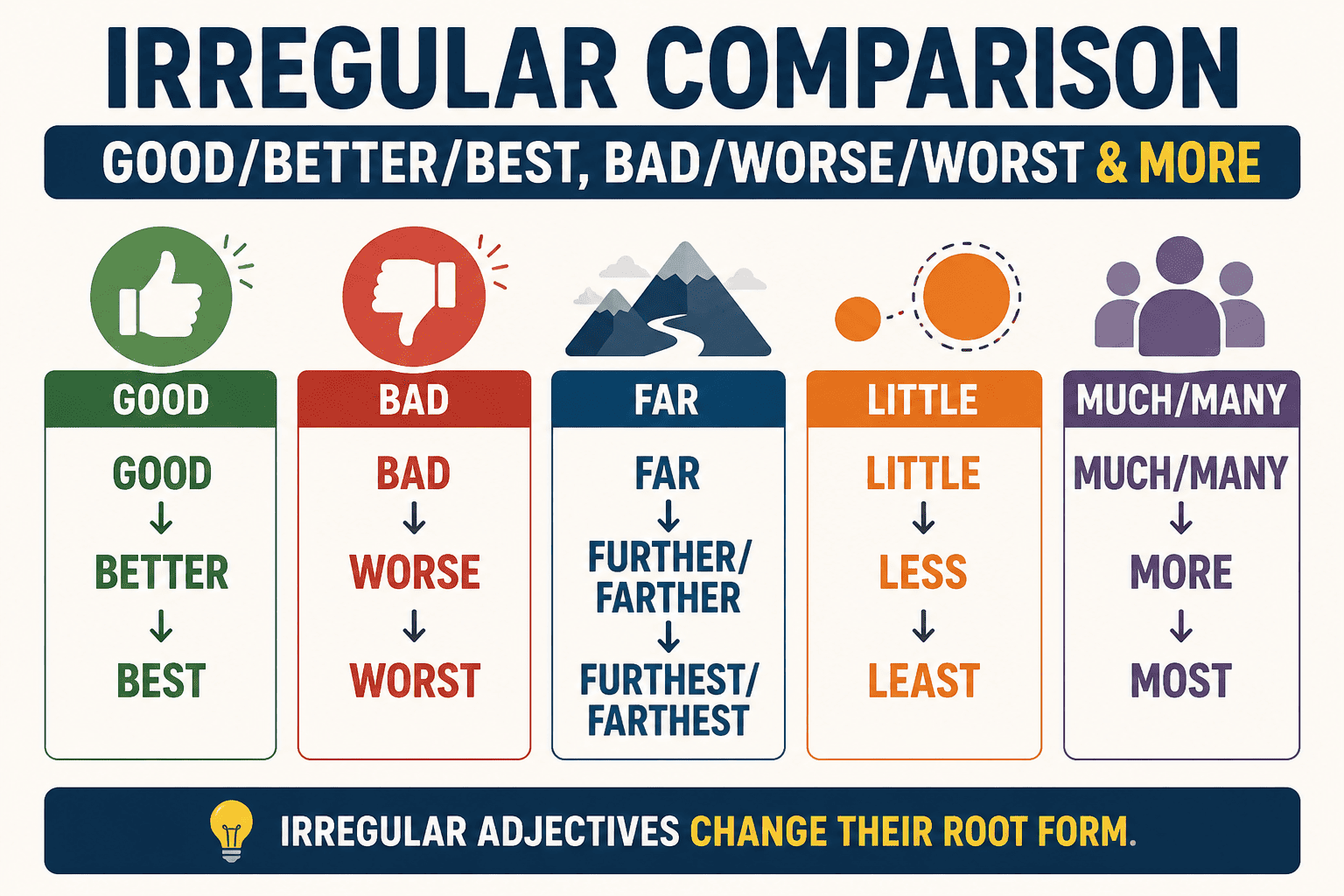
If you’ve ever wondered why we say “better” instead of “more good,” or “worse” instead of “more bad,” you’ve already encountered irregular comparison. English comparison rules work smoothly for most adjectives, but a small, high-frequency group refuses to play by the rules. These are the irregular comparatives and superlatives, and mastering them is essential for fluent, natural English.
Irregular comparison occurs when an adjective or adverb forms its comparative and superlative degrees by changing its root word entirely, rather than following the standard patterns of adding -er / -est or using more / most. The resulting forms must be memorized as distinct vocabulary items because they cannot be predicted by any rule.
Before diving into each irregular set, a quick recap of regular comparison patterns helps you appreciate just how different irregular forms are.
| Type | Rule | Positive | Comparative | Superlative |
|---|---|---|---|---|
| 1-syllable regular | Add -er / -est | tall | taller | tallest |
| 2-syllable -y ending | Change y→i, add -er / -est | happy | happier | happiest |
| 3+ syllable regular | more / most + adjective | important | more important | most important |
| Irregular | Root changes entirely | good | better | best |
| Irregular | Root changes entirely | bad | worse | worst |
| Irregular | Root changes entirely | little | less | least |
Most irregular forms in English come from different historical roots. “Better” and “best” derive from Old English betera / betst, while “good” itself comes from a separate root. Similarly, “worse/worst” have Germanic roots distinct from “bad.” These words were already in use before modern comparison rules developed, so the irregularity is simply a fossil of linguistic history.
good functions as an adjective: “She gave good advice.”
well functions as an adverb of manner: “She performed well.”
Both share the same comparative and superlative: better and best.
“This is a better solution.”
“She sings better than I do.”
“It was the best meal I’ve ever had.”
“More good” and “most good” are never correct in standard English. Always use better (comparative) and best (superlative).
“More good” and “most good” are never correct in standard English. Always use better (comparative) and best (superlative). This is one of the most common errors made by language learners at all levels.
bad (adjective, poor quality): “That was a bad idea.”
ill (adjective, unwell, especially British English): “She felt ill all morning.”
Both share worse and worst in many contexts.
“The traffic is worse today than yesterday.”
“It was the worst storm the region had seen.”
“He felt worse after taking the medication.”
“The traffic is more bad today.”, Never correct. Always use worse.
The adverb badly also has irregular comparison forms: worse (comparative) and worst (superlative). Example: “He performed worst of all the candidates.” This mirrors how “well” shares forms with “good.”
The adjective and adverb far has two valid comparative and superlative sets, and knowing which to use is one of the finer points of English grammar.
Use for: Literal, physical distance, especially in American English.
Use for: Distance and figurative meaning (additional, more advanced). Preferred in British English for both uses.
When in doubt, use further / furthest, it works for both physical distance and figurative meaning, and is correct in both British and American English. “Farther/farthest” is only correct for physical distance and is more common in American English.
| Context | Preferred Form | Example |
|---|---|---|
| Physical distance (AmE) | farther / farthest | “The farther city is Denver.” |
| Physical distance (BrE) | further / furthest | “How much further is it?” |
| Figurative / additional | further only | “No further action is needed.” |
| Academic / formal writing | further / furthest | “Further research is required.” |
| Either variety, safe choice | further / furthest | “She has gone the furthest.” |
The little → less → least set is used with uncountable nouns (things that can’t be counted individually: sugar, time, money, information). For countable nouns, English uses the separate set few → fewer → fewest. Confusing these two is one of the most frequent grammar mistakes, even among native speakers.
Less (irregular: from “little”) → use with uncountable nouns.
Fewer (regular: from “few”) → use with countable nouns.
✅ “There is less sugar in this recipe.” (uncountable: sugar)
✅ “There are fewer students this year.” (countable: students)
❌ “There are less students this year.”, Common but incorrect in formal English.
❌ “There are fewer time left.”, “Time” is uncountable; use “less.”
Ask yourself: can I count it individually? Cars, students, books, mistakes = countable → use fewer. Water, money, time, patience, information = uncountable → use less.
Both much (uncountable: “much time”) and many (countable: “many people”) share the same comparative and superlative: more and most.
“We need more time.” (uncountable: time)
“She has more friends than he does.” (countable: friends)
“He has the most experience on the team.”
“More” and “most” do double duty: as irregular forms of “much/many” AND as the regular comparison markers for long adjectives (3+ syllables).
The adjective old has a partial irregular set: elder and eldest, which exist alongside the regular older and oldest. Knowing when to use which form is a mark of advanced English grammar command.
Use for: All general age comparisons, people, animals, things, buildings. Works as both attributive and predicative.
Use for: Family relationships only. Usually placed before a noun (attributive). Cannot be used after a verb with “than.”
Elder/eldest = family relationships only, and never use with “than.” If you’re comparing ages using “than,” always use older than. If you’re describing a sibling or child in a family with a possessive (“my elder sister”), either form works, but “elder” sounds more formal and British.
The adjective late has two superlative forms with different meanings, this is one of the trickier irregular comparison distinctions in English.
| Form | Meaning | Example |
|---|---|---|
| late | Not on time; near the end | “He arrived late to the meeting.” |
| later | More recently in time; after this | “We’ll discuss this later.” / “A later edition was published.” |
| latest | Most recent; most up-to-date | “Have you seen the latest news?” / “the latest iPhone model” |
| last | Final in a series; the one before now | “That was the last train.” / “I saw her last week.” |
Latest = most recent (implies more may follow): “the latest update” suggests further updates are possible.
Last = final (implies nothing follows): “the last update” suggests no more updates are coming.
Near follows a mostly regular pattern (nearer, nearest) but its superlative is complicated by next, which functions as a conceptually related but structurally different superlative.
| Form | Meaning | Example |
|---|---|---|
| near | Close in distance or time | “The station is near.” / “The deadline is near.” |
| nearer | Closer than another option | “The hospital is nearer than the clinic.” |
| nearest | Closest in physical distance | “Where is the nearest pharmacy?” |
| next | The one immediately following in sequence or time | “I’ll see you next Monday.” / “Read the next chapter.” |
The key distinction: nearest refers to physical proximity (distance), while next refers to sequence or time order.
Use this table as your complete reference for every major irregular comparison set in English. Bookmark it for quick access when writing, editing, or studying.
| Base (Positive) | Comparative | Superlative | Notes & Key Rule |
|---|---|---|---|
| good | better | best | Never “more good / most good.” Used for quality. |
| well (adv.) | better | best | Adverb of manner; also adjective meaning “healthy.” |
| bad | worse | worst | Never “more bad / most bad.” Used for negative quality. |
| ill (BrE adj.) | worse | worst | Shares forms with “bad.” “He felt worse after resting.” |
| badly (adv.) | worse | worst | “She performed worst of all the candidates.” |
| far | farther / further | farthest / furthest | Farther = physical distance (esp. AmE). Further = distance + figurative. |
| little | less | least | For uncountable nouns. Countable → fewer / fewest. |
| much | more | most | Uncountable: “much water → more water → most water.” |
| many | more | most | Countable: “many cars → more cars → most cars.” |
| old | older / elder | oldest / eldest | Elder/eldest = family relationships only; not used with “than.” |
| late | later | latest / last | Latest = most recent. Last = final in a series. |
| near | nearer | nearest / next | Nearest = physical proximity. Next = sequence/time order. |
| fore | former | foremost / first | Archaic/formal. “Foremost” = most important. “First” = earliest. |
Even advanced learners make predictable mistakes with irregular comparison. Here are the most common errors and how to fix them.
Error: “This plan is more good.”
Fix: “This plan is better.”
Good is always → better → best.
Error: “The weather is more bad now.”
Fix: “The weather is worse now.”
Bad is always → worse → worst.
Error: “My cousin is elder than me.”
Fix: “My cousin is older than me.”
Elder cannot follow a verb with “than.”
Error: “There are less students today.”
Fix: “There are fewer students today.”
Less = uncountable; fewer = countable.
Error: “Have you seen the lastest news?”
Fix: “Have you seen the latest news?”
Never double-mark irregular superlatives.
Not always wrong, but in formal American English, prefer farther for physical distance and further for everything else to maintain precision.
Never add “more” or “most” to an already irregular form. Errors like “more better,” “most worst,” or “more further” are called double comparatives and are always grammatically incorrect in standard English.
Irregular comparatives and superlatives appear constantly in casual speech. Phrases like “better luck next time,” “feeling worse,” “the best I can do,” and “the least I can say” are idiomatic staples. Fluency with these forms directly signals natural, confident English.
Comparative structures, especially “better than,” “the most effective,” “the least costly,” and “further research”, are workhorses of academic argumentation. Knowing irregular forms prevents elementary errors that can undermine an otherwise strong piece of writing.
Grammar sections of major standardized tests frequently test knowledge of irregular comparison through multiple-choice and error-correction questions. Common test scenarios include:
Notice how naturally irregular forms blend into fluent, varied writing:
“The best doctors know that the least invasive treatment is often better than aggressive intervention. Further research into minimally invasive procedures has confirmed what older clinical studies first suggested: patient outcomes are worse when recovery time is not carefully managed. The latest guidelines now recommend a more patient-centered approach.”
Fill in the blank with the correct comparative or superlative form. Answers are shown below each question.
Explore hundreds of grammar guides, vocabulary lists, and interactive tools at Belekar Sir’s Academy.
Browse All Articles → Try Our ToolsIrregular comparison is a small but essential chapter of English grammar. The handful of adjectives covered here, good, bad, far, little, much, old, late, and near, appear in virtually every sentence we write or speak about comparisons. Getting them right is the difference between sounding fluent and sounding like a learner.
The good news: there aren’t many of them. Unlike regular comparison rules, which apply to thousands of adjectives, the irregular set is a fixed, memorizable list. Once you’ve internalized good/better/best, bad/worse/worst, and the nuances of further vs. farther, elder vs. older, and less vs. fewer, you’ll have covered the vast majority of what you need.
Practice them in context, use them when writing emails, essays, descriptions, and stories. Notice them when reading and listening. The more you encounter irregular comparison in real use, the more natural it becomes.
Deepen your knowledge of English adjectives and grammar with our guides on adjectives for schools, adjectives starting with W, adjectives starting with M, adjectives starting with E, and adjectives for mom.

Belekar Sir is the founder and lead instructor at Belekar Sir’s Academy, a trusted name in English language education. With over a decade of teaching experience, he has helped thousands of students—from beginners to advanced learners—develop fluency, confidence, and real-world communication skills. Known for his practical teaching style and deep understanding of learner needs, Belekar Sir is passionate about making English accessible and empowering for everyone. When he’s not teaching, he’s creating resources and guides to support learners on their journey to mastering spoken English.