The New Year offers a perfect opportunity to engage fourth grade students in meaningful writing activities that combine reflection with forward thinking creativity. As students return from winter break, their minds are filled with holiday memories, fresh perspectives, and excitement about new possibilities. This natural enthusiasm makes January the ideal time to strengthen writing skills through purposeful prompts that resonate with their experiences.
Fourth grade represents a critical developmental stage where students transition from learning to write toward writing to learn. They have mastered basic sentence structure and are ready to explore more complex narrative techniques, descriptive language, and persuasive arguments. New Year writing prompts provide authentic contexts for practicing these skills while helping students develop self awareness and goal setting abilities that extend far beyond the language arts classroom.
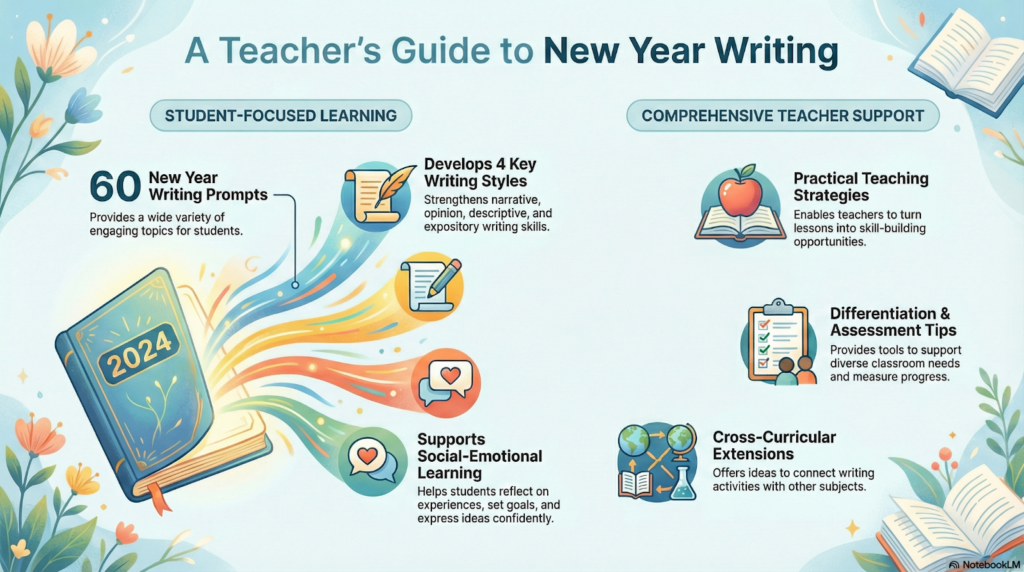
This comprehensive guide offers 60 carefully crafted writing prompts organized by category, along with practical implementation strategies, assessment tips, and creative extensions that will make your New Year writing lessons engaging and educationally valuable.
Benefits of New Year Writing Prompts for Fourth Graders
Developing Critical Thinking Skills
New Year prompts naturally encourage metacognition as students examine their past experiences and imagine future possibilities. When fourth graders write about what they learned last year or set goals for the coming months, they engage in higher order thinking that strengthens analytical abilities. They must evaluate their actions, consider cause and effect relationships, and make connections between past experiences and future aspirations.
This reflective practice builds executive functioning skills essential for academic success. Students learn to assess their own progress, identify areas for improvement, and create action plans for achieving objectives. These transferable skills support learning across all subject areas and contribute to personal growth beyond the classroom environment.
Building Writing Fluency and Stamina
Regular writing practice with engaging prompts increases writing fluency and helps students develop stamina for longer compositions. New Year themes provide familiar content that reduces cognitive load, allowing students to focus on craft elements like word choice, sentence variety, and organizational structure. When students write about personally meaningful topics, they naturally produce more text and take greater risks with language.
The emotional connection to New Year themes motivates reluctant writers to put pen to paper. Students who typically struggle with blank page anxiety find these prompts less intimidating because they can draw from genuine experiences and feelings. This increased confidence creates positive associations with writing that encourage continued practice and improvement.
Supporting Social Emotional Learning
Writing about resolutions, challenges, and personal growth directly supports social emotional learning objectives. Students develop self awareness by reflecting on their strengths and areas for growth. They practice responsible decision making when setting realistic goals and planning steps to achieve them. Sharing their writing with classmates builds social awareness and relationship skills as students discover common experiences and learn from different perspectives.
New Year prompts also provide safe opportunities to process emotions surrounding change, disappointment, and hope. Fourth graders navigate complex feelings as they mature, and writing offers a healthy outlet for expression. Teachers can use student responses to gain insights into individual needs and provide targeted support.
Reflection and Memory Prompts
Reflection prompts help students process their experiences from the previous year, strengthening memory and analytical skills while building appreciation for personal growth.
Past Year Memories
- Describe your favorite memory from last year. Include sensory details that help readers experience the moment with you.
- Write about three things that made you laugh during the past twelve months. Why were these moments so funny?
- Explain a challenge you faced last year and how you overcame it. What did this experience teach you?
- List ten words that describe your year. Choose your words carefully, then explain why each one fits.
- Write a letter to your past self at the beginning of last year. What advice or encouragement would you give?
- Describe the best book you read last year. What made it special and how did it affect you?
- Write about a time you helped someone during the past year. How did helping others make you feel?
- Explain your biggest accomplishment from last year. What steps did you take to achieve this goal?
- Describe how you changed or grew during the past twelve months. What caused these changes?
- Write about a disappointment from last year. Looking back, what did you learn from this experience?
Family and Friendship Reflections
- Describe your favorite family tradition from the past year and why it matters to you.
- Write about a friend who made your year better. Include specific examples of their kindness or support.
- Explain a family celebration or gathering you enjoyed. What made this event memorable?
- Describe a time when your family worked together to solve a problem or complete a project.
- Write about someone new you met last year. How did this person impact your life?
Goal Setting and Resolution Prompts
Goal oriented prompts teach fourth graders how to set achievable objectives while practicing persuasive and expository writing techniques.
Personal Goals
- Write three specific goals for the New Year. For each goal, explain why it matters and list steps you will take to achieve it.
- Describe a new skill you want to learn this year. How will you practice and who can help you?
- Explain one habit you want to develop during the coming year. Why is this habit important?
- Write about something that scares you that you want to try this year. What will help you be brave?
- Describe how you want to improve as a student. What specific actions will you take?
- Create a reading goal for the year. How many books will you read and what genres interest you?
- Write about one way you want to be a better friend, sibling, or family member. Give concrete examples.
- Describe a place you want to visit this year. Research facts about this location and explain your interest.
- Explain one way you want to help your community or make the world better. What is your plan?
- Write about a subject you want to improve in at school. What resources and strategies will help you succeed?
Academic and School Goals
- Persuade your teacher to help you achieve one specific academic goal. Explain why this goal matters.
- Describe your ideal study environment and routine. How will this setup help you learn better?
- Write about a school project you want to excel at this year. What steps will ensure your success?
- Create a plan for organizing your homework and assignments. Explain how this system will work.
- Describe one way you want to participate more actively in class discussions and group work.
Creative Narrative Prompts
Story based prompts allow fourth graders to exercise imagination while practicing narrative writing elements like character development, plot structure, and descriptive language.
Magical New Year Stories
- Write a story about discovering a magical calendar where each date leads to a different adventure.
- Imagine the New Year Baby appears at your door on January first. Describe your conversation and what happens next.
- Create a story about a family of time traveling mice who celebrate New Year in different eras.
- Write about finding a mysterious box on New Year Day that contains items predicting your future.
- Imagine you could freeze time at midnight on New Year Eve. What would you do with this power?
- Describe a world where everyone must complete one special task to welcome the New Year. What is yours?
- Write a story about fireworks that come to life after the New Year countdown. What do they do?
- Create a tale about a girl who can hear what animals say only on the first day of the year.
- Imagine you wake up on January first with the ability to grant three New Year wishes. Tell what happens.
- Write about a town where New Year celebrations last an entire week with a different theme daily.
Character and Adventure Stories
- Create a character who makes an unusual New Year resolution. Describe their journey to keep it.
- Write about kids who organize the perfect New Year party but everything goes wonderfully wrong.
- Imagine you are a detective solving the mystery of stolen New Year decorations. What clues do you find?
- Create a story about a shy student who becomes brave enough to perform at the school New Year assembly.
- Write about siblings competing to see who can keep their resolution longest. How does the competition end?
Opinion and Persuasive Prompts
Opinion writing prompts strengthen argumentative skills while encouraging students to develop and defend personal viewpoints.
Traditions and Celebrations
- Should schools celebrate New Year with special activities? Defend your opinion with three strong reasons.
- Persuade your family to try a new New Year tradition. Explain what it is and why it would be meaningful.
- Do you think making New Year resolutions is helpful or unnecessary? Support your position with examples.
- Should fourth graders be allowed to stay up until midnight on New Year Eve? Present your argument.
- Argue whether New Year Day should be spent with family, friends, or alone. Explain your reasoning.
- Is it better to celebrate quietly at home or attend a big community event? Defend your preference.
- Should schools assign homework over winter break? Present both sides, then state your position.
- Persuade readers that your favorite New Year tradition is the best way to celebrate. Use descriptive details.
- Do you think fireworks are essential for New Year celebrations? Explain why or why not.
- Should families make resolutions together or individually? Support your opinion with reasoning.
School and Learning Opinions
- Persuade your principal to add one new subject or activity to the school curriculum this year.
- Should students help teachers plan classroom activities? Present arguments for your position.
- Argue whether longer recess or more art class would benefit fourth graders most. Support your claim.
- Do you think grades motivate students or create stress? Explain your viewpoint with examples.
- Should schools have a special New Year celebration assembly? Make your case convincingly.
Descriptive and Expository Prompts
Descriptive prompts help students master sensory details and vivid language while expository prompts develop their ability to explain and inform.
Describing Celebrations
- Describe your perfect New Year Day from morning until night. Include sensory details for each part of the day.
- Explain how your family celebrates New Year Eve. What traditions make your celebration unique?
- Describe the sights, sounds, smells, tastes, and feelings of a New Year party. Make readers feel present.
- Compare and contrast how two different cultures celebrate the New Year. Research and explain differences.
- Describe the most beautiful New Year decoration you have ever seen. Use specific visual details.
- Explain step by step how to make a New Year craft or recipe. Write clear instructions someone could follow.
- Describe what midnight feels like on New Year Eve. Capture the excitement and anticipation.
- Explain three New Year traditions from around the world. Why are these customs important?
- Describe your ideal New Year gift. Explain what makes this gift meaningful rather than just fun.
- Write a detailed description of preparing for a New Year party. Include all the tasks involved.
Implementation Strategies for Teachers
Creating a Writing Routine
Establish consistent writing time during the first weeks of January when New Year themes feel most relevant. Begin each session with a brief discussion connecting the prompt to students experiences. Allow five minutes for brainstorming or quick sketching before writing begins. This prewriting time helps students organize thoughts and reduces anxiety about starting.
Consider implementing a daily quick write routine where students respond to shorter prompts in ten minutes. Quick writes build fluency without overwhelming students. Reserve longer writing periods for more complex prompts requiring planning, drafting, and revision. Mix prompt types throughout the week to maintain interest and practice various writing modes.
Differentiation Techniques
| Student Need | Adaptation Strategy | Example |
| Struggling Writers | Provide sentence frames and word banks | I remember when ___. It made me feel ___ because ___. |
| Advanced Writers | Add complexity with multi part prompts | Write about a memory, analyze its significance, and connect it to a future goal. |
| Visual Learners | Include drawing opportunities | Sketch your memory before writing or create an illustrated timeline. |
| English Learners | Offer prompts in native language first | Allow initial brainstorming in L1 before translating to English. |
| Reluctant Writers | Reduce length requirements initially | Start with three sentences, gradually increasing expectations. |
Assessment Approaches
Use rubrics that evaluate both content and craft appropriate for fourth grade standards. Focus on idea development, organization, word choice, and conventions. Provide specific feedback highlighting strengths before addressing areas for improvement. Celebrate growth rather than comparing students to each other.
Consider using student self assessment in conjunction with teacher evaluation. After completing pieces, have students reflect on their writing process, identify their strongest paragraph, and note what they would change given more time. This metacognitive practice reinforces learning and encourages ownership.
Extension Activities and Cross Curricular Connections
Publishing and Sharing
Transform student writing into meaningful products that extend beyond the classroom. Compile class responses into a New Year memory book that students can revisit at year end. Create a bulletin board displaying goals where students can track progress throughout the year. Record students reading their narratives to share with families or other classes.
Host a New Year writing celebration where students present their favorite pieces. Invite parents, administrators, or older student mentors to attend. Provide positive feedback forms where audience members write encouraging comments about specific writing they enjoyed. This authentic audience motivates students to produce quality work.
Math Connections
Use goal prompts to create data displays. Have students categorize their resolutions and create bar graphs showing the most common types of goals. Calculate what percentage of the class set academic versus personal goals. Practice measurement by tracking progress toward quantifiable objectives like reading certain numbers of books.
Create word problems based on New Year scenarios from student stories. If a character wants to save money for something special, students can calculate weekly savings needed or compare prices. Time based word problems work well with New Year countdowns and celebration planning.
Social Studies Integration
Research New Year traditions from different countries and cultures. Students can compare celebration customs, create presentations about diverse traditions, and write comparative essays. Explore the history of calendar systems and why different cultures celebrate new years at different times. Discuss how resolutions reflect cultural values and personal priorities.
Investigate the science behind fireworks displays. Students can research chemical reactions that create colors and write explanatory texts about the process. Explore the physics of sound and light related to celebration activities. Connect weather phenomena to winter celebrations in different hemispheres.
Digital Integration Options
Technology Enhanced Writing
Use word processing for final drafts, teaching formatting and editing features. Students practice digital literacy while producing polished writing. Consider collaborative documents where students provide peer feedback through comments. This approach mirrors real world writing processes and builds community.
Create digital portfolios where students collect their New Year writing over multiple years. By fourth grade, students can reflect on their growth by comparing current work to previous years. Digital formats allow easy sharing with families and provide lasting records of development.
Multimedia Projects
Extend writing prompts into multimedia presentations. Students might create digital slideshows combining their goal writing with images and music. Record video interviews where students discuss their resolutions and plans. These projects develop communication skills while maintaining writing as the foundation.
Use free animation tools to bring narrative prompts to life. Students write scripts based on their New Year stories, then create simple animations illustrating key scenes. This integration reinforces story structure while engaging students through multiple modalities.
Tips for Maximum Engagement
Making Prompts Personal
Allow students to modify prompts to match their interests and experiences. If a prompt asks about family traditions and a student has nontraditional family structures, encourage adaptation. Flexibility shows respect for diversity and increases relevance, leading to more authentic writing.
Offer choice boards with multiple prompts per category. Students select from options that appeal to their interests and comfort levels. Choice increases motivation and helps students develop preferences about writing topics and styles. Track which prompts prove most popular to inform future lesson planning.
Building Writing Confidence
Start with lower stakes writing activities where students know their work is for practice rather than grading. Use prompts for journal entries, class discussions, or small group sharing before assigning graded pieces. This progression allows students to experiment without fear of judgment.
Celebrate diverse writing styles and voices rather than expecting uniformity. Share examples showing how different students approached the same prompt uniquely. Emphasize that good writing comes in many forms, encouraging students to develop individual styles rather than mimicking a single model.
Conclusion
New Year writing prompts for fourth grade serve multiple educational purposes while capitalizing on students natural enthusiasm for fresh starts and new possibilities. These carefully designed prompts strengthen essential writing skills, support social emotional development, and provide meaningful contexts for reflection and goal setting. By implementing the strategies outlined in this guide, teachers can transform the return from winter break into a powerful learning opportunity that sets positive tone for the entire second semester.
The sixty prompts presented here offer variety across narrative, opinion, expository, and descriptive modes, ensuring students practice the full range of writing skills required by fourth grade standards. The key to success lies in creating a supportive environment where students feel safe exploring ideas, taking risks with language, and developing their unique voices. Remember that writing is a process, and these New Year prompts provide engaging entry points for that ongoing journey of growth and discovery.
As you implement these prompts, observe which types resonate most with your students and adapt accordingly. The ultimate goal extends beyond producing quality writing samples to fostering genuine love for written expression that students carry throughout their lives. The New Year represents new beginnings, making it the perfect time to help young writers discover the power of their own words.
Frequently Asked Questions:
How many writing prompts should I use with my fourth grade class?
Use two to three prompts per week, mixing different types to maintain variety and practice multiple writing modes.
What length should fourth grade New Year writing be?
Expect one to two paragraphs for quick writes and three to five paragraphs for longer assignments depending on complexity.
How do I help students who struggle with reflection prompts?
Provide sentence starters, specific examples, and conferencing time to help them identify memories and feelings to write about.
Should I grade all New Year writing assignments?
Use some prompts for practice and feedback without grades, reserving formal assessment for polished final drafts of selected pieces.
Can these prompts work for English language learners?
Yes, with modifications like sentence frames, word banks, visual supports, and allowing native language brainstorming before writing.
How do I prevent students from writing too little?
Set minimum requirements, provide detailed prompts with multiple parts, and conference with students to expand their ideas through questioning.
What if students cannot think of goals or resolutions?
Brainstorm class goals together first, discuss realistic versus unrealistic objectives, and provide categories like school, home, hobbies, and friendships.
Should students share their New Year writing with classmates?
Yes, sharing builds community and provides authentic audiences, but allow students to choose which pieces they share and keep some private.
How can I connect New Year writing to other subjects?
Incorporate math through goal tracking graphs, social studies through cultural traditions research, and science through celebration related phenomena.
What follow up activities work well after writing?
Publishing class books, creating goal tracking systems, revisiting reflections at year end, and hosting family sharing events extend learning.

Belekar Sir is the founder and lead instructor at Belekar Sir’s Academy, a trusted name in English language education. With over a decade of teaching experience, he has helped thousands of students—from beginners to advanced learners—develop fluency, confidence, and real-world communication skills. Known for his practical teaching style and deep understanding of learner needs, Belekar Sir is passionate about making English accessible and empowering for everyone. When he’s not teaching, he’s creating resources and guides to support learners on their journey to mastering spoken English.