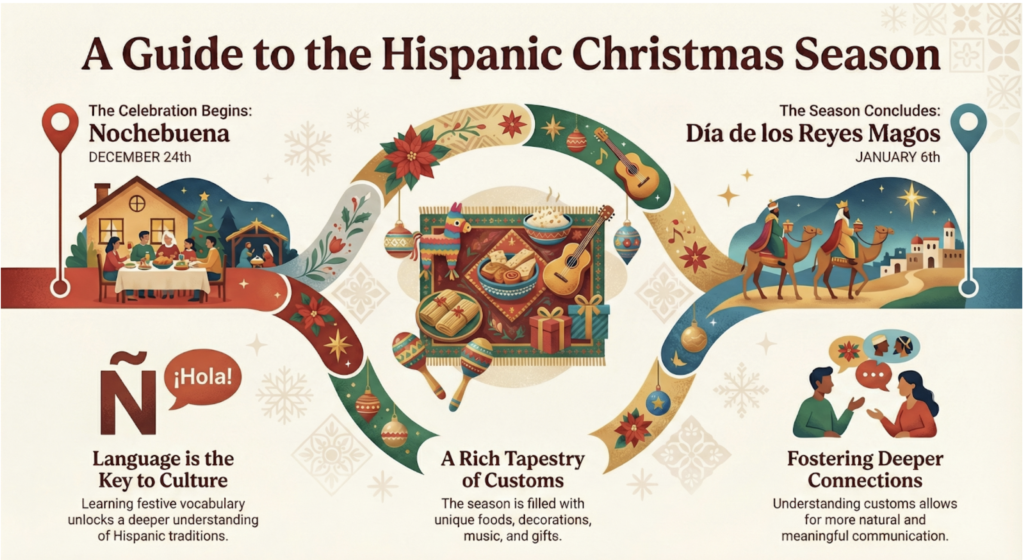
Christmas in Spanish-speaking countries is a vibrant, deeply meaningful celebration that extends far beyond December 25th. From the religious observances of Nochebuena to the joyful gift giving of Día de los Reyes Magos on January 6th, the Hispanic holiday season offers rich linguistic and cultural experiences. Whether you are planning to spend Christmas in a Spanish-speaking country, want to connect with Spanish-speaking friends and family during the holidays, or simply wish to expand your vocabulary, mastering Spanish Christmas vocabulary opens doors to understanding beautiful traditions celebrated across Spain, Latin America, and Hispanic communities worldwide.
This comprehensive guide provides over 100 essential Christmas words and phrases in Spanish, organized by category with pronunciation guidance, cultural context, and practical usage examples. You will learn not just translations but also the cultural significance behind terms, regional variations, and how to use this vocabulary naturally in conversation. By the end, you will be equipped to wish someone Feliz Navidad authentically, discuss holiday traditions confidently, and appreciate the depth and diversity of Spanish-speaking Christmas celebrations.
Essential Christmas Greetings and Wishes
The first Spanish Christmas vocabulary you need includes greetings and well wishes that you will use throughout the holiday season.
Basic Holiday Greetings
Feliz Navidad Pronunciation: feh-LEES nah-vee-DAHD Meaning: Merry Christmas This is the most universal Christmas greeting. Feliz means happy or joyful, and Navidad comes from natividad meaning nativity. You will hear this greeting from early December through early January.
Felices Fiestas Pronunciation: feh-LEE-ses fee-EHS-tahs Meaning: Happy Holidays This inclusive greeting works when you want to acknowledge the entire holiday season without focusing specifically on Christmas. It is appropriate for diverse audiences.
Feliz Nochebuena Pronunciation: feh-LEES noh-cheh-BWEH-nah Meaning: Happy Christmas Eve Nochebuena literally translates to Good Night and refers to December 24th. In many Spanish-speaking countries, Nochebuena celebrations are more important than Christmas Day itself, featuring large family dinners and midnight Mass.
Próspero Año Nuevo Pronunciation: PROHS-peh-roh AH-nyoh NWEH-voh Meaning: Prosperous New Year This phrase wishes someone prosperity and success in the coming year. It is commonly paired with Feliz Navidad in the combined greeting Feliz Navidad y Próspero Año Nuevo.
Feliz Año Nuevo Pronunciation: feh-LEES AH-nyoh NWEH-voh Meaning: Happy New Year The straightforward way to wish someone a happy new year, used on December 31st and throughout early January.
Extended Holiday Wishes
| Spanish Phrase | English Translation | When to Use |
| Que tengas una Feliz Navidad | I hope you have a Merry Christmas | Personal, warm greeting to individuals |
| Mis mejores deseos para ti y tu familia | My best wishes for you and your family | Formal or heartfelt message |
| Que se cumplan todos tus sueños | May all your dreams come true | New Year wishes, aspirational |
| Paz y amor en estas fiestas | Peace and love this holiday season | Emphasizing spiritual values |
| Que Dios te bendiga este año nuevo | May God bless you this new year | Religious blessing |
| Que lo pases de lo mejor | Have the best time | Casual, friendly holiday wish |
| Felices fiestas y próspero año nuevo | Happy holidays and prosperous new year | Complete season greeting |
Key Dates and Celebrations
Understanding the timeline of Spanish Christmas celebrations helps contextualize vocabulary and traditions.
Important Holiday Dates
Nochebuena (December 24th) Christmas Eve is the centerpiece of Hispanic Christmas celebrations. Families gather for elaborate dinners, often featuring traditional dishes specific to their region. Many Catholic families attend Misa del Gallo, the midnight Mass held at 12 AM on the night of December 24th going into Christmas morning. The name literally means Rooster’s Mass, traditionally the time when roosters begin crowing to announce the new day.
Navidad (December 25th) Christmas Day itself is celebrated more quietly in many Spanish-speaking countries, often as a day of rest after the late night Nochebuena festivities. Some families exchange small gifts, but major gift giving often waits until January 6th.
Día de los Santos Inocentes (December 28th) This day commemorates the biblical story of King Herod’s massacre of infant boys. However, modern celebrations resemble April Fools’ Day, with people playing practical jokes called inocentadas on friends and family.
Nochevieja (December 31st) New Year’s Eve, literally Old Night, marks the final night of the old year. A beloved tradition involves eating twelve grapes, one at each stroke of midnight, representing good luck for each month of the coming year. This custom, las doce uvas de la suerte, originated in Spain and spread throughout Latin America.
Día de Reyes or Día de los Reyes Magos (January 6th) Three Kings Day or Epiphany celebrates when the Three Wise Men brought gifts to baby Jesus. In many Hispanic countries, this is the primary gift giving day, more important than Christmas itself. Children leave their shoes out on the night of January 5th, and the Reyes Magos fill them with presents and candy. Well behaved children receive gifts, while naughty children traditionally receive carbón, a piece of coal or candy shaped like coal.
Christmas Decorations and Symbols
Spanish Christmas decorations blend religious imagery with festive ornaments, creating homes filled with warmth and meaning.
Essential Decoration Vocabulary
El árbol de Navidad The Christmas tree While not historically a Spanish tradition, Christmas trees have become popular throughout the Spanish-speaking world in recent decades, often decorated with luces (lights), bolas (ornaments), and topped with una estrella (a star) or un ángel (an angel).
El belén or El nacimiento The nativity scene This is the most important Christmas decoration in Spanish-speaking homes and churches. Elaborate belenes feature figurines representing Mary, Joseph, baby Jesus, shepherds, angels, the Three Wise Men, and various animals. Some families create intricate scenes with landscapes, buildings, and dozens of figures.
La corona de Adviento The Advent wreath This circular wreath holds four candles, one lit on each Sunday of Advent leading up to Christmas, symbolizing the progressive arrival of light into the world.
La guirnalda The wreath or garland Decorative wreaths hang on doors and walls, often made from evergreen branches, pine cones, and red ribbons.
La flor de Pascua or La flor de Nochebuena The poinsettia This iconic Christmas flower, native to Mexico, is called the Easter flower in some regions and the Good Night flower in others. Mexican legend tells of a poor girl who presented roadside weeds to baby Jesus, which miraculously transformed into beautiful red poinsettias.
Las luces de Navidad Christmas lights Twinkling lights adorn trees, homes, streets, and public spaces throughout the holiday season.
Las velas Candles Candles provide both practical light and symbolic spiritual illumination during Christmas celebrations.
El espumillón Tinsel Shiny metallic garland used to decorate trees and doorways.
Las bolas de Navidad Christmas ornaments Glass, plastic, or handmade ornaments hung on Christmas trees.
La estrella de Belén The Star of Bethlehem The guiding star that led the Three Wise Men to Jesus, often placed atop Christmas trees or featured prominently in nativity scenes.
Characters and Figures of Spanish Christmas
Spanish Christmas features a rich cast of traditional characters, some familiar to English speakers and others unique to Hispanic culture.
Holiday Characters
Papá Noel or Santa Claus Santa Claus has gained popularity in Spanish-speaking countries in recent decades, though he competes with traditional gift bringers. In some regions he is also called San Nicolás.
Los Reyes Magos The Three Wise Men Melchor, Gaspar, and Baltasar are the traditional gift bringers in Hispanic Christmas celebrations. Children write cartas a los Reyes Magos (letters to the Three Kings) requesting gifts, similar to letters to Santa. On the night of January 5th, children leave out water for the camels and food for the kings before going to sleep.
El Niño Jesús Baby Jesus The central figure of Christmas, featured in nativity scenes and emphasized in religious celebrations.
Los pastores The shepherds Important figures in the nativity story and popular characters in nativity scenes.
Los ángeles The angels Heavenly messengers who announced Jesus’s birth to the shepherds.
Traditional Spanish Christmas Foods
Food plays a central role in Spanish Christmas celebrations, with each region boasting signature dishes and treats.
Main Dishes and Meals
El pavo Turkey Common Christmas main dish, often prepared pavo trufado (truffled turkey) in Spain.
El cordero Lamb Traditional Christmas meat in many regions, often roasted with herbs.
El cochinillo Roast suckling pig A delicacy served during Christmas feasts, especially in Spain.
El bacalao Cod Dried salt cod appears in many traditional Christmas recipes, particularly for Nochebuena dinner.
Christmas Sweets and Desserts
| Spanish Name | Description | Region |
| El turrón | Nougat candy made from almonds, honey, and egg whites | Spain, widely popular |
| El mazapán | Sweet almond paste molded into shapes | Spain, Toledo famous for it |
| Los polvorones | Crumbly shortbread cookies with almonds | Spain and Latin America |
| Las mantecadas | Sweet sponge cakes | Spain |
| Los buñuelos | Fried dough pastries, often filled | Latin America |
| El roscón de Reyes | Ring-shaped cake with candied fruit for Epiphany | Spain and Latin America |
| El pan de pascua | Chilean Christmas fruitcake with spices and nuts | Chile |
| Los tamales | Corn masa filled with meat or sweet fillings, wrapped and steamed | Mexico, Central America |
| Las galletas de Navidad | Christmas cookies in various shapes and flavors | Universal |
| El tronco de Navidad | Yule log cake, chocolate roll cake | Spain and some Latin American countries |
Christmas Beverages
El ponche de Navidad Christmas punch A warm, spiced beverage made with fruits, spices, and sometimes rum. Recipes vary by region but typically include ingredients like cinnamon, cloves, guava, and tamarind.
El rompope Mexican eggnog A sweet, creamy beverage made with eggs, milk, vanilla, and rum, similar to eggnog but thicker and spicier.
El cava Sparkling wine Spanish sparkling wine traditionally served for toasting during Christmas and New Year celebrations.
La sidra Cider Popular in northern Spain, poured from height for aeration in a traditional serving method.
El chocolate caliente Hot chocolate Thick, rich hot chocolate served with churros or sweet bread.
Christmas Activities and Traditions
Understanding verbs and activities associated with Christmas helps you discuss celebrations and participate in traditions.
Christmas Verbs and Actions
Celebrar la Navidad To celebrate Christmas Example: Mi familia celebra la Navidad con una cena grande (My family celebrates Christmas with a big dinner).
Decorar el árbol To decorate the tree Example: Vamos a decorar el árbol este fin de semana (We are going to decorate the tree this weekend).
Intercambiar regalos To exchange gifts Example: En mi trabajo intercambiamos regalos el último día antes de las vacaciones (At my work we exchange gifts on the last day before vacation).
Cantar villancicos To sing Christmas carols Los villancicos are traditional Spanish Christmas carols. Example: Nos gusta cantar villancicos en familia (We like to sing Christmas carols as a family).
Hornear galletas To bake cookies Example: Mi abuela hornea galletas de Navidad cada año (My grandmother bakes Christmas cookies every year).
Enviar tarjetas de Navidad To send Christmas cards Example: Enviamos tarjetas de Navidad a todos nuestros amigos (We send Christmas cards to all our friends).
Hacer un brindis To make a toast Example: Vamos a hacer un brindis por el año nuevo (We are going to make a toast for the new year).
Abrir regalos To open presents Example: Los niños abren sus regalos el día de Reyes (The children open their presents on Three Kings Day).
Asistir a la misa To attend Mass Example: Asistimos a la Misa del Gallo cada Nochebuena (We attend Midnight Mass every Christmas Eve).
Montar el belén To set up the nativity scene Example: Montamos el belén en la sala cada diciembre (We set up the nativity scene in the living room every December).
Music and Entertainment
Music fills the air during the Spanish Christmas season, from ancient carols to modern holiday hits.
Musical Vocabulary
Los villancicos Christmas carols Traditional songs dating back centuries, originally rural folk songs that evolved into religious Christmas music.
Popular villancicos include: Noche de Paz (Silent Night) Los peces en el río (The Fish in the River) Campana sobre campana (Bell Upon Bell) Arre borriquito (Hurry Little Donkey) Mi burrito sabanero (My Little Donkey from the Savanna)
La zambomba A friction drum used in Spanish Christmas music, producing a distinctive groaning sound.
Las panderetas Tambourines Common instruments in villancico performances.
La cabalgata The parade Refers specifically to the Cabalgata de Reyes, the spectacular parade on January 5th where the Three Kings arrive in town on floats, throwing candy to children lining the streets.
Weather and Winter Vocabulary
While not all Spanish-speaking countries experience winter during Christmas, winter vocabulary appears frequently in Christmas contexts.
La nieve Snow Example: Me encanta cuando hay nieve en Navidad (I love when there is snow at Christmas).
El muñeco de nieve Snowman Example: Los niños hicieron un muñeco de nieve en el jardín (The children made a snowman in the yard).
El frío The cold Example: Hace mucho frío en diciembre (It is very cold in December).
El invierno Winter Example: El invierno es mi estación favorita por la Navidad (Winter is my favorite season because of Christmas).
Los copos de nieve Snowflakes Example: Los copos de nieve caen suavemente (The snowflakes fall softly).
Gift Giving Vocabulary
Exchanging presents is central to Christmas celebrations, requiring specific vocabulary.
Los regalos Gifts or presents Example: Tengo que comprar regalos para toda mi familia (I have to buy gifts for my whole family).
El papel de regalo Wrapping paper Example: Necesitamos papel de regalo y lazos (We need wrapping paper and ribbons).
La cinta or El lazo Ribbon or bow Example: Puse un lazo rojo en el regalo (I put a red ribbon on the gift).
La tarjeta Card Example: No olvides escribir una tarjeta (Do not forget to write a card).
El amigo invisible or El amigo secreto Secret Santa Example: En la oficina hacemos amigo invisible (At the office we do Secret Santa).
Desenvolver or Abrir To unwrap or open Example: Los niños quieren desenvolver sus regalos ya (The children want to unwrap their gifts now).
El carbón Coal Example: Los niños traviesos reciben carbón en lugar de regalos (Naughty children receive coal instead of gifts).
La lista de regalos Gift list or wish list Example: Mi hija ya hizo su lista de regalos para los Reyes (My daughter already made her gift list for the Kings).
Regional Variations and Cultural Notes
Spanish Christmas vocabulary includes regional variations that reflect diverse traditions across the Spanish-speaking world.
Spain vs. Latin America Differences
Gift Giving Traditions: In Spain, children traditionally receive gifts from the Reyes Magos on January 6th, with December 25th being more low key. In many Latin American countries, particularly those with strong U.S. cultural influence, Papá Noel brings gifts on December 25th, though Three Kings Day remains important.
Nativity Scene Names: Spain uses el belén while many Latin American countries say el nacimiento or el pesebre.
Poinsettia Names: Spain calls it la flor de Pascua (Easter flower), Mexico uses la flor de Nochebuena (Good Night flower), and other countries may say la pascua.
Regional Specialties: Mexican Christmas includes posadas, nine day reenactments of Mary and Joseph seeking shelter. Venezuela celebrates with patinatas, roller skating to early morning Mass. Colombia features elaborate nativity scenes with lighting displays. Puerto Rico has parrandas, surprise musical visits to homes.
Practical Conversation Examples
Putting vocabulary into context helps solidify learning and prepare you for real conversations.
Shopping Conversations
Necesito comprar regalos de Navidad para mi familia. I need to buy Christmas gifts for my family.
¿Dónde puedo encontrar decoraciones navideñas? Where can I find Christmas decorations?
Busco un árbol de Navidad de dos metros. I am looking for a two meter Christmas tree.
¿Tienen papel de regalo y tarjetas? Do you have wrapping paper and cards?
Social Conversations
¿Cómo celebras la Navidad? How do you celebrate Christmas?
Vamos a tener una cena grande en Nochebuena. We are going to have a big dinner on Christmas Eve.
Mi tradición favorita es montar el belén con mi familia. My favorite tradition is setting up the nativity scene with my family.
¿Asistirás a la Misa del Gallo? Will you attend Midnight Mass?
Family Traditions
En mi familia, cantamos villancicos después de la cena. In my family, we sing Christmas carols after dinner.
Los niños escriben cartas a los Reyes Magos en diciembre. The children write letters to the Three Kings in December.
Siempre horneamos galletas de Navidad juntos. We always bake Christmas cookies together.
Decoramos la casa con luces y guirnaldas. We decorate the house with lights and garlands.
Learning Tips and Memory Strategies
Mastering Spanish Christmas vocabulary requires more than memorization. These strategies help vocabulary stick and become usable.
Immersion Techniques
Listen to Spanish Christmas music and villancicos repeatedly. The repetition and melody help vocabulary enter long term memory naturally.
Watch Christmas movies and shows in Spanish with Spanish subtitles. This reinforces both written and spoken vocabulary.
Follow Spanish-speaking social media accounts posting holiday content. Exposure to authentic usage in context solidifies understanding.
Practice Activities
Label your own Christmas decorations with Spanish vocabulary words using sticky notes.
Create flashcards with images on one side and Spanish terms on the other.
Write your own Christmas wishes and greetings in Spanish to friends learning the language.
Keep a holiday journal in Spanish, describing your Christmas preparations and celebrations.
Cook traditional Spanish Christmas recipes, learning food vocabulary hands on.
Cultural Connection
Understanding cultural context makes vocabulary more memorable and meaningful. Research Christmas traditions in specific Spanish-speaking countries that interest you. Learning that el roscón de Reyes contains a hidden figurine and whoever finds it wears a crown makes the vocabulary more engaging than simple translation.
Conclusion
Mastering Spanish Christmas vocabulary opens windows into the rich cultural traditions celebrated across the Spanish-speaking world. From the sacred observance of Nochebuena to the joyful parades of the Cabalgata de Reyes, from the sweet taste of turrón to the melodic beauty of traditional villancicos, the Hispanic Christmas season offers linguistic learners countless opportunities to expand vocabulary while connecting with meaningful cultural practices.
The over 100 words and phrases covered in this guide provide a comprehensive foundation for understanding, discussing, and participating in Spanish Christmas celebrations. Whether you use these terms to wish Spanish-speaking friends Feliz Navidad, discuss holiday traditions with language exchange partners, understand Christmas music and media, or simply appreciate the diversity of global Christmas celebrations, this vocabulary enriches both your language skills and cultural understanding.
Remember that language learning is most effective when connected to authentic cultural context, so as you practice these terms, explore the traditions behind them, listen to villancicos, taste traditional foods, and immerse yourself in the warmth and joy that characterize the Hispanic holiday season. Feliz Navidad y Próspero Año Nuevo to you and your family as you continue your Spanish learning journey.
Frequently Asked Questions
How do you say Merry Christmas in Spanish?
Feliz Navidad is the most common way, literally meaning Happy Christmas or Happy Nativity.
What is the difference between Nochebuena and Navidad?
Nochebuena is Christmas Eve (December 24th), while Navidad is Christmas Day (December 25th).
When do children receive presents in Spanish-speaking countries?
Traditionally on January 6th from Los Reyes Magos, though December 25th gift giving has become common in some regions.
What does Próspero Año Nuevo mean?
It means Prosperous New Year, wishing someone prosperity and success in the coming year.
What are villancicos?
Villancicos are traditional Spanish Christmas carols, originally rural folk songs that evolved into religious holiday music.
What is Misa del Gallo?
Midnight Mass held at 12 AM on Christmas Eve, literally Rooster’s Mass, traditionally when roosters crow announcing the new day.
How do you say Happy New Year in Spanish?
Feliz Año Nuevo is the standard expression for Happy New Year.
What is a belén?
A belén is a nativity scene, one of the most important Christmas decorations in Spanish-speaking homes featuring figurines of the nativity story.
What foods are traditional for Spanish Christmas?
Turrón (nougat), mazapán (marzipan), polvorones (shortbread cookies), roscón de Reyes (Kings cake), and various regional specialties.
Is Santa Claus celebrated in Spanish-speaking countries?
Papá Noel has become popular in recent decades, especially in Latin America, though traditional Reyes Magos remain important.
What is the tradition of eating twelve grapes?
On New Year’s Eve at midnight, people eat twelve grapes, one with each bell chime, for good luck in each month of the coming year.
How long does the Christmas season last in Spanish-speaking countries?
From early December through January 6th, Día de Reyes, making it a month-long celebration.

Belekar Sir is the founder and lead instructor at Belekar Sir’s Academy, a trusted name in English language education. With over a decade of teaching experience, he has helped thousands of students—from beginners to advanced learners—develop fluency, confidence, and real-world communication skills. Known for his practical teaching style and deep understanding of learner needs, Belekar Sir is passionate about making English accessible and empowering for everyone. When he’s not teaching, he’s creating resources and guides to support learners on their journey to mastering spoken English.