Reading is one of the most essential abilities a person can develop. It is the foundation of learning, communication, critical thinking, and independent growth. Yet, many people think reading is simply recognizing words on a page. In reality, reading is a complex process that involves many interconnected skills, from decoding letters and understanding vocabulary to analyzing meaning, drawing conclusions, and evaluating information.
In today’s world, where information is abundant and attention spans are challenged, strong reading skills are more important than ever. Whether a student is trying to understand a textbook, an adult is processing digital content, or a professional is evaluating a report, the ability to read efficiently and meaningfully can deeply influence academic success, career growth, and lifelong learning.
This comprehensive guide explores what reading skills are, the different types, how they work together, and practical ways to develop them. Drawing from educational psychology, literacy research, and modern learning practices, this article provides everything you need to understand, and improve, reading skills effectively.
Understanding Reading Skills: What They Really Mean
Reading skills refer to the combination of cognitive, linguistic, and analytical abilities required to read text, understand its meaning, interpret it accurately, and apply the information. These skills allow individuals not only to recognize words but to process, evaluate, and respond to written language.
Reading is not a single skill, it is a bundle of abilities working together, such as:
- Recognizing letters and words
- Understanding vocabulary and grammar
- Following sentence structure
- Comprehending ideas
- Using memory to retain information
- Drawing inferences
- Analyzing arguments
- Evaluating meaning and purpose
When these skills develop effectively, reading becomes effortless, efficient, and enjoyable. When one or more skills are weak, reading becomes slow, confusing, or overwhelming.
Modern reading also occurs across formats, textbooks, digital screens, research articles, blogs, emails, and visual texts, each requiring a slightly different approach. This makes reading skills more crucial than ever.
Core Subskills: The Building Blocks of Reading
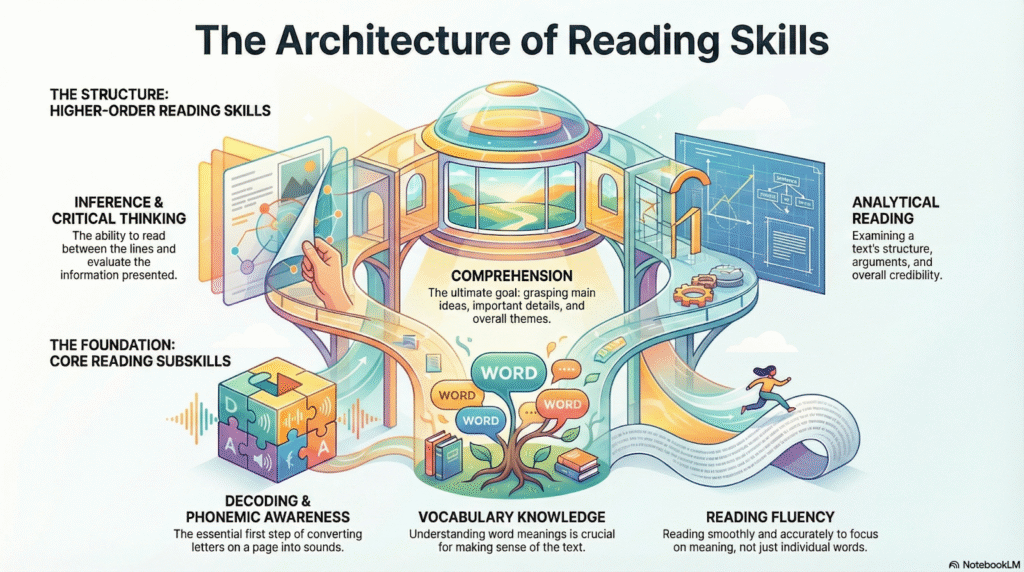
Every strong reader has a foundation of essential subskills. These abilities allow them to process written language fluently and accurately before moving on to interpretation and analysis.
a. Decoding & Phonemic Awareness
Decoding is the ability to translate printed symbols into sounds and words. Phonemic awareness helps children recognize and manipulate sounds in spoken language. Together, they form the foundation of reading fluency.
Without decoding, readers struggle with every new word, making comprehension nearly impossible. This subskill is particularly important for early learners or individuals overcoming reading difficulties.
b. Vocabulary Knowledge
Vocabulary determines how well a reader understands text. When readers encounter unfamiliar words, comprehension breaks down.
Strong vocabulary includes:
- Basic words used daily
- Subject-specific terminology
- Complex and abstract language
- Figurative and contextual meanings
Readers with rich vocabulary understand information faster, interpret ideas better, and analyze texts more effectively.
c. Fluency: Smooth, Automatic Reading
Reading fluency is the ability to read text quickly, correctly, and naturally. Fluent readers do not spend mental effort sounding out words; instead, they focus on understanding meaning.
Fluency includes:
- Accurate word recognition
- Proper pacing
- Natural rhythm
- Correct expression and intonation
Fluency bridges the gap between decoding and comprehension. Without it, readers become stuck on individual words instead of understanding ideas. Learning when kids develop fluency can help parents and educators support young readers effectively.
d. Understanding Sentence Structure and Cohesion
Reading requires understanding how sentences work, the relationship between subjects and verbs, how clauses connect, how pronouns refer to earlier ideas, and how punctuation changes meaning.
Beyond individual sentences, readers must understand:
- Transitions
- Paragraph flow
- Idea linking
- Narrative or logical structure
This ability helps readers capture meaning across larger sections of text.
e. Working Memory & Attention
Strong reading depends on the mind’s capacity to store, process, and use information while reading. Working memory allows readers to remember the beginning of a sentence while reading the end, follow plotlines, connect ideas, and retain details.
Attention skills help the reader stay focused, avoid distractions, and maintain engagement with the text.
These cognitive abilities are essential for comprehension, especially with long or complex texts.
Higher-Order Reading Skills & Comprehension Strategies
Once foundational skills are in place, readers develop advanced abilities that enable deeper understanding and interpretation.
a. Reading Comprehension
Comprehension is the ability to understand, interpret, and internalize written information. It includes recognizing main ideas, supporting details, themes, arguments, and implications.
Comprehension requires:
- Background knowledge
- Vocabulary
- Working memory
- Reasoning skills
It is the ultimate goal of reading, to understand and make sense of text. If you’re looking for practical ways to develop this skill, explore how to practice reading skills through targeted exercises and techniques.
b. Inference & Critical Thinking
Inference means reading between the lines, understanding what is implied rather than directly stated. Strong readers use clues, context, tone, and background knowledge to interpret meaning.
Critical thinking goes further. It includes:
- Questioning assumptions
- Evaluating logic
- Comparing perspectives
- Identifying bias
- Assessing credibility
This skill is vital for modern digital reading, where misinformation is common.
c. Analytical and Evaluative Reading
Analytical reading involves breaking down a text to understand how it works, its structure, arguments, evidence, and writing style. Evaluative reading takes it a step further, judging the accuracy, relevance, and value of the text.
These skills are essential for academic study, professional work, and informed citizenship.
d. Skimming and Scanning
These efficient reading strategies help manage large volumes of information.
- Skimming gives an overview by focusing on headings, topic sentences, keywords, and summaries.
- Scanning helps locate specific information quickly (dates, names, definitions, statistics).
These techniques are essential for students, researchers, and professionals who need to process information efficiently. Understanding how to improve reading speed while maintaining comprehension is a valuable skill for managing information overload.
e. Extensive and Intensive Reading
Both types contribute to skill development:
- Intensive reading – Slow, careful reading of difficult texts to understand details, structure, and meaning.
- Extensive reading – Reading large amounts for enjoyment, fluency, and exposure to language.
A good reading routine balances both.
Why Multiple Reading Skills Matter: The Reading-as-a-Process Model

Reading is not linear, it is an active mental process involving the simultaneous use of multiple abilities. One of the most widely accepted literacy frameworks explains reading as:
Reading Comprehension = Word Recognition × Language Comprehension
This means a reader must decode words and understand language. If one component is missing, comprehension falls apart.
Why Skill Balance Matters
- A child may decode perfectly but not understand meaning.
- A student may have strong vocabulary but struggle with attention and memory.
- An adult may read fluently but lack critical thinking to evaluate content.
Strengthening each skill is essential for becoming a capable, confident, and independent reader.
How to Develop and Improve Reading Skills
Improving reading is possible at any age. Below are research-based strategies that help learners build strong, well-rounded reading abilities.
a. Strengthen Foundational Skills First
If decoding, phonics, or fluency is weak, the learner should focus on:
- Phonics practice
- Sound-letter mapping
- Reading aloud
- Repeated reading exercises
- Using graded readers
A strong foundation accelerates progress in all other skills. Parents wondering how to teach a kid to learn how to read will find structured phonics and decoding practice especially beneficial.
b. Build Vocabulary Actively
Vocabulary grows through:
- Regular reading
- Using dictionaries
- Learning words in context
- Flashcards or digital vocabulary tools
- Keeping a “new words notebook”
- Using new words in writing or conversation
The richer the vocabulary, the stronger the comprehension.
c. Improve Fluency with Consistent Practice
Fluency improves when reading becomes a daily habit. Helpful techniques include:
- Reading aloud
- Echo reading (hearing and repeating)
- Paired reading with a partner
- Using audiobooks with text
- Practicing with short passages
Increasing fluency reduces reading fatigue and boosts confidence. Research shows that reading aloud does improve fluency by strengthening word recognition and expression.
d. Develop Comprehension Through Thoughtful Reading
Readers should engage actively with the text by:
- Asking questions before, during, and after reading
- Summarizing paragraphs or chapters
- Predicting what happens next
- Connecting ideas to real-life situations
- Identifying main ideas and supporting details
These habits turn passive reading into active learning.
e. Use Multiple Reading Techniques Based on Purpose
Different goals require different reading styles:
- Skim for overview
- Scan for facts
- Read intensively for exams or deep understanding
- Read extensively for language improvement and enjoyment
Smart readers choose the right technique for the task.
f. Diversify Reading Material
A variety of texts builds flexible reading skills:
- Fiction
- Nonfiction
- Articles and essays
- Newspapers
- Poetry
- Digital content
- Academic and professional texts
Each type strengthens different abilities, narrative understanding, analysis, vocabulary, logical reasoning, and more. For learners seeking to strengthen language skills, discovering how to read books to improve English through strategic text selection can accelerate progress.
g. Build Critical and Analytical Thinking
Encourage higher-order skills by:
- Comparing multiple texts
- Evaluating arguments
- Identifying bias or persuasion techniques
- Analyzing structure and tone
- Reflecting on author’s purpose
These skills are essential for advanced academic study and real-world decision-making.
h. Strengthen Working Memory and Focus
Improve cognitive skills through:
- Mindfulness practices
- Memory exercises
- Chunking information
- Reading in distraction-free environments
- Taking short breaks during long reading sessions
Better focus = better comprehension.
The Role of Reading in Education, Work, and Personal Growth
Strong reading skills empower individuals in multiple areas of life.
In Education
- Improves test scores and academic performance
- Enhances subject comprehension
- Strengthens writing skills
- Supports independent learning
Students aiming to excel academically should understand how to improve reading score through targeted practice and test-taking strategies.
In Professional Life
- Helps process reports, emails, and instructions
- Aids critical thinking and decision-making
- Supports continuous skill development
In Personal Growth
- Expands knowledge
- Stimulates imagination
- Builds empathy
- Encourages lifelong learning
Reading is not just a skill, it is a tool for personal and intellectual transformation. Understanding what skills do you get from reading can motivate learners to invest time in this valuable activity.
Conclusion: Why Reading Skills Matter More Than Ever
Reading skills form the foundation of learning, communication, and critical thinking. They help individuals decode information, understand meaning, analyze ideas, and make informed decisions. In a world filled with constant information, the ability to read effectively is not optional, it is essential.
By understanding the different types of reading skills, from decoding and vocabulary to analysis and evaluation, learners can identify their strengths and work on weaknesses. With consistent practice, varied reading, and active engagement, anyone can become a strong, confident, and effective reader.
Developing strong reading skills is one of the most valuable investments in a person’s education, career, and life. It shapes how we learn, how we think, and how we understand the world. Strengthening these skills opens the door to endless opportunities for knowledge, growth, and success. Parents seeking support can learn how to help kids read better through proven techniques and consistent encouragement, while adults can explore how to improve reading and writing through complementary practice methods.
Frequently Asked Questions (FAQs)
1. What are the 5 basic reading skills?
The five basic reading skills include phonemic awareness (sound recognition), phonics (letter-sound relationships), fluency (smooth reading), vocabulary (word knowledge), and comprehension (understanding meaning). These foundational abilities work together to enable effective reading and must be developed progressively from early childhood through adulthood.
2. At what age should a child become a fluent reader?
Most children develop reading fluency between ages 7-9, though this varies based on individual development, practice, and support. Early readers may achieve fluency sooner, while others need additional time and targeted instruction. Consistent reading practice and exposure to diverse texts significantly influence fluency development.
3. How can I improve my child’s reading comprehension?
Improve comprehension by asking questions before, during, and after reading, encouraging predictions, discussing story elements, and connecting texts to real-life experiences. Regular reading practice, vocabulary building, and modeling active reading strategies also strengthen comprehension skills over time.
4. What is the difference between intensive and extensive reading?
Intensive reading involves careful, detailed analysis of shorter, complex texts to master vocabulary, grammar, and meaning, often used in academic settings. Extensive reading focuses on reading larger volumes of easier material for enjoyment and fluency, building confidence and natural language acquisition through exposure.
5. Does reading aloud really help improve reading skills?
Yes, reading aloud significantly improves fluency, pronunciation, expression, and comprehension by engaging multiple senses and reinforcing word recognition patterns. It helps readers hear natural rhythm, correct errors immediately, and build confidence, making it an effective practice for learners at all levels.
6. How long should I read daily to see improvement?
Reading for 20-30 minutes daily can produce noticeable improvements in vocabulary, fluency, and comprehension within weeks. Consistency matters more than duration, regular daily practice, even for shorter periods, yields better results than occasional longer sessions, as it builds habits and reinforces learning.
7. What are the signs of poor reading skills in adults?
Adult reading difficulties include slow reading pace, frequent re-reading of sentences, limited vocabulary, difficulty following complex texts, avoidance of reading tasks, and comprehension challenges. These may stem from undiagnosed learning differences or lack of practice and can be addressed through targeted instruction and consistent practice.
8. Can reading skills be improved at any age?
Absolutely, neuroplasticity allows the brain to form new connections throughout life, enabling reading improvement at any age. Adults can strengthen decoding, fluency, vocabulary, and comprehension through consistent practice, appropriate materials, and strategic instruction, proving it’s never too late to become a better reader.
9. How does vocabulary impact reading comprehension?
Strong vocabulary directly enhances comprehension by enabling readers to decode meaning quickly without constant interruptions for word lookup. Limited vocabulary forces readers to struggle with basic understanding, preventing deeper analysis and slowing reading speed, while rich vocabulary allows focus on complex ideas and critical thinking.
10. What reading strategies work best for test preparation?
Effective test-reading strategies include skimming for main ideas, scanning for specific information, annotating key points, practicing with timed passages, and reviewing question types beforehand. Active reading techniques like summarizing paragraphs, identifying text structure, and eliminating distractors improve both speed and accuracy during standardized assessments.

Belekar Sir is the founder and lead instructor at Belekar Sir’s Academy, a trusted name in English language education. With over a decade of teaching experience, he has helped thousands of students—from beginners to advanced learners—develop fluency, confidence, and real-world communication skills. Known for his practical teaching style and deep understanding of learner needs, Belekar Sir is passionate about making English accessible and empowering for everyone. When he’s not teaching, he’s creating resources and guides to support learners on their journey to mastering spoken English.