Most people forget what they read because the brain stores information inefficiently without active engagement. This guide explains the science behind forgetfulness and shares practical, proven strategies to improve memory, boost retention, and remember more of every book you read.
Have you ever finished a book or article and realized you remember almost nothing? You’re not alone. Most readers forget up to 90% of what they read within a week, not because they aren’t smart, but because reading alone doesn’t guarantee memory retention.
Improving your reading memory means learning how to encode, store, and recall information more effectively. When you can remember what you read, you:
- understand topics more deeply
- learn faster
- apply ideas in real life
- save time by avoiding re-reading
This article combines insights from cognitive psychology, proven reading strategies, and memory-boosting techniques. You’ll learn why your brain forgets and how you can remember more, with practical methods you can use immediately.
How Memory Works: The Science Behind Remembering What You Read
Before improving reading memory, it helps to understand how memory actually works. Reading information is only the first step, your brain must process it through encoding, consolidation, and retrieval to store it long-term.
1. Encoding: Turning Information Into Meaning
Your brain remembers only what it pays attention to. If you read while distracted or half-aware, the information never gets encoded. That’s why reading when tired, stressed, or multitasking leads to poor recall.
Key idea: Focused attention = stronger memory encoding.
2. Consolidation: Storing Information in Long-Term Memory
After encoding, your brain must consolidate the information, usually during sleep or quiet reflection. This is why:
- spaced repetition
- reviewing notes
- reflecting on what you read
dramatically increases retention.
3. Retrieval: The Ability to Recall Information Later
Memory becomes stronger every time you recall it. That’s why summarizing, teaching, or practicing self-quizzing works so well.
Understanding these three stages prepares you for the next part: how to read actively and intelligently so the brain naturally retains more information.
Active Reading Techniques to Strengthen Memory
Improving reading memory starts with how actively your brain engages with the content. Passive reading leads to quick forgetting, while active reading creates strong mental connections that boost retention. Here are the most effective techniques:
Read With a Clear Purpose
Before starting, ask yourself:
- Why am I reading this?
- What do I want to learn?
Studies show that reading with intention primes your brain to notice key ideas and store them more effectively.
Use the SQ3R Method (Survey, Question, Read, Recite, Review)
This is one of the most proven comprehension strategies:
- Survey: Skim headings and summaries.
- Question: Turn headings into questions.
- Read: Read to answer those questions.
- Recite: Say key points aloud.
- Review: Revisit your notes after a short break.
This technique transforms reading into an active, memory-boosting process.
Take Smart Notes (Not Everything!)
The goal is to process information, not copy text.
Write:
- Main ideas
- Connections with previous knowledge
- Short summaries in your own words
This forces your brain to encode information deeply.
Visualize Concepts
Creating mental images or diagrams helps your brain “see” information.
If the content is abstract, turn it into:
- Mind maps
- Visual diagrams
- Flowcharts
Information you can visualize is information you can remember.
Memory Techniques & Tools to Boost Retention
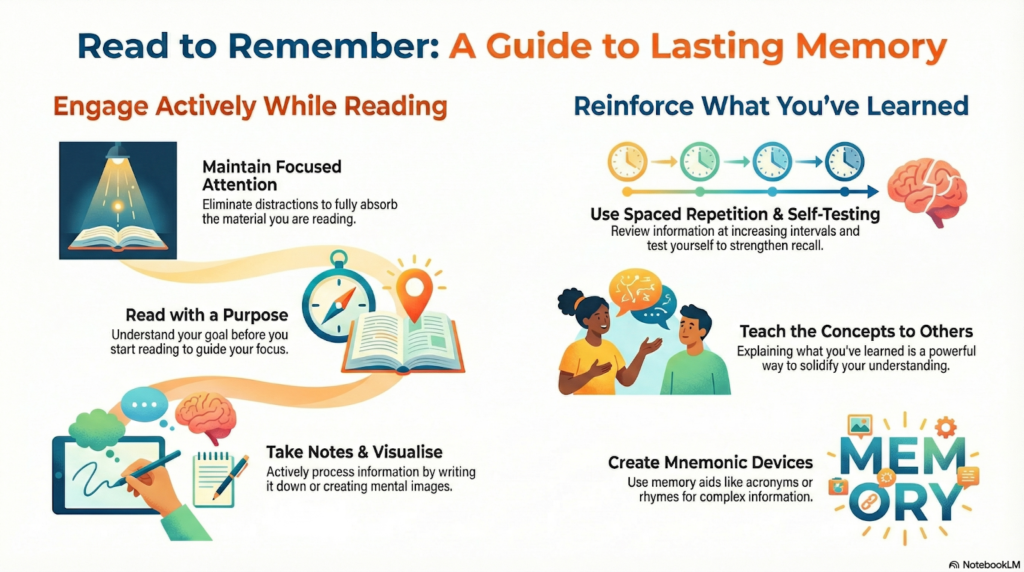
Beyond active reading, memory-formulas and tools can significantly enhance how well you retain what you read.
Use Spaced Repetition
Reading something once isn’t enough.
Review at intervals:
- After 24 hours
- After 1 week
- After 1 month
This moves information from short-term to long-term memory and is scientifically proven to improve retention.
Try Mnemonic Devices
Mnemonics help you remember lists, sequences, or complex ideas by converting them into “sticky” connections.
Examples:
- Acronyms
- Rhymes
- Memory palaces
- Peg systems
They work because they attach new information to patterns your brain easily recalls.
Teach What You Read
Explaining concepts to someone else is one of the most powerful memory tools.
When you teach:
- You organize information
- You identify gaps
- You reinforce understanding
If no one is around, explain aloud to yourself, this still works.
Practice Retrieval (Self-Testing)
Instead of re-reading endlessly, test yourself:
- Close the book and ask, “What did I just learn?”
- List key ideas without looking at your notes
- Try recalling the entire chapter structure
Retrieval practice strengthens memory far more than passive review.
Memory Techniques & Tools: From Spaced Repetition to Mnemonics
Using structured memory techniques can transform how much you remember from reading. Simply reading once isn’t enough, your brain needs active encoding and repeated reinforcement.
Spaced Repetition
- Review content at increasing intervals: after 1 day, 3 days, 1 week, 1 month.
- This technique strengthens the memory trace and moves knowledge from short-term to long-term memory.
- Works well with vocabulary, key concepts, and important facts.
Mnemonic Devices and Memory Palaces
- Mnemonics help convert abstract information into memorable patterns, especially for lists, sequences, or dates.
- Example: associating items with a story or a familiar location (memory palace technique) improves recall.
Teach or Explain Aloud
- Explaining what you read to someone else (or even to yourself) forces you to organize and articulate ideas, reinforcing understanding.
- Teaching transforms passive reading into active learning, which solidifies memory.
Periodic Review and Self-Testing
- Revisit notes or summaries regularly.
- Ask yourself questions: “What were the main points? How do I connect these ideas?”
- Self-testing improves recall and strengthens neural connections.
Building Habits & Environment to Support Long-Term Reading Memory
Your environment and reading habits play a crucial role in memory retention. Even the best techniques fail if reading is inconsistent or distracted.
Focused Reading Sessions
- Short, uninterrupted sessions (10–20 minutes) are more effective than long, distracted ones.
- Focused attention improves encoding and reduces cognitive overload.
Create a Dedicated Reading/Review Routine
- Schedule specific times for reading and review to reinforce consistency.
- Routine signals your brain to prioritize encoding and consolidation.
Keep a Reading Log / Memory Journal
- Summarize articles, note key points, and write reflections.
- This serves as a reference and strengthens internalization.
Mix Reading with Other Learning Modes
- Combine reading with discussion, writing, or practical application.
- Engaging multiple senses and methods strengthens memory and understanding.
SEO Insight: Keywords naturally included: improve memory while reading, reading habits for retention, reading memory techniques.
Avoiding Common Mistakes That Hurt Memory
Even with good intentions, certain habits can drastically reduce how much you remember from reading. Recognizing and avoiding these mistakes is key to improving retention.
Mindless Highlighting or Skimming
- Highlighting everything or skimming too quickly does not engage your brain in processing the information.
- Focus on key points, main ideas, and supporting details for effective retention.
Cramming Without Review
- Reading large amounts at once without revisiting material leads to rapid forgetting.
- Use spaced repetition and short, consistent study sessions for long-term memory.
Not Processing or Internalizing Information
- Simply reading without reflection prevents deep encoding.
- Take notes, summarize, visualize, and make personal connections to strengthen memory.
Ignoring Mental and Physical Conditions
- Fatigue, stress, distractions, or multitasking reduce memory retention.
- Ensure you are alert, focused, and comfortable while reading for optimal learning.
Advanced Strategies: Deep Encoding & Long-Term Retention
To truly remember what you read over months or years, implement advanced strategies that go beyond basic note-taking.
Combine Interleaving and Spaced Repetition
- Alternate between different topics or subjects during reading sessions.
- Revisit previously read material at spaced intervals to integrate knowledge and improve recall.
Use Multimodal Learning (Visual + Verbal + Kinesthetic)
- Draw diagrams, create mind maps, or summarize in your own words.
- Discuss what you read or teach it to someone else, engaging multiple senses strengthens memory pathways.
Periodic Summarization and Meta-Review
- Review past notes or summaries weekly or monthly.
- Reflect on key takeaways and see how ideas connect across readings.
Apply Reading Content in Real Life
- Writing essays, discussing topics, or applying concepts in projects reinforces learning.
- Active application transforms knowledge into usable skills and cements memory.
Conclusion: Make Reading Smarter to Remember More
Improving reading memory is not about reading faster or reading more; it’s about reading smarter and engaging your brain effectively.
- Active reading is key: read with purpose, take notes, highlight selectively, visualize, and connect ideas to what you already know.
- Use memory techniques: spaced repetition, mnemonics, teaching, self-testing, and periodic review strengthen retention.
- Build consistent habits: focused reading sessions, dedicated routines, and memory journals ensure long-term consolidation.
- Avoid common mistakes: mindless highlighting, cramming, ignoring reflection, or reading while distracted drastically reduce retention.
- Apply advanced strategies for long-term memory: interleaving topics, multimodal learning, and real-life application turn reading into lasting knowledge.
Action Step: Start with one short article or chapter today. Take notes, create mental images, review the key points tomorrow, and explain it aloud in your own words. Repeat consistently and gradually implement spaced repetition and advanced strategies. Over time, your reading memory will improve dramatically, and you’ll retain and apply knowledge more effectively.
Takeaway: Reading with focus, using smart techniques, and reviewing systematically will transform how much you remember. Your brain will not just read, it will learn, retain, and apply knowledge efficiently.
FAQs
1. Why do I forget most of what I read?
Because reading is often passive. Without actively engaging, through reflection, note-taking, questioning, or connecting ideas, the brain doesn’t transfer information from short-term to long-term memory.
2. How long does it take to improve reading retention?
With consistent habits like summarizing, annotating, and spaced repetition, most people see improvement within a few weeks.
3. Does highlighting help memory?
Highlighting alone doesn’t improve retention much. It works best when combined with active recall and explaining concepts in your own words.
4. What is the best way to remember books long-term?
Use active recall, spaced repetition, and periodic review. Teaching others or discussing what you’ve read also strengthens memory.
5. Can reading slower help me remember more?
Yes. Reading slower gives your brain more time to process and store information meaningfully, especially for complex material.
6. Should I take notes while reading?
Yes. Taking notes helps reinforce key ideas, keeping you focused and increasing long-term retention.
7. Why do I remember fiction better than nonfiction?
Stories activate more emotional and sensory regions in the brain, making them easier to recall than abstract or informational text.
8. Is rereading a good strategy?
Rereading helps, but active recall is more powerful. Try summarizing what you remember before rereading a chapter.
9. How can I stop my mind from wandering while reading?
Break reading sessions into smaller chunks, set a clear purpose for reading, and remove distractions.
10. Does discussing a book help memory?
Absolutely. Explaining ideas out loud strengthens neural connections and greatly improves recall.

Belekar Sir is the founder and lead instructor at Belekar Sir’s Academy, a trusted name in English language education. With over a decade of teaching experience, he has helped thousands of students—from beginners to advanced learners—develop fluency, confidence, and real-world communication skills. Known for his practical teaching style and deep understanding of learner needs, Belekar Sir is passionate about making English accessible and empowering for everyone. When he’s not teaching, he’s creating resources and guides to support learners on their journey to mastering spoken English.