
Chinese New Year, also known as Lunar New Year or Spring Festival, is one of the most important celebrations in Chinese culture. This 15-day festival brings families together, honors ancestors, and welcomes prosperity for the year ahead. For educators and parents, it offers a perfect opportunity to combine cultural learning with creative writing practice.
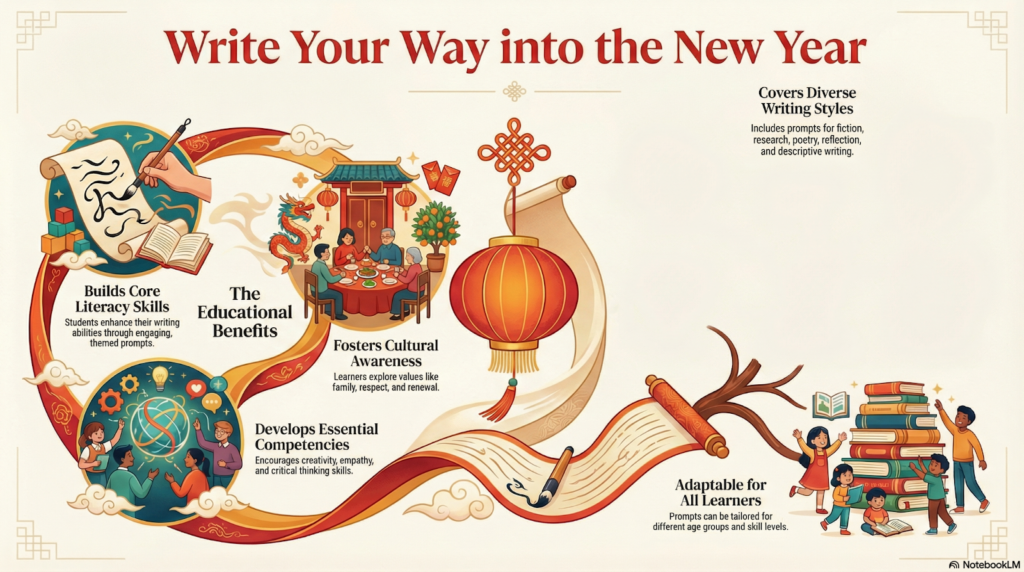
Writing prompts based on Chinese New Year help students develop multiple skills simultaneously. They practice composition and storytelling while learning about traditions, symbols, and customs from another culture. These activities promote cultural awareness, empathy, and global citizenship in young learners.
This comprehensive guide provides 50 writing prompts organized by category, suitable for various age groups and writing abilities. Whether you teach elementary students or high schoolers, homeschool your children, or simply want to engage kids in meaningful writing activities, you will find prompts that inspire creativity while honoring this rich cultural celebration.
Why Use Chinese New Year Writing Prompts
Chinese New Year writing prompts serve multiple educational purposes that extend beyond basic writing practice. They create engaging learning experiences that connect students to global traditions while developing essential literacy skills.
Cultural Education and Global Awareness
Writing about Chinese New Year introduces students to customs they might not encounter otherwise. Through research-based prompts, children learn about the significance of red envelopes, the legend of Nian, zodiac animals, and family reunion dinners. This exposure builds respect for cultural diversity and helps students understand that people around the world celebrate important occasions in different ways.
Creativity and Imagination Development
Festival-themed prompts naturally spark imagination. Students can write about magical dragons, create poems about fireworks, or invent stories featuring zodiac animals with special powers. These creative exercises help young writers explore narrative techniques, character development, and descriptive language in contexts that feel exciting and fresh.
Research and Critical Thinking Skills
Many Chinese New Year prompts require students to investigate traditions, compare celebrations across countries, or analyze the symbolism behind customs. These activities teach research skills, information synthesis, and critical analysis. Students learn to gather facts from reliable sources and present information clearly in their own words.
Empathy and Perspective Taking
When students write from the perspective of characters celebrating Chinese New Year, they practice seeing the world through different cultural lenses. This builds empathy and helps children understand that their own traditions are just one way among many to mark important life moments.
Creative Fiction Writing Prompts
Fiction prompts allow students to explore Chinese New Year through imagination and storytelling. These prompts encourage narrative development while incorporating cultural elements naturally into creative work.
Dragon and Mythical Creature Stories
- Write a story about a friendly dragon who helps a small village prepare for Chinese New Year celebrations and discovers what community truly means.
- Create a tale about the last remaining dragon keeper in modern China who must wake an ancient dragon for one final New Year celebration.
- Imagine a young dragon learning to dance for the first time before the big New Year parade and the mistakes that lead to unexpected success.
- Write about a child who discovers a tiny dragon living in their grandmother’s attic and must keep it secret during the family New Year gathering.
- Develop a story where all twelve zodiac animals must work together to save Chinese New Year from a mischievous spirit.
Family and Tradition Stories
- Write a heartwarming story about a family reuniting from different countries for Chinese New Year dinner and the surprises that unfold.
- Create a narrative about a child who receives a red envelope with an unusual gift inside that changes their understanding of good fortune.
- Tell the story of a grandparent teaching their grandchild an ancient family recipe that must be prepared perfectly for New Year’s Eve.
- Write about siblings who must work together to create the perfect New Year decorations after their parents become too busy to help.
- Imagine a family who has moved to a new country and celebrates Chinese New Year for the first time away from their homeland.
Time Travel and Historical Fiction
- Write about a modern student who travels back in time to ancient China during New Year celebrations and must learn old customs to return home.
- Create a story where a character finds an antique Chinese New Year decoration that transports them to different New Year celebrations throughout history.
- Imagine what the very first Chinese New Year celebration might have looked like and write a story set during that time.
Science Fiction and Fantasy
- Write a science fiction story set in the future where animals from the Chinese zodiac have developed unique superpowers and must protect Earth during New Year.
- Create a tale about a parallel universe where Chinese New Year traditions have magical properties that affect reality.
- Imagine a space colony celebrating Chinese New Year for the first time and adapting traditions for life among the stars.
Cultural Research and Informational Prompts
Research-based prompts help students learn factual information about Chinese New Year while practicing expository writing skills. These activities develop information literacy and analytical thinking.
Tradition and Custom Research
- Research and explain three major customs associated with Chinese New Year, including their historical origins and cultural significance.
- Compare how Chinese New Year is celebrated in three different countries, highlighting similarities and differences in traditions.
- Investigate the legend of Nian and write an informational essay explaining how this mythical creature influences modern New Year traditions.
- Research the significance of the color red during Chinese New Year and explain why it appears in decorations, clothing, and gifts.
- Explore the tradition of giving red envelopes and write about the proper etiquette, typical amounts, and what the custom represents.
- Research the Chinese zodiac calendar system and explain how zodiac signs are determined and what they mean to people.
- Investigate the foods traditionally eaten during Chinese New Year and explain the symbolic meaning behind each dish.
- Research the practice of spring cleaning before Chinese New Year and explain its cultural and spiritual significance.
Comparative Cultural Studies
- Write an essay comparing Chinese New Year celebrations to your own cultural New Year traditions, identifying universal themes.
- Research how Chinese New Year has been adapted by Chinese communities living in your country and what elements remain versus what has changed.
- Compare the Chinese zodiac system to the Western zodiac system, explaining how each works and their cultural purposes.
Poetry and Creative Expression Prompts
Poetry prompts encourage students to play with language, rhythm, and imagery while exploring Chinese New Year themes. These activities develop linguistic creativity and appreciation for different poetic forms.
Acrostic and Structured Poems
- Create an acrostic poem for your Chinese zodiac animal, with each line highlighting a characteristic of that animal.
- Write a haiku series describing the 15 days of Chinese New Year celebration, with one haiku for each day.
- Develop a series of acrostic poems spelling out CHINESE NEW YEAR, with each poem focusing on a different tradition.
Descriptive and Sensory Poems
- Write a poem that captures the sounds, sights, smells, tastes, and textures of a Chinese New Year celebration using all five senses.
- Create a poem from the perspective of a firecracker describing its brief but brilliant moment during New Year celebrations.
- Write a color poem focused on red and gold, the traditional colors of Chinese New Year, and what they symbolize.
Traditional Forms
- Research and write a couplet poem about good luck and happiness to hang on a door, following the traditional Chinese New Year poetry custom.
- Create a series of two-line rhyming couplets about different aspects of Chinese New Year celebration.
Opinion and Reflective Writing Prompts
Opinion prompts encourage students to think critically and express personal viewpoints while considering cultural practices and values. These activities develop argumentation skills and self-reflection.
Personal Reflection
- If you could add one Chinese New Year tradition to your own family celebrations, which would you choose and why?
- Write about which Chinese zodiac animal you identify with most and explain why its characteristics match your personality.
- Reflect on the importance of family reunions during Chinese New Year and compare it to family gatherings in your own culture.
- Explain which Chinese New Year food you would most like to try and what makes it appealing to you.
- Write about whether you think 15 days is the right length for a New Year celebration and defend your opinion.
Critical Thinking and Analysis
- Argue whether ancient traditions should be preserved exactly as they were or adapted for modern times, using Chinese New Year customs as examples.
- Write an opinion piece about whether schools should recognize and teach about cultural celebrations like Chinese New Year.
- Discuss whether the commercialization of cultural festivals like Chinese New Year helps or harms the preservation of authentic traditions.
Descriptive and Observational Prompts
Descriptive prompts help students develop their ability to create vivid imagery and detailed observations through writing about visual and experiential elements of Chinese New Year.
Scene and Setting Description
- Describe a bustling Chinese New Year parade with elaborate costumes, dragon dances, and colorful floats moving down the street.
- Write a detailed description of a table set for a traditional Chinese New Year reunion dinner, including the foods, decorations, and atmosphere.
- Describe the transformation of a home being decorated for Chinese New Year, from the cleaning process to the final festive appearance.
- Create a vivid description of a traditional Chinese lantern festival taking place on the fifteenth night of New Year celebrations.
Character and Object Description
- Describe a handmade Chinese New Year decoration in such detail that someone reading could recreate it.
- Write a detailed character sketch of an elder family member preparing special dishes for New Year’s Eve dinner.
- Describe a child’s experience of receiving their first red envelope, capturing their emotions and the significance of the moment.
Age-Appropriate Prompt Selection Guide
Choosing the right prompts for different age groups ensures students feel challenged without becoming frustrated. This guide helps educators match prompts to developmental levels.
| Age Group | Best Prompt Types | Skills Developed | Example Prompts |
| Ages 5-7 | Simple descriptive, drawing-based, short creative stories | Basic sentence structure, vocabulary, imagination | Describe fireworks in ten words, draw and label a dragon, write about receiving a red envelope |
| Ages 8-10 | Narrative stories, basic research, comparison activities | Paragraph development, research basics, sequencing | Write a story about a magical parade, compare two celebrations, create zodiac animal poems |
| Ages 11-13 | Complex fiction, cultural research, opinion pieces | Essay structure, citation skills, argumentation | Research red envelope customs, write science fiction with zodiac powers, debate tradition preservation |
| Ages 14-18 | Analytical essays, creative synthesis, multimedia projects | Critical analysis, sophisticated writing, interdisciplinary thinking | Compare zodiac systems across cultures, write historical fiction with research, create cultural documentary scripts |
Tips for Using Writing Prompts Effectively
Maximizing the educational value of writing prompts requires thoughtful implementation and support. These strategies help students succeed with Chinese New Year writing activities.
Create a Supportive Writing Environment
Before students begin writing, provide background knowledge about Chinese New Year. Read age-appropriate books, watch videos of celebrations, or invite community members to share their experiences. This foundation gives students the cultural context they need to write authentically and respectfully.
Display visual aids around your classroom or learning space. Hang images of dragons, lanterns, zodiac animals, traditional foods, and celebration scenes. These references spark ideas and help students visualize what they are writing about.
Differentiate for All Learners
Offer choice within assignments by providing multiple prompts at similar difficulty levels. Some students connect better with fiction while others prefer research-based topics. Allowing choice increases engagement and gives students ownership of their learning.
Modify prompts for different ability levels. For struggling writers, provide sentence starters, graphic organizers, or word banks. For advanced students, add complexity by requiring multiple perspectives, deeper research, or longer formats.
Encourage Research and Authenticity
Teach students to use reliable sources when researching Chinese New Year traditions. Provide age-appropriate websites, books, and videos as starting points. Emphasize the importance of presenting accurate cultural information respectfully.
Remind students that they are learning about real traditions practiced by real people. Encourage them to approach cultural topics with curiosity and respect rather than making assumptions or relying on stereotypes.
Incorporate Multiple Writing Stages
Guide students through the complete writing process rather than expecting perfect first drafts. Teach brainstorming techniques, outlining strategies, and revision skills. Chinese New Year prompts work well for practicing process writing because the topic is engaging enough to sustain student interest through multiple drafts.
Provide opportunities for peer feedback and collaborative revision. Students can share their work in small groups, offering constructive suggestions to help each other improve their writing.
Celebrate Student Work
Create a classroom display or digital portfolio showcasing student writing about Chinese New Year. This validation motivates students and allows them to learn from each other’s approaches to the prompts.
Consider hosting a reading celebration where students share their favorite pieces with classmates, other classes, or families. This authentic audience makes writing feel purposeful and meaningful.
Extending Learning Beyond Writing
Chinese New Year writing prompts can serve as springboards for interdisciplinary learning experiences that reinforce concepts across multiple subject areas.
Art Integration
Have students create illustrations for their stories or design authentic Chinese New Year decorations to accompany their research essays. Teach students to write their names in Chinese characters or create paper lanterns with poems written on them.
Mathematics Connections
Incorporate math by having students calculate dates for Chinese New Year over multiple years, graph zodiac animal distribution in their class, or research currency exchange rates when writing about red envelope gifts.
Science Links
Connect to science by researching the astronomy behind lunar calendars, investigating the chemistry of fireworks, or studying the biology and habitats of real animals represented in the Chinese zodiac.
Social Studies Extension
Expand social studies learning by mapping where Chinese New Year is celebrated worldwide, creating timelines of how celebrations have evolved, or comparing governmental recognition of the holiday in different countries.
Performance Arts
Transform written work into performance pieces. Students can turn their stories into reader’s theater scripts, create puppet shows based on their dragon tales, or choreograph simple dragon dances to accompany their descriptive writing.
Common Mistakes to Avoid
Being aware of potential pitfalls helps educators and students approach Chinese New Year writing activities more effectively and respectfully.
Cultural Appropriation vs. Appreciation
Teach students the difference between respectfully learning about a culture and treating it as a costume or caricature. Emphasize that Chinese New Year is an important celebration with deep meaning, not just an exotic theme for entertainment.
Avoid reducing the culture to stereotypes. Move beyond fortune cookies, chopsticks, and generic dragon imagery to explore the genuine traditions, values, and diversity within Chinese New Year celebrations.
Historical Accuracy
Ensure that research-based prompts lead students to accurate information. Not all websites provide reliable cultural information. Vet sources before sharing them with students and teach young researchers how to identify credible references.
Acknowledge that Chinese New Year traditions vary by region, family, and generation. Help students understand that there is no single correct way to celebrate, and what they research represents common practices but not universal rules.
Writing Quality Over Decoration
While themed writing paper and decorative elements can be motivating, do not let presentation overshadow the writing itself. Focus instructional time on developing content, organization, and language skills rather than elaborate coloring and cutting activities.
Tokenism
Avoid treating Chinese New Year as the only time you discuss Chinese culture or Asian history. This creates a tokenistic approach that reduces rich cultures to single celebrations. Integrate diverse perspectives throughout your curriculum year-round.
Conclusion
Chinese New Year writing prompts offer educators and parents a powerful tool for developing literacy skills while fostering cultural awareness and global citizenship. The 50 prompts in this guide span multiple genres and difficulty levels, ensuring that every student can find engaging topics that match their interests and abilities.
When students write about Chinese New Year traditions, they practice essential composition skills including narrative development, research synthesis, descriptive language, and persuasive argumentation. Simultaneously, they learn about a major world celebration, gaining appreciation for cultural diversity and the universal human desire to mark new beginnings with hope and joy.
The most successful implementation of these prompts goes beyond completing writing assignments. Create rich learning environments where students explore Chinese New Year through multiple lenses including literature, art, history, and personal connection. Invite community members to share experiences, provide authentic resources, and emphasize respectful learning about living traditions.
Remember that writing prompts are starting points, not limitations. Encourage students to take creative risks, pursue their curiosities, and develop their unique voices while honoring the cultural significance of what they are learning. Through this combination of skill development and cultural education, Chinese New Year writing prompts can create meaningful learning experiences that resonate long after the festival lanterns are extinguished.
Whether you integrate one prompt into your existing curriculum or design a complete unit around Chinese New Year, these activities will help students become better writers and more culturally aware global citizens. The creativity, research, and reflection involved in these prompts build skills students will use throughout their academic careers and beyond.
Frequently Asked Questions:
What age group are these Chinese New Year writing prompts suitable for?
These prompts span ages 5-18 with options for elementary through high school students, differentiated by complexity and writing requirements.
How do I adapt prompts for struggling writers?
Provide sentence starters, word banks, graphic organizers, or allow verbal responses before writing. Shorten length requirements and offer more structured formats.
Can these prompts be used for ESL students?
Yes, cultural topics like Chinese New Year can be particularly engaging for ESL learners. Provide extra vocabulary support and visual references to help with comprehension.
How long should students spend on each prompt?
This varies by age and prompt complexity. Simple prompts might take 15-20 minutes while research essays could span several class periods or weeks.
Should non-Chinese students write about Chinese New Year?
Yes, learning about other cultures is valuable for all students. Emphasize respectful learning and accurate research rather than appropriation or stereotyping.
What resources help students research Chinese New Year accurately?
Use reputable educational websites, library books, cultural organization materials, and when possible, invite community members to share firsthand experiences.
How can I assess creative writing about cultural topics?
Focus rubrics on writing skills like organization, voice, and conventions while checking for cultural accuracy and respectful representation separately.
Can these prompts work for homeschool settings?
Absolutely. These prompts adapt well for home education and can be completed individually or with siblings at different levels.
What if my school does not celebrate holidays?
Frame activities as cultural education and literacy practice rather than celebration. Focus on learning about global traditions as part of social studies curriculum.
How do I make writing about Chinese New Year meaningful beyond a worksheet activity?
Connect to real audiences by sharing work with partner classes, creating books for younger students, or submitting to school publications. Integrate with broader cultural studies units.

Belekar Sir is the founder and lead instructor at Belekar Sir’s Academy, a trusted name in English language education. With over a decade of teaching experience, he has helped thousands of students—from beginners to advanced learners—develop fluency, confidence, and real-world communication skills. Known for his practical teaching style and deep understanding of learner needs, Belekar Sir is passionate about making English accessible and empowering for everyone. When he’s not teaching, he’s creating resources and guides to support learners on their journey to mastering spoken English.


