LSAT Reading Comprehension challenges even strong readers because it demands much more than casual reading. The passages are dense, the arguments subtle, and the questions are intentionally designed to test precision, endurance, and analytical thinking. Many test-takers experience difficulty not because they lack intelligence, but because they haven’t learned the specific type of active, structured reading the LSAT requires.
To improve, you need to adopt a system that helps you understand the author’s purpose, track viewpoints, and anticipate what the exam is testing. Once you shift from reading for information to reading for structure, the section becomes far more manageable. With the right strategies and consistent practice, you can significantly boost both accuracy and timing.
Understanding the Purpose of LSAT Reading Comprehension
Reading Comprehension is not simply about reading quickly; it is about understanding deeply. The test is designed to evaluate how well you can analyze arguments, interpret complex ideas, and identify relationships between different viewpoints. Every passage is a mini-exercise in critical thinking.
The LSAT wants to see how effectively you recognize an author’s tone, locate the main idea, and distinguish between evidence, assumptions, and conclusions. It also measures your ability to understand abstract concepts such as theoretical frameworks, comparative structures, and competing perspectives. When you understand these underlying goals, your approach shifts from passively absorbing text to actively interrogating it, turning Reading Comprehension into a predictable, learnable skill.
Master the Art of Active Reading
LSAT Reading Comprehension rewards readers who actively engage with the text instead of passively absorbing words. Active reading means treating each passage like a structured argument. As you read, identify the author’s purpose, tone, attitudes, and the central thesis. Highlight or mentally note shifts in perspective, contrasting viewpoints, and strong keywords such as “however,” “although,” “therefore,” and “on the other hand.” These signal important logical turns in the passage. Active reading also involves predicting what might come next and asking yourself, “Why did the author mention this example?” or “How does this paragraph support the overall claim?” Over time, this habit strengthens your ability to anticipate LSAT question traps and make accurate inferences.
Another key part of active reading is monitoring your understanding as you go. If a sentence or paragraph feels confusing, pause briefly and reframe it in simpler words. Don’t get stuck on complex vocabulary. Shakespeare-level decoding isn’t needed. Focus on the role each part plays in the structure. When you train yourself to stay mentally alert through the passage, the questions become far easier because you already understand the author’s reasoning.
Improve Your Analytical Breakdown of Passages
Beyond reading actively, you need a system to break passages into intellectually manageable pieces. LSAT passages usually follow predictable patterns: introduction of a topic, context or background, argument or viewpoint, conflicting perspective, and a concluding idea. Learning to instantly identify these sections helps you grasp the logical map of the passage. Developing an eye for structure is far more valuable than memorizing details, because most LSAT questions focus on reasoning, relationships, and intent, not random facts.
Once you recognize the structure, start labeling each paragraph’s function. Ask questions like: “Is this defining a concept?” “Is this presenting evidence?” “Is this offering criticism?” These functional labels give you a roadmap of the author’s logic, guiding you through complex texts like legal theory or scientific arguments. With practice, you will notice recurring passage archetypes, such as comparative passages where two viewpoints are contrasted. Understanding these patterns makes Reading Comprehension feel less overwhelming and much more predictable.
Mastering Passage Structure and Logical Organization
LSAT Reading Comprehension becomes far easier when you learn to identify how a passage is built. Every passage has an internal architecture: an introduction, a shift, supporting points, counterarguments, and a conclusion. When you train yourself to recognize these components, the text feels less overwhelming and more predictable. Start by finding the main purpose of each paragraph. Ask yourself: Is the author introducing a concept, giving background, presenting evidence, or arguing a point? Once you see these roles clearly, the passage stops feeling like a long wall of text and starts functioning like a logical argument map. This skill not only improves your comprehension but also speeds up your ability to locate information during questions, especially for detail-oriented or inference items.
Strategies for Tackling Complex Language and Dense Texts
LSAT passages are intentionally written in dense, formal, and sometimes abstract prose. To handle this effectively, you must develop strategies that help you decode meaning without getting lost in the vocabulary or sentence structure. One powerful method is chunking, where you break long sentences into smaller parts and restate them in your own words. This prevents you from skimming past important ideas. Another method is focusing on author’s attitude, because tone often reveals what arguments or perspectives the author supports or criticizes. Additionally, train yourself to recognize signal words such as “however,” “therefore,” “in contrast,” or “for example” since they instantly tell you when the author is shifting direction or making an important point. Over time, these decoding techniques make even the toughest passages more manageable and far less intimidating.
Build a Habit of Reading for Structure, Not Just Content
One of the biggest differentiators between average LSAT RC performance and top-tier scores is learning to read structurally. Most test-takers focus on “what” the passage says, but high scorers pay closer attention to how it is built. Every LSAT passage is constructed around a logical architecture of claims, evidence, viewpoints, shifts, comparisons, and conclusions. When you train yourself to see these components as you read, the passage becomes significantly easier to retain, analyze, and question later.
To do this effectively, practice summarizing each paragraph in one short sentence immediately after reading it. Identify the function of the paragraph: does it introduce a problem, contrast viewpoints, supply evidence, present a theory, or challenge an existing one? Over time, this trains your brain to track the hierarchy of ideas rather than drown in details. As a result, inference and structure-based questions, which make up the majority of RC, become faster and more intuitive.
Practice Active Annotation That Mirrors LSAT Logic
Annotations for LSAT RC should be lean, functional, and strategic—not full of underlined sentences or highlighted paragraphs. Your goal is to leave a “breadcrumb trail” that helps you revisit key ideas instantly. The best annotation systems rely on quick symbols or brief margin notes that mark things like the author’s opinion, competing viewpoints, definitions, shifts in tone, and examples.
A simple system might use symbols like “A” for author viewpoint, “EV” for evidence, “?” for uncertainty or ambiguity, and arrows for transitions. The key is consistency. Over time you will train yourself to spot LSAT-relevant patterns automatically. Remember: the purpose of annotation is not decoration; it is to create a visual map you can rely on during timed questions. Effective annotations should reduce cognitive load, not increase it.
Master the Art of Anticipating Questions
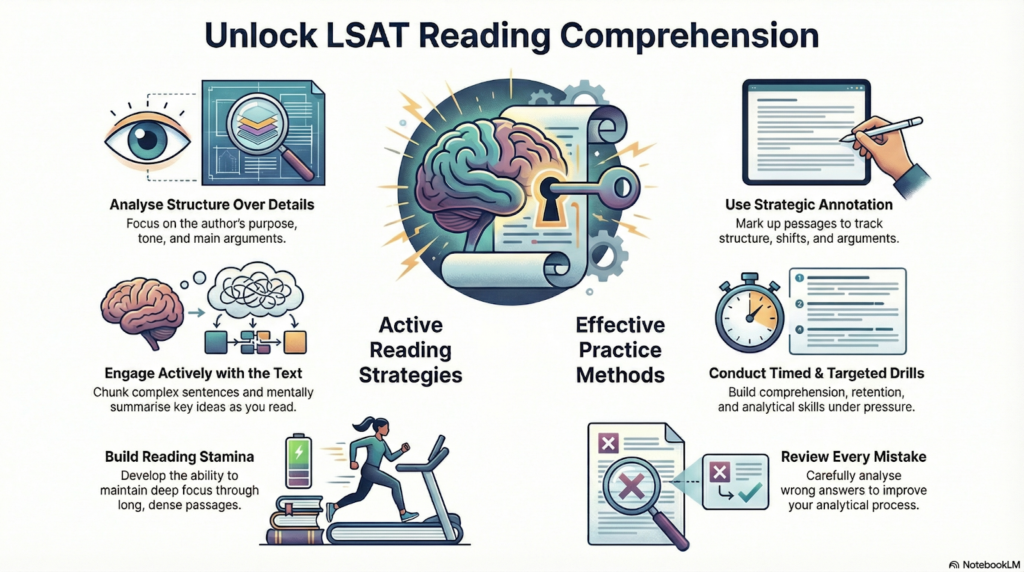
Strong LSAT readers don’t just absorb information they actively predict what the test might ask. The LSAT is built around patterns, and once you recognize them, you’ll read with sharper intention. As you go through a passage, pause periodically to predict likely question types. For example, if the author strongly criticizes a theory, expect questions about the author’s attitude, the weaknesses of the theory, or the purpose of the critique. If you see two contrasting viewpoints, prepare for comparison questions. This anticipatory mindset keeps your brain engaged and significantly reduces the time spent hunting for answers later. Over time, predictions become almost automatic, making you faster without sacrificing accuracy.
Strengthen Memory and Retention (Without Note-Taking)
Unlike other exams, LSAT RC doesn’t give you time to annotate heavily. Instead, you must build your reading memory your ability to hold the structure and key ideas in your mind as you move through a dense text. To improve this skill, practice summarizing paragraphs mentally in 3–5 words. This forces your brain to store only the essential meaning rather than unnecessary details. Over time, you’ll naturally keep track of main arguments, tone shifts, and logical development. This simple habit greatly reduces re-reading and helps you maintain steady momentum during the test.
Focus on Structure Over Details
Many students get trapped in complicated sentences or unfamiliar topics. LSAT passages are designed to throw you off with scientific jargon, legal references, and abstract academic debates. But the real key is structure, not terminology. When you hit a confusing idea, don’t stop and decode every term. Instead, ask: Why is this detail here? What role does it play? Once you identify whether a sentence is providing evidence, illustrating an example, acknowledging a counterpoint, or offering a conclusion, the rest becomes manageable. Structure acts like a roadmap—follow it, and you’ll always know where you are and what the author is trying to accomplish.
Improve Stamina for Long Passages
The LSAT RC section requires sustained focus across multiple long, dense passages. Many students start strong but lose concentration midway, causing accuracy to drop significantly. Building stamina is essential. The best way is through daily reading drills that mimic LSAT density scientific journals, legal essays, humanities criticism, and social science research. Start with 10–15 minutes of uninterrupted reading and gradually increase to 30 minutes. Pair this with full timed sections 2–3 times per week. The goal is not only to read more but to maintain sharp comprehension across the entire session.
Review Your Mistakes Strategically
Blind drilling won’t boost your RC score unless you deeply analyze your errors. After each passage, take time to understand why you missed a question. Was it because you misunderstood the author’s tone? Overlooked a structural clue? Fell for an attractive trap answer? LSAT RC wrong answers are crafted with predictable patterns out-of-scope, extreme language, subtle distortions, or reversed logic. Once you learn to recognize these traps, your accuracy improves dramatically. A strong review routine often contributes more to score gains than the reading itself.
Simulate Test-Day Conditions
Perfecting RC requires practicing under authentic LSAT conditions. This means no phones, no breaks, and strict time limits. Simulating pressure helps you regulate nerves and learn pacing naturally. Practice marking your internal checkpoints being done with passage one by minute 8, for example. The more you rehearse the conditions you will face on test day, the less your performance will be affected by stress, fatigue, or time pressure.
Build a Flexible Passage Strategy
Not all LSAT RC passages are equal. Some people excel in science passages, while others prefer humanities or legal topics. Develop a flexible strategy where you adjust your approach based on passage difficulty and your strengths. For instance, if a passage seems unusually dense or abstract, skim the first paragraph for its main idea before committing to a deeper read. If a comparative passage seems straightforward, move quickly and bank time for a challenging one later. Strategic flexibility allows you to maximize your score by avoiding mental fatigue and allocating your time wisely.
Conclusion
Improving your LSAT Reading Comprehension skills is not about reading faster, it’s about reading smarter. By learning to recognize passage structures, identify author viewpoints, analyze logic, and anticipate common LSAT traps, you can move from passive reading to active, strategic engagement. Consistent practice with annotation techniques, targeted drills, and timed sets helps you build the mental stamina and analytical habits needed for high-level performance. Remember, RC is a skill built through repetition, reflection, and refinement. With a clear system and steady practice, you can turn Reading Comprehension into one of your strongest LSAT sections.
Frequently Asked Questions
1. What makes LSAT Reading Comprehension so difficult?
LSAT RC is challenging because the passages are dense, the arguments are subtle, and the questions test analytical reasoning rather than simple recall. Many students struggle not with reading speed, but with identifying structure, viewpoints, and logical relationships within the passage. It measures how deeply and precisely you understand complex writing under time constraints.
2. How much time should I spend on each Reading Comprehension passage?
A common strategy is to spend 3–4 minutes reading and 4–5 minutes answering questions, but the exact timing depends on your reading speed and strategy. The goal is not to read faster but to read more effectively, understanding the passage well enough to answer most questions without re-reading.
3. Should I take notes or annotate during LSAT RC?
Yes, but only light, purposeful annotation. Mark structure, transitions, author attitude, and contrasting viewpoints, not every detail. Over-annotating wastes time and breaks comprehension flow. Develop a shorthand that helps you track the passage without slowing down.
4. How can I improve my accuracy on inference and main-point questions?
Focus on understanding the overall structure and purpose of the passage. Identify what each paragraph contributes to the argument or narrative. For inference questions, rely strictly on what the passage supports; do not bring outside assumptions. Practicing active reading and summarizing each paragraph in your mind improves inference accuracy.
5. Is it helpful to read the questions before reading the passage?
For LSAT RC, most students benefit from reading the passage first. Pre-reading questions often creates unnecessary bias or distracts focus from understanding the structure. However, selectively previewing question types (like “Which of the following is most analogous…”) can help advanced test-takers anticipate analytical demands.
6. How can I handle comparative reading passages more effectively?
Treat each passage separately first, identifying its main idea, structure, and viewpoint. Then analyze how the two compare agreements, disagreements, tone differences, and purpose. Practice recognizing the relationship quickly, as most comparative RC questions rely on this skill rather than tiny details.
7. What is the best way to improve LSAT vocabulary for Reading Comprehension?
The LSAT does not test obscure vocabulary. Instead, focus on academic reading exposure (journals, essays, science articles, legal writing) to get comfortable with formal language and complex sentence structures. Context clues are usually enough to interpret unfamiliar terms on test day.
8. How often should I practice LSAT Reading Comprehension?
Consistency matters more than marathon sessions. Aim for one RC passage per day and a full RC section 1–2 times per week. Frequent exposure helps you internalize structure recognition, pacing, and reading stamina. Review your mistakes in depth understand why an answer is right, not just what the right answer is.
9. How do I improve my reading speed without losing comprehension?
Instead of forcing yourself to read faster, train yourself to read more strategically. Focus on identifying:
- The main idea
- Author’s viewpoint
- Changes in perspective
- Logical structure
With practice, your reading speed increases naturally because you learn what matters and what doesn’t.
10. Can I dramatically improve my LSAT Reading Comprehension score in a short time?
Improvements are possible, especially if your weaknesses come from inefficient reading habits or poor strategy. However, RC is a long-term skill built through consistent practice. The biggest gains usually come from:
- Adjusting reading approach
- Understanding passage structure
- Reviewing explanations deeply
Most students see meaningful improvement within 4–8 weeks of focused RC practice.

Belekar Sir is the founder and lead instructor at Belekar Sir’s Academy, a trusted name in English language education. With over a decade of teaching experience, he has helped thousands of students—from beginners to advanced learners—develop fluency, confidence, and real-world communication skills. Known for his practical teaching style and deep understanding of learner needs, Belekar Sir is passionate about making English accessible and empowering for everyone. When he’s not teaching, he’s creating resources and guides to support learners on their journey to mastering spoken English.