For many readers, the idea of reading Shakespeare can feel intimidating. The language seems old-fashioned, the sentences look complex, and the poetic structure is unlike anything found in modern writing. Yet Shakespeare remains one of the most celebrated writers in the world, not because his work is meant only for experts, but because it captures human emotions with unmatched depth and beauty.
Why Shakespeare Feels Difficult (and Why It’s Worth It)
Shakespeare’s plays explore universal themes: love, ambition, betrayal, grief, jealousy, hope, courage. These experiences are familiar to everyone, which means that his stories still resonate today, even though they were written centuries ago. What often creates the barrier is not the meaning, but the unfamiliar style in which those meanings are expressed.
When approached the right way, Shakespeare becomes much more accessible. With the right techniques, context, and mindset, anyone, not just literature student,s can read and enjoy his work. This guide will walk you through exactly how to make Shakespeare understandable, enjoyable, and even exciting.
Understanding What Makes Shakespeare “Hard” — And What Actually Isn’t
Before diving into strategies, it helps to understand why Shakespeare feels challenging. One common misconception is that Shakespeare wrote in Old English. In reality, he wrote in Early Modern English the foundation of the English we use today. While the vocabulary and sentence patterns may feel unfamiliar at first, they are not as far removed from modern usage as many people think.
The first layer of difficulty comes from the language itself: words that are no longer common, phrases that carry historical meanings, and pronouns like “thou,” “thee,” “thy,” and “thine.” Shakespeare also loved playing with words, metaphors, puns, imagery, and double meanings appear constantly. This richness, while beautiful, can be overwhelming for new readers.
The second challenge lies in the structure. Shakespeare often writes in verse, especially iambic pentameter, which gives the language a rhythmic quality. Because of this rhythm, sentences may not follow modern patterns. A thought may begin in one line and end several lines later, making it necessary to read with attention.
However, despite these challenges, much of Shakespeare is surprisingly universal. His characters grapple with the same emotions and moral dilemmas we do today. The humor, jealousy, ambition, fear, and passion in his plays are instantly recognizable. When we move past the initial unfamiliarity of the language, we find stories that feel timeless stories that speak directly to the human experience.
Preparing to Read: What Helps Before You Begin
Before diving into Shakespeare’s world, a little preparation can transform the experience from intimidating to enjoyable. The first step is choosing the right edition. Modern-spelling versions, annotated copies, or side-by-side editions with explanations can make the older language far more approachable. These editions help decode unfamiliar vocabulary, idioms, and references that might otherwise slow you down, ensuring that the beauty of the text remains intact while the meaning becomes clearer.
It also helps to start with plays that are known for being more accessible or engaging for beginners. Comedies and shorter plays often have lighter language, simple storylines, and humorous moments, making them easier to follow. Getting familiar with basic elements of Shakespearean English can also prepare you for a smoother reading experience. Learning a handful of archaic pronouns, common expressions, and major poetic devices allows you to recognise patterns and decode meaning faster.
Finally, decide how you prefer to experience Shakespeare. Reading silently works for some, while others find that reading aloud brings the rhythm and energy of the language to life. As Shakespeare wrote primarily for performance, hearing the words can make them feel more natural and meaningful. With the right preparation, the text becomes less foreign and far more enjoyable.
How to Read Shakespeare Actively and Effectively
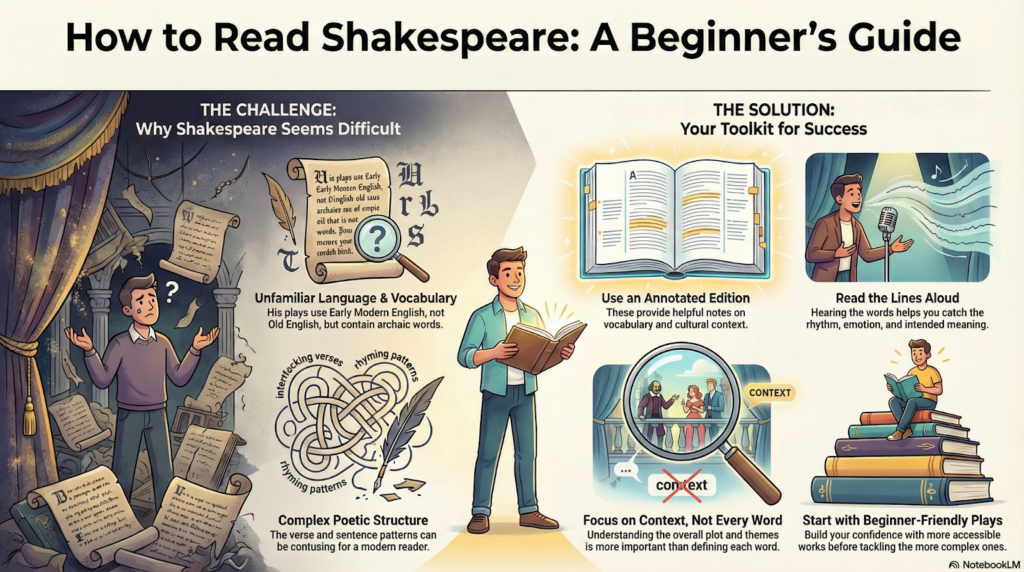
Reading Shakespeare requires a more active approach than reading modern fiction, but the effort pays off. One of the most helpful techniques is reading aloud. When spoken, the cadence, rhythm, and emotional tone of Shakespeare’s lines become clearer, revealing meaning that may not be obvious on the page. Shakespeare’s works were crafted to be performed, not silently studied, so hearing the language often unlocks its natural flow.
It’s equally important not to get bogged down by every unfamiliar word. Many readers pause too often to look up definitions, which interrupts the story and exhausts the reader. Instead, focus on the overall sense of a scene the emotions, the actions, and the relationships. Often, the context supplies enough clues for you to understand the general meaning, and you can revisit specific terms later if needed.
Pay attention to the structure of the lines as well. Shakespeare frequently wrote in iambic pentameter, a rhythmic pattern that gives the dialogue its musical quality. Feeling this rhythm helps you sense where emphasis falls and how emotions shift. Try reading in small sections rather than racing through entire acts. Pausing to reflect on what you’ve read, summarizing moments in your own words, or paraphrasing complex speeches can deepen your understanding and memory.
By actively engaging with the text actively reading aloud, using context, noticing rhythm, and pacing yourself, Shakespeare becomes not only readable, but genuinely captivating.
Understand Shakespeare’s Themes, Motifs, and Big Ideas
Once you’re comfortable with Shakespeare’s language, the next major step is understanding his universal themes love, ambition, power, betrayal, identity, revenge, duty, morality, and human flaws. These themes are why Shakespeare’s works remain timeless. When you approach a play with awareness of its central idea, the story becomes easier to follow and far more meaningful.
Before reading, take a moment to think about the overarching theme of the play. For instance, Macbeth explores how ambition can destroy a person, while Romeo and Juliet examines the power and consequences of intense young love. Recognizing these ideas upfront will help you understand why characters act the way they do. Additionally, pay attention to motifs recurring elements like dreams, disguises, storms, supernatural signs, or references to fate. These motifs often symbolise deeper meaning and offer important clues about what Shakespeare wants readers to notice. Understanding themes and motifs makes Shakespeare’s world easier to navigate and enriches every scene you read.
Learn How to Read Shakespeare’s Structure: Acts, Scenes & Dramatic Devices
Shakespearean plays are crafted with purposeful structure, and understanding this framework helps you follow the story with much greater clarity. Each play is divided into five acts, representing exposition, rising action, climax, falling action, and resolution. When you know where you are in the structure, you can predict the pace, tension, and direction of the plot. For example, Act III often contains the turning point, while the final act wraps up the story’s conflicts.
Shakespeare also uses dramatic devices that may initially feel unfamiliar like soliloquies, monologues, asides, foreshadowing, and dramatic irony. Learning how these devices work unlocks the emotional depth and humor in the plays. A soliloquy reveals a character’s private thoughts, an aside lets you in on a secret, and dramatic irony creates powerful tension between what the audience knows and what the characters believe. When you start to recognize these devices, Shakespeare’s plays become far more vivid, engaging, and easier to understand.
Understand Shakespeare’s Language: Why It Feels Difficult and How to Approach It
Shakespeare’s English is not “Old English,” nor is it completely foreign it is Early Modern English, the direct ancestor of the language we use today. The challenge often comes from unfamiliar vocabulary, poetic phrasing, and complex sentence structures. Instead of being intimidated, readers should approach his language like a puzzle that gets easier with exposure.
Shakespeare frequently rearranges sentence order for rhythm, emotion, or poetic effect. This inversion can make lines seem confusing at first glance, but once you begin recognizing patterns, meaning becomes clearer. Additionally, Shakespeare introduces hundreds of now-common words, along with metaphors and idioms that require thoughtful interpretation. The key is to slow down, read actively, and allow yourself time to absorb the style. With patience and practice, what once felt overwhelming becomes exciting and enjoyable.
Learn to Identify Common Shakespearean Vocabulary, Grammar, and Expressions
To read Shakespeare smoothly, familiarity with his vocabulary and grammar is essential. Words like “thou,” “thee,” “thy,” and “thine” simply mirror modern pronouns like “you” and “your.” Other terms such as “wherefore” (meaning why, not where), or “hark” (listen), gradually become recognizable through repeated exposure.
Beyond vocabulary, Shakespeare frequently uses contractions and verb forms that mirror earlier English patterns such as “dost,” “hath,” “art,” or “wilt.” Understanding these basics provides a strong foundation for interpreting his dialogue. Many lines gain power once you learn to decode metaphors and symbolic references that reflect Elizabethan beliefs, humor, and culture.
Taking time to learn these recurring words and structures will significantly improve your reading experience. Over time, they become second nature, and you’ll find yourself navigating Shakespeare’s language with confidence and appreciation.
Understanding Shakespeare’s Language: Why It Feels Difficult
One of the biggest challenges readers face with Shakespeare is the language, not because it is impossible, but because it is unfamiliar. Shakespeare wrote in Early Modern English, a form of English that predates many modern expressions, meanings, and sentence structures. Words we no longer use, metaphors rooted in 16th-century culture, and poetic phrasing often make the text seem more complex than it really is.
However, once you understand what makes Shakespeare’s language different, it becomes far easier to decode. Many of the “difficult” words are simply older versions of the ones we already use (“thou” for “you,” “doth” for “does”). Other phrases rely on metaphors that make sense when you know the context for example, references to mythology, nature, and royal customs. Recognising these patterns helps you move from confusion to clarity.
What surprises most beginners is that the actual grammar of Shakespeare isn’t always complicated it’s just arranged in poetic, rhythmic ways. Shakespeare frequently inverted sentences to fit meter, meaning a line like “Gives sorrow words” simply means “Give words to your sorrow.” Once you get used to these inversions, reading his lines becomes smoother and more intuitive.
Start with Beginner-Friendly Plays
Not all Shakespeare plays are equally difficult. Some are filled with dense political language, while others use straightforward storytelling, clear emotions, and accessible humour. Starting with the right plays makes all the difference for beginners.
Comedies like A Midsummer Night’s Dream, The Tempest, or Much Ado About Nothing are often recommended because they use lively dialogue, magical or humorous situations, and characters whose motivations are easy to understand. These plays allow new readers to enjoy the story without getting overwhelmed by historical references or complex themes.
If you prefer drama, Romeo and Juliet is a great entry point because its themes love, conflict, family pressure are universal and immediately relatable. The language is poetic but not excessively complex, making it ideal for building confidence.
By beginning with these more accessible plays, you get comfortable with Shakespeare’s rhythm, vocabulary, and storytelling techniques before moving on to more challenging works like Hamlet, Macbeth, or Julius Caesar. Starting simple doesn’t dilute the experience it builds the foundation for deeper appreciation later.
Develop an Understanding of Shakespeare’s Themes
One of the most effective ways to make Shakespeare easier to read is to familiarise yourself with the universal themes that run through his plays and poems. Shakespeare’s works explore ideas like love, ambition, jealousy, betrayal, power, fate, and identity, all concepts that still shape human life today. When you know the core themes beforehand, the language feels less intimidating because you already understand the emotional and philosophical foundation of the story.
Before diving into a play, spend a few minutes reading about its major themes. For example, Macbeth explores the destructive power of unchecked ambition, while Much Ado About Nothing revolves around misunderstandings, honor, and romantic complications. With this context, you’ll find it easier to interpret metaphors, analyze character motives, and recognize subtle hints that appear throughout the text. Understanding the thematic structure transforms Shakespeare from a linguistic puzzle into a meaningful and relatable reading experience.
Break Down the Text: Read in Small, Manageable Sections
Shakespeare’s writing is dense, poetic, and layered with meaning, so attempting to read long passages at once can feel overwhelming. A better approach is to break the text into smaller units scenes, speeches, or even individual lines, and work through them slowly. This helps you absorb the rhythm of the verse, understand vocabulary in context, and notice literary devices that enrich the storytelling.
Start by reading a short section aloud. Shakespeare’s language was meant to be spoken, and hearing the words can clarify meaning and emotion. Next, paraphrase the passage line by line in modern English. This isn’t just a comprehension tool it trains your brain to think in Shakespeare’s phrasing while connecting it to everyday speech. You can also annotate the text, marking unfamiliar words, rhetorical devices, or shifts in tone. Over time, this method builds confidence and allows you to read longer sections without losing clarity or enjoyment.
Learn to Read Shakespeare’s Language with Context Clues
Shakespeare’s English, often referred to as Early Modern English can feel intimidating because of unfamiliar vocabulary, poetic phrasing, and inverted sentence structures. However, one of the most effective ways to understand his writing is by relying on context clues. Shakespeare often repeats ideas in different ways or reinforces emotions through imagery, allowing readers to infer meaning even when the words feel strange. Instead of stopping at every unfamiliar word, try to understand the general sense of the line from the surrounding sentences or the emotional tone of the scene. Paying attention to metaphors, symbols, and the characters’ relationships will give you enough clues to follow the story without getting stuck. Over time, the language becomes more intuitive, and what once felt confusing starts to feel natural even enjoyable.
Familiarize Yourself with Common Shakespearean Vocabulary and Grammar
While you don’t need to memorise every archaic word, learning some of the most frequently used Shakespearean terms and grammar patterns can dramatically improve comprehension. Words like “thee,” “thou,” “hath,” “dost,” and “ere” appear regularly and follow consistent meanings. Additionally, Shakespeare often flips the usual subject-verb order for poetic effect, for example, “Goes he” instead of “He goes.” Becoming aware of these patterns helps you interpret lines more quickly and confidently. Building a small mental glossary of common expressions or reviewing a short list before reading can remove a lot of the initial friction. As you continue reading, vocabulary that once felt foreign will start to feel familiar, and the rhythm of Shakespeare’s language will become easier to follow.
Explore Shakespeare’s Language Tools (Rhythm, Imagery & Wordplay)
Shakespeare’s writing becomes much easier to understand when you recognize the techniques he uses throughout his plays and poems. One of the most important features is iambic pentameter, the rhythmic pattern that mimics natural speech. Once readers become familiar with this rhythm, the dialogue feels far more predictable and easier to follow. Shakespeare also uses vivid imagery, metaphors, and personification to express emotions or describe situations in powerful ways. Instead of reading each line literally, paying attention to these images helps unlock the deeper meaning behind the words. Additionally, Shakespeare loved puns, double meanings, and wordplay, which were extremely popular in Elizabethan times. Understanding that many confusing lines are simply clever jokes or layered word choices can make the text more enjoyable and far less intimidating.
Another essential aspect is Shakespeare’s frequent use of inversions, changing the normal word order for poetic effect. For example, instead of saying “I love thee,” he might write “Thee I love.” Recognizing these patterns helps readers rearrange sentences in their minds to understand the intended meaning. When approached with curiosity rather than fear, Shakespeare’s language becomes a rich playground of creativity instead of a barrier.
Start With Accessible Plays and Build Up Gradually
Not all Shakespeare plays are equally difficult, so choosing the right starting point is crucial for a smooth reading experience. Some plays have simpler language, clearer plots, and more engaging themes, making them ideal for beginners. Comedies such as A Midsummer Night’s Dream or Much Ado About Nothing are great introductions because they combine humor, straightforward narratives, and memorable characters. For readers interested in drama, Romeo and Juliet and Julius Caesar are also excellent starting points due to their familiar stories and relatively accessible dialogue. Beginning with these easier works builds confidence and helps readers adjust to Shakespearean vocabulary and structure.
Once a foundation is established, readers can gradually move on to more complex plays like Hamlet, Macbeth, or King Lear. These works feature deeper psychological themes, intricate plots, and richer language that can be better appreciated after gaining familiarity with Shakespeare’s style. Following a progression, from simple to complex, ensures that reading Shakespeare becomes enjoyable instead of overwhelming, helping readers develop both understanding and appreciation with each new play.
Conclusion
Reading Shakespeare may seem intimidating at first, but with the right approach, it becomes an enriching and enjoyable experience. The challenges of archaic language, poetic structure, and historical context can be overcome through patience, active reading, and the use of supportive tools like annotated editions, performances, and discussion groups.
By starting with beginner-friendly plays, reading aloud, and gradually exploring more complex works, readers can unlock the depth of Shakespeare’s themes, characters, and language. Engaging with his plays enhances not only literary appreciation but also critical thinking, emotional insight, and language skills.
Ultimately, reading Shakespeare is not about perfection or understanding every word immediately. It’s about immersion, curiosity, and connecting with timeless human experiences. With persistence and an open mind, anyone can enjoy the beauty, wisdom, and artistry of Shakespeare, making it a rewarding journey that enriches both intellect and imagination.
Frequently Asked Questions:
Why is Shakespeare English so difficult to read?
Shakespeare’s English uses archaic vocabulary, inverted sentence structures, and poetic devices that are unfamiliar to modern readers.
Do I need prior knowledge of English literature to read Shakespeare?
No, beginners can start with strategies like annotations, modern translations, and reading aloud to understand and enjoy the text.
Which Shakespeare plays are easiest for beginners?
Plays like A Midsummer Night’s Dream, Romeo and Juliet, and Macbeth are considered more approachable for first-time readers.
How can I understand archaic words and phrases?
Using footnotes, glossaries, modern translations, and online resources can help decode unfamiliar words and phrases.
Should I read Shakespeare aloud or silently?
Reading aloud helps with rhythm, pronunciation, and comprehension, especially for poetic lines and dialogue.
How can I follow the plot of complex plays?
Summarizing each scene, using character charts, and watching performances can clarify plot and character relationships.
Is it necessary to memorize lines to understand Shakespeare?
No, comprehension is the priority. Memorization may help actors, but readers can focus on meaning and interpretation.
Are there resources to make Shakespeare easier to understand?
Yes, annotated editions, online summaries, study guides, and video performances provide context and explanations.
Can reading Shakespeare improve my language skills?
Absolutely. It enhances vocabulary, understanding of grammar and syntax, appreciation of literary devices, and analytical thinking.
How often should beginners practice reading Shakespeare?
Regular, short sessions (15–30 minutes) combined with discussion or watching performances help build familiarity and enjoyment over time.

Belekar Sir is the founder and lead instructor at Belekar Sir’s Academy, a trusted name in English language education. With over a decade of teaching experience, he has helped thousands of students—from beginners to advanced learners—develop fluency, confidence, and real-world communication skills. Known for his practical teaching style and deep understanding of learner needs, Belekar Sir is passionate about making English accessible and empowering for everyone. When he’s not teaching, he’s creating resources and guides to support learners on their journey to mastering spoken English.