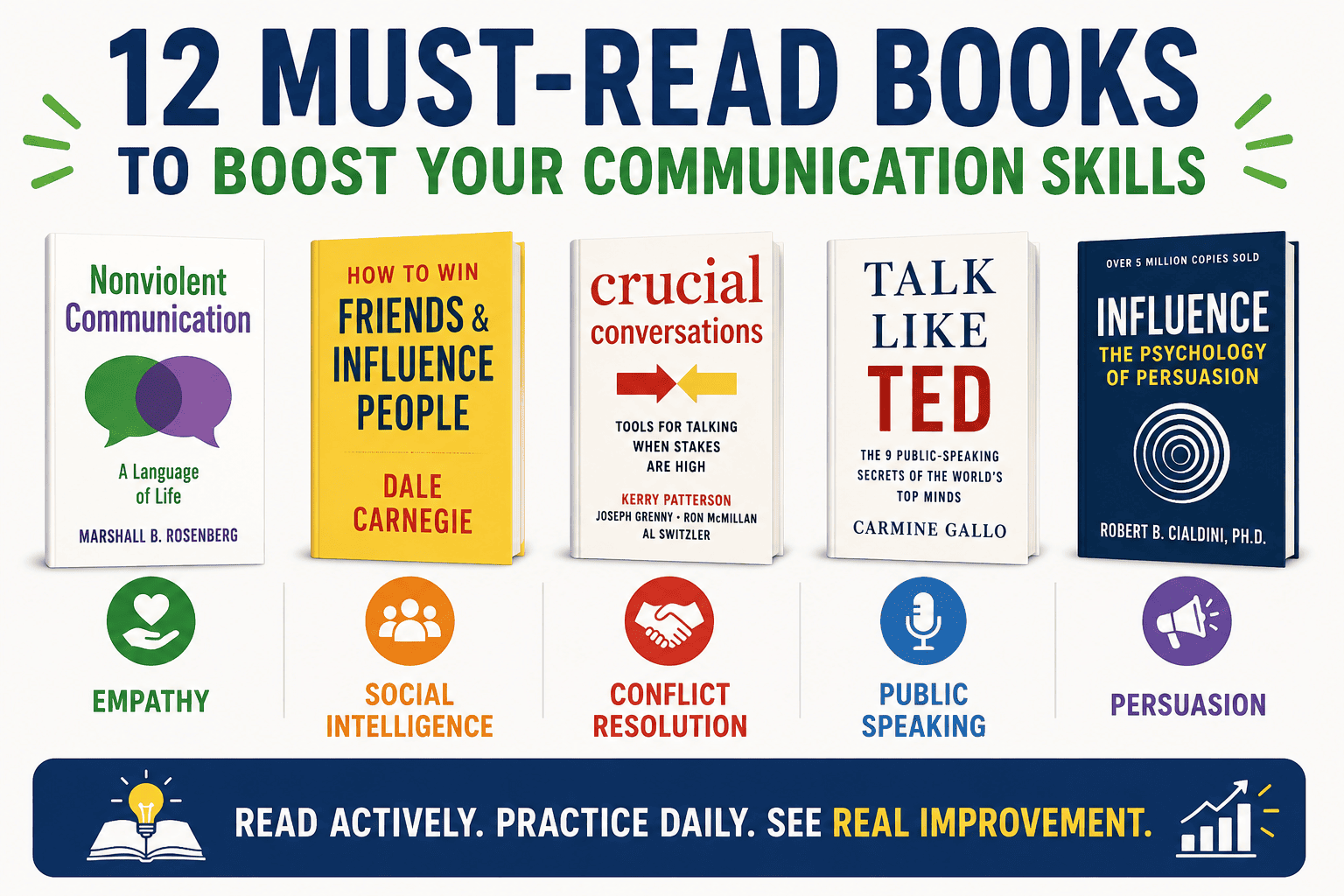
The best books to improve communication skills include Nonviolent Communication (empathy), How to Win Friends & Influence People (social intelligence), Crucial Conversations (conflict resolution), Talk Like TED (public speaking), and Influence: The Psychology of Persuasion (persuasion). Read actively and practice daily to see real improvement, even 2–3 books applied consistently can transform your communication within weeks.
Improving communication skills is one of the most valuable investments you can make in your personal and professional life. Whether you want to become a more confident speaker, a more persuasive writer, a better listener, or someone who builds meaningful relationships, reading the right books can accelerate your growth dramatically.
Below is a curated list of 12 essential books covering every aspect of communication, from empathy and active listening to public speaking, persuasion, and writing. Each book offers proven frameworks and practical techniques you can start using immediately.
Reading alone won’t transform your skills, active reading + consistent practice will. Even reading 2–3 books and applying their lessons can lead to significant improvement within weeks. The key is to read with intention and practice what you learn daily.
Teaches speaking with empathy, defusing conflict, and building respectful relationships. Key framework: observe without judging, identify feelings and needs, make compassionate requests.
Four color-based personality types: Red (direct), Blue (analytic), Green (patient), Yellow (expressive). Learn to tailor your message for clarity and avoid unnecessary conflict.
Timeless principles: show genuine interest, remember names, avoid arguments, make people feel important. Essential for building trust and cooperation in any setting.
Strategies for staying calm and effective during difficult conversations. Learn to speak respectfully under pressure, control emotions, and use facts instead of accusations.
Analyzes hundreds of TED Talks to reveal techniques: tell stories, use simple language, connect emotionally, speak with passion and authenticity. Perfect for speakers at any level.
SUCCESs: Simple, Unexpected, Concrete, Credible, Emotional, Story-based. Craft messages that people remember and act upon, essential for leaders, teachers, and marketers.
Compassionate speech and mindful listening. Understand yourself before communicating with others. Silence can be powerful. A spiritual approach to authentic connection.
Six principles: reciprocity, scarcity, authority, consistency, liking, social proof. Understand why people say “yes”, and how to use these principles ethically in business and life.
Eliminate clutter, write with purpose, improve tone and rhythm. Good writing clarifies thinking and improves verbal communication. A must-read for anyone who writes professionally.
Essential rules of grammar, punctuation, and composition. Builds accuracy, clarity, and credibility in all written communication. The classic guide to clear, correct writing.
Classical rhetoric principles for modern life. Learn framing, word choice, emotional appeals, and building common ground, win arguments respectfully and persuasively.
True communication is about connecting on a human level. Move from surface-level talk to meaningful relationships. Essential for leaders, managers, and anyone who wants to build trust.
If you’re new to communication books, start with How to Win Friends & Influence People for foundational principles, then move to Crucial Conversations for handling difficult situations, and Talk Like TED for presentation skills. This combination covers the most essential areas.
Highlight definitions, examples, and techniques. Write your own interpretations and create a list of strategies to apply in your daily interactions.
After each chapter ask: What did I learn? How can I use this? What habit should I change? Write summaries in your own words to solidify understanding.
Try active listening in family conversations. Use persuasion techniques in group discussions. Apply storytelling at work. Practice transforms knowledge into skill.
Notice how authors construct sentences, create flow, simplify complex ideas, this improves your own verbal and writing style through osmosis and analysis.
Keep a journal with new phrases, techniques, example dialogues, and personal progress. Review weekly to increase self-awareness and track improvement. This habit alone accelerates growth dramatically.
15–30 minutes daily, one book every 2–3 weeks, or one chapter per day. Small daily progress leads to big improvements over time.
Rotate between empathy (NVC), persuasion (Influence), writing (On Writing Well), and public speaking (Talk Like TED) for holistic growth across all communication domains.
After reading a chapter, practice one technique: tell a short story, express a need calmly, or rewrite an email more concisely. Application locks in learning.
Every few weeks ask: Am I listening better? Expressing more clearly? More confident in conversations? Adjust your focus based on what needs the most improvement.
Becoming a skilled communicator is a lifelong journey, not a destination. Even expert communicators continue to learn and refine their approach. With consistent practice, strategic habits, and genuine curiosity, anyone can move from good to great in communication.
Reading these books is just the beginning. The real transformation happens when you take what you’ve learned and apply it consistently in real conversations, presentations, and written communications. Each book offers a framework, but you build the skill through practice.
Start with one book that addresses your biggest communication challenge. Read actively, take notes, and commit to practicing one new technique each week. Over time, these small changes compound into remarkable improvement in how you connect with others.
The best communicators aren’t born, they’re made through intentional practice, continuous learning, and a genuine desire to connect with others. Every conversation is an opportunity to improve. Start today.
Explore more resources on English fluency, vocabulary, and professional communication at Belekar Sir’s Academy.
Explore More Guides → Try Our ToolsContinue your communication journey with our guides on skilled reading, reading comprehension, and reading and creativity.

Belekar Sir is the founder and lead instructor at Belekar Sir’s Academy, a trusted name in English language education. With over a decade of teaching experience, he has helped thousands of students—from beginners to advanced learners—develop fluency, confidence, and real-world communication skills. Known for his practical teaching style and deep understanding of learner needs, Belekar Sir is passionate about making English accessible and empowering for everyone. When he’s not teaching, he’s creating resources and guides to support learners on their journey to mastering spoken English.