Numbers are everywhere in our daily lives, from bank statements and population statistics to scientific data and financial reports. While reading small numbers comes naturally to most English speakers, large numbers containing thousands, millions, and billions can feel overwhelming. Many people stumble when faced with numbers like 45,783 or 2,504,619, unsure of how to properly pronounce them or where to pause while speaking.
Understanding how to read thousand numbers correctly is an essential skill for professional communication, academic work, and everyday conversations. Whether you are discussing salary figures, reading news articles about government budgets, or explaining statistical data in presentations, the ability to read large numbers fluently demonstrates competence and builds credibility with your audience.
The good news is that reading thousand numbers in English follows systematic rules that anyone can learn. Once you understand the underlying patterns and conventions, even seemingly intimidating numbers become manageable. This comprehensive guide will teach you everything you need to know about reading numbers in the thousands, millions, billions, and beyond. You will learn the fundamental principles, master important exceptions, understand regional differences between British and American English, and practice with real examples that solidify your skills.
Understanding the Number System in English
How the English Number System Works
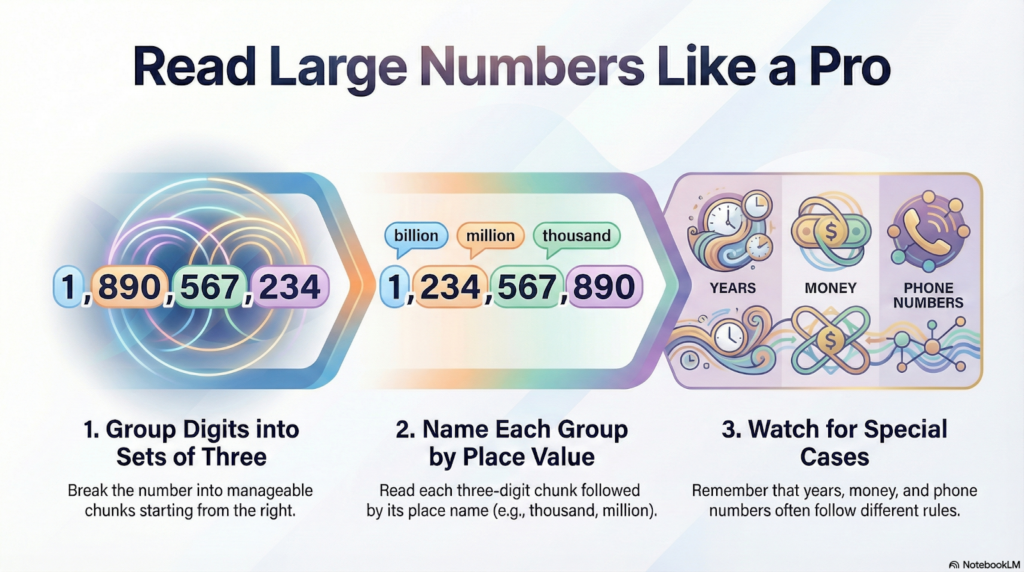
The English number system groups digits into sets of three, moving from right to left. Each group of three digits has a specific name: ones (or units), thousands, millions, billions, and so on. This grouping system makes large numbers manageable by breaking them into smaller, comprehensible chunks. Understanding this fundamental structure is the first step to reading any large number confidently.
When you write large numbers in English, you typically separate each group of three digits with a comma. For example, the number 1234567 becomes 1,234,567, making it immediately clear that we have one million, two hundred and thirty-four thousand, five hundred and sixty-seven. The commas serve as visual guides that help you identify the magnitude of each number group.
Each digit within a number has a place value that determines its actual worth. In the number 5,432, the digit 5 represents five thousand, the digit 4 represents four hundred, the digit 3 represents thirty, and the digit 2 represents two ones. This place value system forms the foundation of how we interpret and read numbers in English.
Place Value Chart for Thousands
Understanding place values becomes crucial when reading large numbers. Here is a comprehensive place value chart showing how numbers organize into groups:
| Billions | Hundred Millions | Ten Millions | Millions | Hundred Thousands | Ten Thousands | Thousands | Hundreds | Tens | Ones |
| 1 | 2 | 3 | 4 | 5 | 6 | 7 | 8 | 9 | 0 |
The number above would be read as: one billion, two hundred and thirty-four million, five hundred and sixty-seven thousand, eight hundred and ninety.
Each column represents a specific position in our number system. Moving from right to left, each position increases in value by a factor of ten. The ones place holds single digits, the tens place holds groups of ten, the hundreds place holds groups of one hundred, and so forth. This systematic increase continues indefinitely, allowing us to express numbers of any magnitude.
Breaking Numbers into Groups of Three
The most effective way to read large numbers involves breaking them into groups of three digits, starting from the right side. Each group receives a label based on its position: the first group from the right contains ones, the second group contains thousands, the third group contains millions, the fourth group contains billions, and this pattern continues for even larger numbers.
For example, take the number 5,234,789. Working from right to left, we have:
789: seven hundred and eighty-nine (ones group) 234: two hundred and thirty-four (thousands group) 5: five (millions group)
Read together: five million, two hundred and thirty-four thousand, seven hundred and eighty-nine.
This grouping method works for numbers of any size. Once you master reading three-digit numbers and learn the names of each group position, you can read any large number by applying the same pattern repeatedly. The key is recognizing the groups and their corresponding labels.
Reading Numbers in the Thousands
Basic Thousands: 1,000 to 9,999
Numbers in the basic thousands range from 1,000 to 9,999. These numbers contain four digits and represent the first step beyond hundreds. Reading these numbers requires stating the thousands digit or digits, followed by the word thousand, then reading any remaining hundreds, tens, and ones.
Simple examples:
- 1,000: one thousand
- 2,500: two thousand, five hundred
- 3,482: three thousand, four hundred and eighty-two
- 4,007: four thousand and seven
- 5,900: five thousand, nine hundred
Notice that when we have only thousands and hundreds with no tens or ones, we simply state both values without any additional words between them. However, when we jump from thousands directly to a number less than one hundred, British English typically includes the word and.
Ten Thousands: 10,000 to 99,999
Ten thousands represent five-digit numbers. When reading these numbers, state the ten thousands and thousands together as a complete number, followed by thousand, then continue with any remaining digits.
Examples:
- 10,000: ten thousand
- 15,600: fifteen thousand, six hundred
- 23,450: twenty-three thousand, four hundred and fifty
- 47,892: forty-seven thousand, eight hundred and ninety-two
- 99,001: ninety-nine thousand and one
The pattern remains consistent: read the first two digits as a regular number, add thousand, then read the remaining three digits as you would any three-digit number. This systematic approach works for all numbers in the ten thousands range.
Hundred Thousands: 100,000 to 999,999
Hundred thousands contain six digits. These numbers push into larger territory but follow the same fundamental pattern. State the hundreds, tens, and ones of the thousands, followed by thousand, then finish with any remaining hundreds, tens, and ones.
Examples:
- 100,000: one hundred thousand
- 250,000: two hundred and fifty thousand
- 456,789: four hundred and fifty-six thousand, seven hundred and eighty-nine
- 678,012: six hundred and seventy-eight thousand and twelve
- 999,999: nine hundred and ninety-nine thousand, nine hundred and ninety-nine
When reading hundred thousands, pay special attention to zeros. If you have 500,003, you say five hundred thousand and three, not five hundred thousand, zero, zero, three. Zeros simply indicate the absence of value in those positions, so we skip over them when reading unless they fall at the end of a complete group.
Special Cases with Zeros
Numbers containing zeros require special attention because we do not pronounce the zeros themselves, but they affect how we structure our reading. The placement of zeros determines which number labels we include and where we insert the word and.
Consider these examples:
- 10,000: ten thousand (no mention of zeros)
- 10,001: ten thousand and one (zeros are skipped, and goes before the ones)
- 20,050: twenty thousand and fifty (zero in hundreds place is skipped)
- 100,100: one hundred thousand, one hundred (zeros mark empty places)
- 305,000: three hundred and five thousand (zeros show no hundreds, tens, or ones)
The rule is simple: pronounce the non-zero digits in their appropriate positions and include the correct group labels, but never say the word zero when reading standard numbers. The exceptions occur in special contexts like phone numbers, identification numbers, or scientific measurements where each digit must be stated individually.
Reading Numbers in the Millions
Basic Millions: 1,000,000 to 9,999,999
Millions represent a significant jump in magnitude. Reading these numbers becomes straightforward when you recognize that the same grouping pattern continues. State the millions, then the thousands, then the ones, each with their appropriate label.
Examples:
- 1,000,000: one million
- 2,500,000: two million, five hundred thousand
- 3,456,789: three million, four hundred and fifty-six thousand, seven hundred and eighty-nine
- 5,000,023: five million and twenty-three
- 9,876,543: nine million, eight hundred and seventy-six thousand, five hundred and forty-three
Notice how we separate millions from thousands with a comma when writing, and we pause briefly at that comma when speaking. This pause helps listeners distinguish between the different magnitude groups, making your speech clearer and easier to understand.
Ten Millions and Hundred Millions
As numbers grow into ten millions and hundred millions, the pattern remains consistent. These larger numbers simply add more digits to the millions group, which we read as a complete number before saying million.
Examples:
- 10,000,000: ten million
- 25,500,000: twenty-five million, five hundred thousand
- 125,000,000: one hundred and twenty-five million
- 456,789,123: four hundred and fifty-six million, seven hundred and eighty-nine thousand, one hundred and twenty-three
- 999,000,001: nine hundred and ninety-nine million and one
The key is breaking each group of three into hundreds, tens, and ones, adding the appropriate magnitude label after each group, then moving to the next group. This systematic approach works regardless of how large the number becomes.
Understanding When to Use And
The word and causes confusion for many English learners and even native speakers. Usage rules differ between British and American English, adding to the complexity. Understanding these differences helps you speak naturally and understand regional variations you encounter.
British English Rules:
In British English, we typically use and before the final two-digit number in each group of three. This means and appears before any number less than one hundred that represents the tens and ones positions.
Examples:
- 345: three hundred and forty-five
- 2,567: two thousand, five hundred and sixty-seven
- 45,678: forty-five thousand, six hundred and seventy-eight
We also use and when jumping from a larger group directly to a small number: 5,000,023 becomes five million and twenty-three because we skip over the empty thousands and hundreds.
American English Rules:
American English generally omits and within numbers, though many Americans still use it naturally in speech even if formal writing discourages it.
Examples:
- 345: three hundred forty-five
- 2,567: two thousand, five hundred sixty-seven
- 45,678: forty-five thousand, six hundred seventy-eight
The practical reality is that you will hear both styles in everyday English. Understanding both conventions helps you comprehend different speakers and choose the style appropriate for your context.
Reading Numbers in the Billions and Beyond
Billions: Understanding the Scale
Billions represent enormous numbers that most people encounter primarily in discussions of national economies, global populations, or astronomical distances. One billion equals one thousand millions, or 1,000,000,000. Reading billions follows the same pattern as reading millions, just with another group of three digits added.
Examples:
- 1,000,000,000: one billion
- 5,200,000,000: five billion, two hundred million
- 12,456,789,123: twelve billion, four hundred and fifty-six million, seven hundred and eighty-nine thousand, one hundred and twenty-three
- 500,000,000,000: five hundred billion
- 999,999,999,999: nine hundred and ninety-nine billion, nine hundred and ninety-nine million, nine hundred and ninety-nine thousand, nine hundred and ninety-nine
When numbers grow this large, we often simplify them in everyday speech by stating only the most significant figures and rounding. For example, we might say about five billion rather than pronouncing every single digit. However, in formal or financial contexts, precision matters, and we state the complete number.
Trillions and Higher
Trillions represent the next magnitude beyond billions. One trillion equals one thousand billions, or 1,000,000,000,000. While trillion represents an almost incomprehensibly large number for most contexts, modern discussions of national debt, global economics, and scientific measurements sometimes reach this scale.
Examples:
- 1,000,000,000,000: one trillion
- 5,600,000,000,000: five trillion, six hundred billion
- 23,450,000,000,000: twenty-three trillion, four hundred and fifty billion
Beyond trillions, the English language includes names like quadrillion, quintillion, sextillion, and many more, though these rarely appear outside specialized scientific or mathematical contexts. For practical purposes, most English speakers never need to use or understand numbers larger than trillions.
Historical Note: British vs American Billions
An important historical note: until the 1970s, the word billion meant different things in British and American English. In American English, one billion has always meant 1,000,000,000 (one thousand millions). In traditional British English, however, one billion meant 1,000,000,000,000 (one million millions, what Americans call one trillion).
This difference arose from competing systems for naming large numbers called the short scale and long scale. The United Kingdom officially adopted the American short scale system in 1974, bringing both countries into alignment. However, some older British texts and speakers may still use the traditional long scale, so awareness of this difference helps when reading historical documents or communicating with older generations.
Today, virtually all English speakers worldwide use the American short scale system, where each new term represents one thousand times the previous term.
Special Cases and Exceptions
Reading Years as Thousands
English speakers commonly break four-digit years into two pairs of digits rather than reading them as standard thousands. This convention applies primarily to years between 1000 and 2009, creating a more natural speaking rhythm.
Examples:
- 1066: ten sixty-six (not one thousand and sixty-six)
- 1492: fourteen ninety-two
- 1776: seventeen seventy-six
- 1999: nineteen ninety-nine
- 2001: two thousand and one (or twenty oh one)
For years in the hundreds, we typically use the standard reading:
- 845: eight forty-five (or eight hundred and forty-five)
- 999: nine ninety-nine (or nine hundred and ninety-nine)
For years from 2000 to 2009, usage varies. Some people say two thousand and nine, while others say twenty oh nine. Both are acceptable. For 2010 onward, most speakers returned to the paired-digit pattern: twenty ten, twenty fifteen, twenty twenty-four.
Round Numbers and Informal Speech
In casual conversation, English speakers often simplify round numbers, especially when exactness is less important than quick communication. This informal speech pattern appears frequently in everyday contexts.
Common simplifications:
- 1,500: fifteen hundred (instead of one thousand, five hundred)
- 2,400: twenty-four hundred
- 3,200: thirty-two hundred
- 8,900: eighty-nine hundred
This pattern works for any multiple of one hundred up to 9,900. Once you reach 10,000, we typically return to standard thousands: ten thousand, not one hundred hundred.
We also use informal terms for certain round numbers:
- 1,000: a grand (particularly for money), a K
- 12: a dozen
- 20: a score (archaic but still known)
- 100: a century
These informal terms add color to speech but should be used appropriately based on context. Professional and formal settings generally require standard number reading.
Phone Numbers and ID Numbers
Phone numbers, identification numbers, credit card numbers, and similar strings follow different rules because they represent sequences rather than quantities. We typically read each digit individually or in small groups that make the number easy to remember and communicate.
Phone number examples (American format):
- 555-1234: five, five, five, one, two, three, four
- (800) 555-0199: eight hundred, five, five, five, zero, one, nine, nine
Some speakers naturally group the last four digits into pairs: five, five, five, twelve, thirty-four. This grouping makes the number easier to remember without losing clarity.
Credit card numbers are usually broken into groups of four: 1234 5678 9012 3456 becomes one, two, three, four, five, six, seven, eight, nine, zero, one, two, three, four, five, six.
The key difference is that we do say zero in these contexts rather than skipping over it as we would when reading standard numbers.
Practical Applications and Context
Financial Numbers
Reading financial numbers requires precision and clarity, especially in business contexts. Money amounts follow standard number reading rules with the addition of currency words like dollars, pounds, euros, or yen.
Examples:
- $5,000: five thousand dollars
- $23,456: twenty-three thousand, four hundred and fifty-six dollars
- $2,500,000: two million, five hundred thousand dollars
- $1,234,567.89: one million, two hundred and thirty-four thousand, five hundred and sixty-seven dollars and eighty-nine cents
For very large amounts, speakers sometimes use simplified forms:
- $2,500,000: two and a half million dollars
- $5,750,000: five point seven five million dollars
- $1,200,000: one point two million dollars
When using simplified forms with decimal points, read the digits after the decimal point individually: five point seven five, not five point seventy-five.
Scientific and Statistical Numbers
Scientific writing often uses large numbers to describe measurements, quantities, or statistical findings. In formal scientific communication, writers typically use scientific notation for very large or very small numbers, but in presentations and less formal writing, standard number words appear frequently.
Population examples:
- 325,000,000: three hundred and twenty-five million people
- 7,800,000,000: seven point eight billion people (or seven billion, eight hundred million people)
Distance examples:
- 93,000,000 miles: ninety-three million miles
- 149,600,000 kilometers: one hundred and forty-nine million, six hundred thousand kilometers
Scientific contexts value precision, so complete numbers are more common than rounded approximations, though very large numbers may be stated with significant figures rather than every single digit.
Percentages and Fractions with Large Numbers
Combining percentages or fractions with large numbers creates expressions that require careful reading. The percentage or fraction typically comes after the complete number.
Examples:
- 45,000 (45%): forty-five thousand, or forty-five percent
- 1,500,000 (1.5 million): one and a half million, or one point five million
- 2,750,000 (2.75 million): two point seven five million, or two and three-quarter million
When expressing parts of numbers, use proper fraction words: one half million, one third of a million, three quarters of a million. This phrasing sounds more natural than saying five hundred thousand for half a million, though both are correct.
Common Mistakes and How to Avoid Them
Incorrect Use of Plural Forms
One of the most common errors involves adding an s to hundred, thousand, million, or billion when used with specific numbers. These words remain singular when paired with a precise number, even though the quantity itself is plural.
Incorrect:
- five thousands dollars
- twenty millions people
- two hundreds cars
Correct:
- five thousand dollars
- twenty million people
- two hundred cars
The rule is simple: when you state a specific number before hundred, thousand, million, or billion, these words stay singular. You only use the plural forms when speaking generally without a specific number: thousands of people, millions of dollars, hundreds of reasons.
Misplacing the Word And
Placing and incorrectly within large numbers represents another frequent mistake. In British English, and should appear only before the final two-digit number in each three-digit group, not between hundreds and thousands or between thousands and millions.
Incorrect:
- five hundred and thousand (500,000)
- twenty thousand and three hundred (20,300)
- five million and six hundred thousand (5,600,000)
Correct:
- five hundred thousand
- twenty thousand, three hundred
- five million, six hundred thousand
Think of and as marking the final descent to the last two digits within each group of three. It signals to listeners that you are finishing that particular group.
Reading Too Quickly or Slowly
Pace matters when reading large numbers aloud. Reading too quickly causes digits to blur together, making comprehension difficult for listeners. Reading too slowly with excessive pauses between every word makes numbers sound disjointed and hard to follow mentally.
The ideal pace involves slight pauses at commas (the breaks between three-digit groups) and smooth reading within each group. Practice with actual numbers helps you develop a natural rhythm that balances clarity with fluency.
Forgetting to Use Commas When Writing
While this guide focuses on reading numbers aloud, proper written formatting supports accurate reading. Always use commas to separate groups of three digits when writing large numbers. This visual organization helps both writers and readers process numbers correctly.
Incorrect formatting:
- 1234567
- 45678901
Correct formatting:
- 1,234,567
- 45,678,901
The commas provide instant visual cues about magnitude and structure, reducing errors when reading the number aloud. Most style guides and formal writing standards require commas in large numbers for exactly this reason.
Practice Exercises
Exercise 1: Reading Basic Thousands
Read these numbers aloud, following the rules for British English:
- 5,432
- 18,907
- 45,000
- 72,563
- 99,001
- 10,500
- 63,789
- 81,020
- 34,567
- 90,101
Answers:
- five thousand, four hundred and thirty-two
- eighteen thousand, nine hundred and seven
- forty-five thousand
- seventy-two thousand, five hundred and sixty-three
- ninety-nine thousand and one
- ten thousand, five hundred
- sixty-three thousand, seven hundred and eighty-nine
- eighty-one thousand and twenty
- thirty-four thousand, five hundred and sixty-seven
- ninety thousand, one hundred and one
Exercise 2: Reading Millions and Billions
Read these larger numbers aloud:
- 3,456,789
- 25,000,000
- 456,789,123
- 7,800,000,000
- 125,500,250
- 1,000,000,001
- 50,050,050
- 999,999,999
- 12,345,678,901
- 500,000,500,000
Answers:
- three million, four hundred and fifty-six thousand, seven hundred and eighty-nine
- twenty-five million
- four hundred and fifty-six million, seven hundred and eighty-nine thousand, one hundred and twenty-three
- seven billion, eight hundred million
- one hundred and twenty-five million, five hundred thousand, two hundred and fifty
- one billion and one
- fifty million, fifty thousand and fifty
- nine hundred and ninety-nine million, nine hundred and ninety-nine thousand, nine hundred and ninety-nine
- twelve billion, three hundred and forty-five million, six hundred and seventy-eight thousand, nine hundred and one
- five hundred billion, five hundred thousand
Exercise 3: Mixed Practice with Special Cases
Read these numbers, which include various special situations:
- 1984 (as a year)
- $2,500,000 (as money)
- 555-1234 (as a phone number)
- 1,500 (informal style)
- 50,000 (as a population figure)
Answers:
- nineteen eighty-four
- two million, five hundred thousand dollars
- five, five, five, one, two, three, four
- fifteen hundred
- fifty thousand people
Tips for Mastering Number Reading
Practice with Real-World Materials
The best way to improve your number reading skills involves practicing with authentic materials you encounter in daily life. Read numbers aloud from newspapers, financial reports, sports statistics, scientific articles, and any other sources where large numbers appear. This real-world practice builds confidence and exposes you to the variety of contexts where number reading matters.
Create a habit of reading numbers you see throughout your day: prices in stores, population statistics on news broadcasts, budget figures in articles, distances on road signs, or statistics in sports coverage. The more frequently you practice, the more automatic the process becomes.
Record and Review Yourself
Recording yourself reading numbers aloud and then listening to the playback provides valuable feedback about your pronunciation, pace, and accuracy. You can identify specific trouble spots and work on them deliberately. This self-monitoring accelerates improvement by making you conscious of patterns in your speaking.
Try reading a list of numbers into your phone, then play it back while looking at the written numbers. Note any discrepancies between what you intended to say and what you actually said. Common issues include dropping and where it belongs, rushing through digits too quickly, or stumbling over complicated number combinations.
Use Visualization Techniques
When you encounter a large number, take a moment to visualize how it breaks down into groups of three. This mental organization helps you approach the number systematically rather than feeling overwhelmed by a long string of digits. With practice, this visualization becomes instantaneous.
Imagine drawing a comma after every three digits from right to left. Once you can mentally see those groupings, attach the appropriate labels: ones, thousands, millions, billions. Then read each group as a simple three-digit number followed by its label. This methodical process works for numbers of any size.
Learn from Native Speakers
Listen to how native English speakers handle large numbers in various contexts: news broadcasts, financial reports, sports commentary, podcast discussions, or video presentations. Pay attention to their pacing, where they pause, how they group digits, and their overall rhythm. Imitating these natural speech patterns helps you sound more fluent.
Notice regional variations between British and American speakers, particularly regarding the use of and. Observe how speakers in different professional contexts adapt their style: scientists speaking with precision, journalists striving for clarity, or business professionals balancing accuracy with conciseness.
Conclusion
Reading thousand numbers in English requires understanding systematic patterns and conventions rather than memorizing individual numbers. By breaking large numbers into groups of three, learning the labels for each position, and following clear rules about when to use and, anyone can master this essential skill. Whether you are discussing millions in a business presentation or reading billions in a news article, the same fundamental principles apply consistently.
Remember that practice makes perfect. The more you work with large numbers, reading them aloud and using them in speech, the more natural and automatic the process becomes. Start with simpler thousands, build confidence, then progressively challenge yourself with millions and billions. Real-world practice using newspapers, financial reports, and other authentic materials provides the most effective training.
British and American English differ slightly in their conventions, particularly regarding the use of and, but understanding both styles helps you communicate effectively with English speakers worldwide. Modern English has largely standardized on the American short scale for naming large numbers, making international communication clearer and more consistent.
Special cases like years, phone numbers, and informal speech add variety to number reading but follow logical patterns once you understand the reasoning behind them. Context determines which conventions to apply, and with experience, these choices become intuitive rather than confusing.
Master these skills, and you will approach large numbers with confidence rather than anxiety. Whether you are an English learner working toward fluency or a native speaker seeking to polish your professional communication, accurate number reading demonstrates competence and enhances your credibility in any English-speaking context.
Frequently Asked Questions
How do you read 1,000 in English?
One thousand. When writing it out, thousand remains singular, not thousands, even though it represents multiple units.
What is the difference between British and American number reading?
British English typically uses and before the final two digits in each group (three hundred and forty-five), while American English often omits it (three hundred forty-five).
Do you say thousand or thousands when reading numbers?
Use thousand (singular) with specific numbers like five thousand. Use thousands (plural) only when speaking generally without a specific number: thousands of people.
How do you read 1,500 informally?
Fifteen hundred is commonly used in casual speech instead of one thousand, five hundred. This works for any hundred up to 9,900.
Should you say and when reading large numbers?
In British English, use and before the last two-digit number in each three-digit group. In American English, and is often omitted, though many Americans use it naturally in speech.
How do you read years like 1984?
Read four-digit years as two pairs: nineteen eighty-four. For years 2000-2009, options include two thousand and nine or twenty oh nine.
What is the difference between million and millions?
Million stays singular with specific numbers: five million. Use millions only when speaking generally: millions of dollars (no specific number stated).
How do you read phone numbers in English?
Read each digit individually, often with natural grouping. The number 555-1234 becomes: five, five, five, one, two, three, four. Unlike standard numbers, say zero rather than skipping it.
When should you use commas in large numbers?
Use commas to separate every three digits from right to left: 1,234,567. Commas help identify number groups and prevent reading errors.
How do you read decimal points in large numbers?
Say point then read following digits individually. The number 2.5 million becomes: two point five million, not two point fifty million.

Belekar Sir is the founder and lead instructor at Belekar Sir’s Academy, a trusted name in English language education. With over a decade of teaching experience, he has helped thousands of students—from beginners to advanced learners—develop fluency, confidence, and real-world communication skills. Known for his practical teaching style and deep understanding of learner needs, Belekar Sir is passionate about making English accessible and empowering for everyone. When he’s not teaching, he’s creating resources and guides to support learners on their journey to mastering spoken English.