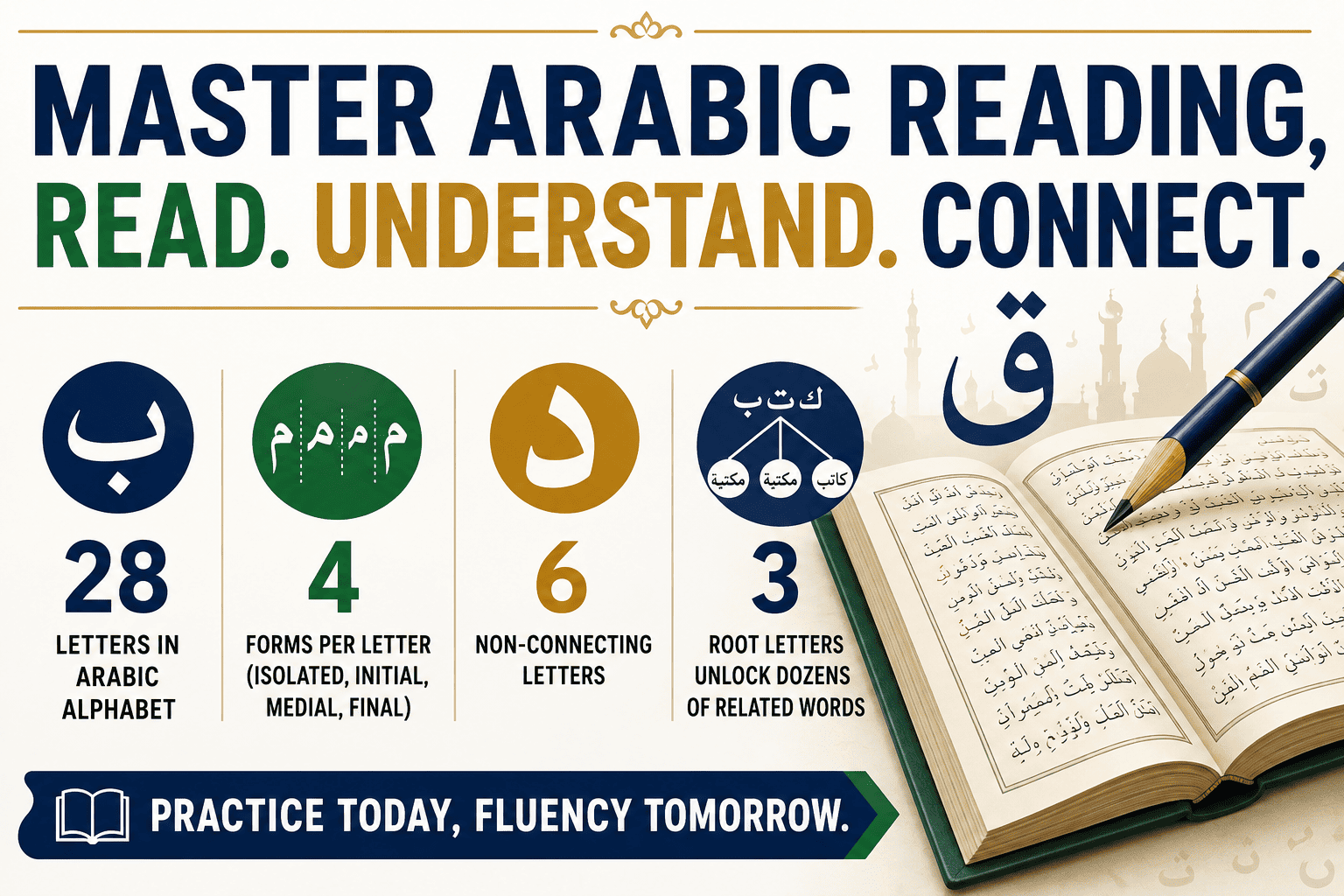
Yes, with the right approach, you can master Arabic reading. Start by mastering the alphabet, all 28 letters in their 4 positional forms. Then learn the root system, 3-letter roots unlock thousands of words. Read daily for 15–20 minutes with vowelized texts, then gradually move to unvowelized materials. Read aloud to build fluency and pronunciation. With consistent daily practice, basic reading takes 3–6 months; fluency develops in 2–3 years.
Arabic, spoken by over 400 million people, flows from right to left, its letters connecting in elegant cursive forms. For learners from non-Semitic backgrounds, the script can feel daunting: 28 letters with position‑dependent shapes, short vowels often omitted, and a root‑based vocabulary unlike English. Yet with the right approach, reading Arabic becomes not just achievable but deeply rewarding.
Reading Arabic opens doors to a rich cultural heritage, religious texts, and professional opportunities. The Arabic script is used by over 400 million native speakers across 22 countries. Mastering it connects you to a civilization that has shaped mathematics, science, literature, and philosophy for centuries.
Letters in Arabic alphabet
Forms per letter (isolated, initial, medial, final)
Non‑connecting letters
Root letters unlock dozens of related words
The Arabic alphabet (Al-Abjadiyah) consists of 28 consonants. It’s an abjad, where short vowels are indicated by optional diacritical marks (harakat) or inferred from context. Learning to recognize letters in all four positional forms is the first milestone on your reading journey.
| Position | Example (letter Baa) | Usage |
|---|---|---|
| Isolated | ب | Standing alone or after non‑connecting letter |
| Initial | بـ | Beginning of word, connects to next |
| Medial | ـبـ | Middle, connects both sides |
| Final | ـب | End of word, connects to previous |
Short vowels: Fatha (َ) = short a, Kasra (ِ) = short i, Damma (ُ) = short u. Sukoon (ْ) means no vowel; Shadda (ّ) doubles a consonant. Long vowels use Alif, Waaw, and Yaa. Modern texts usually omit short vowels, so learners should start with fully vowelized materials. Six letters do NOT connect to the following letter: Alif (ا), Daal (د), Dhaal (ذ), Raa (ر), Zay (ز), Waaw (و).
Most Arabic words derive from a three‑letter root (jiḏr) that carries a core meaning. By inserting root consonants into different patterns (awzaan), Arabic creates families of related words.
Learning just 50 common roots can unlock thousands of words. This system transforms vocabulary learning from memorization into pattern recognition.
Train yourself to extract the three root consonants from any word, ignoring prefixes like الـ or suffixes like ة. This skill is indispensable for dictionary use.
Example: root ك-ت-ب (K-T-B) = writing
| Word | Transliteration | Meaning |
|---|---|---|
| كَتَبَ | kataba | he wrote |
| كِتَاب | kitaab | book |
| كَاتِب | kaatib | writer |
| مَكْتَبَة | maktaba | library |
| مَكْتُوب | maktoob | written / letter |
Practice writing each letter in all four forms daily. Use flashcards, say names aloud, and drill similar‑looking pairs (ب/ت/ث, ج/ح/خ, س/ش). Focus on unique Arabic sounds: ع (Ayn), غ (Ghayn), ح (Haa), خ (Khaa), ق (Qaaf).
Read fully vowelized children’s books or Quranic verses. Practice reading aloud: كَتَبَ (kataba), كُتِبَ (kutiba), كِتَاب (kitaab).
Move from vowelized to partially vowelized texts, then to unvowelized materials. Consistency, 15–20 minutes daily, beats marathon sessions.
Consistency rewires neural pathways faster than weekly cramming. Start with 10–15 minutes minimum.
Select texts with 80–90% known vocabulary. Children’s books → graded readers → news → novels.
Reinforces letter‑sound mapping, improves pronunciation, and builds fluency.
Guess unknown words from surrounding text before reaching for a dictionary.
Read Arabic first, then check English for confirmation and understanding.
Highlight roots, add margin notes, and summarize paragraphs in your own words.
Learn themed lists and use spaced repetition (Anki). Master the top 1,000 high‑frequency words.
Skim for main ideas, scan for specific facts. Both boost reading efficiency.
News, children’s lit, religious texts, poetry, social media, each builds different skills.
Find a partner or group. Social learning provides accountability and feedback.
When you encounter an unfamiliar word, first identify its three‑letter root. Then guess the pattern (e.g., مَفعَل often indicates a place). This unlocks meaning without a dictionary.
Similar letters (ب/ت/ث, ج/ح/خ, س/ش). Solution: Use color‑coded highlighting and write minimal pairs repeatedly.
Supplying vowels becomes automatic with experience. Stick with vowelized texts until patterns feel intuitive.
Normal at early stages. Focus on accuracy; speed follows naturally with practice.
Drop difficulty level to 80% known words. Learn words in thematic clusters rather than random lists.
Set micro‑goals (“read one paragraph”), track progress, and recall your deeper “why” for learning Arabic.
Flashcard timed tests for initial/medial/final forms. Build automatic recognition.
Underline root letters in any paragraph; verify with root dictionary.
Read the same passage 4 times: (1) gist, (2) look up key words, (3) syntax focus, (4) smooth fluency.
Listen to Arabic audio with transcript and read aloud simultaneously, matching pace and intonation.
Translate a short text yourself, then compare with a professional translation to spot gaps.
Read continuously for 10–15 minutes without stopping for unknown words; note them afterward.
Children’s books (fully vowelized), graded readers, Alif Baa app, Arabic children’s YouTube channels.
Simplified news (BBC Arabic, Al Jazeera Learn), Arabic subtitles on YouTube, graded readers at higher levels.
Classical literature, contemporary novels, academic journals, Arabic newspapers and magazines.
Monitor: pages read per week, time per page, percentage of vocabulary understood without dictionary, ability to summarize after reading. Reread a challenging passage every 2 months to see clear gains.
The path to Arabic reading fluency is built one letter, one root, one page at a time. With the strategies and exercises in this guide, you have everything you need to make meaningful progress. Remember: consistency beats intensity. Fifteen minutes of daily reading produces better results than sporadic marathon sessions.
Start today. Master one letter form. Learn one root. Read one vowelized sentence. Then do it again tomorrow. The Arabic script is waiting. Your reading fluency is waiting. All that remains is opening the first page and beginning the journey. استمر (keep going), you will read Arabic with confidence soon.
Learning to read Arabic is a journey of patience and persistence. Every letter you master, every word you decode, brings you closer to fluency. Trust the process, celebrate small wins, and keep reading. You can do this.
Explore more language guides, root‑based vocabulary tools, and learning resources at Belekar Sir’s Academy.
Browse All Language Guides → Try Our ToolsContinue exploring language learning with our guides on English phonetics, types of adjectives, and adjectives to describe yourself.

Belekar Sir is the founder and lead instructor at Belekar Sir’s Academy, a trusted name in English language education. With over a decade of teaching experience, he has helped thousands of students—from beginners to advanced learners—develop fluency, confidence, and real-world communication skills. Known for his practical teaching style and deep understanding of learner needs, Belekar Sir is passionate about making English accessible and empowering for everyone. When he’s not teaching, he’s creating resources and guides to support learners on their journey to mastering spoken English.