Yes, decoding can be systematically improved at any age. Research shows that explicit, systematic instruction in phonological awareness and phonics yields significant gains. Build phonological awareness through rhyming and sound manipulation. Teach systematic phonics following a clear scope and sequence. Use multisensory techniques engaging visual, auditory, and kinesthetic pathways. Practice with decodable text matching current skills. Master all 6 syllable types and division patterns. With 20-30 minutes of daily practice, most students show measurable improvement in 8-12 weeks.
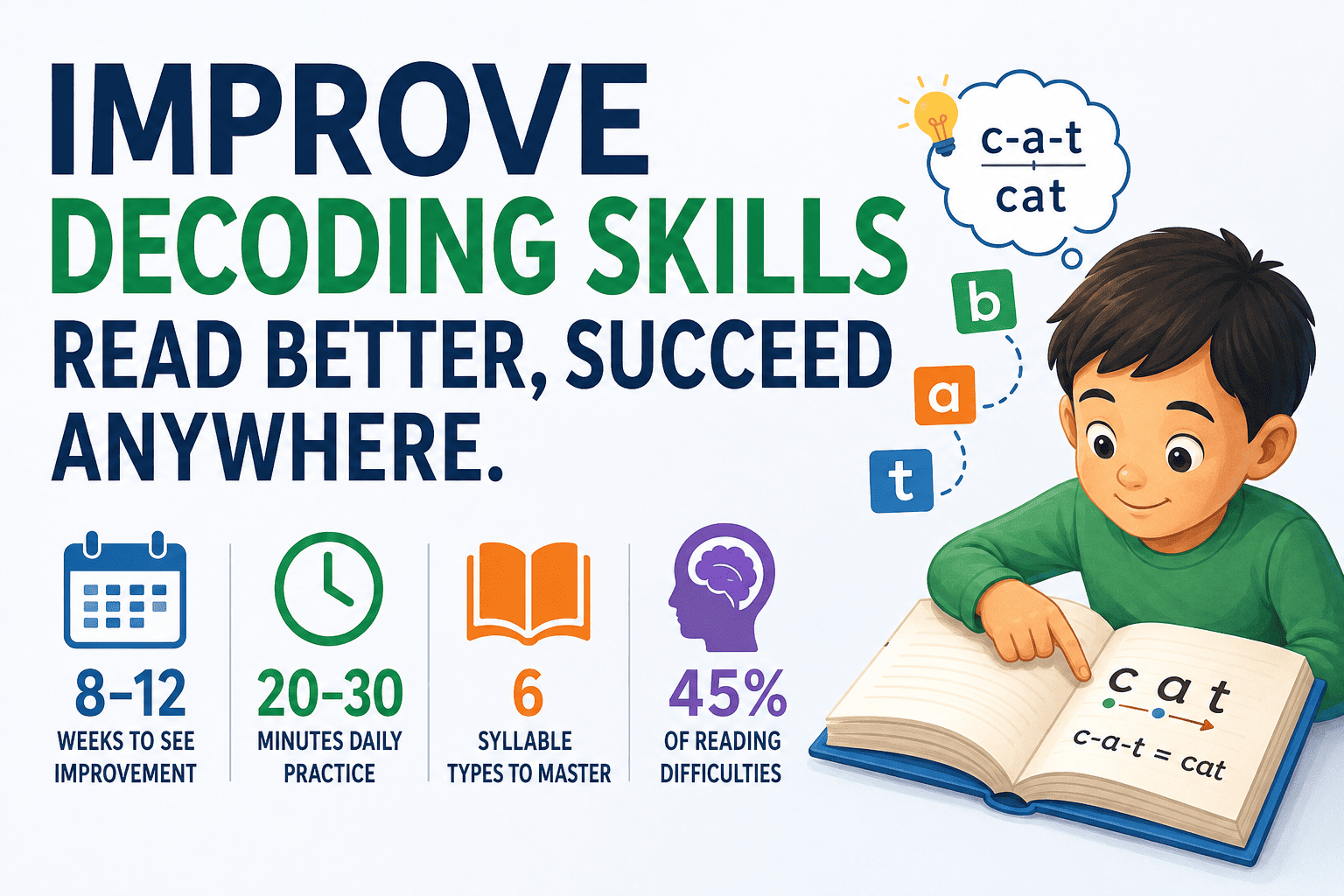
Watching a child struggle to read is heartbreaking. They stare at a page, eyes moving slowly across unfamiliar words, frustration building with each moment. Often, the root cause is weak decoding — the ability to apply letter‑sound relationships to pronounce written words. The good news: decoding can be systematically taught and dramatically improved at any age. This guide distills decades of reading research into practical strategies for teachers and parents.
Decoding is the process of translating printed words into speech by matching letters and letter patterns to their corresponding sounds. It requires phonological awareness (hearing sounds in words), phonemic awareness (manipulating individual sounds), letter-sound knowledge, blending (combining sounds to form words), and segmenting (breaking words into sounds). Without strong decoding, reading remains exhausting and comprehension suffers because all mental energy goes into sounding out.
The ability to hear and manipulate sounds in spoken language. Includes rhyming, syllable awareness, and phoneme manipulation. Foundation for all decoding instruction.
Connecting sounds to letters. Teaching letter-sound relationships systematically. Students learn that letters represent sounds and can be combined to form words.
The process of permanently storing words in memory. Strong decoding leads to automatic sight word recognition through repeated successful decoding attempts.
Decoding = active sounding out and blending of unfamiliar words. Sight word recognition = automatic identification through orthographic mapping. Strong decoding builds a large bank of sight words over time through repeated exposure and successful decoding.
Decades of reading research consistently shows that explicit, systematic phonics instruction is the most effective approach for teaching decoding. Students who receive systematic phonics instruction outperform those taught through whole language or balanced literacy approaches on measures of decoding, spelling, and reading comprehension.
Start with rhyme recognition, syllable blending/segmentation, and phoneme isolation. Progress systematically from easier to harder skills. Teach orally without letters initially to ensure the sound foundation is solid before adding letter-sound connections.
| Skill | Example Activity | Level |
|---|---|---|
| Rhyme recognition | “Which word rhymes with cat: dog, hat, pig?” | Beginning |
| Syllable blending | “Put these parts together: ‘bas’ ‘ket'” | Beginning |
| Phoneme isolation | “What’s the first sound in ‘sun’?” | Intermediate |
| Phoneme blending | “What word is /c/ /a/ /t/?” | Advanced |
| Phoneme manipulation | “Change /c/ in ‘cat’ to /b/'” | Advanced |
Follow a clear scope and sequence: consonants → short vowels → CVC words → digraphs and blends → long vowels (silent e, vowel teams) → r‑controlled vowels → multisyllabic strategies. Use “I do, we do, you do” modeling and cumulative review to ensure retention.
Teach the six syllable types: closed (cat), open (he), VCe (make), vowel team (rain), r‑controlled (car), and consonant‑le (table). Teach division patterns (VC/CV, V/CV, VC/V). Show students to mark vowels, divide, identify syllable types, decode each part, then blend the whole word.
Engage visual, auditory, kinesthetic, and tactile pathways: color‑coding letter patterns, sky‑writing letters and words, sand trays for tracing, letter tiles for word building, finger tapping sounds, and simultaneous say‑trace‑read routines that activate multiple learning channels.
Decodable texts contain only patterns and sight words already taught. Match texts precisely to current skills, pre‑teach new sight words, and provide repeated readings for fluency. Avoid texts with untaught patterns that encourage guessing rather than decoding.
Explicit steps: look at the whole word → mark vowels → divide into syllables → determine syllable types → decode syllable by syllable → blend the syllables → check for meaning → adjust if needed. This gives students a reliable procedure when encountering unfamiliar words.
Practice using sound boxes (Elkonin boxes), continuous blending (stretching sounds together), robot talk (speaking slowly then speeding up), and finger tapping. Start with 2‑phoneme words, progress to 3‑phoneme, then blends and digraphs, then multisyllabic words.
Teach common prefixes, suffixes, and roots to make longer words manageable. Cover suffixes (-ed, -ing, -s) first, then prefixes (un-, re-, pre-), then Greek and Latin roots. Understanding word parts helps students decode and comprehend unfamiliar words.
Use word chains, speed drills, repeated reading, word sorts, and flash cards. Prioritize accuracy first, then speed. Brief daily practice sessions are more effective than longer, infrequent sessions for building automaticity.
Stop errors immediately, model the correct response, have the student repeat correctly, and reread the sentence for context. Use a positive, encouraging tone and focus on the process rather than criticizing mistakes.
Start with phonological awareness if it’s weak. Move to letter-sound instruction. Practice decoding in isolation and in connected text. Monitor progress weekly. Adjust based on student response.
Track letter-sound fluency, nonsense word reading, and text reading accuracy weekly. These measures show whether instruction is working and guide your next teaching steps.
Minutes 1-5: Phonological awareness warmup (oral practice with sounds) • Minutes 6-15: Explicit phonics instruction (new pattern + guided practice with immediate feedback) • Minutes 16-25: Decodable text reading (student reads aloud with teacher support and feedback) • Minutes 26-30: Word study or review game (reinforcing previously taught patterns)
Use age‑appropriate materials that don’t feel childish. Move quickly through basics if gaps exist. Focus on high‑utility patterns and connect instruction to their interests. Acknowledge effort without shame. Older students often progress quickly once foundational gaps are filled.
Pre‑teach vocabulary before reading. Connect sounds across languages when possible. Use pictures to support meaning. Allow extra processing time. Build oral language alongside decoding.
Provide more intensive explicit instruction. Use multisensory techniques extensively. Allow extra practice time. Consider assistive technology. Celebrate small wins. Progress may be slower but is absolutely achievable.
Accelerate through basics that are already mastered. Emphasize morphology earlier. Provide challenging multisyllabic words. Explore etymology and word origins. Read more complex decodable texts.
Be patient and celebrate effort. Make it playful with games. Keep sessions brief (10‑15 minutes). Follow teacher recommendations. Read decodable books together daily. Play sound games in the car or during chores.
Encourage guessing from pictures. Tell words without letting them try. Express frustration. Compare to siblings. Practice skills that haven’t been taught yet. Push when they’re tired or frustrated.
“I spy something that starts with /b/.” “Clap the syllables in ‘broccoli’.” “What rhyme can you make with ‘cat’?” “Say ‘sun’ without the /s/.” These playful activities build phonological awareness without pressure.
Increased phonological awareness accuracy. Faster letter‑sound recall. Willing attempts at unfamiliar words. Less guessing from pictures. More confident reading attempts.
Reads decodable text at appropriate pace. Applies syllable division automatically. Improves spelling of regular words. Increased reading stamina and enjoyment.
Reads grade‑level text with increasing fluency. Decodes multisyllabic words independently. Improved comprehension and enjoyment. Transfers decoding skills to new reading material.
Improving decoding skills is one of the most impactful interventions you can provide for a struggling reader. With systematic instruction, consistent practice, and your belief in them, students can transform from hesitant word-callers to confident, capable readers. The strategies outlined in this guide are backed by decades of research and have helped countless students unlock the code of written language.
Remember that progress takes time. Celebrate small victories along the way — each correctly decoded word, each page read independently, each book finished. Your patience and encouragement make all the difference. Whether you’re a teacher in the classroom or a parent at home, you have the power to change a child’s reading trajectory forever.
Every student deserves the opportunity to become a confident reader. Decoding is the key that unlocks this door. With the right instruction, practice, and support, struggling readers become strong readers. The strategies in this guide work — I’ve seen them transform students’ lives. Start today, stay consistent, and watch your students grow.
Explore our library of evidence‑based literacy resources, intervention guides, and teacher tools to support every reader.
Browse All Literacy Guides → Try Our ToolsContinue exploring literacy development with our guides on English phonetics, 3rd grade reading comprehension, and types of adjectives.
Every child can learn to decode. With systematic instruction, consistent practice, and your belief in them, struggling readers become confident, capable readers.

Belekar Sir is the founder and lead instructor at Belekar Sir’s Academy, a trusted name in English language education. With over a decade of teaching experience, he has helped thousands of students—from beginners to advanced learners—develop fluency, confidence, and real-world communication skills. Known for his practical teaching style and deep understanding of learner needs, Belekar Sir is passionate about making English accessible and empowering for everyone. When he’s not teaching, he’s creating resources and guides to support learners on their journey to mastering spoken English.