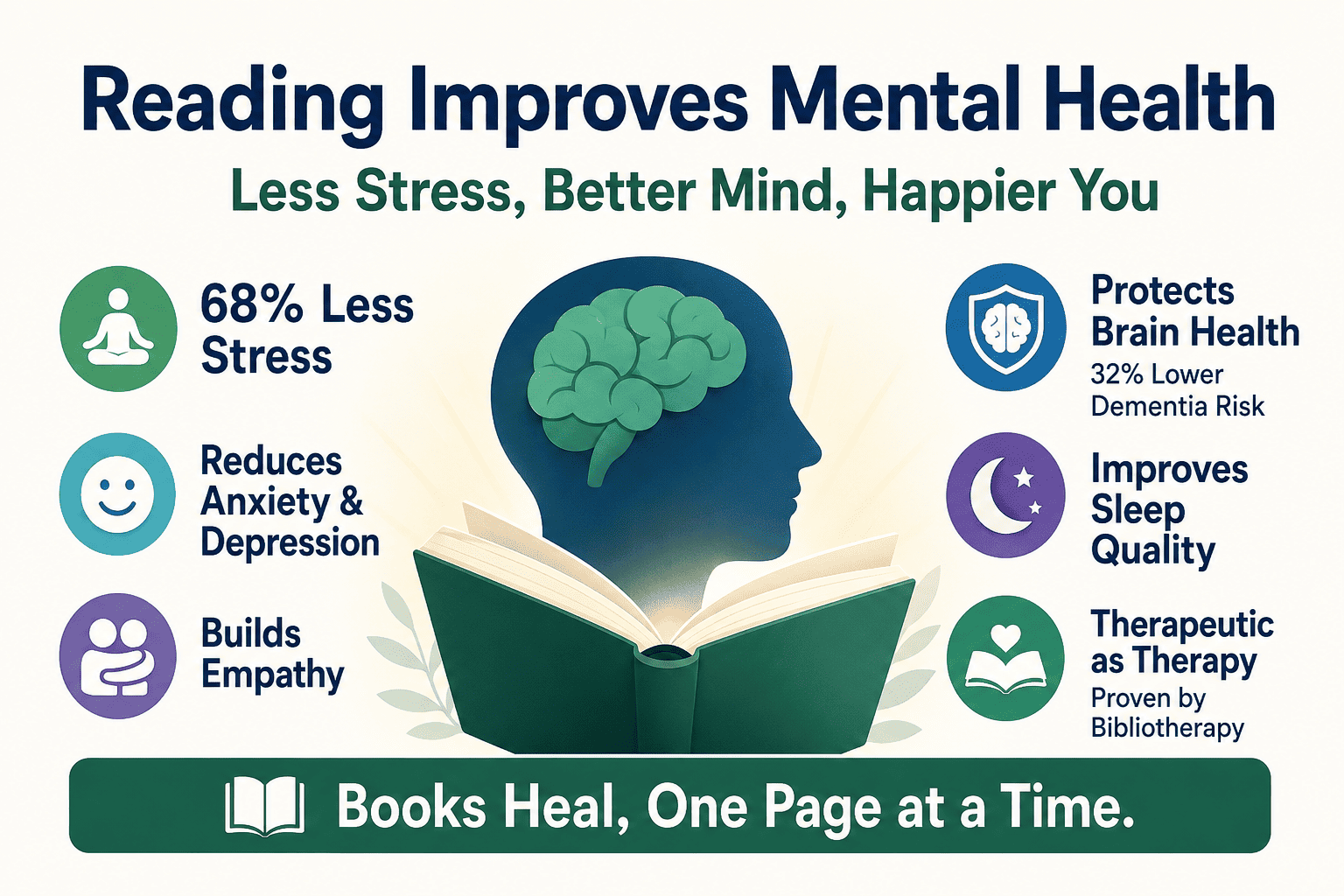
Quick Answer: Yes, extensive research shows reading significantly improves mental health. Just six minutes of reading reduces stress by 68%, outperforming music or walking. Regular reading decreases depression and anxiety symptoms, builds empathy, protects against cognitive decline (reducing dementia risk by 32%), and improves sleep quality. Bibliotherapy, the therapeutic use of books, shows effects comparable to traditional therapy for mild to moderate conditions. Reading is one of the most accessible, evidence-based tools for mental wellbeing available.
You close your eyes after another exhausting day. Stress weighs on your shoulders. Anxious thoughts race through your mind. Then you reach for a book. Within minutes, the tightness in your chest begins to ease. Your breathing slows. The worries fade as you slip into another world.
This simple act of reading is not just escapism. It represents one of the most accessible and powerful tools available for improving your mental health. In an era where mental health challenges affect millions worldwide, reading offers something remarkable: it costs little or nothing, requires no special equipment, and can be done anywhere, yet delivers profound benefits backed by decades of research.
Reading activates extensive neural networks, far more than other activities. Reading about physical experiences activates the same brain regions as actually having those experiences. When you read about a character running, your motor cortex activates. This neural embodiment means reading provides genuine experiences that shape your brain and emotions.
fMRI studies show that reading activates language processing areas, visual cortex, memory centers, and emotional regions simultaneously, creating rich neural engagement.
When absorbed in a story, you mentally leave your surroundings. This reduces self-focused attention (which drives anxiety) and allows your nervous system to reset.
Studies measuring heart rate, blood pressure, and muscle tension show reading reduces physiological arousal within minutes, with six minutes lowering stress by 68%.
A landmark study found that reading for just six minutes lowered stress levels by 68 percent, outperforming listening to music, drinking tea, or taking a walk. Researchers attributed this to reading’s ability to engage your mind completely, forcing stressful thoughts aside while allowing your body to relax.
| Benefit | Key Finding | Research Support |
|---|---|---|
| Anxiety & Depression Relief | Bibliotherapy reduces depression symptoms with effects lasting months | Meta-analysis of 13 studies |
| Enhanced Empathy | Fiction reading correlates with better perspective-taking and social cognition | Multiple longitudinal studies |
| Cognitive Protection | Weekly reading reduces dementia risk by 32% | 14-year study of adults over 64 |
| Improved Sleep | Print reading before bed reduces sleep onset time and increases duration | Sleep hygiene research |
| Stress Reduction | 6 minutes of reading lowers stress by 68% | University of Sussex study |
A 14-year longitudinal study of adults over 64 found that those who read at least weekly experienced significantly less cognitive decline than non-readers. Another study found cognitive activities like reading reduced dementia risk by 32%. Even among those who developed dementia, readers showed symptoms an average of five years later than non-readers.
Excels at building empathy, reducing stress, and providing emotional experiences in safe contexts. Literary fiction focusing on character psychology particularly enhances social cognition.
Provides explicit strategies for managing mental health challenges. Memoirs offer validation and connection by showing others’ struggles and recovery.
Condensed language offers powerful connection moments. Brief format works when concentration difficulties prevent sustained reading.
Provide many of print reading’s benefits while increasing accessibility and fitting into busy schedules. May help when concentration is difficult.
Mental health professionals have long recognized reading’s therapeutic potential, formalizing it into an intervention called bibliotherapy, the strategic use of reading materials to promote mental health.
Books teaching specific skills like CBT strategies for anxiety. Readers work through independently, applying concepts to their own situations.
Uses fiction and narrative works to help readers explore emotions, gain insights, and develop new perspectives through discussion and reflection.
Incorporates reading into formal therapy sessions. Therapists and clients discuss reactions, connect themes to personal experiences, and use material as therapeutic springboards.
Studies show bibliotherapy successfully reduces: depression symptoms (comparable to traditional therapy for mild to moderate cases), anxiety across multiple disorders, OCD symptoms, insomnia, stress and burnout, grief and bereavement distress, and trauma symptoms when appropriately matched.
| Strategy | Implementation | Mental Health Benefit |
|---|---|---|
| Set specific reading times | Choose consistent times daily, even 10-15 minutes | Creates routine that reduces decision fatigue |
| Create a reading environment | Designate a comfortable, quiet space | Associates location with relaxation |
| Start small | Begin with 5-10 minutes daily | Prevents overwhelm, builds sustainable practice |
| Remove barriers | Keep books easily accessible throughout home | Reduces friction, increases spontaneous reading |
| Join a reading group | Meet regularly to discuss books with others | Adds social support and accountability |
Engaging fiction in genres you enjoy. Mystery, fantasy, romance, or literary fiction all work if they absorb your attention.
Calm, contemplative pacing. Nature writing, gentle memoirs, and self-help books teaching anxiety management techniques.
Uplifting or inspiring material without toxic positivity. Memoirs of recovery and books teaching behavioral activation.
Rich character development. Books with characters facing similar situations. Reading group participation for real social connection.
Pleasantly engaging but not overstimulating. Avoid cliffhangers and violent content. Familiar rereads work well.
Eliminate distractions. Take a few deep breaths before opening your book. Notice when your mind wanders and gently return attention. Pause periodically to notice your emotional and physical responses. Mindful reading transforms reading from passive consumption to active meditation, building present-moment awareness that transfers to daily life.
Start with 5 minutes daily. Read during waiting times. Listen to audiobooks during commutes. Consistency matters more than duration.
Begin with easier, engaging material. Use audiobooks. Try shorter formats like essays. Accept that some days are harder.
Ask for recommendations from friends, librarians, or online communities. Use award winner lists. Any book beats no book.
Read familiar favorites requiring less mental energy. Set tiny goals like one page. Read during highest-energy times.
Utilize libraries for free access. Explore used bookstores. Swap books with friends. Check free public domain sources.
Builds emotional vocabulary, develops empathy, provides safe exploration of difficult topics, reduces screen time, and creates calming bedtime routines.
Memoirs show how others navigated similar passages. Self-help books offer frameworks. Fiction exploring relevant themes provides emotional processing.
Slows cognitive decline, provides meaningful activity, maintains social connection through book clubs, reduces isolation. Large-print books and audiobooks increase accessibility.
Reading helps but requires tailoring. Start small for depression. Choose calming material for anxiety. Work with therapists for trauma. Use audiobooks for attention disorders.
While reading is often solitary, its social aspects significantly enhance mental health benefits. Reading groups provide structured social interaction centered on shared interest, delivering regular social contact, shared purpose, communication skill development, accountability, and community belonging.
Research on reading groups documents improvements in wellbeing, social connection, and quality of life. Participants report feeling more connected, understood, and supported. The format provides structure that reduces social anxiety while building relationships.
The evidence is overwhelming. Reading improves mental health through multiple mechanisms. It reduces stress and anxiety. It protects cognitive function and brain health. It builds empathy and emotional intelligence. It provides therapeutic benefits comparable to professional interventions for many conditions. It connects people to others through shared experiences and social reading.
Start today. Five minutes of daily reading establishes the habit. Choose material you genuinely enjoy. Create a comfortable reading space. Turn off distractions. Allow yourself to be transported. Notice how your mind and body respond.
In a world that often feels chaotic and overwhelming, reading offers refuge and renewal. Between the pages of a book, you can find peace, perspective, connection, and hope. The mental health benefits wait for you, requiring only that you open a book and begin.
Explore more articles on wellness, learning, and personal growth at Belekar Sir’s Academy.
Browse All Articles → Try Our ToolsContinue exploring wellness and learning with our guides on adjectives for mom, positive adjectives for husbands, and types of adjectives.

Belekar Sir is the founder and lead instructor at Belekar Sir’s Academy, a trusted name in English language education. With over a decade of teaching experience, he has helped thousands of students—from beginners to advanced learners—develop fluency, confidence, and real-world communication skills. Known for his practical teaching style and deep understanding of learner needs, Belekar Sir is passionate about making English accessible and empowering for everyone. When he’s not teaching, he’s creating resources and guides to support learners on their journey to mastering spoken English.