What separates someone who simply “knows how to read” from someone who reads with depth, clarity, and insight? The difference lies in skilled reading an advanced ability that goes beyond decoding words on a page. Skilled readers analyze, interpret, evaluate, and connect ideas effortlessly. They approach text with purpose and use a wide range of strategies automatically, making reading not only efficient but highly meaningful.
Becoming a skilled reader is not just important for academic success, but also for lifelong learning, professional growth, and personal enrichment. Skilled readers engage more deeply with text, comprehend complex ideas, and apply what they read in practical, creative, or analytical ways. This article breaks down the essential characteristics and cognitive processes behind skilled reading, offering a complete understanding of what expert readers do differently and how these skills develop.
Understanding What “Skilled Reading” Truly Means
Skilled reading is the result of multiple cognitive and linguistic processes working together seamlessly. It is an active, purposeful, and strategic approach to reading where the reader understands not just what the text says, but also why it says it, how the information fits together, and what it means within a broader context.
A skilled reader does not struggle with basic decoding or vocabulary. Instead, they focus on interpreting ideas, evaluating arguments, and drawing connections. They move fluidly between surface meaning and deeper insight, adjusting their reading approach depending on the complexity of the material. Skilled reading is therefore both a science requiring cognitive efficiency and an art requiring thoughtful engagement and perspective.
Core Cognitive Processes Behind Skilled Reading
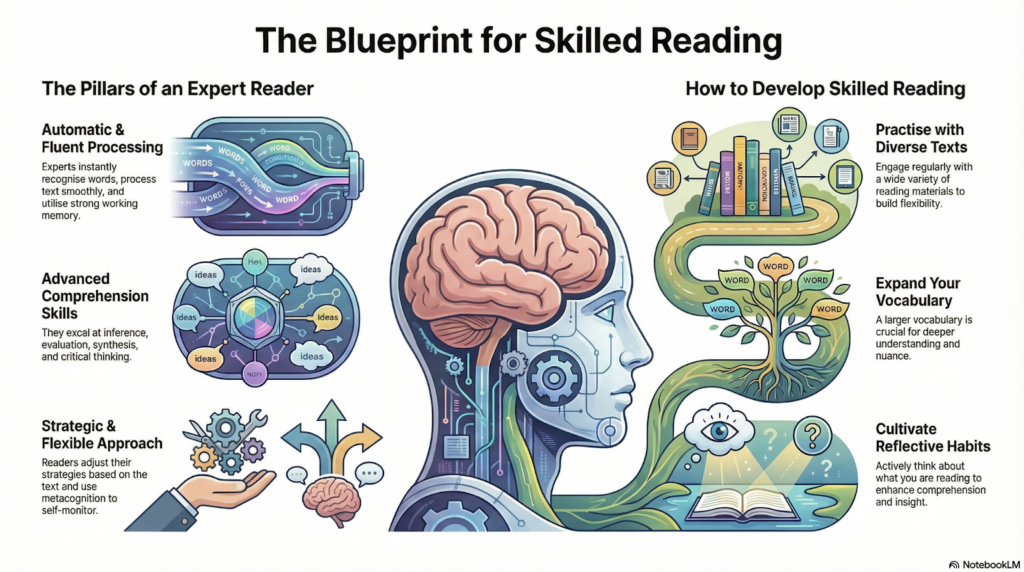
Skilled reading doesn’t happen by accident; it is driven by underlying mental processes that develop through practice. Some of the key cognitive components include:
Automatic Word Recognition
Expert readers instantly recognize familiar words without sounding them out. Their mental lexicon an internal “dictionary” is highly developed. Because decoding is automatic, the brain has more energy available for comprehension and analysis.
Fluent Processing
Skilled readers move through text smoothly and at an appropriate pace, adjusting reading speed depending on content difficulty. This fluency helps maintain the thread of meaning, preventing comprehension breakdowns.
Strong Working Memory
Reading involves holding information in mind long enough to connect sentences, track plotlines, or follow arguments. Skilled readers have strong working memory that supports comprehension, inference-making, and synthesis.
Efficient Cognitive Switching
Good readers shift seamlessly between different modes of reading: skimming, scanning, careful analysis, and evaluation. They adjust their strategy based on their goals and the nature of the text.
These cognitive processes work together to create a reading experience that is accurate, meaningful, and fast the hallmark of a skilled reader.
Characteristics That Define a Skilled Reader
Skilled readers share certain traits that set them apart from struggling or average readers. These characteristics reflect both their mindset and reading approach.
Purpose-Driven Reading
A skilled reader always has a reason for reading whether it’s to learn, analyze, enjoy, or evaluate. They approach text with goals that guide how they read and what they focus on.
Engagement With Text
They actively interact with text by asking questions, making predictions, noting patterns, and forming opinions. They treat reading as a dialogue rather than a passive activity.
Flexibility of Thought
Skilled readers adjust their reading strategy depending on the genre, difficulty, and purpose. They know when to skim, when to slow down, and when to reread.
Attention to Detail
Expert readers notice subtle cues such as tone, structure, implications, and hidden assumptions details that less skilled readers often miss.
Resilience With Difficult Texts
When faced with complex material, they don’t give up. They break down ideas, look for clues, draw from prior knowledge, and persist until they achieve understanding.
These traits combine to create readers who read not just accurately but thoughtfully and effectively.
Linguistic Skills That Support Skilled Reading
Language proficiency is at the heart of skilled reading. Several linguistic abilities play a major role:
Strong Vocabulary
Skilled readers have an extensive vocabulary that helps them interpret ideas quickly. They also infer the meaning of unfamiliar words using context clues, prefixes, suffixes, and root knowledge.
Grammar and Syntax Awareness
Understanding sentence structure helps expert readers decode complex sentences, identify relationships between ideas, and extract meaning even from dense academic writing.
Semantic Knowledge
Skilled readers understand how language conveys meaning both literally and figuratively enabling them to interpret metaphors, tone, nuances, and deeper messages.
Phonological and Orthographic Awareness
Although skilled readers rarely think consciously about sounds or spelling patterns, these foundational skills support automatic recognition and fluent reading.
Together, these linguistic skills allow a reader to interpret text accurately, even when ideas are abstract or challenging.
Comprehension Skills of a Skilled Reader
Reading comprehension is where skilled readers truly excel. Key abilities include:
Understanding Main Ideas and Supporting Details
They grasp the central message quickly and see how details contribute to the overall argument.
Making Inferences
Skilled readers read between the lines, identifying meaning that is implied but not directly stated.
Recognizing Structure
They can identify patterns of organization such as cause-and-effect, compare-and-contrast, or problem-solution which helps them absorb information efficiently.
Evaluating Arguments
They critically assess claims, evidence, and logic, distinguishing strong arguments from weak or biased ones.
Synthesizing Information
A skilled reader combines new information with prior knowledge to form deeper insights or broader understanding.
These comprehension skills allow expert readers to navigate everything from literature to academic content with confidence.
Analytical and Critical Thinking Skills
Skilled readers go beyond understanding text they analyze and critique it. Their abilities include:
Identifying Themes and Concepts
They understand not just what the text says but the underlying message, theme, or philosophy.
Interpreting Author Intent
Expert readers detect why the author wrote the piece, what perspective they hold, and how their purpose shapes the content.
Detecting Tone, Mood, and Style
These subtle elements help skilled readers interpret meaning at a deeper level, especially in literature and persuasive writing.
Recognizing Bias and Assumptions
They can evaluate the credibility of sources, identify logical fallacies, and recognize propaganda or emotional manipulation.
Connecting Ideas Across Texts
Skilled readers relate new information to other books, academic concepts, or real-world contexts, making their reading richer and more meaningful.
These higher-order thinking skills transform reading into a tool for insight and intellectual growth.
How Skilled Readers Approach Different Types of Text
One of the most defining qualities of a skilled reader is adaptability.
Fiction
In fiction, they focus on characters, themes, symbolism, narrative structure, and emotional resonance. They track plotlines and motives while appreciating literary elements.
Nonfiction
For informational text, they pay attention to arguments, evidence, organization, and clarity. They read to learn, evaluate, and compare ideas.
Academic Texts
Skilled readers analyze definitions, theories, data, and methodology. They annotate, summarize, and question content deeply.
Technical or Professional Material
They decode jargon, follow instructions carefully, and translate complex concepts into simpler terms.
Their flexible approach makes them efficient learners in any field.
Habits That Skilled Readers Build Over Time
Becoming a skilled reader requires consistent habits, including:
- Reading regularly across genres
- Annotating texts or taking notes
- Asking questions while reading
- Seeking deeper meaning and themes
- Discussing books or ideas with others
- Reflecting on what they read
- Expanding vocabulary intentionally
How Skilled Readers Use Metacognition
Metacognition thinking about one’s own thinking is a key skill of expert readers.
Skilled readers monitor their comprehension while reading. They notice when something doesn’t make sense, pause to clarify, adjust their reading pace, or reread complex sections. They also set goals before reading and reflect on what they’ve learned afterward.
This awareness helps them remain in control of their learning process and ensures that comprehension stays strong from start to finish.
How to Develop Skilled Reading Abilities
While some readers develop these skills naturally, most people build them through practice. Techniques include:
- Building foundational decoding and fluency skills
- Reading a variety of materials
- Expanding vocabulary intentionally
- Learning to summarize and paraphrase
- Practicing inference-making
- Using annotation methods
- Reviewing unfamiliar concepts
- Reading challenging material gradually
With consistent effort, anyone can move from basic reading to skilled, expert-level reading.
Conclusion
A skilled reader is not simply someone who reads quickly or avoids mistakes; they are purposeful, analytical, flexible, and deeply engaged with text. They combine cognitive efficiency, linguistic strength, comprehension ability, and critical thinking to create a rich and meaningful reading experience. Skilled reading opens doors to academic success, professional competence, and lifelong learning. Understanding these skills and learning how to cultivate them empowers anyone to elevate their reading from basic decoding to expert interpretation.
Frequently Asked Questions (FAQs)
1. What is the difference between a fluent reader and a skilled reader?
Fluent readers read smoothly and accurately, while skilled readers also interpret, analyze, evaluate, and connect ideas beyond surface meaning.
2. Can anyone become a skilled reader?
Yes. Skilled reading is learned through practice, exposure to diverse texts, and the development of strategic reading habits.
3. How long does it take to become a skilled reader?
It depends on reading frequency, text difficulty, and learning strategies. Progress is gradual but consistent with regular practice.
4. Are skilled readers always fast readers?
Not necessarily. Skilled readers adjust speed based on purpose sometimes reading slowly for deeper comprehension.
5. What age can a child become a skilled reader?
Children begin developing skilled reading behaviors in late elementary years, but mastery continues into high school and adulthood.
6. Do skilled readers need a large vocabulary?
A strong vocabulary helps significantly, but skilled readers also infer meaning using context clues and linguistic knowledge.
7. How can I improve my analytical reading skills?
Practice annotating, questioning text, comparing ideas, and identifying themes or arguments regularly.
8. What types of books help build skilled reading abilities?
A mix of fiction, nonfiction, academic texts, and challenging literature supports well-rounded development.
9. Is rereading necessary for skilled reading?
Yes. Skilled readers often reread complex sections to ensure complete understanding.
10. Can digital reading develop skilled reading?
Absolutely as long as the reader engages deeply, minimizes distraction, and applies active reading strategies.

Belekar Sir is the founder and lead instructor at Belekar Sir’s Academy, a trusted name in English language education. With over a decade of teaching experience, he has helped thousands of students—from beginners to advanced learners—develop fluency, confidence, and real-world communication skills. Known for his practical teaching style and deep understanding of learner needs, Belekar Sir is passionate about making English accessible and empowering for everyone. When he’s not teaching, he’s creating resources and guides to support learners on their journey to mastering spoken English.