Yes, decades of neuroscience and psychology research confirm that reading systematically develops creative capacity. Reading activates bilateral brain networks, strengthens cognitive flexibility, enhances divergent thinking, and builds the neural infrastructure supporting innovation. Frequent readers score significantly higher on creativity measures than non-readers. Just 15-30 minutes of daily reading provides measurable creative benefits, with fiction particularly enhancing imagination and perspective-taking, while nonfiction builds knowledge frameworks for creative problem-solving.
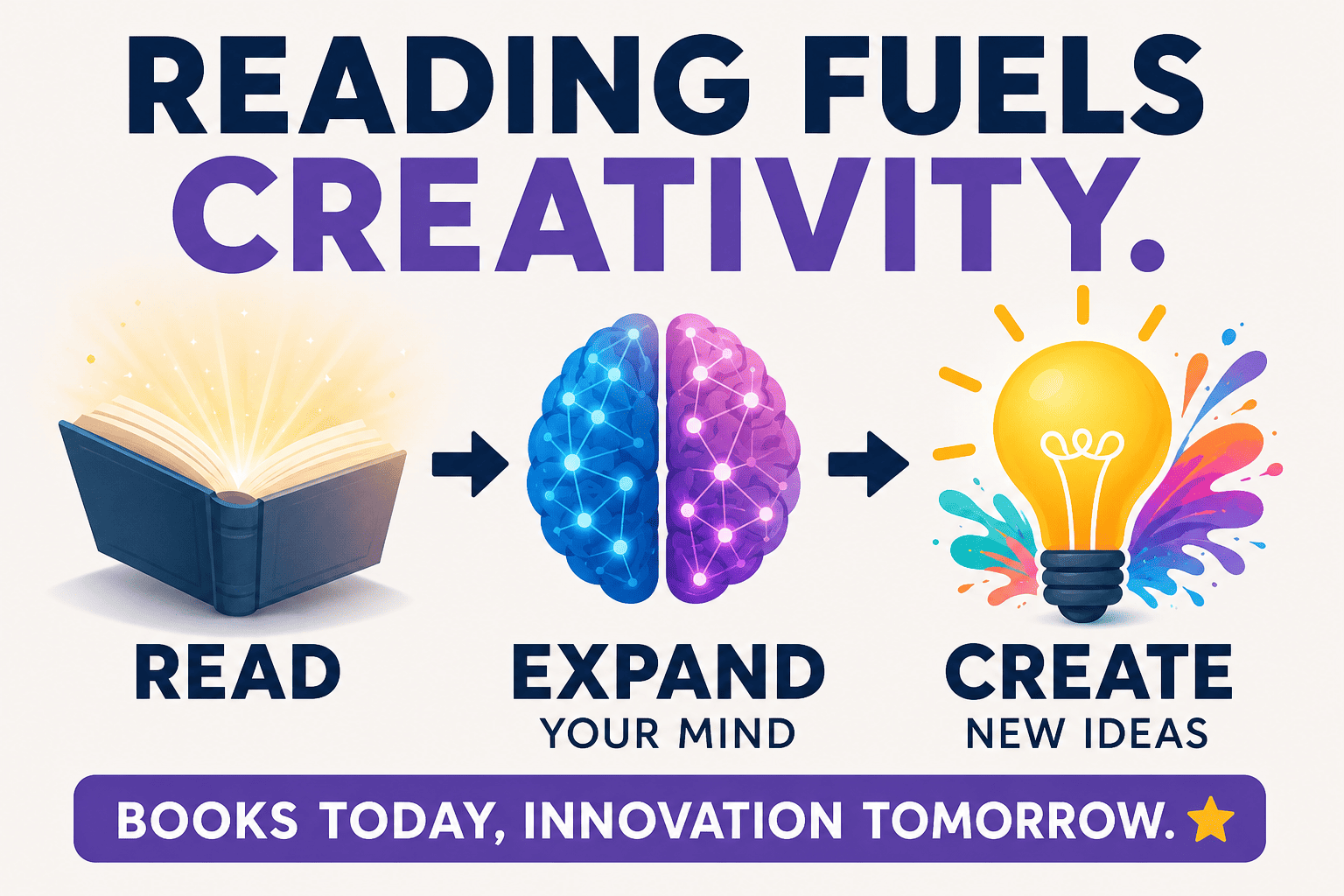
You stare at a blank page. The cursor blinks mockingly. Your mind feels like a desert where ideas once flourished. Creative block has struck again. Now imagine picking up a book. Within pages, your mind begins shifting. New connections form. Fresh perspectives emerge. Solutions appear where obstacles once stood. This transformation is not magic. It represents the scientifically proven impact of reading on creative capacity.
While creativity often feels mysterious, research reveals it as a skill that reading systematically develops and strengthens. Creativity functions like a muscle that grows stronger with proper exercise. Reading provides that exercise, activating neural networks, expanding mental frameworks, and building cognitive flexibility that defines creative thinking.
Reading activates far more extensive neural networks than passive activities. Multiple brain regions engage simultaneously: the left temporal cortex processes language, the frontal lobe handles comprehension, the parietal lobe integrates sensory information, and the visual cortex creates mental imagery. Most significantly, reading activates the right hemisphere, associated with creative thinking, pattern recognition, and holistic processing, creating ideal conditions for creative insight.
Reading engages both logical left-brain and creative right-brain processing simultaneously, strengthening integration between analytical and creative thinking.
When absorbed in a story, you mentally leave your environment and inhabit another viewpoint. This perspective-shifting practice directly enhances cognitive flexibility.
Regular readers develop stronger neural connections in areas associated with imagination and abstract thinking. Reading increases neuroplasticity, your brain’s ability to form new connections.
Neuroscience research using fMRI shows that reading about physical experiences activates the same brain regions as actually having those experiences. When you read about a character running, your motor cortex activates. This neural embodiment means reading provides genuine experiences that shape your brain’s creative architecture.
Reading requires constructing mental images from written descriptions. This constant visualization practice strengthens imagination muscles, developing ability to envision possibilities that don’t yet exist.
Literature presents complex situations with multiple interpretations. Studies show frequent readers perform significantly better on tests measuring divergent thinking, generating multiple solutions to open-ended challenges.
Reading trains you to unconsciously recognize narrative patterns, character archetypes, and structural techniques, skills that transfer to identifying opportunities and predicting outcomes.
Reading diverse perspectives adds new frameworks for understanding the world. With more mental models available, you approach challenges from multiple angles and generate more diverse solutions.
A landmark study comparing frequent readers to non-readers found readers performed significantly better on creativity assessments measuring: generating unusual uses for common objects, creating original captions for pictures, proposing multiple solutions to open-ended problems, making connections between unrelated concepts, and producing original stories from prompts.
| Reading Type | Primary Creative Benefits | Best For |
|---|---|---|
| Literary Fiction | Empathy, emotional intelligence, nuanced thinking, character motivation understanding | Writers, therapists, leaders |
| Genre Fiction | Imagination, plot construction, world-building, tension management | Problem-solvers, storytellers |
| Poetry | Language precision, metaphorical thinking, emotional expression, brevity | Communicators, marketers, artists |
| Biography | Alternative life paths, decision-making models, resilience strategies | Entrepreneurs, leaders facing challenges |
| History | Long-term pattern recognition, cause-effect thinking, contextual understanding | Strategists, policy-makers |
| Science | Analytical creativity, hypothesis formation, evidence evaluation | Researchers, analysts, inventors |
| Philosophy | Abstract thinking, logical argument construction, assumption questioning | Critical thinkers, innovators |
Fiction provides sustained imaginative engagement by creating realities that exist only in imagination. A study of university students found fiction readers scored significantly higher on creativity measures than non-fiction readers or non-readers, showing greater fluency in generating ideas and stronger originality.
Nonfiction builds creativity by providing knowledge frameworks and explicit strategies. The creative value comes from actively considering how concepts apply to your specific situations. Biography and memoir prove particularly valuable for creative inspiration.
Maximum creative benefit comes from reading across genres. This diversity creates conceptual blending, where ideas from different domains combine to generate novel insights. Cross-disciplinary reading multiplies creative potential.
| Study Type | Key Finding | Implication |
|---|---|---|
| Landmark University Study | Frequent readers scored higher on creativity measures including divergent thinking and originality, even after controlling for intelligence and education | Reading develops broad creative capacity, not just narrow skills |
| Longitudinal Child Study | Children who read more showed steeper increases in creative thinking scores over several years | Creative benefits strengthen with sustained practice |
| Neuroscience (fMRI) | Regular readers show greater activation in creative brain regions when solving problems | Reading literally strengthens neural infrastructure supporting creativity |
| Default Mode Network Research | Frequent readers show enhanced connectivity in brain network associated with imagination and creative thinking | Reading builds the biological foundation for creativity |
Cognitive flexibility: Reading reduces mental rigidity • Reduced functional fixedness: Seeing objects and concepts beyond fixed purposes • Enhanced working memory: Holding more information simultaneously • Improved pattern recognition: Identifying connections across contexts • Emotional intelligence: Supporting creative collaboration
For breaking mental ruts: Read outside your usual genres. For specific projects: Related reading from unexpected angles. For sustained development: Mix fiction and nonfiction, time periods, and cultures. For immediate unblocking: Highly engaging fiction for complete transportation.
Question as you read: How might concepts apply to your work? Visualize actively: Create detailed mental images. Note creative techniques for adaptation. Generate personal connections. Pause for reflection rather than rushing.
Alternative ending generation • Character adaptation to your situations • Concept application (list 10+ applications) • Cross-book connections journaling • Creative constraints: Read seeking solutions to specific problems
Daily reading blocks (20-30 minutes) • Morning reading to prime creative thinking • Pre-work reading to activate creative networks • Bedtime reading for subconscious processing • Project-specific reading sprints when beginning major work
Week 1: Read 15 minutes daily in a genre you rarely explore. Week 2: Add active questioning, after each reading session, note one idea that applies to your work. Week 3: Try an alternative ending exercise with a short story. Week 4: Maintain reading while adding creative production, write, sketch, or brainstorm using reading as fuel.
Solution: Light, engaging fiction requiring minimal cognitive effort but providing mental escape and nervous system reset.
Solution: Read perspectives radically different from yours, exposing alternative frameworks and breaking rigid thinking patterns.
Solution: Read about creative process, failure, and iteration to internalize that creativity involves trial and error, not flawless production.
Solution: Strategic nonfiction reading filling specific knowledge needs that block progress on current projects.
Solution: Biographies, essays, or fiction that ignites passion and demonstrates creative possibilities, masters in your field or rule-breakers who challenged conventions.
Read-alouds build stronger imagination and creative confidence than passive screen time. Children who read widely explore diverse worlds and possibilities, developing richer creative resources. Parents maximize benefits by reading aloud regularly and discussing stories with open-ended questions.
Young adult literature helps teens navigate identity formation by presenting diverse characters facing similar challenges. Teens who read broadly develop sophisticated thinking about complex issues and learn that multiple valid answers exist for most questions.
Professional creativity benefits enormously from consistent reading. Business leaders generate innovative strategies. Creative professionals avoid stale thinking. Maintain reading through dedicated time, audiobooks during commutes, short bursts, and reading groups for accountability.
Research shows regular readers maintain creative capacity better than non-readers. Reading counteracts mental rigidity accompanying aging, keeps minds active and engaged, and provides connection to wider worlds when mobility limits direct experience.
| Obstacle | Solution |
|---|---|
| Lack of time | Start with 10-15 minutes daily; audiobooks during commutes; read during existing waiting times |
| Difficulty concentrating | Begin with highly engaging page-turners; use audiobooks; try shorter formats like essays |
| Overwhelming choices | Ask for recommendations; use curated lists; trust gut reactions to covers and descriptions |
| Cost concerns | Utilize libraries; explore used bookstores; free public domain classics; borrow from friends |
| Reading feels unproductive | Reframe as professional development; track creative ideas sparked by reading; notice enhanced problem-solving |
| Screen exhaustion | Choose physical books; use e-readers without backlighting; designate screen-free reading time |
| Perfectionism about finishing | Give permission to abandon unsatisfying books; skim sections; read endings first if helpful |
The evidence is overwhelming. Reading systematically develops creative capacity through enhanced imagination, cognitive flexibility, divergent thinking, pattern recognition, and mental model expansion. Every book you read rewires your brain, strengthening neural networks that support creative thinking. Every story you enter teaches perspective-shifting. Every new idea expands your mental toolkit.
The creative benefits emerge not from occasional reading binges but from consistent habit. Fifteen minutes daily of engaged reading provides more creative benefit than sporadic weekend marathons. Like physical fitness developed through regular exercise, creative capacity grows through sustained reading practice.
Start today. Choose one book. Dedicate just fifteen minutes. Notice what happens in your thinking. Observe connections forming, ideas emerging, perspectives shifting. Feel your creative capacity expanding. Then do it again tomorrow. The books are waiting. Your creative potential is waiting. All that remains is opening the first page and beginning the journey.
Explore more articles on learning, innovation, and personal growth at Belekar Sir’s Academy.
Browse All Articles → Try Our ToolsContinue exploring learning and development with our guides on English phonetics, types of adjectives, and adjectives to describe yourself.

Belekar Sir is the founder and lead instructor at Belekar Sir’s Academy, a trusted name in English language education. With over a decade of teaching experience, he has helped thousands of students—from beginners to advanced learners—develop fluency, confidence, and real-world communication skills. Known for his practical teaching style and deep understanding of learner needs, Belekar Sir is passionate about making English accessible and empowering for everyone. When he’s not teaching, he’s creating resources and guides to support learners on their journey to mastering spoken English.