
Spelling and reading are two sides of the same coin. Good spelling helps you read fluently, while strong reading skills reinforce correct spelling patterns. Together, they improve comprehension, communication, and confidence in English.
Many learners struggle with irregular spellings, inconsistent word patterns, or mispronunciations that slow down reading and affect writing accuracy. While reading exposes you to correct word forms, spelling reinforces your ability to recognize, recall, and use words correctly.
This article will explore proven strategies, practical techniques, and daily habits to improve both spelling and reading simultaneously. By combining phonics, active reading, writing practice, memory techniques, and consistent routines, you can dramatically enhance your English skills.
Why Spelling Matters for Reading? (and Vice Versa)
Spelling and reading reinforce each other in multiple ways:
1. Spelling Strengthens Decoding Skills
Knowing how words are spelled helps you recognize them faster when reading. You notice patterns, suffixes, prefixes, and roots, which makes reading smoother and improves comprehension.
2. Reading Reinforces Correct Spelling
Frequent reading exposes you to proper word forms repeatedly, helping your brain internalize spelling patterns subconsciously. This repeated exposure improves vocabulary and reduces mistakes in writing.
3. Better Reading Improves Confidence
When you recognize words quickly and accurately, you can focus on understanding the content instead of decoding each word. This fluency boosts confidence, making both reading and writing more enjoyable.
4. Writing Fluency Benefits
Accurate spelling ensures your writing flows naturally, allowing you to focus on expressing ideas instead of worrying about mistakes. This synergy between reading and writing accelerates overall language development.
Foundational Strategies: Building a Strong Base
Before diving into advanced techniques, it’s crucial to strengthen the fundamentals of both spelling and reading. A strong foundation makes learning more efficient and long-lasting.
1. Learn Phonics and Letter–Sound Relationships
- Understanding how letters and combinations of letters correspond to sounds is key to decoding new words while reading.
- Phonics helps learners recognize patterns, spell unfamiliar words, and pronounce them correctly.
2. Master Common Spelling Rules and Patterns
- Familiarize yourself with rules for prefixes, suffixes, root words, plural forms, and silent letters.
- Learning common exceptions in English spelling prevents repeated mistakes and boosts confidence.
3. Use Word Families and Related Word Groups
- Recognize related words (e.g., act → action, activate, active) to make spelling and reading new words easier.
- This approach reinforces understanding of patterns and helps build vocabulary efficiently.
4. Break Words into Syllables or Chunks
- Chunking long or complex words into syllables or morphemes makes spelling easier and improves reading fluency.
- Example: unbelievable → un + be + liev + able
Active Practice: Reading and Writing Habits to Reinforce Skills
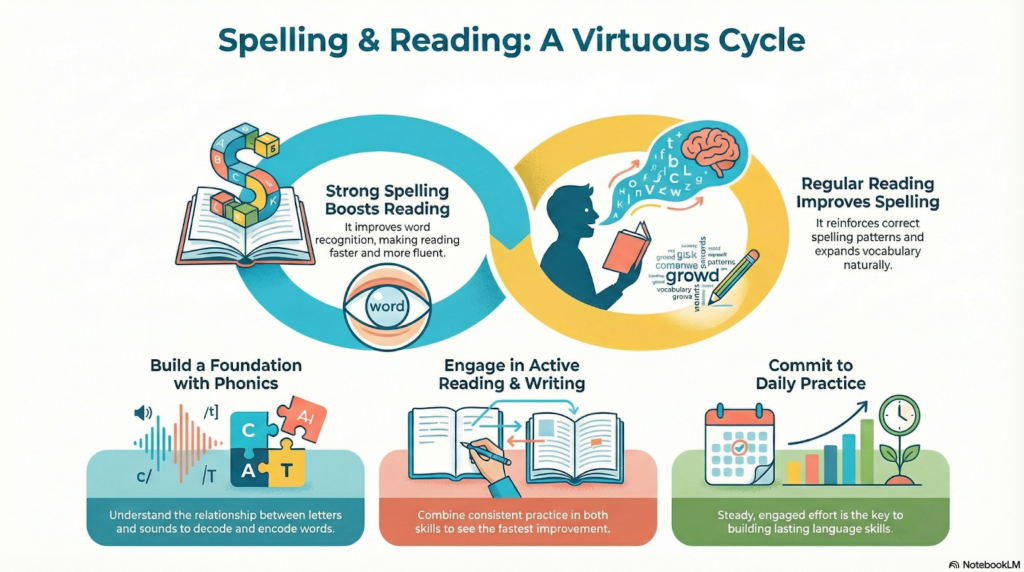
Active practice is essential to internalize spelling patterns and improve reading fluency. Simply reading passively is not enough.
1. Read Regularly and Widely
- Explore books, articles, blogs, and newspapers. Exposure to correct spelling and varied vocabulary strengthens both skills.
- Include materials slightly above your comfort level to encounter new words and sentence structures.
2. Maintain a Personal Spelling/Vocabulary Notebook
- Note down tricky or unfamiliar words along with pronunciation, meaning, and usage.
- Regularly review your notebook to reinforce memory and recall.
3. Write Consistently
- Keep journals, essays, or summaries to practice spelling actively.
- Avoid over-relying on spell-checkers; try to spell words manually to reinforce learning.
4. Combine Reading with Writing
- After reading an article or story, rewrite or summarize it in your own words.
- This practice tests spelling knowledge, reinforces vocabulary, and improves comprehension simultaneously.
Memory & Reinforcement Techniques: Make Spelling Stick
To truly improve spelling and reading, it’s important to use memory techniques that reinforce learning and retention.
1. Use Mnemonics and Visualization
- Associate tricky words with images, stories, or colors to make them easier to remember.
- Example: Remember “necessary” by visualizing it as one collar (c) and two sleeves (s).
2. Apply Spaced Repetition
- Review words and notes at increasing intervals (e.g., after 1 day, 3 days, 1 week).
- This helps transfer knowledge from short-term to long-term memory, making spelling more automatic.
3. Multi-Sensory Learning
- Say words aloud, write them, and see them written to engage visual, auditory, and kinesthetic memory.
- Using multiple senses strengthens neural connections and improves both spelling and reading recall.
4. Gamify Your Practice
- Engage in spelling games, puzzles, or apps (crosswords, word searches, Scrabble) to make learning fun.
- Gamification encourages consistent practice while reinforcing correct spelling and vocabulary.
Advanced Tips: From Good to Great Spelling & Reading
Once foundational skills are strong, use these advanced strategies to enhance your spelling and reading proficiency.
1. Challenge Yourself with Advanced Reading
- Read texts slightly above your level to encounter complex words and sentence structures.
- Exposure to new vocabulary improves recognition and strengthens spelling patterns.
2. Analyze Word Structure
- Study roots, prefixes, and suffixes to understand why words are spelled the way they are.
- Recognizing word components helps in spelling related words correctly.
3. Consistency with Spelling Conventions
- Be aware of British vs American English spellings and maintain consistency in writing.
- Example: colour vs color, realise vs realize.
4. Use Dictionaries and Spelling Tools Wisely
- Refer to dictionaries for verification, but do not rely solely on spell-checkers.
- Learning and internalizing the correct spelling is more effective than passive correction.
Common Mistakes to Avoid
Even with consistent practice, certain habits can hinder progress in spelling and reading. Being aware of these mistakes helps you avoid setbacks.
1. Over-Reliance on Spell-Checkers
- Relying too much on autocorrect prevents your brain from internalizing correct spellings.
- Practice spelling words manually to reinforce memory.
2. Passive Reading
- Skimming or reading without engaging the material reduces retention and spelling awareness.
- Active reading (taking notes, summarizing, and writing words) is essential.
3. Memorizing Words in Isolation
- Learning words without context or usage often leads to forgetting or misusing them.
- Always practice spelling words within sentences or stories for better retention.
4. Inconsistent Practice
- Irregular reading or writing habits slow progress. Consistency is more effective than volume.
5. Ignoring Irregularities and Exceptions
- English has many irregular spellings. Ignoring them can result in repeated errors.
- Learn exceptions alongside rules to strengthen mastery.
Conclusion: Take Action to Improve Spelling and Reading
Improving spelling and reading requires a systematic, active, and consistent approach.
- Combine reading and writing: Read widely, take notes, summarize, and write regularly to reinforce learning.
- Use memory techniques: Mnemonics, visualization, spaced repetition, and multi-sensory methods help retain spelling patterns.
- Advance gradually: Challenge yourself with complex texts, analyze word structure, and learn irregular spellings.
- Maintain consistency: Daily practice, reviewing past words, and actively engaging with material is more effective than cramming.
Action Plan: Start with 10–15 minutes of focused reading each day. Maintain a vocabulary notebook, practice spelling difficult words aloud and in writing, and review them regularly. Gradually incorporate advanced reading and word analysis strategies.
By following these steps, your spelling accuracy, reading fluency, and overall English proficiency will improve steadily. Reading and spelling will no longer be separate skills they will reinforce each other, making you a confident and capable English communicator.
Frequently Aske Questions
1. Why are spelling and reading considered foundational skills?
Spelling and reading lay the groundwork for all language-based learning. They support writing, comprehension, communication, and academic performance across subjects.
2. How does improving spelling enhance reading ability?
Better spelling strengthens understanding of word patterns, pronunciation, and structure, making it easier for readers to decode new words and read fluently.
3. Can reading improvement help with overall communication?
Yes. Strong reading skills expand vocabulary, improve sentence formation, and boost the ability to express ideas clearly in both speaking and writing.
4. Do spelling and reading skills impact academic success?
Absolutely. Students with strong literacy skills perform better in all subjects because they can understand instructions, interpret questions, and engage with complex texts.
5. How do spelling and reading affect confidence?
When learners can read fluently and spell correctly, they feel more confident participating in class discussions, writing assignments, and communicating socially.
6. Can digital tools help improve spelling and reading?
Yes. Apps, audiobooks, interactive reading platforms, and spelling games can support consistent practice and make learning more engaging.
7. How much daily practice is needed to see improvement?
Even 10–20 minutes a day of focused reading or spelling practice can lead to noticeable progress over time.
8. Does reading fiction or nonfiction help more?
Both help. Fiction improves imagination, empathy, and vocabulary, while nonfiction boosts knowledge, comprehension, and analytical thinking.
9. Can adults still improve their spelling and reading skills?
Definitely, literacy skills can improve at any age with regular practice, the right materials, and targeted strategies.
10. What are some simple ways to improve spelling and reading at home?
Reading aloud, using word lists, writing daily, practicing phonics, and engaging with a variety of books are effective ways to strengthen both skills.

Belekar Sir is the founder and lead instructor at Belekar Sir’s Academy, a trusted name in English language education. With over a decade of teaching experience, he has helped thousands of students—from beginners to advanced learners—develop fluency, confidence, and real-world communication skills. Known for his practical teaching style and deep understanding of learner needs, Belekar Sir is passionate about making English accessible and empowering for everyone. When he’s not teaching, he’s creating resources and guides to support learners on their journey to mastering spoken English.


