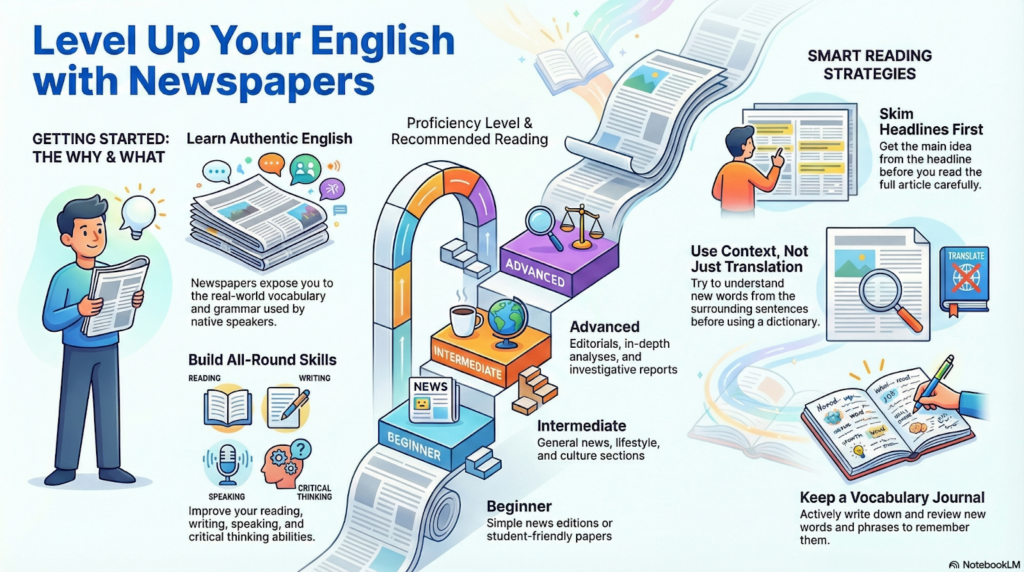
Reading English newspapers is one of the most practical ways to improve your English. Unlike textbooks, newspapers provide authentic, real-world language covering current events, opinion pieces, culture, and everyday life. This exposes learners to natural vocabulary, grammar, idioms, and sentence structures that are actually used by native speakers.
By regularly reading newspapers, learners can:
- Expand vocabulary across diverse topics: politics, science, business, culture, lifestyle.
- Improve reading comprehension and sentence understanding.
- Learn the practical use of idioms, phrasal verbs, and formal/informal expressions.
- Develop critical thinking skills by engaging with opinion pieces and editorials.
- Enhance writing and speaking skills through exposure to structured, concise language.
Despite these benefits, many learners struggle to read newspapers because of unfamiliar vocabulary, long sentences, or fast-paced news writing. This article will provide step-by-step strategies to make newspaper reading easier, more effective, and enjoyable.
Why Newspapers Are Effective for Language Learning
Newspapers offer a rich, authentic learning experience that textbooks cannot replicate.
Vocabulary Expansion in Context
Reading news articles introduces words in context. You don’t just memorize a list of words you see how they are used in sentences, which strengthens retention and understanding. Over time, this builds a functional vocabulary that you can use in writing and conversation.
Improving Reading Comprehension and Grammar
Newspaper sentences often use complex structures, connectors, and transitions. By reading regularly, learners internalize grammar rules naturally, enhancing comprehension and fluency.
Critical Thinking and Cultural Awareness
Editorials, opinion columns, and feature articles encourage readers to analyze, compare, and form opinions. This improves not only language skills but also cultural and contextual understanding of English-speaking countries.
Boosting Writing and Speaking Skills
Exposure to professional journalistic writing helps learners see how ideas are structured, how arguments are made, and how language is used to persuade or inform. Reproducing these structures in your writing or speech strengthens communication skills.
Extra Insight: Combining reading with discussion or summarization (e.g., talking about the article with a friend or writing a short summary) reinforces comprehension and retention, making learning more active.
How to Choose the Right Newspaper and Sections to Start With?
Choosing the right newspaper and sections is crucial for making your reading practice effective and enjoyable. Not all newspapers are suitable for learners at every level, so it’s important to match the material to your skills and interests.
Select a Newspaper That Matches Your English Level
- Beginners: Choose newspapers or digital editions with simpler language, shorter sentences, and clear explanations. Many international newspapers offer “learner-friendly” sections.
- Intermediate: Try newspapers with moderately complex articles covering daily news, culture, and lifestyle.
- Advanced: Regular newspapers, editorials, and investigative reports are ideal for vocabulary expansion and advanced grammar.
Focus on Sections That Interest You
- Start with sections you enjoy, such as sports, entertainment, lifestyle, or technology, to make reading engaging.
- Gradually include editorials, opinion pieces, and feature articles to challenge your comprehension and critical thinking.
Mix Easy and Challenging Articles
- Balance your reading: easy articles build fluency, while challenging texts expand vocabulary and comprehension.
- This gradual increase in difficulty prevents frustration and ensures continuous learning.
Strategies for Active Reading: How to Read Newspapers for Maximum Benefit
Active reading is key to learning English effectively from newspapers. Simply skimming articles is not enough; you need techniques that engage your brain and improve retention.
Skim First, Then Read Intensively
- Quickly glance through headlines, subheadings, and images to understand the article’s main idea.
- Then read selected articles carefully, paying attention to details, grammar, and vocabulary.
Use Context to Infer Meaning
- Don’t stop for every unfamiliar word. Use context clues to guess meanings.
- Check the dictionary only for essential words that affect understanding.
Take Notes and Keep a Vocabulary Journal
- Write down new words, phrases, and expressions, along with their meaning and an example sentence.
- Review the journal regularly to reinforce memory.
Read Aloud or Follow Audio Versions
- Reading aloud connects written words to their pronunciation and rhythm.
- If the newspaper offers audio versions, follow along to improve listening and speaking skills alongside reading.
Summarize and Reflect
- After reading, write a short summary or paraphrase the article in your own words.
- Ask questions: What was the main point? What did you learn? What’s your opinion?
- This reinforces comprehension, vocabulary, and critical thinking.
Strategies for Active Reading: How to Read Newspapers for Maximum Benefit
Active reading is key to learning English effectively from newspapers. Simply skimming articles is not enough; you need techniques that engage your brain and improve retention.
Skim First, Then Read Intensively
- Quickly glance through headlines, subheadings, and images to understand the article’s main idea.
- Then read selected articles carefully, paying attention to details, grammar, and vocabulary.
Use Context to Infer Meaning
- Don’t stop for every unfamiliar word. Use context clues to guess meanings.
- Check the dictionary only for essential words that affect understanding.
Take Notes and Keep a Vocabulary Journal
- Write down new words, phrases, and expressions, along with their meaning and an example sentence.
- Review the journal regularly to reinforce memory.
Read Aloud or Follow Audio Versions
- Reading aloud connects written words to their pronunciation and rhythm.
- If the newspaper offers audio versions, follow along to improve listening and speaking skills alongside reading.
Summarize and Reflect
- After reading, write a short summary or paraphrase the article in your own words.
- Ask questions: What was the main point? What did you learn? What’s your opinion?
- This reinforces comprehension, vocabulary, and critical thinking.
Building a Consistent Reading Habit
Consistency is crucial to improving English through newspapers. Even a small daily routine can have a significant impact over time.
Set Realistic Daily Reading Goals
- Start with 15–30 minutes per day, reading one or two articles.
- Focus on quality over quantity better to read a short article carefully than skim multiple articles without understanding.
Create a Reading-Friendly Environment
- Find a quiet space with good lighting.
- Keep your newspaper, notebook, and dictionary handy.
- Minimize distractions from phones, TV, or social media.
Rotate Newspapers and Article Types
- Exposure to different newspapers and topics expands vocabulary and comprehension.
- Read articles on politics, science, sports, and lifestyle to get familiar with various writing styles.
Combine Reading with Writing or Discussion
- Discuss articles with a friend or teacher.
- Write short summaries or opinion pieces based on the articles.
- Active engagement reinforces comprehension and helps internalize new vocabulary.
Common Pitfalls and How to Avoid Them
Even motivated learners often face challenges. Avoiding these common mistakes ensures faster progress and reduces frustration.
Over-Translating Every Word
- Trying to translate every word slows reading and reduces comprehension.
- Focus on main ideas and infer meaning from context, checking the dictionary only when necessary.
Choosing Articles That Are Too Difficult
- Starting with highly advanced newspapers can be demotivating.
- Match material to your level and gradually increase difficulty.
Reading Passively
- Skimming without engagement offers limited benefits.
- Take notes, summarize, and reflect to turn reading into an active learning process.
Inconsistent Practice
- Skipping reading for days or weeks slows progress.
- Short, daily sessions are more effective than sporadic long sessions.
Ignoring Review and Repetition
- Vocabulary and comprehension improve with spaced repetition.
- Revisit earlier articles and notes to reinforce learning.
Advanced Strategies for Long-Term Improvement
Once you have a basic routine and comprehension skills, these advanced strategies can help you read English newspapers more efficiently and confidently, while enhancing your overall language skills.
Integrate Newspapers with Other Skills
- Writing: Summarize articles, write opinion pieces, or rewrite news in simpler words.
- Speaking: Discuss articles with friends, teachers, or language partners.
- Listening: Follow audio versions of news or related podcasts.
- Combining these skills reinforces vocabulary, grammar, and fluency in multiple ways.
Track and Expand Vocabulary Systematically
- Maintain a vocabulary journal with new words, expressions, and phrases.
- Review regularly using spaced repetition to ensure long-term retention.
Focus on Structure and Style
- Analyze how articles are written: headlines, lead sentences, paragraph organization, connectors.
- Try to apply these structures in your own writing and summaries to improve composition skills.
Set Gradual Challenges
- Slowly move to longer, complex articles or editorials.
- Engage with topics that challenge your comprehension and critical thinking, building both language and cognitive skills.
Conclusion: Make Newspaper Reading a Habit to Master English
Reading English newspapers regularly is a highly effective way to improve vocabulary, comprehension, grammar, writing, and speaking skills.
- Start with easy articles, read daily for 15–30 minutes, and gradually challenge yourself.
- Engage actively: skim, read, summarize, take notes, and discuss.
- Avoid common pitfalls: over-translating, reading passively, or skipping practice.
- Combine reading with writing, speaking, and listening for a holistic learning approach.
- Use a vocabulary journal and review system to retain new words and phrases.
Action Step: Pick one article today, read it carefully, note down 5–10 new words, summarize it in your own words, and discuss it with someone or reflect on it. Repeat daily, and over weeks, you will notice significant improvement in your English reading, comprehension, and communication skills.
Frequently Asked Questions:
1. How does reading English newspapers improve my vocabulary?
Newspapers expose you to a wide range of real-life vocabulary, formal, informal, technical, and conversational. Seeing new words in context helps you understand meaning naturally and remember them better than memorizing from lists.
2. Can beginners benefit from reading English newspapers?
Yes. Beginners can start with simpler articles such as short news briefs, lifestyle sections, or children’s news editions. Over time, reading becomes easier as vocabulary and comprehension grow.
3. Which English newspaper is best for improving language skills?
Any reputable English newspaper helps, but choices differ by level.
• Beginners: The Times of India (student edition), Hindustan Times (HT School), or simplified news apps.
• Intermediate/Advanced: The Hindu, Indian Express, The Guardian, New York Times.
Consistency matters more than the specific paper.
4. How much time should I spend reading newspapers daily?
Even 15–20 minutes a day is enough to improve vocabulary, grammar awareness, and reading fluency. The key is to read regularly and choose sections that interest you.
5. Will reading newspapers help improve my grammar?
Yes. Newspapers use professional, well-edited English. Regular exposure helps you subconsciously absorb correct sentence structure, punctuation, and grammar patterns.
6. Can reading newspapers improve my writing skills?
Absolutely. You learn paragraph structure, argument style, headlines, transitions, and tone. You can even imitate the writing style to practice your own essays, reports, and emails.
7. Is reading newspapers better than using English-learning apps?
Both are helpful, but newspapers provide real-world context, current topics, and natural language usage. Apps are useful for practice drills, but newspapers develop practical comprehension and critical thinking.
8. What sections of the newspaper should I read to improve English?
Start with what interests you, sports, entertainment, lifestyle, or local news. As your skills grow, add editorials, opinion pieces, and long-form reports to strengthen advanced comprehension and analytical ability.
9. Should I look up every difficult word while reading?
No. Looking up every word breaks your flow. Instead, try understanding from context and check only the important or repeated words. This keeps reading enjoyable and effective.
10. How long does it take to see improvement by reading newspapers daily?
Most learners notice better vocabulary, comprehension, and confidence within 4–8 weeks of consistent reading. Improvement depends on frequency, engagement, and the difficulty of the content you choose.

Belekar Sir is the founder and lead instructor at Belekar Sir’s Academy, a trusted name in English language education. With over a decade of teaching experience, he has helped thousands of students—from beginners to advanced learners—develop fluency, confidence, and real-world communication skills. Known for his practical teaching style and deep understanding of learner needs, Belekar Sir is passionate about making English accessible and empowering for everyone. When he’s not teaching, he’s creating resources and guides to support learners on their journey to mastering spoken English.