
Christmas has become increasingly popular in Chinese-speaking regions, transforming from a Western religious holiday into a widely celebrated cultural event, especially in major cities across China, Taiwan, Hong Kong, and Singapore. While only about 5 percent of China’s population identifies as Christian, the festive atmosphere of Christmas has captured hearts with glittering decorations, shopping festivals, and joyful gatherings that transcend religious boundaries.
For Mandarin learners, Christmas vocabulary provides an engaging entry point into Chinese language and culture. These seasonal words demonstrate how Chinese adapts foreign concepts using its logical character system, where combining existing characters creates new meanings. Understanding Christmas terminology helps language learners connect with Chinese speakers during the holiday season, participate in festive conversations, and appreciate how global celebrations blend with local customs.
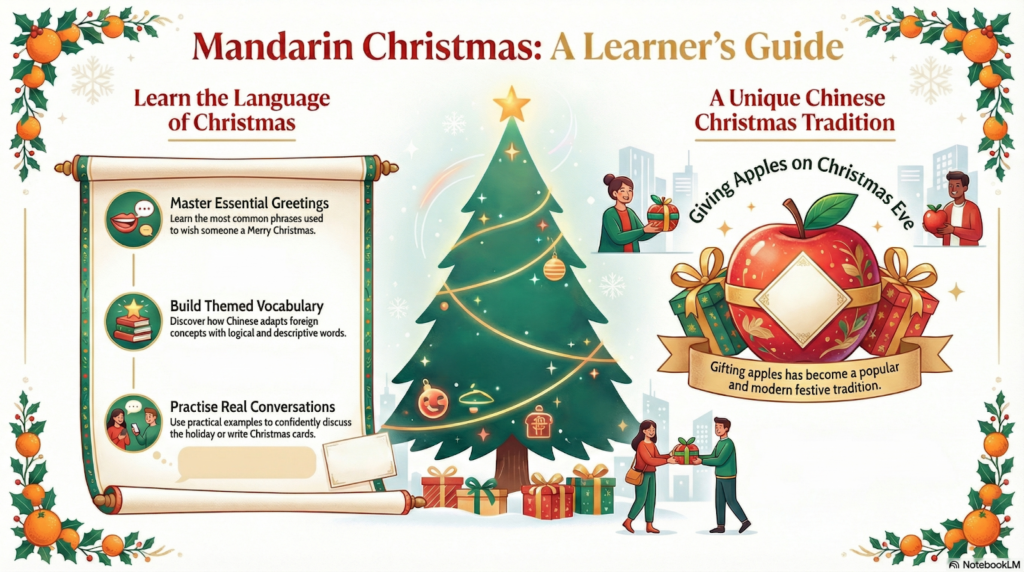
This comprehensive guide provides everything you need to confidently use Chinese Christmas vocabulary. You will discover essential greetings and phrases, learn the pronunciation and meaning behind key terms, explore vocabulary organized by category, understand cultural practices unique to Chinese Christmas celebrations, and master conversation patterns for real-world usage. Whether you are a beginning student learning your first holiday phrases or an advanced speaker expanding cultural knowledge, this resource will prepare you to spread holiday cheer in Mandarin Chinese.
Essential Christmas Greetings in Chinese
Mastering basic Christmas greetings allows you to connect authentically with Chinese speakers during the holiday season. These phrases work in various contexts from casual conversations to formal holiday cards.
Core Christmas Greeting
The most common way to say Merry Christmas in Chinese is 圣诞快乐 pronounced Shengdan kuaile. This phrase combines two elements that reveal the logical structure of Chinese vocabulary building.
圣诞 means Christmas, literally translating as holy birth. The character 圣 means holy or sacred while 诞 means birth or to be born. Together they reference the religious origin of the holiday. 快乐 means happy or joyful. The character 快 conveys happiness and speed while 乐 represents joy and music. Combined, these characters create the equivalent of merry or happy.
The literal translation of 圣诞快乐 is Christmas happy, which may sound backwards to English speakers but follows standard Chinese grammar where descriptive elements come after nouns. This phrase works in virtually all contexts including greeting cards, text messages, social media posts, workplace wishes, and casual conversations with friends.
Extended Christmas Greetings
For slightly more formal situations, use the complete phrase 圣诞节快乐 pronounced Shengdan jie kuaile. This version adds 节 meaning festival or holiday, making it translate to Happy Christmas Holiday. While this extended greeting sounds more complete and formal, many Chinese speakers find it a mouthful and prefer the shorter version for everyday use.
The difference between these greetings parallels the English distinction between saying Merry Christmas versus Happy Christmas Holiday. Both are correct and understood, but one flows more naturally in casual conversation.
Alternative Holiday Greetings
Beyond the standard Christmas greeting, several other phrases let you express holiday wishes in different contexts.
新年快乐 pronounced Xinnian kuaile means Happy New Year and works for the Western New Year on January 1st. This greeting appears everywhere from December 31st through early January as people celebrate the calendar turning.
元旦节快乐 pronounced Yuandan jie kuaile specifically means Happy New Year’s Day and refers to January 1st itself rather than the general new year period. Use this phrase on New Year’s Day specifically for precision.
祝你节日快乐 pronounced Zhu ni jieri kuaile translates to Wishing you happy holidays and provides an inclusive greeting for anyone celebrating various end-of-year holidays. This phrase shows cultural sensitivity when you are unsure of someone’s specific traditions.
Adding Personal Touch to Greetings
Enhance basic greetings by adding introductory phrases that show extra thoughtfulness and care.
祝你 pronounced Zhu ni means I wish you and precedes the main greeting to create complete sentences. For example, 祝你圣诞快乐 becomes I wish you a Merry Christmas, adding warmth and formality.
祝你和家人 pronounced Zhu ni he jiaren means wishing you and your family, acknowledging the importance of family in Chinese culture. This phrase demonstrates cultural awareness and shows you understand that holidays are family-centered occasions.
致以节日的问候与温馨的祝福 pronounced Zhi yi jieri de wenhou yu wenxin de zhufu is an elegant phrase meaning Season’s greetings and warm wishes. This formal greeting works well in business contexts, holiday cards to respected individuals, or any situation requiring elevated language.
Christmas Vocabulary by Category
Organizing Christmas vocabulary by category helps learners build comprehensive understanding while making memorization more manageable through thematic connections.
Characters and Figures
| Chinese Characters | Pinyin | English Translation | Literal Meaning |
| 圣诞老人 | Shengdan laoren | Santa Claus | Christmas old person |
| 驯鹿 | Xunlu | Reindeer | Domesticated deer |
| 鲁道夫 | Ludaofu | Rudolph | Transliteration |
| 雪人 | Xueren | Snowman | Snow person |
| 精灵 | Jingling | Elf | Spirit/fairy |
| 天使 | Tianshi | Angel | Heavenly messenger |
The term for Santa Claus perfectly demonstrates Chinese linguistic logic. Rather than transliterating the foreign name, Chinese creates 圣诞老人 by combining Christmas with old person, instantly conveying the concept’s meaning. Similarly, snowman becomes snow person, using the simplest possible construction to name this winter figure.
Decorations and Objects
| Chinese Characters | Pinyin | English Translation | Literal Meaning |
| 圣诞树 | Shengdan shu | Christmas tree | Christmas tree |
| 装饰品 | Zhuangshi pin | Decorations | Decorative items |
| 彩灯 | Caideng | Christmas lights | Colored lights |
| 花环 | Huahuan | Wreath | Flower ring |
| 蜡烛 | Lazhu | Candle | Wax pillar |
| 铃铛 | Lingdang | Bell | Bell |
| 金箔 | Jinbo | Tinsel | Gold foil |
| 槲寄生 | Hujisheng | Mistletoe | Oak parasitic plant |
| 长筒袜 | Changtongwa | Stocking | Long tube sock |
| 雪花 | Xuehua | Snowflake | Snow flower |
Notice how decorative items often use descriptive language that paints pictures. Christmas lights become colored lights, wreaths are flower rings, and snowflakes are snow flowers. This descriptive approach makes vocabulary more memorable by creating visual associations.
Food and Treats
| Chinese Characters | Pinyin | English Translation | Notes |
| 姜饼 | Jiangbing | Gingerbread | Ginger cake |
| 姜饼人 | Jiangbingren | Gingerbread man | Ginger cake person |
| 姜饼屋 | Jiangbingwu | Gingerbread house | Ginger cake house |
| 拐杖糖 | Guaizhang tang | Candy cane | Walking stick candy |
| 热可可 | Re keke | Hot chocolate | Hot cocoa |
| 火鸡 | Huoji | Turkey | Fire chicken |
| 烤栗子 | Kao lizi | Roasted chestnuts | Roasted chestnuts |
| 蛋酒 | Danjiu | Eggnog | Egg alcohol |
Food vocabulary reveals cultural adaptations where Chinese describes items through appearance or composition rather than transliteration. Candy canes become walking stick candy, perfectly describing their curved shape. Turkey amusingly translates as fire chicken, likely referencing cooking methods or the bird’s coloring.
Activities and Traditions
| Chinese Characters | Pinyin | English Translation | Usage Context |
| 庆祝 | Qingzhu | To celebrate | General celebrations |
| 装饰 | Zhuangshi | To decorate | Setting up decorations |
| 交换礼物 | Jiaohuan liwu | Exchange gifts | Gift exchanges |
| 唱圣诞歌 | Chang shengdan ge | Sing Christmas carols | Carol singing |
| 报佳音 | Bao jiayin | Caroling | Announcing good news |
| 购物 | Gouwu | Shopping | Holiday shopping |
| 聚会 | Juhui | Party/gathering | Holiday parties |
| 许愿 | Xuyuan | Make a wish | Making wishes |
| 烤火 | Kao huo | Sitting by the fire | Warming by fire |
Activity vocabulary shows action-oriented terms that describe holiday traditions. Notice how caroling translates as announcing good news, emphasizing the purpose rather than just the singing action. This reveals cultural interpretations of Western traditions.
Gifts and Presents
| Chinese Characters | Pinyin | English Translation | Literal Meaning |
| 礼物 | Liwu | Gift/present | Courtesy object |
| 礼品 | Lipin | Present | Courtesy item |
| 包装 | Baozhuang | Wrapping | Package/wrap |
| 丝带 | Sidai | Ribbon | Silk ribbon |
| 蝴蝶结 | Hudiajie | Bow | Butterfly knot |
| 礼品卡 | Lipinka | Gift card | Present card |
| 愿望清单 | Yuanwang qingdan | Wish list | Wish list |
| 惊喜 | Jingxi | Surprise | Startling joy |
Gift vocabulary centers around the concept of 礼 which encompasses courtesy, propriety, and ceremony. This character appears in multiple gift-related words, emphasizing that presents represent respect and thoughtfulness rather than mere material exchanges.
Weather and Nature
| Chinese Characters | Pinyin | English Translation | Description |
| 雪 | Xue | Snow | Snow |
| 下雪 | Xia xue | Snowing | Down snow |
| 冬天 | Dongtian | Winter | Winter season |
| 寒冷 | Hanleng | Cold | Frigid |
| 冰 | Bing | Ice | Ice |
| 冰柱 | Bingzhu | Icicle | Ice pillar |
| 霜 | Shuang | Frost | Frost |
| 暴风雪 | Baofengxue | Blizzard | Violent wind snow |
Weather vocabulary uses concrete imagery to describe winter conditions. The phrase for snowing is literally down snow, describing the falling action. Icicles become ice pillars, and blizzards are violent wind snow, each term painting vivid pictures through character combinations.
Religious and Traditional Concepts
| Chinese Characters | Pinyin | English Translation | Cultural Context |
| 耶稣基督 | Yesu Jidu | Jesus Christ | Religious figure |
| 圣经 | Shengjing | Bible | Holy scripture |
| 教堂 | Jiaotang | Church | Teaching hall |
| 弥撒 | Misa | Mass | Religious service |
| 祈祷 | Qidao | Prayer | Request way |
| 祝福 | Zhufu | Blessing | Wish happiness |
| 感恩 | Ganen | Gratitude | Feel grace |
| 平安 | Pingan | Peace | Peaceful safety |
Religious vocabulary demonstrates how Chinese handles foreign religious concepts, sometimes through transliteration like Jesus Christ and sometimes through meaningful character selections like church becoming teaching hall. These terms see more use in Christian Chinese communities versus general Christmas celebrations.
Pronunciation Guide for Key Terms
Proper pronunciation helps you communicate effectively and shows respect for the language. Chinese is a tonal language where pitch patterns change meaning, making accurate tone production essential.
Understanding Pinyin and Tones
Mandarin Chinese uses pinyin romanization to represent sounds, with tone marks indicating four distinct tones plus a neutral tone. The same syllable pronounced with different tones creates completely different words.
First tone appears as a flat line above vowels like a and maintains a high, level pitch. Second tone has an upward line and rises from middle to high pitch like asking a question. Third tone shows a downward curve and dips low before slightly rising. Fourth tone features a downward line and drops sharply from high to low pitch. Neutral tone has no mark and is pronounced lightly without emphasis.
Pronunciation Breakdown for Common Terms
圣诞快乐 Shengdan kuaile breaks into four syllables. Sheng uses fourth tone falling sharply, dan uses fourth tone falling sharply, kuai uses fourth tone falling sharply, and le uses fourth tone falling sharply. The combination of four fourth tones creates a rhythmic, decisive greeting.
圣诞老人 Shengdan laoren combines Sheng and dan in fourth tones, lao in third tone with the characteristic dip, and ren in second tone rising upward. Practice smoothly transitioning between these tone changes for natural delivery.
圣诞树 Shengdan shu adds shu in fourth tone to the Christmas root, creating a straightforward compound term requiring consistent tone accuracy.
Common Pronunciation Challenges
English speakers often struggle with certain pinyin combinations. The x in 雪 xue sounds like English sh but with the tongue positioned further forward. The zh combination in 祝福 zhufu sounds similar to English j but with a retroflex tongue position. The ue vowel combination in 快乐 kuaile requires rounding lips while pronouncing the vowel.
Practice these challenging sounds separately before combining them in full words. Record yourself and compare to native speaker audio to identify areas needing improvement. Consistent practice builds muscle memory for unfamiliar mouth positions and tone patterns.
Cultural Context of Christmas in China
Understanding how Chinese culture celebrates Christmas provides context that enriches vocabulary learning and prevents cultural misunderstandings.
Commercial Rather Than Religious
Christmas in China functions primarily as a commercial and cultural celebration rather than a religious holiday. Department stores transform into winter wonderlands with massive decorations, Western restaurants offer special Christmas menus, shopping malls host Santa appearances and photo opportunities, and businesses run major sales events rivaling Western Black Friday.
Young Chinese people especially embrace Christmas as a romantic holiday similar to Valentine’s Day. Couples exchange gifts, enjoy nice dinners, and attend Christmas-themed events together. This romantic association differs significantly from the family-centered Western Christmas tradition.
Unique Chinese Christmas Traditions
Apple Giving on Christmas Eve
One distinctly Chinese Christmas tradition involves giving apples on Christmas Eve, known as 平安夜 pronounced Pingan ye meaning Peaceful Night. This custom emerged because the word for apple 苹果 pinguo sounds similar to 平安 pingan meaning peace and safety. Vendors sell specially wrapped apples, often in decorative boxes or gift wrap, as symbols of wishing someone peace and safety for the coming year.
This tradition demonstrates how Chinese culture adapts foreign holidays through language play and auspicious symbolism. The practice has become so popular that apple prices spike during Christmas week as demand surges.
Christmas as a Working Day
Despite widespread celebrations, Christmas is not a national holiday in China. December 25th remains a regular working day for most Chinese citizens. Government offices, schools, and most businesses operate normally. Only international companies, foreign schools, or businesses with Western connections typically give employees the day off.
This working day status means Christmas celebrations concentrate on Christmas Eve rather than Christmas Day itself. Young people go out on December 24th evening for parties and gatherings since December 25th is a work day with early wake up times.
Regional Variations in Celebration
Major metropolitan areas like Beijing, Shanghai, Guangzhou, and Shenzhen embrace Christmas celebrations most enthusiastically with extensive decorations and commercial events. Smaller cities and rural areas show less Christmas influence, with celebrations limited to commercial spaces rather than private homes.
Hong Kong and Taiwan, with longer histories of Western cultural influence, celebrate Christmas more traditionally. Hong Kong particularly features extensive public decorations and light displays that draw both locals and tourists. Taiwan’s significant Christian population means religious Christmas services are more common there than in mainland China.
Practical Conversation Examples
Applying vocabulary in realistic conversations helps learners transition from memorization to active usage. These conversation patterns demonstrate natural Christmas dialogue in Chinese.
Planning Christmas Activities
Person A: 圣诞节快到了,你准备好庆祝了吗 pronounced Shengdan jie kuai dao le, ni zhunbei hao qingzhu le ma, meaning Christmas is coming soon, have you made your plans?
Person B: 还在准备呢,我打算买一棵圣诞树,还要买一些装饰品。你呢 pronounced Hai zai zhunbei ne, wo dasuan mai yi ke shengdan shu, hai yao mai yixie zhuangshi pin. Ni ne, meaning I am still preparing. I plan to get a Christmas tree and some decorations. What about you?
Person A: 我已经买好了礼物,还准备了圣诞晚餐,要请家人和朋友一起过节 pronounced Wo yijing mai hao le liwu, hai zhunbei le shengdan wancan, yao qing jiaren he pengyou yiqi guojie, meaning I already bought gifts and prepared a Christmas dinner. I want to invite family and friends to celebrate together.
This exchange demonstrates common vocabulary in context including time expressions, planning verbs, decoration terms, and social customs around holiday gatherings.
Discussing Christmas Traditions
Person A: 你知道中国人平安夜送苹果吗 pronounced Ni zhidao Zhongguoren pingan ye song pingguo ma, meaning Do you know Chinese people give apples on Christmas Eve?
Person B: 知道!因为苹果的发音和平安很像 pronounced Zhidao! Yinwei pingguo de fayin he pingan hen xiang, meaning Yes! Because the pronunciation of apple sounds similar to peace.
Person A: 这个传统很有意思。我也想送朋友一个苹果 pronounced Zhege chuantong hen you yisi. Wo ye xiang song pengyou yi ge pingguo, meaning This tradition is very interesting. I also want to give a friend an apple.
This conversation illustrates cultural knowledge vocabulary, explanation patterns, and expressions of interest in traditions.
Greeting Someone at a Holiday Party
Person A: 圣诞快乐!很高兴见到你 pronounced Shengdan kuaile! Hen gaoxing jian dao ni, meaning Merry Christmas! Very happy to see you.
Person B: 圣诞快乐!这个聚会真热闹 pronounced Shengdan kuaile! Zhege juhui zhen renao, meaning Merry Christmas! This party is really lively.
Person A: 是啊!你看那棵圣诞树,装饰得真漂亮 pronounced Shi a! Ni kan na ke shengdan shu, zhuangshi de zhen piaoliang, meaning Yes! Look at that Christmas tree, it is decorated so beautifully.
Person B: 我最喜欢那些彩灯,闪闪发光的 pronounced Wo zui xihuan naxie caideng, shanshan faguang de, meaning I especially like those lights, they are twinkling.
This dialogue practices greetings, description vocabulary, and expressing preferences in natural conversational flow.
Learning Tips for Chinese Christmas Vocabulary
Effective study strategies accelerate vocabulary acquisition and improve retention beyond simple memorization.
Use Spaced Repetition
Review new vocabulary at increasing intervals to move words from short-term to long-term memory. Study new Christmas terms immediately after learning them, review again after one day, revisit after three days, practice again after one week, and continue reviewing after two weeks and one month. Digital flashcard apps like Anki or Pleco automate this spacing algorithm for optimal retention.
Create Personal Connections
Associate Chinese Christmas vocabulary with personal experiences and emotions. When learning 礼物 liwu meaning gift, recall a meaningful present you received or gave. Visualize 圣诞树 shengdan shu Christmas tree by remembering trees from your childhood holidays. These personal connections create stronger neural pathways than abstract memorization.
Practice Through Multiple Channels
Engage with vocabulary through varied activities including writing characters by hand to build motor memory, speaking phrases aloud to develop pronunciation, listening to native speakers through videos or audio, reading Christmas stories or articles in Chinese, and using new words in actual conversations or messages. This multi-sensory approach reinforces learning through different cognitive pathways.
Learn in Context Not Isolation
Study vocabulary within complete phrases and sentences rather than individual words. Learning 快乐 kuaile happy alone provides less value than mastering 圣诞快乐 Shengdan kuaile Merry Christmas as a complete greeting. Context shows how words function grammatically and provides practical usage patterns you can immediately apply.
Immerse in Chinese Holiday Content
Watch Chinese Christmas advertisements, holiday themed TV shows, or celebration videos on platforms like YouTube or Bilibili. Read Chinese blog posts or social media content about Christmas preparations and traditions. Listen to Mandarin covers of Christmas carols. This authentic exposure demonstrates natural vocabulary usage while building cultural understanding.
Tips for Writing Christmas Cards in Chinese
Creating handwritten holiday cards in Chinese characters shows impressive cultural respect and language dedication.
Basic Card Structure
Open with a personalized greeting using 亲爱的 qin ai de meaning dear followed by the recipient’s name. Include your main Christmas greeting such as 圣诞快乐 Shengdan kuaile or 祝你圣诞节快乐 Zhu ni shengdan jie kuaile. Add a personal message wishing happiness, health, or success using phrases like 祝你和家人幸福安康 meaning wishing you and your family happiness and health. Close with a signature line and your name.
Character Writing Tips
Practice characters before writing final cards since Chinese characters require precision for readability. Use reference materials showing proper stroke order and proportions. Write slowly and deliberately, focusing on balance and spacing rather than speed. Consider using a mechanical pencil first to sketch guidelines before inking final versions. For those uncomfortable with handwriting, printed cards with typed Chinese text remain appropriate and appreciated.
Appropriate Tone Selection
Match your language formality to your relationship with the recipient. For friends and peers, casual greetings like 圣诞快乐 suffice. For teachers, bosses, or elders, add respectful elements like 祝您 zhu nin the formal you form, and longer formal wishes. For business contexts, use elegant phrases like 致以节日的问候与温馨的祝福 Season’s greetings and warm wishes.
Conclusion
Mastering Chinese Christmas vocabulary opens doors to cultural connection and language practice during one of the year’s most joyful seasons. The 100 words and phrases in this guide provide comprehensive coverage of Christmas terminology from basic greetings to detailed descriptions of traditions, decorations, food, and activities. Understanding these terms allows you to participate authentically in Chinese Christmas celebrations whether in China, with Chinese-speaking friends, or through online cultural exchanges.
The logical structure of Chinese vocabulary building makes Christmas terms particularly interesting for language learners. Seeing how Chinese creates new concepts by combining existing characters like Christmas old person for Santa Claus or snow person for snowman reveals the elegant efficiency of the language. This compositional nature means learning Christmas vocabulary simultaneously builds understanding of character combinations applicable far beyond holiday contexts.
Cultural context enriches vocabulary learning beyond simple translation. Understanding that Christmas functions as a commercial and romantic holiday in China rather than primarily religious or family-centered celebration prevents cultural misunderstandings. Knowing about unique traditions like giving apples on Christmas Eve for their phonetic connection to peace demonstrates how Chinese culture adapts foreign holidays through local customs and linguistic play.
Practical application transforms memorized vocabulary into communication skills. The conversation examples, pronunciation guides, and usage tips throughout this guide provide frameworks for active language use. Whether writing holiday cards, texting Christmas wishes, discussing holiday plans, or participating in festive conversations, you now possess the vocabulary and cultural knowledge needed for confident communication.
As you continue your Chinese language journey, let Christmas vocabulary serve as an engaging entry point into broader linguistic and cultural exploration. The same learning strategies applied here like spaced repetition, contextual learning, and cultural immersion transfer to any Chinese vocabulary domain. The confidence gained from mastering one complete vocabulary set builds momentum for tackling increasingly complex language challenges.
This holiday season, surprise your Chinese-speaking friends, colleagues, or language partners with heartfelt greetings in their language. The effort you invest in learning proper pronunciation, understanding cultural context, and applying vocabulary authentically demonstrates respect and creates meaningful connections. 圣诞快乐 Shengdan kuaile from all of us to you and yours!
Frequently Asked Questions:
How do you say Merry Christmas in Chinese?
The most common way is 圣诞快乐 Shengdan kuaile, pronounced like shung-dahn kwhy-luh, meaning literally Christmas happy.
Is Christmas celebrated in China?
Yes, especially in cities as a commercial and social holiday, though it is not a national holiday or traditional Chinese celebration.
What is the apple giving tradition?
Chinese people give apples on Christmas Eve because apple 苹果 pinguo sounds like peace 平安 pingan, symbolizing wishes for safety.
How do you pronounce Chinese Christmas vocabulary?
Chinese uses tones that change meaning. Practice with native audio and focus on the four tone patterns plus neutral tone.
What is the difference between 圣诞快乐 and 圣诞节快乐?
Both mean Merry Christmas but 圣诞节快乐 adds festival making it more formal though longer and less commonly used.
Can I use Christmas greetings with non-Christian Chinese people?
Yes, Christmas is viewed as a cultural celebration in China so greetings are appropriate and appreciated by most people.
How do you write Merry Christmas in Chinese characters?
Write 圣诞快乐 with proper stroke order. Practice each character separately before combining them in greetings.
What other holiday greetings should I know?
Learn 新年快乐 Xinnian kuaile for Happy New Year and 春节快乐 Chunjie kuaile for Happy Chinese New Year.
Is it better to learn simplified or traditional characters?
Learn simplified characters for mainland China and Singapore, traditional for Taiwan, Hong Kong, and Macau. Context determines which system.
How can I practice Chinese Christmas vocabulary?
Use spaced repetition apps, watch Chinese holiday content, write cards to Chinese friends, and practice conversations with language partners.


